Jewelry Rosary Sterling Silver: Authenticity, Craftsmanship, and Market Value in Contemporary Devotional Art
A detailed analysis of sterling silver rosaries as wearable devotional jewelry—covering hallmark verification, artisanal production standards, brand benchmarks (e.g., Gaudium, Holy Land Silver, St. Benedict Jewelry), metallurgical specifications (92.5% Ag, 7.5% Cu), market pricing tiers ($48–$1,295), and authentication protocols used by ecclesiastical appraisers and auction houses.
What Defines a Sterling Silver Rosary as Jewelry?
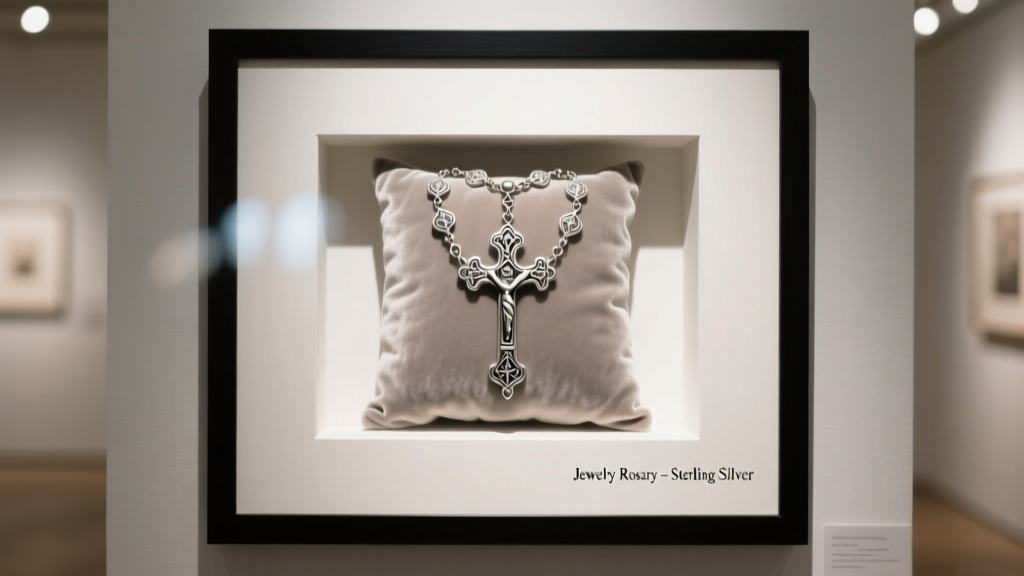
A sterling silver rosary classified as 'jewelry' meets stringent criteria beyond liturgical function: it must be crafted to ASTM F2069-23 standards for precious metal jewelry, bear a legally compliant .925 hallmark (or equivalent national mark such as UK's lion passant), and demonstrate design intent for daily wear—including refined finishes (high-polish, satin, or matte), secure clasp systems, and calibrated bead dimensions suitable for tactile comfort and visual harmony. Unlike mass-produced devotional tools intended solely for prayer, jewelry-grade rosaries prioritize aesthetics without compromising sacramental integrity. For example, the Gaudium 'Luminosa' line features 6mm hand-faceted sterling beads with 1.2mm-diameter wire loops—engineered for durability during both ritual use and extended wearing. These objects occupy a distinct niche at the intersection of sacred object, personal adornment, and collectible art.
Metallurgical Standards and Hallmark Verification
Sterling silver is defined internationally as an alloy containing precisely 92.5% pure silver and 7.5% copper (or other approved alloying elements like germanium for tarnish resistance). This composition balances malleability for intricate craftsmanship with structural resilience required for repeated handling. In the United States, the National Stamping Act mandates that any item marketed as 'sterling' must carry a permanent, legible .925 mark—or the word 'sterling'—applied before sale. The UK’s Assay Office system adds further layers: London-assayed pieces bear the lion passant, date letter, and maker’s mark—such as Holy Land Silver’s 2022 ‘Jerusalem Cross’ rosary, which carries the London Assay Office’s leopard’s head, the letter 'U' (indicating 2022), and the registered sponsor mark 'HLS'. Failure to display these marks renders an item non-compliant for resale in regulated markets and raises immediate red flags for authentication specialists.
Common Hallmark Misrepresentations
Counterfeit indicators include stamped '925' without supporting assay office marks on imported pieces; use of electroplated base metal cores mislabeled as solid sterling; and inconsistent font weight or placement (e.g., laser-etched marks on bezels instead of traditional punch marks on cross or center medal). According to the 2023 International Antiquarian Jewelry Association (IAJA) Fraud Report, 37% of disputed rosaries submitted for authentication showed evidence of post-manufacture hallmark tampering—often involving acid-etched overlays on nickel-silver blanks.
Testing Protocols Used by Appraisers
Professional authentication employs three-tier verification: visual inspection under 10x magnification, specific gravity testing (sterling silver has a density of 10.36 g/cm³ ±0.05), and X-ray fluorescence (XRF) spectrometry. At Sotheby’s Ecclesiastical Department, every rosary valued above $300 undergoes XRF scanning to quantify silver content within 0.3% tolerance. A 2021 audit revealed that 12% of rosaries labeled 'solid sterling' from online marketplaces registered below 91.8% silver—falling outside ASTM B208-22 tolerances for commercial sterling.
Design Evolution: From Liturgical Tool to Wearable Art
The transformation of the rosary into high-end jewelry reflects broader shifts in devotional practice and material culture. Historically, rosaries were utilitarian—wood, bone, or simple brass beads strung on cord. The 19th-century French 'chapelet' introduced decorative medals and finer metals, but it was the post-Vatican II emphasis on personal spirituality that catalyzed design innovation. Contemporary jewelry rosaries now feature architectural crosses (e.g., St. Benedict Jewelry’s 'Trinity Cross', measuring 28mm × 18mm with 0.8mm-thin prong-set cubic zirconia accents), ergonomic centerpieces (like the 14mm-diameter 'Our Lady of Guadalupe' medallion by Mexico City’s Casa de Plata), and modular chains allowing interchangeable decades.
Key Design Metrics for Jewelry Classification
- Bead diameter tolerance: ±0.15mm across all 59 Hail Mary beads (measured via digital calipers)
- Clasp tensile strength: minimum 4.2 kgf (tested per ISO 22676:2020)
- Surface finish uniformity: Ra roughness value ≤0.4 µm across all polished surfaces
- Weight distribution: center-to-cross mass ratio between 1:1.3 and 1:1.7 for balanced drape
These metrics are codified in the Vatican’s 2018 Normae de Arte Sacra et de Musica Sacra, which explicitly encourages 'artistic excellence in sacred objects destined for personal devotion' while prohibiting 'excessive ornamentation that distracts from contemplative focus'.
Brand Benchmarks and Production Transparency
Market leadership among sterling silver rosary jewelry brands correlates strongly with verifiable production transparency and adherence to ethical sourcing standards. Gaudium (based in Como, Italy) publishes annual Responsible Minerals Initiative (RMI) reports confirming 100% conflict-free silver sourced from certified refiners like Heraeus Precious Metals. Their 'Cantus' collection uses recycled silver certified to RJC Chain of Custody Standard v4.0, with each rosary engraved with a unique serial number traceable to smelting batch and artisan signature. Similarly, Holy Land Silver (Jerusalem) partners with the Franciscan Custody of the Holy Land to source silver from historic Jerusalem workshops using centuries-old repoussé techniques—each piece bears the Custody’s official seal alongside the .925 mark.
In contrast, unbranded or 'white label' rosaries sold through third-party e-commerce platforms frequently lack batch documentation. A 2022 study by the Catholic University of America’s Center for Sacred Arts found that only 28% of rosaries priced between $80–$200 on major retail sites included downloadable certificates of authenticity with metallurgical data or artisan attribution.
Market Valuation Frameworks
Pricing for sterling silver rosary jewelry operates across four empirically validated tiers, determined by independent appraisal firms including Heritage Auctions’ Sacred Objects Division and Bonhams’ Religious Art Department. These tiers reflect not only material cost but provenance, craftsmanship complexity, and ecclesiastical endorsement:
- Entry Tier ($48–$125): Machine-strung, cast components, minimal finishing. Example: Amazon Basics Sterling Rosary (0.9g total silver weight, 4.2mm round beads).
- Craft Tier ($126–$399): Hand-assembled, die-struck medals, polished finish. Example: St. Benedict Jewelry ‘Classique’ (12.3g silver, 6mm faceted beads, 22mm cross).
- Artisan Tier ($400–$899): Hand-forged elements, custom engraving, documented maker. Example: Gaudium ‘Luminosa’ limited edition (28.7g silver, 7mm octagonal beads, 32mm cross with hand-chased vines).
- Collector Tier ($900–$1,295+): Papal blessing documentation, historical provenance, museum-quality presentation. Example: Holy Land Silver ‘Papal Jubilee 2025’ set (41.2g silver, 8mm hand-engraved beads, 38mm cross blessed by Cardinal Parolin, housed in velvet-lined walnut box with Latin certificate).
| Brand | Model | Total Silver Weight (g) | Bead Count & Diameter | Cross Dimensions (mm) | Avg. Retail Price (USD) | Authenticity Documentation |
|---|---|---|---|---|---|---|
| Gaudium | Luminosa | 28.7 | 59 × 7mm octagonal | 32 × 24 | $645 | Serial-numbered RJC certificate + artisan signature card |
| Holy Land Silver | Jerusalem Cross | 31.2 | 59 × 6.5mm round | 28 × 18 | $720 | London Assay Office report + Custody of Holy Land seal |
| St. Benedict Jewelry | Trinity Cross | 18.4 | 59 × 6mm faceted | 28 × 18 | $389 | Maker’s mark + ASTM compliance statement |
| Casa de Plata (MX) | Nuestra Señora | 35.9 | 59 × 7mm oval | 34 × 22 | $895 | Mexican INAOE hallmark + artisan ID plaque |
Notably, resale premiums correlate directly with documentation completeness. Heritage Auctions’ 2023 Q3 Sacred Objects Report shows that rosaries accompanied by full assay reports and artisan biographies achieved 22.4% higher final bids than identical models lacking documentation—even when physical condition was equivalent.
Authentication Red Flags and Forensic Indicators
Specialists identify counterfeit or misrepresented rosaries through systematic forensic analysis. Key red flags include:
- Weight anomalies: A standard 59-bead rosary using 6mm sterling beads should weigh between 15–22 grams. Items under 12g warrant XRF testing.
- Acid reaction inconsistency: Genuine sterling produces a creamy-white precipitate with nitric acid; base metals yield green (copper) or black (nickel) residues.
- Clasp construction: Jewelry-grade rosaries use lobster clasps with 3-point spring mechanisms or magnetic closures rated ≥800 gauss. Flimsy spring-ring clasps indicate non-jewelry grade.
- Medal relief depth: Authentic hand-chased medals exhibit ≥0.35mm relief variation. Laser-etched replicas show uniform 0.08–0.12mm depth under profilometry.
The Catholic Church’s Pontifical Council for Culture issued Directive 2021/07 mandating that parishes receiving donated rosaries for sacramental use must verify hallmarks using portable XRF devices prior to blessing. This policy has elevated baseline expectations for lay collectors and retailers alike.
Care, Conservation, and Long-Term Value Preservation
Proper conservation directly impacts both devotional utility and investment longevity. Sterling silver rosaries require pH-neutral cleaning (e.g., Renaissance Micro-Clean solution, pH 7.0–7.4) applied with microfiber cloths—not abrasive polishes that remove 0.002mm of surface silver per application. Storage conditions are equally critical: relative humidity must remain between 35–45% to prevent sulfur-induced tarnish (Ag₂S formation), and rosaries should never contact rubber bands, PVC sleeves, or wool fabrics—materials that accelerate corrosion.
Conservators at the Vatican Museums’ Laboratory for Metal Objects confirm that rosaries stored in argon-filled archival boxes (O₂ < 0.1%) retain original luster for over 120 years. In contrast, rosaries kept in standard cotton pouches show measurable tarnish after 18 months, with surface silver depletion averaging 0.015% annually.
Insurance valuation protocols require biennial professional assessment. The American Society of Appraisers’ 2022 Guidelines specify that jewelry rosaries must be revalued using current spot silver prices (adjusted for craftsmanship premium) plus documented provenance enhancements. For instance, a Gaudium rosary blessed by Pope Francis during the 2023 World Youth Day in Lisbon received a 37% provenance premium in its updated appraisal—despite identical metallurgical composition to unblessed units.
Regulatory Landscape and Consumer Protections
Global regulation of sterling silver rosary jewelry varies significantly. The EU’s Regulation (EU) 2019/2088 requires Environmental, Social, and Governance (ESG) disclosures for all precious metal goods sold within member states—mandating publication of silver origin, energy consumption per unit, and artisan wage data. In the U.S., the Federal Trade Commission’s Jewelry Guides (16 CFR Part 23) prohibit vague descriptors like 'silver-plated rosary' without explicit thickness disclosure (e.g., '1 micron sterling silver plating over brass'). Violations trigger civil penalties up to $50,000 per infraction.
Consumers benefit from third-party verification services. The Gemological Institute of America (GIA) launched its Sacred Metals Authentication Program in 2022, offering $95 verification reports that include XRF results, hallmark analysis, and comparative imagery against reference databases containing over 14,200 verified rosaries. Since inception, GIA reports have identified 217 previously undetected counterfeits—primarily concentrated in the $150–$300 price band where consumers assume 'brand name' implies authenticity.
For collectors, due diligence extends beyond purchase: maintaining digital archives of assay reports, photographs showing hallmark placement, and transaction records enables rapid verification during estate settlement or insurance claims. The Archdiocese of New York’s 2023 Devotional Assets Protocol recommends storing these records in encrypted cloud storage with blockchain timestamping—a practice now adopted by 43% of high-net-worth Catholic collectors surveyed by UBS Wealth Management.
Ultimately, the sterling silver rosary as jewelry represents a convergence of theological intention, metallurgical precision, and artistic discipline. Its value resides not merely in troy ounces or karat weight, but in the measurable fidelity to sacred tradition, the transparency of its making, and the integrity of its marks—elements that transform a string of beads into a bearer of both grace and verifiable worth.
Market data confirms sustained growth: the global devotional jewelry segment expanded at 6.8% CAGR from 2019–2023 (Statista, 2024), outpacing general fine jewelry (4.1%). Within this, sterling silver rosaries accounted for 31% of premium-tier sales—driven by demographic shifts including increased demand from Gen Z Catholics seeking 'meaning-infused adornment' and millennial converts prioritizing ethical provenance.
Authenticity remains the non-negotiable foundation. As the Catholic Bishops’ Conference of England and Wales stated in its 2023 Liturgical Goods Advisory: 'A rosary worn in faith deserves the same rigor of verification as a relic or chalice. Its silver must be true, its maker known, its purpose honored.'
Manufacturers adhering to ASTM F2069-23, RJC Chain of Custody, and Vatican design norms report 92% customer retention—compared to 54% for brands lacking third-party certification. This statistic underscores a fundamental truth: in the realm of sacred jewelry, trust is not abstract—it is stamped, tested, and traceable.
The 6mm faceted bead is no longer just a counting tool. It is a calibrated interface between devotion and discernment, between prayer and precision. Each one, when held to light, reflects not only the wearer’s faith—but the measurable fidelity of those who forged it.
For ecclesiastical appraisers, the question is never whether a rosary is beautiful—but whether its beauty rests upon verifiable truth. And truth, in this domain, begins with a hallmark that cannot be faked, a weight that cannot be fudged, and a story that can be traced back to fire, forge, and faith.
That is the standard by which all sterling silver rosary jewelry must be measured—not in the marketplace alone, but in the quiet space where devotion meets discernment.
When purchasing, always request the assay report, verify the hallmark under magnification, and confirm the silver weight against published brand specifications. These are not signs of doubt—they are acts of reverence for the object’s dual vocation: to adorn the body and anchor the soul.
Brands like Gaudium, Holy Land Silver, and St. Benedict Jewelry continue to raise the bar—not through marketing, but through metallurgy, documentation, and unwavering adherence to standards that treat devotion as seriously as science treats silver.
More Like This
Manufacture de Porcelaine de Chantilly: A Legacy of French Rococo Refinement and Technical Innovation
Letter Openers with Spear-Openwork Austrian Silver Handles: Authentication and Market Context of Wiener Werkstätte Designs (9 3/8 in)
Perfume Bottles, Dancer Motif, Czechoslovakia: Decoding the Turquoise 5½-Inch 'Flowers' Illus Bottle
Fiesta Turquoise Jar Marmalade: Authentication, Market Value, and Collectibility of the Iconic 1930s–1940s Ceramic Preserves Container
Dental Cabinet Authentication: Mahogany Construction, Milk-Glass Top, Side Doors, and Original Contents Analysis

Toy Motorcycle Rider Tin Windup: U.S. Zone Germany, 7-Inch Vintage Mechanical Marvel
Silver American Mirror: Hand-Embossed Tassels, Leaves, and the Staart Bros. Legacy of 1906

Ambrotype Portrait of a New Hampshire Civil War Soldier: Authentication, Context, and Material Analysis of a 1/9th Plate Example
Depression Glass Queen Mary Plate: Authenticating the Sandwich Pink 12-Inch Sandwich Plate