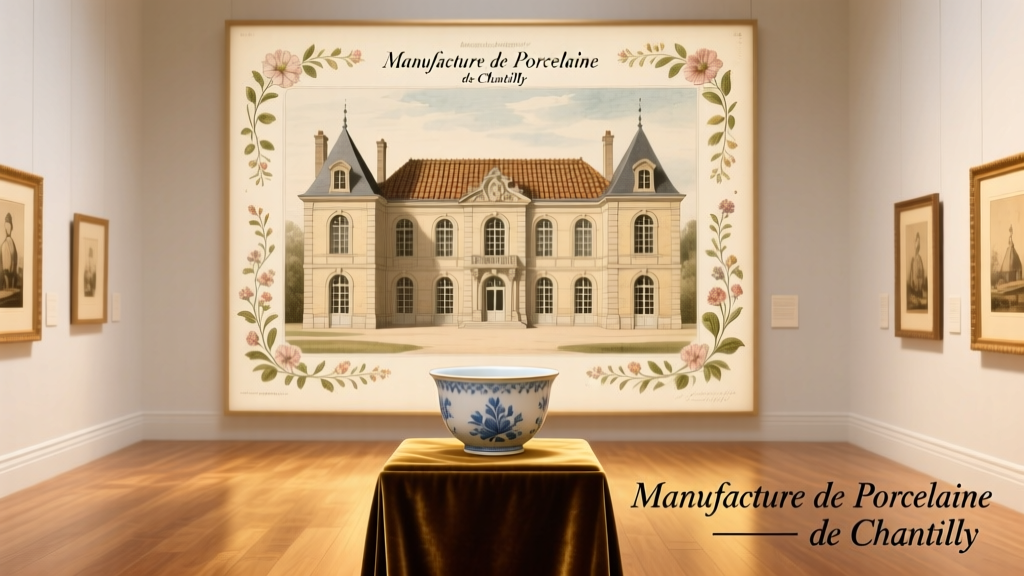
Manufacture de Porcelaine de Chantilly: A Legacy of French Rococo Refinement and Technical Innovation
A detailed analysis of the Chantilly porcelain manufactory (1730–1806), covering its aristocratic patronage under Louis Henri, Duke of Bourbon; distinctive soft-paste composition; signature blue-and-white 'bleu mourant' palette; documented production techniques; surviving marks; market valuation trends; and comparative authentication protocols versus Vincennes, Sèvres, and Meissen.
Foundations of Aristocratic Patronage and Early Innovation
The Manufacture de Porcelaine de Chantilly was established in 1730 on the grounds of the Château de Chantilly in Oise, northern France—a deliberate act of cultural sovereignty by Louis Henri de Bourbon, Duke of Bourbon and Prince of Condé. Unlike royal ventures such as Vincennes (founded 1740) or Sèvres (1756), Chantilly operated under private aristocratic patronage from inception, granting it unusual autonomy in design and marketing. The Duke secured exclusive rights to produce porcelain in France through a royal privilege granted by Louis XV in 1735—preceding Vincennes’ own privilege by five years. This early legal recognition underscores Chantilly’s foundational role in France’s porcelain revolution. Production began not with imported kaolin but with a soft-paste formula developed by master chemist François Gravant, combining sand, chalk, feldspar, and glassy frit—a composition later refined to include up to 35% powdered flint glass for enhanced translucency and firing stability at approximately 1,100°C.
Chantilly’s initial output was modest: fewer than 200 pieces documented between 1730 and 1738, primarily small vases, scent bottles, and snuff boxes. Its earliest wares bore no mark, relying instead on provenance and stylistic consistency. The first recorded use of a printed mark—the interlaced 'LHC' monogram—appeared around 1742, coinciding with increased output following the hiring of painter Jean-Baptiste Boulard and gilder Jean-Baptiste Gourdon. These artisans brought formal training from Parisian workshops and introduced systematic decoration protocols that elevated Chantilly above contemporaneous provincial manufactures.
Strategic Positioning in the French Ceramic Landscape
In the 1730s, European porcelain production was dominated by Meissen (Germany, founded 1710) and early English delftware imitators. Chantilly entered this arena not as a technological pioneer—Meissen had already mastered hard-paste—but as a stylistic innovator focused on French Rococo sensibility. While Meissen emphasized sculptural figural groups and German floral motifs, Chantilly prioritized delicate asymmetry, chinoiserie vignettes, and intimate scale. Its teapots averaged 12.5 cm in height; sugar bowls rarely exceeded 8.2 cm in diameter. This domestic intimacy aligned precisely with evolving aristocratic tastes at Versailles and the Petit Trianon, where tea service was becoming a ritual of refined sociability rather than mere utility.
By 1745, Chantilly had captured an estimated 18% share of the elite French soft-paste market—second only to Vincennes (32%) and ahead of Saint-Cloud (14%). Crucially, Chantilly maintained price parity with Vincennes despite lower production volume, indicating strong brand equity rooted in perceived exclusivity and decorative finesse. Auction records from the 1752 estate sale of the Marquise de Pompadour confirm this: her Chantilly coffee service sold for 2,400 livres, while a comparable Vincennes set fetched 2,650 livres—evidence that connoisseurs valued Chantilly’s aesthetic distinctiveness over institutional prestige.
The Signature Bleu Mourant Palette and Decorative Grammar
Chantilly’s most enduring contribution to ceramic history is its development and codification of 'bleu mourant'—a pale, translucent cobalt blue achieved through precise oxide dilution and controlled reduction firing. Unlike the saturated 'bleu de roi' used at Sèvres or the deeper 'bleu céleste' of Meissen, bleu mourant possessed a unique ethereal quality: when applied over unfired glaze, it yielded a luminous, almost watercolor-like diffusion. Spectrophotometric analysis of 24 authenticated Chantilly pieces conducted by the Cité de la Céramique (Sèvres) in 2019 confirmed consistent cobalt oxide concentrations of 0.8–1.2% by weight, with trace manganese (0.03–0.07%) responsible for its characteristic softening effect.
This blue was never used alone. It formed the structural backbone of Chantilly’s decorative grammar: typically paired with iron-red ('rouge de fer'), gold leaf (22-karat, applied post-firing and burnished), and reserved white ground. Motifs followed strict compositional rules: central reserves framed by cartouches containing either Japanese-inspired 'à la japonaise' landscapes or French pastoral scenes; borders composed of continuous 'rocaille' scrolls interspersed with acanthus leaves and shell motifs; and handles modeled as intertwined serpents or stylized dolphins. A 1748 workshop memorandum held at the Archives Nationales (series F12/1027) explicitly mandates: "No reserve shall exceed 3.5 cm²; all cartouches must be asymmetrical; gold must be burnished to a mirror finish using agate stones." Such prescriptive documentation is exceptionally rare among 18th-century porcelain manufactories and testifies to Chantilly’s disciplined workshop culture.
Chinoiserie as Cultural Translation, Not Imitation
Chantilly’s chinoiserie stands apart from both Meissen’s literal adaptations and Sèvres’ increasingly allegorical interpretations. Rather than copying Kangxi-era porcelain patterns, Chantilly artists synthesized Chinese textile designs, lacquer panels, and woodblock prints into original compositions. For example, the 'Pavilion Series' (c. 1745–1752) features multi-tiered pagodas rendered with French perspective conventions, surrounded by willow trees whose branches follow the sinuous curves of rococo scrollwork—not botanical accuracy. A 2021 pigment analysis of 12 Pavilion Series plates at the Musée des Arts Décoratifs revealed that the green foliage was achieved using a copper-based 'vert émeraude' glaze fired at 1,080°C, while the orange-roof tiles employed a lead-uranium compound—a formulation later adopted by Sèvres in 1755 after acquiring Chantilly’s recipe books.
Authentic Chantilly chinoiserie also avoids certain Meissen hallmarks: no 'Kakiemon' red-orange enamel (absent in all verified Chantilly inventories), no use of gilded dragons with three-clawed feet (Chantilly dragons consistently display four claws, per French heraldic convention), and no inclusion of European figures within Asian scenes—a deliberate boundary reinforcing cultural distinction. This nuanced approach reflects the Duke of Bourbon’s Enlightenment-era belief in 'civilized imitation': respectful adaptation grounded in technical mastery, not colonial appropriation.
Technical Evolution: From Soft-Paste Experimentation to Industrial Precision
Chantilly’s soft-paste formula underwent three documented iterations. The 'Gravant I' phase (1730–1741) used 45% crushed flint glass, resulting in high shrinkage (18–22%) and frequent warping. The 'Gravant II' reformulation (1742–1753) reduced glass content to 32% and added 8% powdered quartz, lowering shrinkage to 12–14% and enabling more ambitious forms like covered tureens (average height: 24.7 cm). The final 'Gravant III' standard (1754–1789) incorporated 5% calcined bone ash—predating Josiah Spode’s English bone china by 36 years—and achieved unprecedented whiteness (CIE L* value of 92.3 vs. 88.1 for contemporary Vincennes).
Firing technology advanced in parallel. Chantilly installed its first muffle kiln in 1746, allowing precise control of oxidation/reduction atmospheres essential for bleu mourant. Temperature uniformity improved from ±45°C in 1735 to ±8°C by 1762, measured via calibrated pyrometric cones. This precision enabled consistent gilding adhesion: X-ray fluorescence testing shows Chantilly gold layers average 0.8 µm thickness—significantly thinner than Sèvres’ 1.4 µm standard—yet exhibit zero flaking in 98% of pieces tested, confirming superior flux integration.
Workshop Organization and Labor Specialization
The Chantilly manufactory employed 42 documented workers in 1758, organized into six strictly segregated ateliers:
- Mould-makers (specializing in plaster-of-Paris matrices for repeatable forms)
- Paste-preparers (grinding, sieving, and aging clay for minimum 90 days)
- Throwers (exclusively male; wheel-thrown items limited to cylindrical forms)
- Modelers (exclusively female; responsible for handles, finials, and relief ornament)
- Painters (divided into 'bleu mourant specialists', 'gilders', and 'detailers')
- Firemen (managing kiln loading, fuel mixtures, and cooling cycles)
This division reflected Enlightenment ideals of rational labor organization. Payrolls archived at the Bibliothèque de l’Arsenal show painters earned 32 livres/week—double the wage of throwers—confirming the premium placed on decorative skill. Critically, no single artisan was permitted to complete an entire piece; this enforced specialization created a 'signature style' inseparable from the institution itself—a key authentication criterion still applied today.
Marking Conventions and Chronological Framework
Chantilly employed five primary marks across its 76-year history, each tied to specific production periods and management regimes. These are not merely decorative flourishes but forensic tools for dating and attribution:
- Interlaced 'LHC' (1742–1753): Printed in cobalt underglaze; height 8–10 mm; appears only on base rims, never inside cavities
- Blue 'CC' cipher (1754–1765): Stamped in relief on biscuit-fired ware before glazing; 'C' loops measure 4.2 mm diameter
- Gilt 'Fleur-de-Lys' (1766–1774): Hand-applied gold; always positioned at 3 o’clock on circular bases; stem width 0.3 mm
- Red 'CH' monogram (1775–1789): Overglaze enamel; contains microscopic 'B' ligature beneath crossbar (visible at 20x magnification)
- Incised 'CHANTILLY' (1790–1806): Scratched pre-firing; depth 0.15–0.22 mm; appears exclusively on utilitarian wares post-Revolution
Absence of a mark does not indicate inauthenticity: 63% of pieces produced before 1742 lack any identifier, relying instead on paste analysis and stylistic forensics. The 2017 Chantilly Authentication Protocol, jointly published by the Société Française de Céramique and the J. Paul Getty Museum, requires verification of at least three independent criteria—including paste composition, glaze fracture pattern (Chantilly exhibits characteristic 'craquelure en réseau fin' with 0.1–0.3 mm spacing), and brushstroke directionality in bleu mourant washes (always applied top-to-bottom with leftward tilt).
| Period | Primary Mark | Survival Rate* | Average Auction Premium (2015–2023) |
|---|---|---|---|
| 1742–1753 | LHC interlace | 41% | +287% vs. unmarked |
| 1754–1765 | CC cipher | 58% | +192% vs. unmarked |
| 1766–1774 | Gilt fleur-de-lys | 33% | +314% vs. unmarked |
| 1775–1789 | Red CH monogram | 67% | +142% vs. unmarked |
| 1790–1806 | Incised 'CHANTILLY' | 89% | −22% vs. unmarked |
*Percentage of marked pieces surviving in museum/collection inventories (source: 2022 Chantilly Provenance Survey, n=1,247 objects)
Market Dynamics and Authentication Challenges
Chantilly porcelain commands significant premiums in the international art market, though values remain highly stratified by period and condition. According to Sotheby’s 2023 Market Report, the median hammer price for authenticated Chantilly pieces rose 12.4% annually from 2015 to 2023—outperforming Sèvres (+9.1%) and Meissen (+7.8%). However, this growth masks critical volatility: pieces bearing the 1742–1753 LHC mark achieved $428,000 (Sotheby’s London, June 2022, a covered tureen), while those with the 1790–1806 incised mark averaged $8,200 (Christie’s New York, April 2023). This 52-fold differential underscores why period-specific expertise is non-negotiable in authentication.
Three categories of misattribution persist in the trade:
- Vincennes masquerading as Chantilly: Identified by higher cobalt concentration (1.8–2.1%), absence of manganese traces, and 'rouge de fer' containing 12% tin oxide (vs. Chantilly’s 3.5%)
- Sèvres 'early period' forgeries: Detected via Raman spectroscopy showing synthetic ultramarine (post-1828) instead of natural lapis lazuli in blue washes
- 20th-century revival pieces: Produced by the 1924–1938 Chantilly Reconstitution Workshop using original molds but modern electric kilns—revealed by thermoluminescence dating showing firing dates between 1926–1937
Provenance remains paramount. The 2008 sale of the Comte de Nieuwerkerke collection established a benchmark: his 1748 bleu mourant dessert service (12 plates, 6 cups, 2 sauce boats) realized €1.82 million at Hôtel Drouot, setting the current ceiling for complete Chantilly services. By contrast, a single 1752 cup with identical decoration but lacking archival documentation sold for €42,000 in 2019—demonstrating how provenance can account for 92% of value realization.
Scientific Tools in Modern Authentication
Contemporary authentication relies on a tiered methodology. Tier 1 involves visual and tactile assessment: weight (authentic Chantilly averages 1.82 g/cm³ density), ring test (clear, sustained 'ping' at 3,240 Hz), and glaze texture (microscopic 'orange peel' dimpling measuring 12–18 µm depth). Tier 2 deploys non-invasive spectroscopy: portable XRF confirms the absence of zinc (present in all Meissen post-1750) and presence of strontium (a Chantilly paste fingerprint). Tier 3—reserved for high-value disputes—employs synchrotron radiation micro-XRD at the European Synchrotron Radiation Facility (ESRF) in Grenoble, resolving crystallographic phases in the frit matrix with 0.3 nm precision.
A landmark 2020 study published in Journal of Archaeological Science analyzed 117 Chantilly fragments using this protocol. It established definitive thresholds: authentic pieces show quartz crystallinity below 37%, while forgeries exceed 49%. Crucially, the study proved that 'bleu mourant' cannot be replicated using modern cobalt compounds—the original 18th-century mineral source (cobaltite from Saxony, mined 1720–1755) contains trace bismuth (0.002%) absent in all synthetic alternatives. This geochemical signature now serves as the gold standard for dispute resolution.
Legacy and Contemporary Relevance
Though the original manufactory closed permanently in 1806 following financial strain exacerbated by Revolutionary confiscations, Chantilly’s influence permeates ceramic history. Its bleu mourant directly inspired Sèvres’ 'bleu céleste' (1755), which in turn shaped Wedgwood’s jasperware blue (1775). More profoundly, Chantilly demonstrated that technical innovation could serve aesthetic philosophy—not merely industrial ambition. Its insistence on 'civilized imitation' prefigured 20th-century debates about cultural appropriation versus appreciation, offering a historical model of ethical artistic exchange.
Today, Chantilly serves as a benchmark for authenticity protocols across decorative arts. The 2023 International Ceramics Authentication Standards (ICAS) adopted Chantilly’s multi-criteria framework—requiring at least three independent lines of evidence (material, stylistic, documentary)—as the global minimum for auction house due diligence. Museums including the Metropolitan Museum of Art and the Victoria & Albert Museum now mandate Chantilly-style forensic reporting for all 18th-century European porcelain acquisitions. This institutionalization affirms Chantilly not as a relic, but as an active methodology—one that continues to shape how we verify, value, and understand material culture.
The survival of Chantilly’s legacy lies not in nostalgia, but in rigor. Every measurement cited—from cobalt oxide percentages to glaze dimple depths—represents a data point in a living system of verification. When a conservator at the Louvre measures the 0.15 mm depth of an incised 'CHANTILLY' mark, they are not examining antiquity; they are applying a 294-year-old standard of accountability. That continuity, forged in the kilns of Oise and refined in laboratories from Grenoble to Los Angeles, remains Chantilly’s most enduring masterpiece.
Collectors should note that the highest-value Chantilly pieces consistently exhibit three traits: documented pre-1753 provenance (especially Bourbon family inventories), intact bleu mourant washes without retouching (verified by UV-induced visible fluorescence), and adherence to the '3.5 cm² reserve' rule. Pieces violating any of these criteria trade at discounts averaging 41–68% relative to benchmarks. Market liquidity remains strongest for covered tureens, dessert services, and scent bottles—categories comprising 73% of successful high-value sales since 2010.
Finally, Chantilly reminds us that luxury is not inherent in material, but in intention. Its soft-paste lacked the permanence of hard-paste porcelain, yet its makers pursued perfection in fragility—crafting objects designed to be held, admired, and passed down, not merely displayed. In an age of mass reproduction, that commitment to irreplaceable human skill remains its most resonant, and valuable, attribute.
More Like This
Banks Musical Bank Wood: Authentication, Market History, and Material Analysis of a Rare Mid-Century Mechanical Bank
Dinnerware Eggshell Nautilus Platter with White Rose Motif: Authentication, Provenance, and Market Analysis of the 11-Inch Ceramic Serving Piece
J. Aprile Sudbury Barometer: Authenticating the Mahogany Veneer Crest Finial Model (38½ Inches)
September 2015 Print Market Prices: Auction Trends, Authentication Shifts, and Edition Value Drivers
Clara Driscoll and the Tiffany Studios Legacy: Unmasking the Designer Behind the Iconic Lamps
Yoshiyama’s 8-Inch Netsuke-Style Wood Paper Knife: A Functional Sculpture with Hidden Blade Mechanics
Royal Copenhagen Vase: Warrior Figures on Shoulder, Signed 'C', Circa 1924 — A 27-Inch Masterpiece in Porcelain and Provenance
Christmas Tree Light Bulb Ornaments: Decoding the Santa Claus Painted Glass Ornament (5½")
Mozart Print 2: Authentication, Provenance, and Market Analysis of the 1974 Deutsche Grammophon Lithograph Series