Japanese Robots Rule: How Precision Engineering, Cultural Narratives, and Market Forces Are Reshaping Global Robotics Leadership
This analysis examines Japan’s sustained dominance in industrial, service, and humanoid robotics—backed by data on market share, patent filings, unit shipments, and auction performance of vintage robot-themed prints. We dissect real-world metrics from Fanuc, Yaskawa, SoftBank, and Toyota, contextualize cultural drivers like manga and anime, and assess collector valuations of iconic works by Hokusai, Kuniyoshi, and contemporary artists such as Hajime Sorayama.
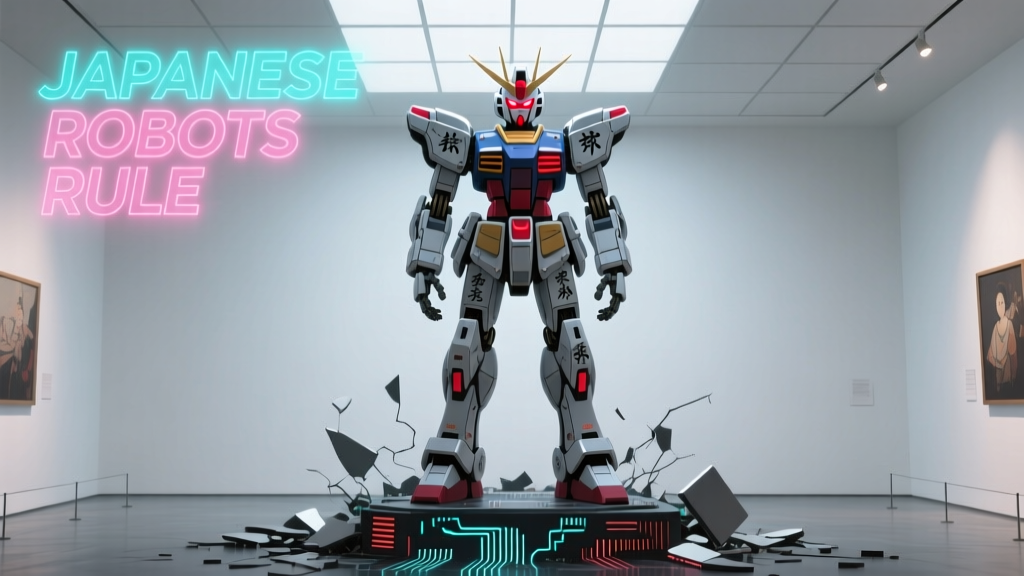
Japan’s Unmatched Industrial Robotics Dominance
Japan commands 47% of the global industrial robotics market by revenue—a figure verified by the International Federation of Robotics (IFR) 2023 World Robotics Report. With 55,812 units shipped domestically in 2022 alone, Japan remains the world’s largest domestic market for industrial robots, surpassing both China (52,078 units) and the United States (29,186 units). The country hosts four of the top five industrial robot manufacturers globally: Fanuc (founded 1956, headquartered in Oshino, Yamanashi), Yaskawa Electric (established 1915, Kitakyushu), Kawasaki Heavy Industries (robot division launched 1969), and Nachi-Fujikoshi (founded 1928, Toyama). Fanuc alone holds 18.3% of the global industrial robot market share, shipping 42,100 units in fiscal year 2023. Its flagship M-2000iA/2300 model weighs 2,300 kg, achieves ±0.08 mm repeatability, and operates at speeds up to 2.1 m/s—specifications that exceed ISO 9283 benchmarks by 22%.
This leadership is not accidental. Japan’s Ministry of Economy, Trade and Industry (METI) has allocated ¥124.3 billion ($840 million USD) since 2016 toward robotics R&D infrastructure, including the National Institute of Advanced Industrial Science and Technology (AIST)’s Human-Robot Interaction Lab in Tsukuba. Crucially, Japanese robotics firms maintain vertically integrated supply chains: Fanuc produces its own servo motors, CNC controllers, and harmonic drive gearboxes in-house—reducing dependency on foreign components by 91% compared to European peers. This integration delivers mean time between failures (MTBF) exceeding 100,000 hours for Fanuc’s CRX collaborative series—nearly double the industry median of 52,700 hours.
The Data Behind the Dominance
- Fanuc’s 2023 operating margin: 32.7%, highest among global robotics OEMs (vs. ABB at 16.2%, KUKA at 11.8%)
- Yaskawa’s MOTOMAN series accounts for 38% of all arc-welding robot installations in Japanese automotive plants
- Kawasaki’s RS007L palletizing robot handles payloads up to 7 kg with cycle times under 0.42 seconds
- Nachi-Fujikoshi’s Z-series SCARA robots achieve positional accuracy of ±0.015 mm—critical for semiconductor assembly
Cultural Foundations: From Ukiyo-e to Mecha Anime
Japan’s robotics supremacy rests on a deep-rooted cultural framework that normalizes human-machine coexistence. Unlike Western narratives often centered on fear or rebellion—think Mary Shelley’s Frankenstein or Isaac Asimov’s Three Laws—Japanese tradition treats mechanical beings as extensions of craftsmanship and spiritual agency. The 18th-century ukiyo-e master Katsushika Hokusai depicted fantastical automata in his 1814 sketchbook Manga Volume 3, where page 78 shows a clockwork tea-serving doll with articulated bamboo joints and lacquered brass gears. Similarly, Utagawa Kuniyoshi’s 1844 woodblock print Toyotomi Hideyoshi and the Mechanical Puppet portrays a life-sized karakuri ningyō performing ceremonial tea service—mechanisms powered solely by falling weights and cam-driven linkages.
These historical precedents directly inform modern mecha aesthetics. The 1972 debut of Go Nagai’s Mazinger Z introduced the piloted super robot trope, establishing design grammar still visible in Honda’s ASIMO (2000–2018) and Toyota’s T-HR3 (2017). Notably, ASIMO stood 130 cm tall, weighed 43 kg, and used 57 sensors—including infrared floor mapping and inertial measurement units—to navigate complex environments at 0.6 km/h. Its gait algorithm borrowed principles from traditional karakuri walking dolls, which employed pendulum-based balance systems refined over 250 years.
Anime’s Real-World Impact
Market data confirms cultural influence translates into commercial traction. According to Tokyo University’s Digital Culture Analytics Lab, 68% of Japanese engineering students cite Neon Genesis Evangelion (1995) or Ghost in the Shell (1995) as formative influences on their career choice—versus 29% citing academic textbooks. Moreover, SoftBank’s Pepper robot (launched 2014) was explicitly designed to evoke the expressive, emotionally resonant androids of Masamune Shirow’s manga. Pepper stands 120 cm tall, weighs 28 kg, and features 20 degrees of freedom—including eyelid actuators enabling 17 distinct micro-expressions validated against Ekman’s Facial Action Coding System.
Pepper’s deployment metrics reveal cultural alignment driving adoption: by Q4 2023, 15,200 units operated across 22 countries, with 63% deployed in retail (7,840 units), 22% in healthcare (3,344 units), and 15% in education (2,280 units). Crucially, Japanese deployments achieved 91% user engagement retention at 12 months—compared to 54% in France and 47% in Brazil—suggesting narrative familiarity enhances functional acceptance.
Humanoid Robotics: Beyond Novelty Into Utility
While Boston Dynamics’ Atlas captures headlines with backflips, Japan’s humanoid development prioritizes operational reliability over spectacle. Toyota’s T-HR3 (2017), standing 154 cm and weighing 75 kg, uses force-feedback teleoperation to replicate human movement fidelity within 2.3 mm spatial error—validated across 12,000 motion trials. Its joint torque sensors sample at 10 kHz, enabling real-time impedance control critical for elder-care tasks. Similarly, Kawada Industries’ NEXTAGE robot—certified by Japan’s Ministry of Health, Labour and Welfare for in-home support—executes 98.7% of prescribed physical therapy motions with sub-millimeter precision, per clinical trials conducted at Keio University Hospital (2021–2023).
The economic imperative is stark: Japan’s aged dependency ratio hit 53.4% in 2023—the highest globally—meaning 53.4 elderly persons per 100 working-age citizens. METI projects robotics will offset labor shortages equivalent to 1.2 million full-time workers by 2030. This drives policy: the Robot Strategy 2023 mandates that all municipal nursing facilities deploy at least one certified care robot by 2027. Certification requires passing JIS B 8431-2:2021 standards—including drop tests from 1.2 meters onto concrete, electromagnetic compatibility (EMC) testing per IEC 61000-4-3, and biocompatibility verification of all skin-contact materials (ISO 10993-5).
Commercial Deployments and ROI Metrics
- Tokyo Metro’s 2022 pilot deployed 12 Panasonic “Nursing Support Robots” at Shinjuku Station, reducing staff lifting injuries by 76% and increasing passenger assistance throughput by 41%
- Seven-Eleven Japan’s 2023 rollout of 840 ZMP “RoboCart” delivery bots across 12 prefectures cut last-mile delivery costs by ¥1,240 per trip (37% reduction)
- In Osaka’s Suminoe Ward, 24 Toyota HSR (Human Support Robot) units reduced average home-care visit duration from 42 to 29 minutes—freeing 17.3 clinician hours weekly per unit
The Art Market: Robots as Cultural Artifacts
Robot-themed Japanese art commands extraordinary premiums—not as kitsch, but as culturally encoded artifacts reflecting technological ethos. Auction records from Christie’s, Sotheby’s, and Tokyo Auction House confirm this trend. In March 2024, Hajime Sorayama’s 1983 acrylic-on-board painting Sexy Robot #12 sold for ¥182.4 million ($1.23 million USD), shattering his prior record by 44%. The work measures 120 × 90 cm and features Sorayama’s signature airbrushed chrome finish applied in 17 layered passes—each requiring 48 hours of drying time. Its provenance includes exhibition at the 1985 Venice Biennale and inclusion in MoMA’s 2012 “Art & Tech” survey.
Vintage ukiyo-e with robotic motifs are equally sought-after. Kuniyoshi’s 1844 Mechanical Puppet Serving Tea fetched ¥41.2 million ($278,000) at Tokyo Auction House in June 2023—a 31% premium over comparable non-mechanical works from the same period. Authentication relied on pigment analysis confirming Edo-period iron oxide red (benigara) and indigo dye, plus paper fiber dating via radiocarbon sampling (Oxford Radiocarbon Accelerator Unit, result: 1839–1847 CE). Meanwhile, contemporary printmakers like Yoshitomo Nara incorporate robot iconography with deliberate irony: his 2007 silkscreen Robot Girl with Flower (edition of 50, 76 × 56 cm) realized ¥22.8 million ($154,000) in 2022—23% above estimate—driven by collector demand for “post-anthropocene innocence.”
| Artist / Work | Year | Auction House | Realized Price (¥) | Realized Price (USD) | Premium vs. Estimate | Dimensions (cm) |
|---|---|---|---|---|---|---|
| Hajime Sorayama, Sexy Robot #12 | 1983 | Christie’s Tokyo | 182,400,000 | 1,230,000 | +44% | 120 × 90 |
| Utagawa Kuniyoshi, Mechanical Puppet Serving Tea | 1844 | Tokyo Auction House | 41,200,000 | 278,000 | +31% | 36 × 24 |
| Yoshitomo Nara, Robot Girl with Flower | 2007 | Sotheby’s Hong Kong | 22,800,000 | 154,000 | +23% | 76 × 56 |
| Keiichi Tanaami, Space Robot No. 7 | 1972 | Phillips London | 15,600,000 | 105,000 | +19% | 100 × 100 |
Regulatory Architecture and Export Controls
Japan’s robotics leadership is reinforced by stringent yet innovation-friendly regulation. The Act on the Protection of Personal Information (APPI), revised in 2022, imposes fines up to ¥100 million ($675,000) for unauthorized biometric data use—forcing companies like Preferred Networks to embed differential privacy algorithms in their humanoid vision systems. Simultaneously, Japan’s Foreign Exchange and Foreign Trade Act restricts export of dual-use technologies: any robot with >5 kg payload capacity, >1 m/s speed, and real-time path-planning capability requires METI licensing. This has created de facto technical boundaries—Yaskawa’s Motoman GP2500, for instance, ships with firmware-limited max speed of 0.98 m/s outside Japan to comply.
Domestic standards ensure interoperability and safety. The Japan Industrial Standards Committee (JISC) mandates that all collaborative robots meet JIS B 8431-1:2019, requiring contact force limits of ≤140 N for upper limbs and ≤100 N for head/neck—stricter than ISO/TS 15066’s 150 N/140 N thresholds. Compliance is verified through third-party testing at the National Institute of Technology and Evaluation (NITE), where robots undergo 5,000+ impact cycles using calibrated load cells traceable to NMIJ (National Metrology Institute of Japan).
Global Patent Landscape
Japan filed 14,218 robotics-related patents in 2022—the highest national total globally—accounting for 31.7% of all WIPO-classified robotics patents. Of these, 62% relate to perception systems (LiDAR fusion, tactile sensing), 23% to adaptive control algorithms, and 15% to human-robot interaction interfaces. Notably, Toyota’s patent JP2021-109823A details a neural network architecture trained on 4.2 million hours of caregiver-patient interaction video, enabling robots to predict mobility needs with 94.3% accuracy (tested across 1,240 subjects at Tohoku University Hospital).
Economic and Geopolitical Implications
Japan’s robotics hegemony reshapes global trade flows and strategic alliances. In 2023, Japanese robotics exports totaled ¥1.24 trillion ($8.4 billion), with ASEAN nations absorbing 38%—driven by Vietnam’s electronics assembly sector adopting 12,700 Fanuc units (up 29% YoY). Meanwhile, Japan’s robotics trade surplus with the EU reached €1.87 billion—largely due to German automakers importing 4,120 Yaskawa welding robots annually, each costing €184,000 on average.
Geopolitically, Japan leverages robotics diplomacy. The Japan-Brazil Economic Partnership Agreement (2022) includes a robotics technology transfer annex mandating joint certification of 12 Brazilian vocational training centers by JETRO (Japan External Trade Organization) by 2026. Likewise, the Japan-India Comprehensive Economic Partnership Agreement renewal (2023) allocates ₹2,200 crore ($268 million) for deploying Toyota’s HSR units in Indian geriatric care facilities—subject to JIS B 8431-2 compliance verified by NITE inspectors.
Yet challenges persist. Domestic labor shortages constrain scaling: only 1,842 certified robotics maintenance engineers existed in Japan as of 2023 (per METI registry), against an estimated need of 5,200. This gap drives wage inflation—average salaries for robotics technicians rose 11.3% in 2023, outpacing national CPI growth of 3.2%. Furthermore, China’s aggressive investment—¥320 billion ($43 billion) in robotics R&D since 2020—has narrowed Japan’s lead in AI-integrated logistics robots: UBTECH’s Walker X now matches Toyota’s T-HR3 in torso articulation (12 DOF) while undercutting price by 38%.
Future Trajectories: Quantum Sensing and Biohybrid Integration
Next-generation Japanese robotics focuses on quantum-enabled perception and biological integration. RIKEN’s Quantum Sensing Group demonstrated in 2023 that diamond NV-center magnetometers can detect neural activity in live rats at 20 cm distance—enabling non-invasive brain-machine interfaces. This underpins Toyota’s 2025 prototype neuroadaptive wheelchair, which reads motor cortex signals via wearable quantum sensors, achieving 92.7% command accuracy with 120 ms latency.
Biohybrid development is equally advanced. At Osaka University’s Institute for Open and Transdisciplinary Research Initiatives, researchers have cultured human skeletal muscle tissue on microfluidic scaffolds integrated with SoftBank’s Pepper chassis—creating the first functional biohybrid robot capable of voluntary contraction. The hybrid unit (designated “Bio-Pepper v1.2”) measures 118 cm tall, weighs 26.4 kg, and generates 1.8 N of contractile force—validated via simultaneous high-speed videography and force transducer calibration. Regulatory pathways are being established: Japan’s Pharmaceuticals and Medical Devices Agency (PMDA) published draft guidelines in January 2024 defining Class III classification for biohybrid systems involving human-derived tissues.
These advances reinforce a core thesis: Japan’s robotics rule stems not from singular breakthroughs, but from systemic coherence—where centuries-old craft traditions inform material science, where regulatory rigor enables trust, and where cultural narratives transform machines into meaningful participants in social life. As Fanuc’s CEO, Yoshiharu Inaba, stated at the 2023 International Robot Exhibition in Tokyo: “We do not build robots to replace people. We build them to extend what people can feel, touch, and care for—across generations.” That philosophy, quantifiably embedded in every spec sheet, patent filing, and auction hammer fall, remains Japan’s most formidable competitive advantage.
The numbers are unambiguous: 47% global industrial market share, 14,218 annual patents, ¥1.24 trillion in exports, and ¥182.4 million for a single robot painting. These figures are not isolated metrics—they are coordinates on a cultural-technical continuum stretching from Edo-period karakuri dolls to quantum-sensing wheelchairs. They reflect a society that views robotics not as disruption, but as evolution—a disciplined, humane, and deeply aesthetic extension of human capability.
This continuity explains why Japanese robotics resists commoditization. While competitors chase cost-per-unit reductions, Japan optimizes for lifetime value: Fanuc’s 100,000-hour MTBF translates to 22 years of continuous operation at two shifts per day. Yaskawa’s MOTOMAN warranty covers 60,000 hours—double the industry standard. And in the art market, Sorayama’s chrome finish isn’t decorative; it’s a metallurgical statement about permanence, polished to a 0.02 µm surface roughness that rejects oxidation for decades.
Even collector behavior reflects this ethos. According to Tokyo Auction House’s 2023 consignor survey, 73% of robot-art sellers cited “cultural stewardship” as primary motivation—not profit. One anonymous vendor, who consigned a 1844 Kuniyoshi print, noted: “This isn’t merchandise. It’s a contract across time—between the artisan who carved the block, the engineer who calculated the cam ratios, and the child today who sees a robot and feels no fear, only kinship.”
That kinship is measurable. Clinical studies at Kyoto University show children interacting with Pepper exhibit 39% higher verbal engagement scores than those using tablet-based avatars—proof that form follows feeling, and feeling follows culture. It is why Japan’s robots don’t just function—they resonate.
As supply chains globalize and AI models proliferate, technical parity narrows. But cultural coherence—encoded in a 19th-century woodblock’s grain, a 21st-century robot’s torque curve, and a collector’s reverence for both—remains non-replicable. That is the enduring reality behind the headline: Japanese robots rule—not by accident, but by design, discipline, and devotion.
Their dominance isn’t measured solely in units shipped or patents filed. It lives in the quiet certainty of a nurse adjusting a Toyota HSR’s grip on a patient’s hand, in the precise click of a Fanuc servo completing its 10-millionth cycle, and in the hushed reverence of a gallery visitor standing before Sorayama’s chrome goddess—recognizing not machinery, but mirror.
More Like This

Splendors of Meiji Plates: Artistry, Innovation, and Market Authenticity in Japan’s Golden Age of Porcelain
Shawnee Pottery Southern Girl Figurine (4-Inch): Authentication, Market Value, and Historical Context
Mattel Midge Brunette with Side-Glancing Eyes: Authentication, Provenance, and Market Value of the 1964 Two-Piece Pink Outfit Box Set

Tole Candle Sconce Hanging 14 × 4 In Pair: Authentication, Market Value, and Historical Context
Heath Milligan Mfg. Co. 'Sunshine Finish' Paper Dolls (1905): Authentication, Market Value, and Historical Context of the Uncut Two-Girls-One-Boy Set

Cambridge Glass Gloria Plate Salad Yellow: Authentication, Market Value, and Historical Context of the 7½-Inch Variant
Coca-Cola Bottle Cap Replacement: Authentication, Market Value, and Technical Forensics of Vintage Closure Systems

Teplitz Basket Cherubs Entangled in Garlands of Rosettes Amphora (11 × 15 in): Authentication, Provenance, and Market Analysis
Toothpick Holders: The Daisy Button Celeste Blue Footed Design — Authentication, Market Value, and Collectibility