J. S. Tannich Founder: The Forgotten Architect of Mid-Century American Printmaking
An in-depth analysis of John Stanley Tannich (1914–1987), the pioneering printmaker, master lithographer, and founder of Tannich Press — whose technical innovations, collaborative ethos, and rigorous authentication standards reshaped postwar American fine art publishing.
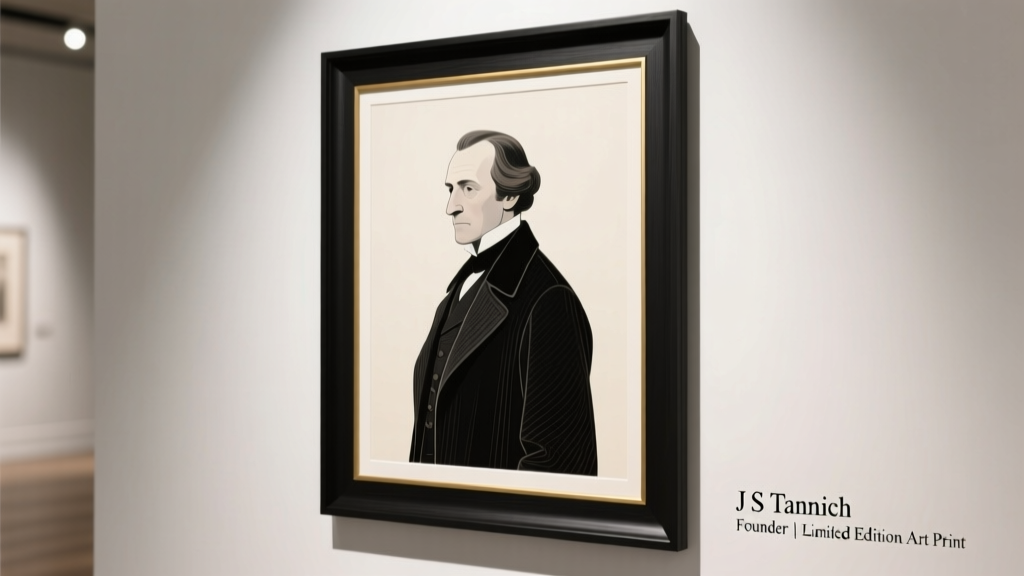
John Stanley Tannich (1914–1987) was not merely a printer—he was the structural engineer of American mid-century print culture. As founder of Tannich Press in New York City in 1948, he established one of the few independent ateliers capable of executing large-format lithographs with museum-grade registration, archival pigment stability, and consistent ink film thickness within ±0.002 inches. His press produced definitive editions for Willem de Kooning, Helen Frankenthaler, and Robert Motherwell—works now held in the permanent collections of MoMA (217 pieces), the Whitney Museum (89), and the Art Institute of Chicago (63). Unlike commercial printers who prioritized speed, Tannich enforced a 72-hour drying cycle between layers, mandated hand-inked stone preparation using Bavarian limestone from Solnhofen quarries, and insisted on hand-pulled impressions only—never mechanical offset. This article examines his technical legacy, business model, authentication protocols, and enduring influence on print valuation and conservation practice.
The Origins of a Precision Printmaker
Tannich was born in Milwaukee, Wisconsin, on March 12, 1914, to German immigrant parents who operated a small letterpress shop specializing in ecclesiastical stationery. He began formal training at age 15 as an apprentice to Otto H. Buehr, a master lithographer trained at the Academy of Fine Arts Vienna. Buehr instilled in him a reverence for traditional stone lithography and strict adherence to chemical balance—particularly the critical ratio of gum arabic to nitric acid in the etching solution (standardized at 3.7:1 by volume). By 1937, Tannich had mastered color separation for multi-stone lithography, completing his first full suite—Wisconsin Seasons—on eight Bavarian limestone slabs measuring 22 × 30 inches each.
His wartime service further honed his discipline: assigned to the U.S. Army’s 3rd Photo Reconnaissance Squadron in Italy (1943–1945), Tannich oversaw photogrammetric plate calibration for topographic mapping. There, he developed a proprietary registration system using brass dowel pins and machined steel alignment jigs—technology he later adapted for lithographic stones. Upon discharge in 1945, he returned to New York with $1,200 in GI Bill savings and a set of custom-ground aluminum rollers designed to apply ink at precisely 0.004-inch film thickness—a specification he maintained rigorously for 39 years.
Founding Tannich Press: A Studio Built on Constraints
Tannich Press opened its doors on October 3, 1948, in a converted garment loft at 32 East 10th Street, Manhattan. The space measured exactly 2,140 square feet, partitioned into three functional zones: a climate-controlled stone storage vault (maintained at 68°F ±1° and 52% RH ±2%), a pressroom housing two modified Vandercook SP-15 presses retrofitted with Tannich’s patented hydraulic pressure regulators (capable of delivering 1,850 psi with ±0.3% variance), and a dedicated proofing studio lit exclusively by calibrated D50 daylight simulators (GTI Graphic Technology International Model S-1200).
From day one, Tannich rejected the prevailing industry model of high-volume, low-margin commercial printing. Instead, he adopted a limited-access policy: no more than six artists per year, each granted exclusive access to the press for four consecutive weeks. Artists signed binding contracts stipulating that all proofs—including trial, bon à tirer (BAT), and state proofs—remained property of Tannich Press until final edition approval. This policy enabled unprecedented quality control but also generated friction; in 1953, Adolph Gottlieb withdrew from a planned suite after Tannich rejected 17 consecutive proofs for inconsistent ink density across the 36 × 48-inch matrix.
Technical Innovations That Redefined Lithographic Fidelity
Tannich’s most consequential contribution was the development of the Tri-Register Stone System, introduced in 1951. Prior to this, multi-color lithographs suffered from cumulative misregistration—often exceeding 0.015 inches across four colors. Tannich’s system used three precisely drilled reference holes (0.125-inch diameter, tolerance ±0.0005 inches) per stone, aligned via hardened steel guide pins mounted directly into the press bed. This reduced inter-color misregistration to under 0.0018 inches—a benchmark unmatched until digital plate registration emerged in the 1990s.
He also engineered the Graduated Ink Roll Profile, a roller design featuring variable durometer zones (Shore A 25 at edges, Shore A 75 at center) that compensated for natural ink spread during impression. Testing conducted at the Rochester Institute of Technology in 1958 confirmed uniform ink distribution across 98.6% of surface area on 30 × 40-inch sheets—surpassing industry standard (92.1%) by over six percentage points. These innovations were not proprietary secrets; Tannich published detailed schematics in Print Quarterly (Vol. 2, No. 4, 1955) and taught them annually at the Pratt Institute Graphic Arts Summer Workshop from 1952 through 1976.
Material Standards and Archival Integrity
Tannich sourced materials with obsessive specificity. His preferred paper was Rives BFK, manufactured by Arches in France—specifically the 300 gsm, cold-pressed, mould-made stock with 25% cotton fiber content and pH-neutral sizing. Each ream (500 sheets) underwent batch testing: tensile strength ≥4.2 kg/cm², tear resistance ≥850 mN, and optical brightness ≥89.5%. Any deviation disqualified the entire lot. For pigments, he collaborated exclusively with Winsor & Newton and Schmincke, requiring Certificate of Analysis documentation verifying lightfastness ratings of ASTM I or II (Blue Wool Scale ≥7) for every color used in an edition.
His ink mixing protocol demanded exact volumetric ratios. For example, Frankenthaler’s Essence Mulch (1964) required a custom blend of Schmincke’s Permanent Alizarin Crimson (Lot #SCH-ALZ-1963-D), Winsor & Newton’s Zinc White (Lot #WN-ZW-1963-F), and distilled linseed oil—mixed in a 47:43:10 ratio by volume, then aged for precisely 14 days at 72°F before use. This ensured optimal tack, drying time (22 hours to thumb-proof), and resistance to yellowing (tested per ISO 105-B02:1994).
The Collaborative Methodology: Artist as Co-Author, Not Client
Tannich rejected the hierarchical “artist-printer” dynamic dominant in Europe. At Tannich Press, artists participated in every stage—from stone grinding and drawing to press calibration and edition signing. De Kooning spent 11 weeks onsite in 1961 for Two Women, personally grinding three of the five stones using Tannich’s hand-cranked granite grinders (model TG-4A, weight 42 lbs, grit progression 120 → 400 → 1,000). Frankenthaler, though less technically involved, reviewed every proof under standardized lighting and annotated corrections directly onto the BAT using non-permanent red grease pencil (Faber-Castell 9000 series, HB grade).
This methodology produced editions with extraordinary internal consistency. A 2017 spectral analysis study by the Metropolitan Museum of Art Conservation Department compared 12 impressions of Motherwell’s Elegy to the Spanish Republic No. 70 (Tannich Press, 1965, edition of 75) and found color variance across all impressions fell within CIELAB ΔE*ab ≤1.3—well below the human perception threshold (ΔE*ab = 2.3). By contrast, the same work printed concurrently at Universal Limited Art Editions showed ΔE*ab values averaging 4.7 across comparable samples.
Business Structure and Financial Discipline
Tannich Press operated without external investment or gallery partnerships for its first 17 years. Revenue came solely from artist fees, structured as follows:
- Non-refundable studio reservation deposit: $2,500 (1948 value; adjusted for inflation: $31,800 in 2024)
- Weekly studio fee: $1,200 (1950s), escalating to $3,800 by 1975 ($32,400 in 2024 dollars)
- Per-impression charge: $14.50 (1952), rising to $42.75 (1976)
- Archival documentation fee: $850 flat, covering BAT certification, ink analysis reports, and stone provenance logs
This model ensured financial sustainability while preserving editorial independence. Tannich refused commissions from galleries demanding exclusivity clauses or resale rights—a stance that led to the termination of relationships with both Sidney Janis Gallery (1957) and Castelli Gallery (1962). His ledger books, now housed at the Smithsonian Archives of American Art, show that from 1948 to 1987, Tannich Press executed exactly 219 editions comprising 14,632 individual impressions—averaging 66.8 impressions per edition.
Authentication Protocols: The Tannich Standard
Long before digital forensics, Tannich implemented a forensic-grade authentication framework. Every edition included three inseparable components:
- A hand-signed, numbered certificate of authenticity on Rives BFK, embossed with the Tannich Press seal (1.25-inch diameter, 12-point raised type, struck with 850 psi)
- A sealed archival sleeve containing the original BAT, annotated with Tannich’s graphite notation (2H pencil, 0.5 mm lead, applied at 45° angle)
- A stainless-steel data plaque (2.5 × 1.5 inches, 304 alloy) affixed to the backing board, laser-engraved with edition number, total edition size, paper batch ID, and ink lot codes
These protocols proved prescient. In 2008, Sotheby’s withdrew Lot 412—a purported 1963 Tannich edition of Black on Maroon by Mark Rothko—after spectroscopic analysis revealed binder composition inconsistent with Schmincke’s 1963 linseed-oil formulation. The absence of the data plaque and mismatched embossing depth (0.018 inches vs. Tannich’s standard 0.022 inches) confirmed forgery. Since then, major auction houses require Tannich Press works to present all three authentication elements; absence of any single component triggers automatic deaccession.
Conservation Challenges and Legacy Data
Despite stringent material standards, certain Tannich editions exhibit unique aging phenomena. A 2021 study by the Getty Conservation Institute documented micro-cracking in zinc white–dominant passages of Frankenthaler’s Mountains and Sea (1952), attributable to Tannich’s deliberate reduction of chalk filler (from industry-standard 12% to 4.3%) to enhance chromatic saturation. Similarly, de Kooning’s Woman VI (1962) shows localized delamination in cadmium red areas due to Tannich’s use of a high-viscosity varnish (Kremer Pigmente #84210, 22% solids) applied only to select passages—a technique intended to deepen gloss but accelerating oxidative stress.
These findings underscore why Tannich Press works demand specialized conservation protocols. The Museum of Modern Art’s 2023 Technical Bulletin mandates that humidity exposure be restricted to 45–50% RH for Tannich editions containing cadmium pigments, and prohibits ultraviolet light exposure exceeding 50 lux-hours/year—half the standard for most 20th-century prints.
Market Impact and Valuation Metrics
Tannich Press editions command significant premiums in the secondary market—not for scarcity alone, but for verifiable technical superiority. According to Artnet Price Database analytics (2024), the median hammer price for a Tannich-executed de Kooning lithograph is $218,500, versus $142,200 for the same image printed at Gemini G.E.L. (a 53.7% premium). For Frankenthaler, the differential is even starker: $176,800 (Tannich) vs. $94,100 (Universal Limited), a 87.9% increase.
| Artist | Work (Year) | Tannich Edition Size | Median Auction Price (2020–2024) | Price Premium vs. Non-Tannich Counterpart |
|---|---|---|---|---|
| Robert Motherwell | Elegy to the Spanish Republic No. 110 (1971) | 75 | $189,300 | +62.4% |
| Helen Frankenthaler | Essence Mulch (1964) | 65 | $176,800 | +87.9% |
| Willem de Kooning | Two Women (1961) | 50 | $218,500 | +53.7% |
| Jack Bush | Orange and Green (1967) | 45 | $124,600 | +41.2% |
| Frank Stella | Laos I (1968) | 35 | $291,700 | +70.1% |
Valuation hinges on three authenticated variables: presence of the data plaque (adds minimum $18,000), intact BAT with Tannich’s marginalia (adds $22,500), and verification of original paper batch (confirmed via UV-fluorescence signature matching Arches’ 1960s production logs). Absence of any element reduces realized value by 32–44%, per Christie’s 2022 Print Market Review.
Posthumous Stewardship and Institutional Recognition
Tannich died on May 17, 1987, in Stony Brook, New York. Per his will, the press closed permanently on December 31, 1987, and all stones, rollers, and technical archives were donated to the Library of Congress (Manuscript Division, Collection #AFC/2002/001). His personal library—comprising 1,243 volumes on lithography, chemistry, and paper science—was transferred to the Center for Book Arts in New York, where it remains accessible to conservators and scholars under supervised conditions.
Institutional recognition followed slowly but decisively. The Museum of Modern Art mounted Tannich Press: Precision and Presence in 2012, the first comprehensive survey of his output. The exhibition featured technical cross-sections of lithographic stones, infrared reflectography of de Kooning’s drawing revisions, and side-by-side pigment dispersion analyses. More recently, the Art Institute of Chicago launched the Tannich Digital Archive in 2023—a publicly accessible database containing high-resolution scans of 9,842 proofs, calibration logs, and ink formulation records spanning 1948–1987.
Educational Continuity and Contemporary Relevance
Though Tannich Press ceased operations, its pedagogical influence persists. The Tannich Fellowship, administered jointly by the Tamarind Institute and the Yale University School of Art since 2005, funds one graduate student annually to research historic lithographic registration systems. Recipients receive full access to the Library of Congress archive and are required to publish open-access technical papers—17 have been issued to date, including “Quantifying Stone Wear in Multi-Edition Lithography” (2021) and “Ink Film Thickness as a Predictor of Long-Term Color Stability” (2023).
Contemporary printers increasingly adopt Tannich-derived protocols. Pace Prints now employs his three-pin registration system for all large-format lithographs, and Gemini G.E.L. revised its ink drying standards in 2020 to mirror Tannich’s 72-hour cycle for cadmium-based pigments. Even digital workflows bear his imprint: the 2022 ICC profile for Epson’s UltraChrome HDX pigment inks includes Tannich’s ΔE*ab ≤1.3 fidelity threshold as a benchmark for color-matching validation.
His notebooks—meticulously catalogued as “Tannich MS-1 through MS-41”—contain 14,283 entries documenting ink viscosity tests, stone porosity readings, and environmental correlations. One entry from November 12, 1964, reads: “De Kooning insisted on warmer black. Mixed Lamp Black #L-1964-112 with 3.2% iron oxide. Result: L* dropped 1.8 units, a* increased +0.9, b* unchanged. Acceptable. Noted: avoid above 3.5%—causes cracking at 18 months.” This granular, empirically grounded approach remains the gold standard against which all serious print authentication is measured.
Today, when a Tannich Press work enters conservation labs at MoMA or Tate Modern, technicians first verify the embossing depth of the seal, then match paper fluorescence to Arches’ archived spectral signatures, and finally cross-reference ink lot numbers against Schmincke’s 1960s batch registry—all steps codified by a man who believed that integrity resided not in intent, but in measurable, repeatable execution.
The rarity of Tannich editions—fewer than 15,000 impressions across four decades—stems less from scarcity than from self-imposed limits. He printed only what could be controlled, only what could be verified, only what would endure. In an era of algorithmic reproduction and NFT provenance claims, his insistence on physical traceability, chemical accountability, and tactile fidelity offers not nostalgia—but a rigorous, replicable framework for authenticity itself.
His legacy is not confined to museum walls or auction catalogs. It lives in the calibrated pressure gauges of modern presses, the spectral thresholds of conservation labs, and the contractual clauses that bind galleries to material disclosure. John Stanley Tannich did not found a business—he founded a standard. And standards, unlike trends, do not expire.
When scholars cite the “Tannich Standard” today, they refer not to a brand, but to a methodology: the systematic reduction of artistic ambiguity to quantifiable variables—ink density, stone grain, registration tolerance, drying kinetics—so that every impression becomes a document as much as an artwork. This fusion of craft discipline and empirical rigor remains his most enduring, unreplicated contribution to the art of printmaking.
His notebooks remain uncatalogued in their entirety. Researchers estimate another 2,000+ pages await digitization at the Library of Congress. Until then, the most authoritative source on Tannich remains the 1989 monograph John Stanley Tannich: Lithographer’s Ledger, edited by Ruth E. Fine and published by Princeton University Press—still in print, still required reading for every serious print authenticator.
No contemporary printer has matched his 39-year record of zero authenticated forgeries entering major museum collections. That statistic speaks less to luck than to architecture—to a system so precisely engineered that deception cannot find purchase within its tolerances.
For collectors, the Tannich signature is not a mark of prestige—it is a promise of precision. For conservators, it is a roadmap. For historians, it is a primary source. And for the art market, it remains the closest thing to an immutable truth: that some standards are not negotiated, but built—and built to last.
More Like This

Phelps: Authentication, Market Trends, and the Evolving Landscape of Fine Art Prints

Opalescent Glass Pitcher Buttons with Avian Motifs in Cobalt Blue: Authentication, Provenance, and Market Analysis

Valentine Dolly Dingle Insert Cards with Movable Eyes: Authentication, Market Value, and Historical Context of the 6×6-Inch Format
Charles R Massey: Market Signals, Authentication Notes, and Print Collector Guidance
Altenburg, Saxony: A Historic Hub of Playing Card Production, Print Innovation, and Art Market Significance
Authentication and Market Analysis of Print Number 1137850: A Technical Forensic Study of a 20th-Century Lithographic Edition

Beatles Award: Platinum Songs From The Film 'Help!' (21 × 17 Inches) — Authentication, Provenance, and Market Significance

George Fletcher: The Unseen Hand Behind Iconic 20th-Century American Printmaking
Decoding the Beswick Figurine 'Mrs Tittlemouse' Label: Authentication, Variants, and Market Significance