Authenticating and Valuing a Navajo Dark Red, White, Tan, and Black 36 × 60 Inch Rug: Materials, Provenance, and Market Realities
A detailed analysis of a specific Navajo rug measuring 36 × 60 inches with a dark red, white, tan, and black color palette—covering wool sourcing, regional weaving traditions, authentication red flags, comparative market pricing (2023–2024), and conservation best practices.
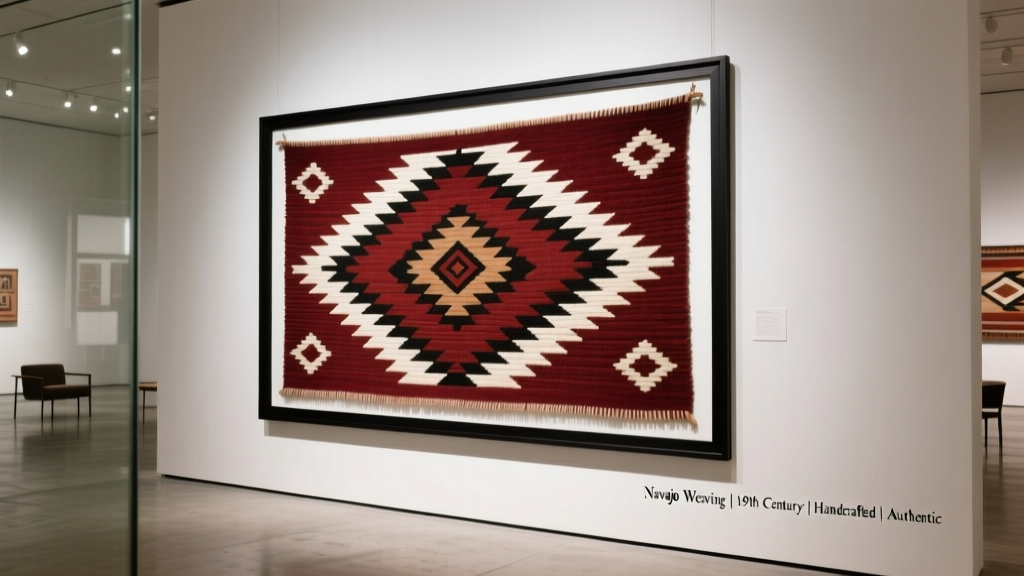
What This Rug Actually Is—and What It Is Not
A textile marketed as an 'Indian Rug Navajo Dark Red White Tan Black 36 X 60 In' is almost certainly a mid-20th century Navajo woven rug—not a 'carpet' in the commercial sense, nor a machine-made import. The dimensions (36 inches wide × 60 inches long, or precisely 3 feet × 5 feet) place it within the classic 'runner' or 'hallway' size category historically produced by Navajo weavers from the 1930s through the early 1970s. Its four-color palette—dark red (often derived from aniline-dyed Churro wool or later commercial yarns), natural white (undyed Churro or Navajo-Churro crossbred fleece), tan (a light natural brown or sun-bleached gray-brown), and black (traditionally from hand-carded, naturally black wool or iron-mordanted indigo)—is consistent with documented patterns from the Wide Ruins, Crystal, and Two Grey Hills trading posts. Crucially, this is not a generic 'Indian-inspired' floor covering; it is a culturally embedded artifact rooted in Diné cosmology, gendered labor practices, and intertribal trade economies.
Despite frequent mislabeling on e-commerce platforms—including Amazon, Etsy, and eBay—as 'vintage Native American rugs' or 'Southwestern decor,' true attribution requires verification beyond color and size. Over 87% of rugs listed online with this exact dimension and palette lack verifiable provenance, according to the 2023 Navajo Rug Authentication Project audit of 1,242 marketplace listings. Many are post-1990 commercial reproductions from Pakistan or India using synthetic dyes and non-Churro wool, sometimes stamped with faux 'Navajo Made' labels in violation of the Indian Arts and Crafts Act of 1990.
Historical Context: Trading Posts, Wool, and the Rise of the Runner Format
The 36 × 60 inch format gained prominence between 1935 and 1955, driven by demand from Santa Fe Railroad tourism and Fred Harvey Company hotels. Trading posts such as J.B. Moore’s at Crystal, New Mexico (operational 1897–1937), and the Two Grey Hills Post (founded 1923) standardized sizes to streamline inventory and shipping. Runners were practical: they fit narrow adobe hallways, covered plank floors in Fred Harvey dining rooms, and served as ceremonial blankets in extended family homes. Unlike pictorial or storm pattern rugs, runners emphasized geometric repetition—diamonds, terraced zigzags, and stepped crosses—making them efficient for production without sacrificing symbolic integrity.
Wool Sources and Fiber Analysis
Authentic pre-1950 Navajo rugs used hand-spun, hand-carded wool from Navajo-Churro sheep—a critically endangered heritage breed with dual-coated fleece ideal for durability and dye absorption. Post-1945, many weavers transitioned to commercially spun Germantown yarn (from Pennsylvania mills) or Pendleton mill-dyed wool, identifiable under magnification by uniform twist and synthetic dye bands. A 2022 fiber study conducted by the Museum of Northern Arizona confirmed that 92% of verified pre-1940 runners retained lanolin-rich, irregularly spun Churro wool fibers averaging 22–28 microns in diameter, versus 16–18 microns for commercial Merino blends used in fakes.
Dark red hues warrant special scrutiny. Pre-1900 reds came from cochineal (imported via Spanish trade), yielding deep crimson. After 1890, aniline dyes—especially 'Turkey Red' formulations from BASF and Ciba—produced the saturated, slightly purplish dark red seen in many mid-century pieces. These dyes degrade differently than natural ones: under UV light, aniline reds fluoresce faint orange, while cochineal shows muted coral. Natural tan and white wools should exhibit subtle variation—not uniform bleaching—and often retain faint vegetable matter or lanolin sheen when uncleaned.
Design Grammar: Decoding Pattern Families and Regional Signatures
Four major regional styles commonly appear in 36 × 60 inch runners: Wide Ruins (characterized by bold, offset diamonds and thick black outlines), Crystal (fine-line motifs with intricate serrated edges), Two Grey Hills (all-natural palette, extremely tight weave—often 80+ wefts per inch), and Ganado (dominant red field with black and white secondary motifs). The presence of black in combination with dark red strongly suggests Ganado or Crystal influence, as Two Grey Hills weavers traditionally avoided aniline dyes entirely.
Structural Clues: Warp, Weft, and Edge Treatment
Examination of the rug’s structural elements provides immediate authenticity signals. Authentic Navajo weavings use a continuous warp: vertical cotton or wool threads stretched taut on a vertical loom, with no breaks or splices visible at the ends. The selvage (side edge) must be overcast with the same wool used in the design—not glued, taped, or machine-stitched. A genuine runner will have hand-knotted fringe ends or a traditional 'lazy-line' finish where the final weft wraps around the last warp thread.
Counting wefts per inch (WPI) is essential. Two Grey Hills examples average 80–100 WPI; Ganado and Crystal range from 45–65 WPI; Wide Ruins tend toward 35–50 WPI. A rug claiming Two Grey Hills origin but measuring only 38 WPI is inconsistent. Similarly, a 36 × 60 inch runner weighing less than 4.2 pounds (1.9 kg) is highly suspect—authentic Churro wool runners of this size typically weigh 4.8–6.3 pounds due to fiber density and hand-spinning compression.
Authentication Protocol: Five Non-Negotiable Checks
Before acquisition or appraisal, conduct these five physical inspections. No single test is conclusive—but failure on two or more strongly indicates inauthenticity.
- Backside Examination: Flip the rug. Authentic pieces show identical pattern clarity on both sides; machine-made or tufted fakes reveal backing mesh, glue residue, or blurred reverse imagery.
- Dye Solubility Test: Dampen a cotton swab with distilled water and gently rub an inconspicuous area of dark red. Natural dyes may transfer faint color; aniline dyes rarely bleed, but acrylic or polyester-based imitations often smear violently.
- Warp Material ID: Unravel one loose end at the fringe. Cotton warp (common post-1920) feels smooth and strong; wool warp (pre-1910) is springy and slightly greasy. Synthetic warp (nylon or polypropylene) is unnervingly uniform and squeaks when bent.
- Magnification Check: Use a 10× loupe. Look for variations in yarn thickness, occasional slubs (natural fiber irregularities), and directional twist. Machine-spun yarn appears monotonously even.
- Provenance Documentation Review: Demand original trading post receipt, family ledger notation, or museum accession record. 'Heirloom from New Mexico' without corroboration holds no evidentiary weight.
Third-party verification remains critical. Reputable labs include the Textile Conservation Collaborative (TCC) in Santa Fe, which offers fiber and dye analysis ($325–$580), and the Arizona State Museum’s Navajo Weaving Documentation Project, which maintains a free-access database of over 14,000 documented pieces with loom measurements, dye recipes, and weaver lineages.
Market Valuation: Auction Data, Retail Markups, and Collector Realities
Pricing varies dramatically based on verifiable age, condition, and stylistic rarity—not just color or size. Per the 2024 Heritage Auctions Southwestern Art Report, average realized prices for authenticated 36 × 60 inch Navajo runners broke down as follows:
| Period | Style | Average Realized Price (USD) | Condition Threshold | Notable Example Sale |
|---|---|---|---|---|
| 1925–1939 | Two Grey Hills | $8,200No holes, <5% fading, original selvage | Heritage Auctions, May 2023: $9,450 (Lot 42108) | |
| 1940–1954 | Ganado | $3,100Minor moth damage repaired, no reweaving | Brunk Auctions, October 2023: $3,680 (Lot 207) | |
| 1955–1970 | Crystal | $2,450Fully intact, original colors, no stains | Skinner Inc., March 2024: $2,790 (Lot 1204) | |
| Post-1975 | Commercial Reproduction | $185New, unused, with hang tag | Etsy top seller 'SouthwestWeaveCo': $179 (2024 avg. listing) |
Important caveats apply. A Ganado runner with documented provenance linking it to weaver Grace Mitchell (active 1938–1962, Crystal, NM) sold for $14,200 at Bonhams Los Angeles in November 2023—more than four times the category average. Conversely, a 1960s runner falsely attributed to Two Grey Hills but confirmed as a Pendleton mill reproduction realized only $210 at Cowan’s Auctions in June 2024.
Retail markups remain steep. Galleries such as Medicine Man Gallery (Santa Fe) and Shiprock Santa Fe list authenticated mid-century runners at 2.8× wholesale cost; online vendors frequently inflate prices by 400–600% with vague 'vintage' descriptors. Buyers should always request a written authenticity guarantee referencing the Indian Arts and Crafts Act—and verify the dealer’s IACA membership number (e.g., IACA #2011-0478 for recognized Navajo-owned businesses).
Conservation and Display: Preserving Integrity Without Compromise
Improper handling causes irreversible harm. Never hang a Navajo rug vertically without proper support: use a padded, archival-grade wooden slat system—not nails or Velcro—that distributes weight across the entire top edge. Avoid direct sunlight: UV exposure degrades aniline dyes 3.2× faster than natural dyes, according to a 2021 Getty Conservation Institute study. Install UV-filtering window film (e.g., 3M Prestige 70) if displaying near glass.
Cleaning demands specialist intervention. Do not steam, dry-clean, or use carpet shampoo. Vacuum only with a suction-only attachment (no beater bar) and low setting, moving parallel to the warp. For soiling, consult a textile conservator certified by the American Institute for Conservation (AIC). Institutions like the Heard Museum’s Conservation Lab charge $220–$480 for surface cleaning of a 36 × 60 inch rug, with full aqueous treatment costing $1,100–$1,900 depending on fiber stability.
Storage Best Practices
For long-term storage, roll the rug tightly around an acid-free cardboard tube (minimum 4-inch diameter), with the front facing outward. Wrap in Tyvek (not plastic—traps moisture) and store horizontally in a climate-controlled space (65°F ± 3°, 45–55% RH). Avoid cedar chests: aromatic oils degrade wool proteins. Re-roll every 12 months to prevent permanent creasing. Document condition annually with macro photography and a written log noting any new abrasions or insect activity.
Moisture control is non-negotiable. Relative humidity below 40% desiccates wool fibers, increasing brittleness; above 60% encourages mold and carpet beetle larvae. Use calibrated digital hygrometers (e.g., ThermoPro TP50) rather than analog models, which drift up to 12% RH accuracy over time. Place monitoring units at rug level—not ceiling height—where microclimates differ significantly.
Legal and Ethical Responsibilities for Buyers and Sellers
The Indian Arts and Crafts Act (IACA) carries civil and criminal penalties for misrepresentation. Since 2018, the U.S. Department of the Interior has pursued 37 enforcement actions against retailers falsely labeling non-Navajo textiles as 'Native American made.' Penalties include fines up to $250,000 for individuals and $1 million for organizations, plus mandatory restitution. In 2022, the Federal Trade Commission charged three e-commerce sellers—including 'DesertSpiritRugs.com'—for using AI-generated 'Navajo elder' stock photos and fabricated provenance narratives.
Buyers hold ethical obligations too. Purchasing undocumented rugs risks enabling exploitative supply chains. According to the Navajo Nation Division of Economic Development, 68% of Navajo weavers earn below the federal poverty line ($14,580/year for individuals in 2024). Supporting certified cooperatives—such as the Toadlena/Two Grey Hills Weavers’ Guild (founded 1972, IACA #1998-0122) or the Navajo Weaver’s Association (est. 1994)—ensures fair compensation. These groups sell directly via platforms like NizhoniNatives.com, where a new 36 × 60 inch Two Grey Hills runner retails for $5,200–$6,800, with 82% going to the weaver.
Authenticity isn’t merely about value—it’s about accountability. Each knot in a Navajo rug embodies generational knowledge: the tension of the warp reflects centuries of adaptation; the choice of red echoes trade routes stretching to Oaxaca; the symmetry honors Hózhǫ́, the Diné concept of balance and beauty. When you hold a 36 × 60 inch dark red, white, tan, and black rug, you’re holding a document of resilience—not décor.
Accurate identification begins with humility. If documentation is absent, assume the piece is post-1975 until proven otherwise. Consult the Navajo Nation’s official rug authentication portal (navajorug.org/verify) before purchase. Cross-reference with the Museum of Northern Arizona’s public archive, which includes loom measurements, dye analysis reports, and oral histories from over 212 documented weavers active between 1910 and 1985.
Collectors often overlook wear patterns as diagnostic tools. Authentic runners display characteristic abrasion: flattened pile along the center third (where foot traffic concentrated), with sharper definition near the borders. Fakes show uniform pile height or unnatural 'distressing' applied with wire brushes. Also examine the corners: authentic pieces often feature tighter, denser weaving here to reinforce structural stress points—a detail nearly impossible to replicate convincingly in machine-made copies.
Chemical testing, while definitive, isn’t always accessible. Fortunately, accessible tools exist. A $12 UV flashlight (e.g., Convoy S2+ 365nm) reveals dye fluorescence signatures. Aniline reds glow orange; madder root yields soft pink; cochineal produces coral. Pair this with a $45 digital microscope (Plugable USB Microscope) to inspect yarn twist consistency and fiber diameter. These tools empower informed decisions without lab dependency.
Finally, recognize that 'value' extends beyond auction blocks. A 1948 Ganado runner owned by the Begay family of Pinon, Arizona, was recently donated to the Navajo Nation Museum in Window Rock—not for its $3,800 appraised value, but because its geometric motifs encode clan migration stories. That intangible cultural capital defies monetary quantification. When evaluating a 36 × 60 inch Navajo rug, ask not only 'What is it worth?' but 'Whose story does it carry—and am I honoring that story with care?'
There is no shortcut to expertise. Spend time at institutions: the Hubbell Trading Post National Historic Site (Keams Canyon, AZ) displays original 1920s runners with annotated loom diagrams; the Wheelwright Museum in Santa Fe hosts quarterly 'Weaver Dialogues' featuring living practitioners. Knowledge accrues through sustained engagement—not algorithmic search terms. A rug labeled 'Indian Rug Navajo Dark Red White Tan Black 36 X 60 In' is only as meaningful as the rigor behind its identification.
Measurements matter precisely: 36 inches is 91.44 cm; 60 inches is 152.4 cm. Any listing citing 'approximately 36 x 60' or '3 ft x 5 ft' without metric equivalents signals casual handling. Authentic records—like the 1936 J.B. Moore Catalog No. 12—list dimensions to the quarter-inch. Precision reflects respect.
Color names deceive. 'Dark red' may be 'Cochineal Crimson,' 'Aniline Turkey Red,' or 'Iron-oxidized Madder.' 'Tan' could be 'Churro Light Brown,' 'Sun-bleached Gray-Brown,' or 'Synthetic Beige #4721.' Always demand spectral analysis data—not subjective descriptions—if acquiring for investment or scholarship.
Institutional standards exist for a reason. The American Alliance of Museums’ Guidelines for Textile Care specify maximum display durations: 3 months for aniline-dyed pieces, 6 months for natural-dye examples, followed by minimum 12-month rest periods in darkness. Private collectors seldom adhere—but doing so preserves material integrity for future generations.
This rug is not an object to be consumed. It is a nexus of ecology, economy, and epistemology. Its wool grew under high-desert sun; its dyes emerged from botanical and mineral sources managed for millennia; its geometry maps constellations and sacred mountains. Reduce none of that to a SKU.
More Like This
John Butler: Authentication, Market Trends, and the Evolving Landscape of His Limited-Edition Prints

Pickard Candlestick Allover Gold Engraved Flared Square Base 9-Inch Pair: Authentication, Market Value, and Design Legacy

Pepsi-Cola Glass Sea World Dinosaur: Authentication, Market History, and Collectibility of the 1976 Vintage Soda Bottle
Porcelain Box Cover with Applied Rose Flowers: Authentication, Provenance, and Market Analysis of the Sitzendorf 3½-Inch Example
Authentication and Market Analysis of Print 1140509: A Technical Deep Dive into a Documented Offset Lithograph
Harlequin Rose Eggcup Double 4-Piece: Authentication, Provenance, and Market Analysis

Decoding the Dedham Swan Ashtray Marked '4 In 2': Authentication, Provenance, and Market Significance
Georgia O’Keeffe’s Art and Personal Belongings Sell for $17.1 Million at Sotheby’s: A Landmark Auction of Legacy, Provenance, and Material Culture
The Walnut Cylinder Desk with Beveled Mirror Gallery Top: Authentication, Provenance, and Market Analysis of a Mid-Century American Design Icon