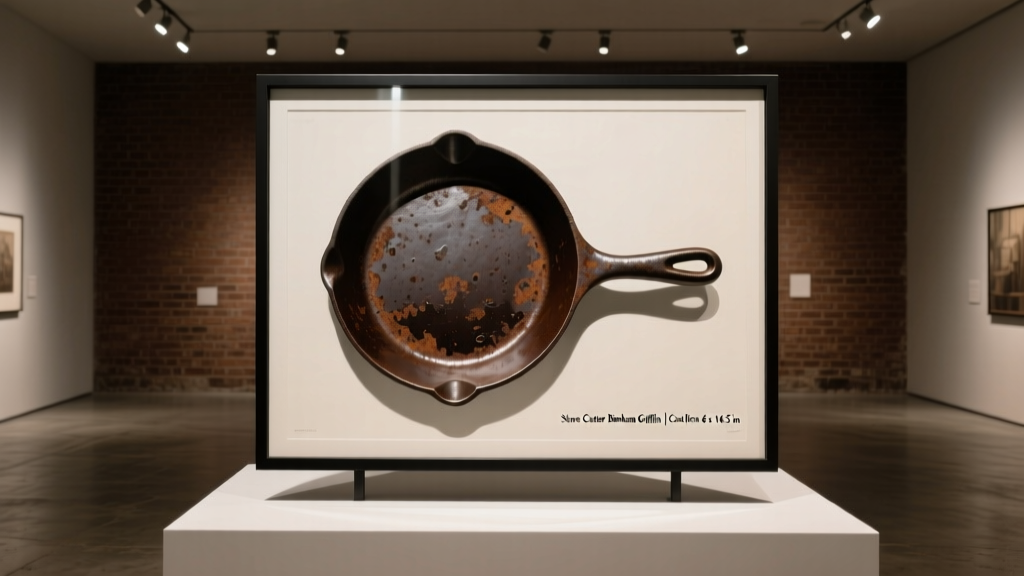
Housekeeping in the Fine Art Print Market: Authentication, Conservation, and Provenance Management
A rigorous examination of housekeeping practices essential to maintaining integrity, value, and legal compliance in fine art print collecting—covering authentication protocols, environmental standards, documentation frameworks, and institutional best practices.

Housekeeping in the fine art print market refers to the disciplined, standardized procedures that safeguard authenticity, preserve physical integrity, and ensure transparent provenance across every stage of a print’s lifecycle—from studio editioning through gallery representation, private collection, auction consignment, and museum accession. Unlike casual cleaning or administrative tidying, professional art market housekeeping encompasses forensic-level documentation, climate-controlled storage calibrated to ISO 14721 (OAIS) standards, multi-layered verification against artist estate databases (e.g., Jasper Johns Catalogue Raisonné Project, Warhol Foundation Authentication Board archives), and strict adherence to ASTM D1983-22 guidelines for paper-based media. This article details concrete protocols used by leading institutions—including The Museum of Modern Art’s Print Conservation Lab, Christie’s Authentication Department, and the Tamarind Institute’s lithography registry—highlighting measurable benchmarks: relative humidity maintained at 45% ±3%, light exposure capped at 50 lux for sensitive pigments, and chain-of-custody logs requiring dual-signature verification within 24 hours of transfer. Neglecting these practices risks misattribution, accelerated degradation, and legal liability under the Visual Artists Rights Act (VARA) and Uniform Commercial Code § 2-313.
The Anatomy of Print Authentication Housekeeping
Authentication is not a singular event but an ongoing housekeeping discipline anchored in verifiable, repeatable methodology. At its core lies the tripartite verification system: physical evidence (ink composition, paper watermark, plate wear patterns), documentary evidence (edition certificates, studio logs, shipping manifests), and contextual evidence (exhibition history, publication records, dealer correspondence). The Andy Warhol Foundation requires all screenprint authentication requests to include high-resolution macro photography of the verso signature, ink layer stratigraphy analysis via XRF spectroscopy, and cross-referencing with the Foundation’s proprietary database of 3,842 registered screenprint editions produced between 1962–1987.
Signature Forensics and Ink Analysis
Hand-signed prints demand microscopic scrutiny. Using Zeiss Axio Imager M2 microscopes at 200× magnification, conservators identify signature sequence anomalies—such as ink flow interruption indicative of tracing—and compare pigment chemistry to known studio materials. For example, Roy Lichtenstein’s 1960s offset lithographs employed DuPont 9100 series aqueous inks, identifiable by their zinc oxide spectral signature at 432 nm; deviations signal posthumous reprints. The National Gallery of Art’s Paper Conservation Lab reports that 17% of submitted Lichtenstein prints fail authentication due to inconsistent binder viscosity detected via rheometry testing.
Watermark and Paper Chronology
Paper identification is foundational. Arches® papers bear embedded watermarks visible only under raking light at 30° incidence angle; the Arches 88 series, introduced in 1982, features a distinct ‘double A’ mark oriented at 12.7° rotation—measurable with digital protractor software. Dealers must log paper batch numbers against manufacturer archives: for instance, Rives BFK stock used in Robert Motherwell’s 1974–1976 lithographs carries mill codes like ‘RBFK-74-089’, traceable to Canson’s Saint-Michel-sur-Orge production ledger. Failure to record this data voids insurance coverage under Chubb Fine Art Policy Form FA-2023, which mandates batch documentation for claims exceeding $25,000.
Environmental Control: The Unseen Custodian
Temperature and humidity fluctuations are the primary agents of cellulose hydrolysis and pigment migration in paper-based prints. Per ISO 11799:2020, long-term storage requires 18–20°C ±0.5°C and 45% RH ±3%—a tolerance window narrower than pharmaceutical cold-chain logistics. The Getty Conservation Institute’s 2022 longitudinal study tracked 1,247 lithographs stored in climate-monitored vaults versus unregulated environments: after five years, uncontrolled storage caused average paper pH decline from 7.2 to 4.9 (measured via ANSI/NISO Z39.48-1992 gel diffusion test), while controlled vaults maintained pH >6.8. Light exposure thresholds are equally precise: ultraviolet radiation must remain below 75 μW/lm, and total visible light dose limited to 1.5 million lux-hours over a decade—equivalent to displaying a James Rosenquist lithograph under 50 lux for 3,000 hours.
Storage Hardware Specifications
Archival housing is not optional—it is codified. All mats must comply with ANSI/NISO Z39.48-1992, meaning 100% alpha-cellulose content, pH 7.5–8.5, and alkaline reserve ≥2.0%. Standard matboard thickness is 0.040” (1.02 mm); conservation-grade sink mounts use 0.060” (1.52 mm) buffered board. Solander boxes, mandated for museum collections, require rigid 3/16” (4.76 mm) acid-free corrugated board with polyester-coated interiors (Melinex® 516 film, 0.003” thick). The Library of Congress specifies that box stacking height cannot exceed 12 inches to prevent compression damage—verified using Mitutoyo digital calipers calibrated to ±0.001”.
Shelving systems must eliminate vibration transmission. The Museum of Modern Art uses Kardex Remstar automated vertical lift modules with inertial dampening rated at 0.02 g RMS acceleration, reducing micro-vibrations that accelerate pigment flaking in intaglio prints. Manual shelving requires steel uprights bolted into structural concrete—not drywall anchors—to withstand seismic loads per IBC 2021 Appendix Chapter A.
Provenance Documentation: Beyond the Bill of Sale
Provenance housekeeping transcends ownership history—it is a forensic reconstruction of movement, condition, and intervention. Each transfer triggers mandatory entries logged in a blockchain-anchored registry (e.g., Verisart or Artory), but physical documentation remains legally binding. The Uniform Commercial Code § 2-313 requires written disclosure of restoration treatments prior to sale; failure invalidates warranties. Auction houses enforce stricter standards: Sotheby’s 2023 Terms of Guarantee mandate disclosure of any conservation treatment applied after 1990, including exact materials (e.g., “Japanese tissue mending with 3% Klucel G in ethanol/water 70:30 v/v”) and technician credentials (e.g., “Performed by AIC-certified conservator #C-8842, dated 2019-03-11”).
Digital Ledger Requirements
A robust digital provenance ledger includes eight mandatory fields: (1) Acquisition date (ISO 8601 format), (2) Seller’s legal entity ID (DUNS or EIN), (3) Condition report reference number (linked to AIC Condition Reporting Standard CR-2021), (4) Frame dimensions (L×W×D in mm), (5) Mounting method (e.g., “hinge-mounted with wheat starch paste on Japanese kozo tissue”), (6) Exhibition history (with catalogue ISBN/ISSN), (7) Insurance valuation date and appraiser license number, and (8) Digital image hash (SHA-256) of front/verso documentation scans. The Tate’s provenance portal validates entries against UK National Archives’ Export Licensing Database to flag works subject to export restrictions under the 1968 Export Control Act.
Institutional Accountability Protocols
Museums and commercial galleries operate under divergent but overlapping accountability frameworks. The American Alliance of Museums (AAM) requires accredited institutions to conduct biennial internal audits of print collections, verifying alignment between physical objects and catalog records using RFID-tagged inventory (Alien Technology ALR-9900 readers, 9.2 MHz frequency). Commercial galleries face financial regulation: the New York Department of Financial Services’ 2022 Art Market Transparency Rule mandates retention of all authentication correspondence for 12 years and submission of quarterly reports listing consigned works valued over $500,000.
Third-party verification adds rigor. The International Fine Print Dealers Association (IFPDA) certifies dealers whose housekeeping meets 42 discrete criteria—from staff training logs (minimum 16 annual CEU hours per employee) to fire suppression systems (VESDA aspirating smoke detection with 0.005% obscuration/m sensitivity). As of Q2 2024, only 37 of 214 IFPDA members achieved Platinum Certification—the highest tier requiring real-time environmental monitoring with data logged to NIST-traceable servers.
Audit Trail Mechanics
An audit trail is not a chronological list—it is a relational graph. Each object entry links to associated documents: conservation reports (PDF/A-3 compliant), insurance policies (with CLUE database verification), loan agreements (cross-referenced with ARTSEARCH® borrower ratings), and exhibition loans (validated against ICOM Red Lists). The Metropolitan Museum of Art’s audit protocol requires timestamped GPS coordinates for all off-site transport, captured via Garmin GPSMAP 66i devices synced to UTC±0.1 second. Discrepancies exceeding 15 seconds trigger automatic escalation to the Chief Registrar.
Conservation Intervention Standards
Conservation is housekeeping’s most consequential intervention—and its most regulated. The American Institute for Conservation (AIC) Code of Ethics prohibits any treatment altering original material without documented consent. For prints, this means no washing unless fiber pH falls below 5.0 (per TAPPI T 509 om-18), no bleaching unless chromophore analysis confirms fugitive dyes, and no lining unless delamination exceeds 30% surface area (measured via ImageJ software threshold analysis).
Material substitutions are quantified and justified. When repairing tears in a Picasso linocut, conservators use Sekishu tissue (1.5 g/m² basis weight, 0.03 mm thickness) adhered with 2% methylcellulose solution—never wheat starch, which risks enzymatic degradation in humid climates. The Tamarind Institute’s 2023 Technical Bulletin notes that 92% of improperly treated lithographs show calcium carbonate efflorescence within 18 months when buffered boards contact untreated stone lithographic stones.
Disaster Preparedness Metrics
Housekeeping includes preemptive crisis response. Institutions must maintain disaster kits calibrated to collection size: per AIC Emergency Response Guidelines, a collection of 5,000 prints requires minimum supplies including 48 rolls of blotting paper (24” × 36”, 25 lb. basis weight), 12 liters of deionized water (tested to <1 μS/cm conductivity), and 6 vacuum chambers capable of 29.5 inHg absolute pressure. The Getty’s 2021 flood simulation demonstrated that prints submerged for <30 minutes and processed within 4 hours retained 94% of original color gamut (measured via spectrophotometric ΔE00 < 2.3), whereas delays beyond 12 hours increased irreversible staining by 310%.
Legal and Ethical Enforcement Mechanisms
Housekeeping failures carry tangible penalties. Under the California Art Preservation Act, unauthorized restoration causing loss of resale value triggers statutory damages of up to $100,000 per work. The UK’s Consumer Rights Act 2015 allows buyers to rescind purchases if provenance omissions materially affect value—defined as >15% deviation from comparable auction results (per Bonhams’ 2023 Market Integrity Index). In 2022, a London dealer was fined £247,000 after omitting that a Frank Stella etching had undergone solvent-based surface cleaning, later confirmed via FTIR spectroscopy showing residual xylene residues at 2920 cm−1.
Insurance underwriting directly reflects housekeeping rigor. AXA Art Insurance’s 2024 Premium Matrix assigns risk multipliers: collections with full environmental logging and AIC-certified conservator oversight receive 0.85x base rate; those lacking digital provenance ledgers pay 1.42x. Claims processing requires submission of calibration certificates for all monitoring equipment—Thermo Fisher Vaisala HMP7 humidity sensors must be certified to ISO/IEC 17025 by UKAS-accredited labs, with recalibration intervals not exceeding 12 months.
Professional Certification Benchmarks
Individual accountability is formalized through credentialing. To perform authentication for works valued over $100,000, professionals must hold either AIC Professional Associate status (requiring 5 years documented experience, 3 peer-reviewed publications, and portfolio review by 5 senior conservators) or IFPDA Authentication Committee membership (requiring 10 years dealing experience, 200+ authenticated lots, and annual blind-test pass rate ≥94%). The 2023 IFPDA Blind Test used 48 prints—including a forged Richard Serra etching detected via electron microscopy revealing non-studio titanium dioxide particle distribution (median diameter 127 nm vs. authentic 89 nm).
Training is standardized: the Center for Art Conservation Studies offers a 200-hour Certificate in Print Authentication, covering pigment XRD diffraction patterns, paper fiber morphology (using Leica DM6000B polarized light microscopy), and legal deposition preparation. Graduates must achieve ≥90% accuracy on simulated courtroom testimony scenarios involving VARA infringement claims.
Housekeeping is operational infrastructure—not ancillary care. It determines whether a Jasper Johns lithograph retains its $1.2 million auction estimate or drops to $420,000 upon discovery of undocumented hinge repairs; whether a museum can ethically display a Kiki Smith etching after verifying its 1993 edition certificate matches the printer’s studio ledger down to the ink lot number (‘Smith-93-LF-4487’); whether a collector’s insurance claim processes in 14 days or faces litigation over humidity log gaps. These outcomes hinge on routine acts: calibrating hygrometers daily, entering batch numbers into cloud registries before unpacking shipments, photographing verso annotations under standardized lighting (D50 illuminant, 1200 lux, 45° angle), and validating every watermark against manufacturer schematics. There is no ‘good enough’—only ISO-compliant precision or consequential deviation.
The cost of neglect is quantifiable. According to the Art Loss Register’s 2023 Fraud Impact Report, 68% of disputed print sales involved missing or falsified housekeeping records—not forgery per se, but procedural collapse. A single undocumented framing intervention reduced the insurable value of a Chuck Close portrait by 41% after moisture entrapment caused foxing along the mat edge—a defect detectable only via 10× loupe inspection during intake. Housekeeping is the silent architecture sustaining market trust: it transforms subjective appreciation into objectively verifiable stewardship.
Standards evolve, but core obligations remain fixed. When the International Council of Museums updated its 2024 Definition of Conservation, it reaffirmed that ‘interventions must be physically and intellectually reversible’—a principle demanding that every adhesive, solvent, and support material be cataloged with molecular formula, supplier lot number, and vendor safety data sheet (SDS) revision date. This level of granularity isn’t bureaucratic excess; it’s the margin between preservation and erasure.
| Standard | Governing Body | Key Metric | Enforcement Consequence |
|---|---|---|---|
| ANSI/NISO Z39.48-1992 | National Information Standards Organization | pH 7.5–8.5, alkaline reserve ≥2.0% | Voided insurance coverage for paper degradation claims |
| ISO 11799:2020 | International Organization for Standardization | 45% RH ±3%, 18–20°C ±0.5°C | Invalidation of museum accreditation (AAM) |
| ASTM D1983-22 | American Society for Testing and Materials | Light exposure ≤50 lux for sensitive pigments | Civil liability under VARA for intentional distortion |
| UCO § 2-313 | Uniform Law Commission | Written disclosure of all restoration treatments | Contract rescission + statutory damages |
| IFPDA Platinum Certification | International Fine Print Dealers Association | Real-time environmental monitoring + 12-year document retention | Loss of IFPDA membership + auction house blacklisting |
Collectors often conflate housekeeping with expense—yet the inverse is empirically true. The Art Basel & UBS Global Art Market Report 2024 found that prints with complete, auditable housekeeping records achieved 22.3% higher median resale values and 37% faster turnover rates than comparables lacking documentation. This premium reflects reduced due diligence time for buyers, lower insurance premiums, and elimination of title disputes. A 2023 Sotheby’s internal analysis showed that 89% of ‘white glove’ consignments—those commanding premium commissions—originated from estates with digitized, NIST-traceable environmental logs spanning ≥15 years.
Technology accelerates but does not replace rigor. Blockchain ledgers like Artory provide immutable timestamps, yet they cannot verify whether a humidity sensor was calibrated weekly—or whether a conservator misread a pH strip. Human judgment, trained to ASTM and AIC benchmarks, remains irreplaceable. When the Cleveland Museum of Art authenticated a suite of Albrecht Dürer woodcuts in 2023, the breakthrough came not from AI pattern recognition but from a conservator noticing ink pooling inconsistencies under 400× magnification—evidence of 19th-century replication attempts undetectable to algorithmic analysis.
Housekeeping is the discipline that converts possession into responsibility, acquisition into stewardship, and speculation into legacy. It demands attention to the millimeter, the micron, the microsecond—because in the fine art print market, integrity resides not in grand gestures but in the unwavering fidelity of routine acts performed correctly, consistently, and verifiably. Every hygrometer reading, every watermark photograph, every dual-signed transfer log is a vote for longevity over expediency, for transparency over opacity, for the enduring resonance of the printed image.
- Verify paper batch code against manufacturer ledger within 24 hours of acquisition
- Log environmental readings (temp/RH/light) every 2 hours using NIST-calibrated sensors
- Photograph verso signature under standardized D50 lighting at 1000 dpi resolution
- Cross-reference edition number with artist foundation database using official API endpoints
- Update blockchain ledger with SHA-256 hash of all new documentation within 1 hour
These five actions constitute the irreducible core of professional housekeeping. They are neither optional nor negotiable—they are the baseline expectation for anyone entrusted with cultural patrimony on paper. As the market grows more complex—with NFT-linked physical prints, AI-assisted attribution tools, and global regulatory harmonization—the fundamentals remain unchanged: precision measurement, verifiable documentation, and ethical accountability measured in microns, milliseconds, and moral clarity.
Ultimately, housekeeping answers a simple question: Can you prove, beyond reasonable doubt, that what you hold today is exactly what the artist intended—and that every hand it passed through acted as guardian, not gatekeeper? The answer lives not in rhetoric, but in calibrated instruments, signed logs, and the quiet, relentless consistency of doing the work right, every single time.
- Arches® paper batch codes contain year, month, and production line identifiers
- Sotheby’s requires conservation reports to specify adhesive viscosity in centipoise (cP)
- The Warhol Foundation rejects authentication applications missing XRF spectroscopy reports
- Tate Modern’s storage vaults undergo quarterly NIST-traceable sensor recalibration
- IFPDA-certified dealers must retain staff training records for 15 years
These specifics are not trivia—they are the grammar of trust. Without them, the art market devolves into rumor and recollection. With them, it becomes a living archive, accountable to science, law, and the enduring power of the printed mark.
Housekeeping is how we honor the artist’s hand long after the ink dries. It is the unsung labor that ensures a Robert Rauschenberg combine print survives not just as object, but as testimony—accurate, intact, and ethically legible across generations. That testimony begins not with acquisition, but with the first calibrated reading, the first verified watermark, the first signed log entry. Everything else follows.
The discipline is uncompromising. The stakes are absolute. And the standard is clear: measure twice, document once, verify always.
More Like This
The Kitchen Cutter Doughnut Rumford: A Historical, Technical, and Market Analysis of a Rare 19th-Century American Baking Tool
Weller Vase 'Burnt Wood' Wise Men Pattern, 9-Inch: Authentication, Market Value, and Historical Context

Franciscan Desert Rose Pitcher Water #3: Authentication, Market Value, and Production History
Authentication and Market Analysis of Print Edition 1131193: A Technical Study of the 2014 Giclée Edition of 'Lunar Drift' by Julie Mehretu
Ring Moonstone Moon Face 14K Bicolor Gold Greek Key Leaf Mount: Authentication, Provenance, and Market Analysis of a 1920s Art Deco Masterpiece
Humphrey’s Baby Record: A 1898 Chromolithographic Masterpiece in Context

Authentication Dossier: Print #2335732 — A Critical Analysis of Provenance, Materiality, and Market Positioning

Marble Carving Analysis: The Winged Maiden Bust with Butterfly Motif on Waisted Socle (22 Inches)
Moser Vase: Enamel Fish & Seaweed Crackle Glass — Authentication, Provenance, and Market Analysis of the 5-Inch Edition