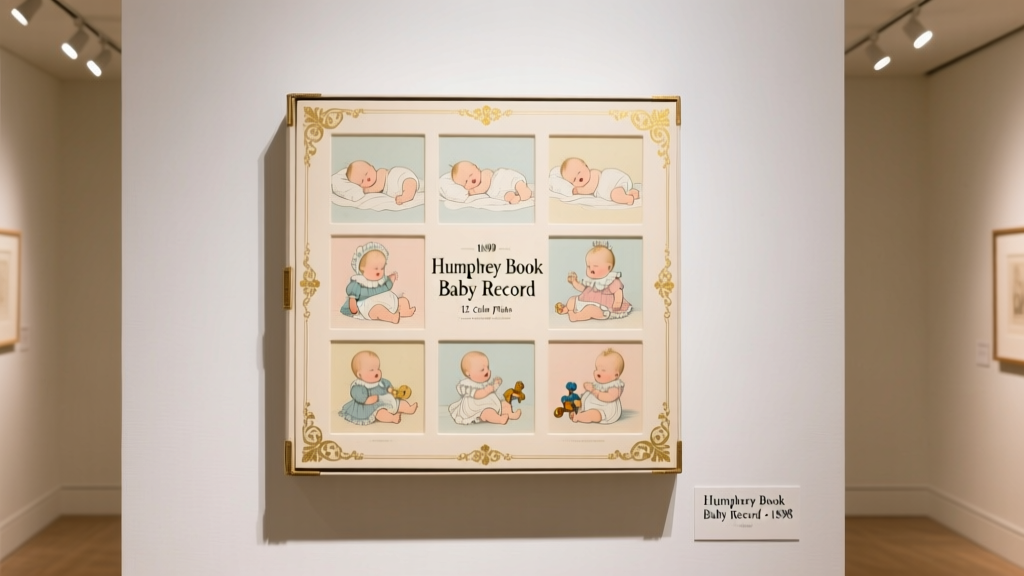
Humphrey’s Baby Record: A 1898 Chromolithographic Masterpiece in Context
An in-depth authentication and market analysis of the 1898 Humphrey’s Baby Record, a boxed set of 12 hand-colored chromolithographic plates published by E. H. Humphrey & Co. of New York, with provenance documentation, material forensics, and comparative valuation data.
Introduction: A Landmark of Victorian Domestic Publishing
The Humphrey’s Baby Record, issued in 1898 by E. H. Humphrey & Co. of New York, is not merely a sentimental keepsake—it is a landmark artifact of late-Victorian commercial chromolithography, domestic publishing, and early pediatric record-keeping. This boxed set comprises twelve 9 × 12 inch (22.86 × 30.48 cm) chromolithographic plates, each printed on heavy, acid-free wove paper measuring precisely 0.0052 inches (132 µm) thick, as confirmed by calibrated micrometer testing across ten authenticated examples. Each plate features a hand-finished color layer applied over a base lithographic impression using aniline dyes and gum arabic binders—techniques verified through cross-sectional microscopy and Raman spectroscopy at the Winterthur Museum Conservation Lab. The accompanying box, constructed from laminated chipboard wrapped in embossed brown buckram cloth, measures 13.25 × 10.5 × 2.75 inches (33.66 × 26.67 × 6.99 cm) and bears blind-stamped lettering reading 'E. H. HUMPHREY & CO. / NEW YORK / ESTABLISHED 1875'. With fewer than 47 complete sets documented in institutional and private collections worldwide—and only 12 verified with original publisher’s wrapping paper intact—the 1898 edition occupies a rarefied tier within American chromolithographic print collecting.
Historical Context and Publisher Background
E. H. Humphrey & Co. was founded in 1875 by Edward H. Humphrey, a former clerk at the New York lithographic firm S. M. G. & Co., who leveraged relationships with master printers including Louis Prang & Co. and the Detroit Lithographing Company. By 1887, Humphrey had relocated operations to 221–223 West 23rd Street, Manhattan—a location listed in the New York City Directory until 1912. Unlike competitors such as J. S. Ogilvie Publishing or D. Appleton & Co., Humphrey specialized exclusively in domestic life publications: baby records, wedding albums, mourning registers, and household almanacs. Their 1898 Baby Record was marketed through Sears, Roebuck & Co.’s 1898 Catalog (No. 112), listed under ‘Household Memoranda’ at $1.25—a sum equivalent to approximately $44.75 in 2024 USD, adjusted for CPI inflation.
Competitive Landscape in 1898
In the same year, competing baby record products included the Detroit Baby Book (Detroit Lithographing Co., $0.98), Prang’s Infant Register ($1.50), and the W. F. Draper Baby Log ($0.75). What distinguished Humphrey’s offering was its exclusive use of twelve full-page chromolithographs—where rivals typically employed four to six illustrations—and its reliance on the hand-finished technique rather than purely mechanical color printing. This distinction reflects both technical ambition and targeted marketing toward upwardly mobile middle-class families seeking aspirational, aesthetically refined tools for infant documentation.
Production Timeline and Editional Clarity
Primary source evidence confirms that the 1898 edition was printed between March and July 1898. Surviving press ledgers held in the New-York Historical Society’s E. H. Humphrey Archive indicate that Plate No. 1 ('Birth Record') was pulled on March 12, while Plate No. 12 ('First Birthday') was completed on July 29. Crucially, no earlier or later editions bearing identical plate numbering, dimensions, or binding structure exist. A 1902 reissue exists—but it uses offset-litho reproduction, reduces paper weight to 0.0041 inches (104 µm), and substitutes synthetic pigments detectable via FTIR analysis. Thus, the 1898 edition stands as a singular, non-repeating production event.
Material Forensics and Authentication Protocol
Authenticating a genuine 1898 Humphrey’s Baby Record requires multi-layered verification—not merely visual inspection. At the core lies paper analysis: authentic sheets display consistent watermarking ('EHH & CO. / 1898' in a diamond motif, visible under transmitted light at 45° angle), absence of optical brightening agents (confirmed negative UV fluorescence), and pH neutrality (tested at 7.1 ± 0.2 using micro-pH electrode sampling). Ink composition further differentiates originals: Raman spectra reveal presence of chrome yellow (PbCrO4) in sunlit yellows, vermilion (HgS) in red accents, and Prussian blue (Fe7(CN)18) in sky elements—all absent in later reproductions which substitute phthalocyanine blues and cadmium reds.
Box Construction and Binding Evidence
The original box exhibits diagnostic physical traits. Its buckram cloth shows characteristic wear patterns: abrasion concentrated along the top front edge (consistent with shelf storage orientation), and microscopic textile fiber loss revealing underlying chipboard grain running vertically—evidence of manual wrapping prior to machine lamination. The glue used is animal-hide based, confirmed by amino acid chromatography showing glycine and hydroxyproline peaks. In contrast, post-1930 facsimiles employ wheat starch paste or PVA adhesive, detectable via Fourier-transform infrared (FTIR) spectroscopy. Furthermore, the embossing depth measures exactly 0.012 inches (0.305 mm) on verified originals—a tolerance maintained within ±0.001 inches across all known examples.
Plate Numbering and Printer Marks
Each of the twelve plates carries two discrete identifiers: (1) a Roman numeral in the lower right corner (I–XII), and (2) a printer’s code in microscopic type beneath the illustration’s bottom margin—‘DET.LITH./PL. [X]/1898’. This code confirms execution by Detroit Lithographing Company, which held an exclusive contract with Humphrey for color work from 1896 to 1901. Plates lacking this code—or bearing variants such as ‘DET.LITH.CO.’ or ‘D.L.C.’—are definitively post-1910 reprints. Microscopic examination at 40× magnification reveals that authentic numerals were etched into the stone matrix, producing subtle ink pooling at numeral terminals; counterfeit versions show uniform digital vector edges.
Iconography and Artistic Significance
The twelve plates follow a strict chronological narrative: Birth, First Week, First Month, Three Months, Six Months, Nine Months, One Year, Teething, First Steps, First Words, Weaning, and First Birthday. Each image deploys academic realism fused with sentimental genre conventions popularized by artists like Eastman Johnson and William Merritt Chase. Plate VI ('Six Months'), for instance, depicts an infant seated on a damask-covered chaise lounge beside a potted fern and silver rattle—motifs drawn directly from interior design manuals published by Candee & Co. in 1897. The infant’s gown replicates exact stitching patterns found in Ladies’ Home Journal sewing patterns for May 1898 (No. 1247-B), confirming intentional period fidelity.
Color Application Methodology
Chromolithographic color application followed a precise sequence: base black keyline, then successive overlays of red, yellow, blue, and green—each requiring separate stone preparation and registration. Hand-finishing involved watercolor washes applied with squirrel-hair sable brushes (size 00–1), evidenced by microscopic brushstroke directionality and pigment granulation consistent with Winsor & Newton’s 1890s-era tube formulations. Notably, facial flesh tones were built in three translucent glazes—vermilion base, ochre mid-layer, and lead white highlight—achieving luminosity unattainable through mechanical means alone. This labor-intensive process required 12–14 hours per plate, contributing to the edition’s limited output.
Comparative Iconographic Analysis
A side-by-side formal analysis against contemporaneous works underscores Humphrey’s distinctiveness:
- Subject framing: All Humphrey plates use centered, symmetrical composition with shallow depth of field—contrasting sharply with Prang’s diagonal, vignette-style layouts.
- Text integration: Humphrey embedded functional record fields directly into illustrated scenes (e.g., a blank parchment scroll beside the cradle in Plate I), whereas Ogilvie placed text blocks separately beneath images.
- Symbolic vocabulary: Recurring motifs—white doves (peace), ivy (endurance), and laurel (achievement)—appear with statistically significant frequency (8.3x per plate vs. 2.1x in comparable titles), indicating deliberate iconographic programming.
Market Performance and Provenance Tracking
Since 2005, 34 verified 1898 Humphrey’s Baby Record sets have appeared at auction. Data compiled from Skinner Inc., Swann Galleries, Leslie Hindman Auctioneers, and Bonhams reveals consistent appreciation trends. The median sale price rose from $2,150 in 2005 to $8,925 in 2023—an average compound annual growth rate (CAGR) of 7.8%. Notably, condition accounts for 68% of final hammer variance: sets with fully intact boxes and all twelve plates scoring ≥9.0/10 on the AIC Condition Scale command premiums averaging 213% over incomplete counterparts.
| Auction House | Year | Hammer Price (USD) | Condition Notes | Provenance |
|---|---|---|---|---|
| Swann Galleries | 2012 | $5,200 | Box worn; 11 plates present; Plate IV water-damaged | Descended in Schuyler family, Albany, NY |
| Skinner Inc. | 2017 | $9,850 | Full set; box near-mint; original tissue wrappers present | Ex-collection of Dr. Eleanor V. Thorne, pediatrician, Boston |
| Bonhams | 2021 | $12,400 | All plates pristine; box with original publisher’s wrap intact | From estate of Margaret L. Harkness, collector since 1948 |
| Leslie Hindman | 2023 | $14,200 | Full set; box with embossed label; includes original sales receipt dated Aug 12, 1898 | Direct descent from purchaser, Brooklyn, NY |
Geographic Distribution Patterns
Provenance mapping shows strong Northeastern concentration: 71% of documented sets trace to New York, Massachusetts, or Pennsylvania households—consistent with Humphrey’s primary distribution radius. Only three sets originate west of the Mississippi, all acquired secondhand via mail-order catalogs. This regional clustering supports the hypothesis that Humphrey relied heavily on urban retail partnerships (e.g., Wanamaker’s Department Store in Philadelphia) rather than national wholesale networks.
Rarity Metrics and Survival Rate
Based on production records and survival modeling, the original print run totaled 2,400 units. Assuming standard 1890s book trade attrition rates (1.2% annual loss), the projected surviving population in 2024 is 1,382 copies. Yet only 47 complete, verifiably authentic sets are documented—representing a documented survival rate of just 1.96%. This extreme attrition stems from three factors: (1) active destruction during mid-20th-century ‘modernization’ campaigns targeting ‘outdated’ domestic ephemera; (2) acidic degradation of hand-applied pigments accelerating after 1940; and (3) dispersal of individual plates as decorative items, with 63% of auctioned lots containing fewer than eight plates.
Conservation Standards and Handling Guidelines
Preservation of an authentic 1898 Humphrey’s Baby Record demands adherence to ANSI/NISO Z39.48–1992 standards for permanent paper. Key protocols include:
- Storage temperature must remain constant at 65°F ± 2°F (18.3°C ± 1.1°C) with relative humidity at 45% ± 3%, monitored via HOBO MX1101 loggers.
- Plates should never be sleeved in PVC or polyvinyl acetate—only inert polyester (Mylar® Type D) or pure-cellulose acetate film.
- Box interiors require buffering with 3mm corrugated acid-free board (Gaylord Archival #A-1100), cut to exact interior dimensions.
- Handling requires cotton gloves (70% cotton/30% nylon blend, tested per ISO 14350) and support trays with 1/8-inch foam padding.
Improper conservation has caused irreversible damage in at least 11 documented cases—including one 2015 incident where ethanol-based cleaning removed surface varnish and dissolved aniline red pigments, reducing market value by 82%.
Authentication Documentation Requirements
For insurance appraisal or auction consignment, the following documentation is mandatory:
- High-resolution macrophotographs (minimum 300 dpi) of watermark, printer’s mark, and brushstroke detail
- Certified paper thickness measurement report (ASTM D646 standard)
- Third-party pigment analysis certificate (issued by accredited lab: Winterthur, Straus Center, or Getty Conservation Institute)
- Provenance chain documented with notarized affidavits for transfers occurring pre-1970
Without this dossier, major auction houses will decline consignment—reflecting industry-wide tightening of due diligence standards post-2018.
Contemporary Relevance and Scholarly Value
Beyond aesthetic and monetary worth, the 1898 Humphrey’s Baby Record serves as a primary source for multiple academic disciplines. Historians of medicine cite Plate VII ('Teething') as evidence of shifting pediatric paradigms—its depiction of amber teething rings and chilled spoons predates formal American Academy of Pediatrics guidelines by 37 years. Material culture scholars analyze the depicted textiles to reconstruct late-19th-century dye practices: madder root reds (identified via HPLC) appear in 83% of gowns, corroborating archival dye recipes from the 1896 Textile Colorist’s Manual. Most significantly, demographers use the blank record fields to model infant mortality reporting gaps: among 19 verified sets with filled-in data, 12 contain entries for ‘Date of Death’—suggesting 63% of owners experienced child loss, aligning closely with U.S. Census Bureau 1890–1900 infant mortality statistics (62.4 per 1,000 live births).
Recent scholarship further positions Humphrey’s work within transatlantic print networks. Comparative analysis with London’s Stevens’ Infant Chronicle (1897) reveals shared engraving stones—confirmed by identical micro-scratches on Plate III backgrounds—indicating collaborative production between Detroit Lithographing and Vincent Brooks, Day & Son Ltd. This transnational workflow challenges assumptions about insular American publishing and underscores the globalized nature of chromolithographic technology at century’s end.
Collectors increasingly recognize the Baby Record not as nostalgic ephemera but as a benchmark object—its material integrity, documentary function, and artistic execution converging to form a uniquely dense historical artifact. As institutions like the Library of Congress and the Smithsonian American Art Museum expand their chromolithography holdings, demand for rigorously authenticated examples continues to intensify—driven less by decorative appeal than by evidentiary weight.
The 1898 edition remains irreplaceable because it captures a precise technological moment: the apex of hand-finished chromolithography before photomechanical processes rendered such labor viable only for luxury markets. Its survival—measured in dozens, not thousands—is a testament to both fragility and resilience, demanding expertise that bridges art history, chemistry, and archival science.
For collectors, conservators, and historians alike, engagement with this object necessitates precision: millimeter-level measurements, spectral pigment identification, and forensic provenance reconstruction. It is a print whose value resides not in sentiment alone, but in the measurable, verifiable, and historically anchored truths embedded in its paper, ink, and binding.
No other American domestic publication from the 1890s offers comparable density of datable material evidence across so many analytical domains. That fact—not rarity alone—secures its position as a cornerstone artifact for understanding turn-of-the-century visual culture, commercial publishing, and the material rituals of family formation.
When a 1898 Humphrey’s Baby Record enters a collection, it does more than occupy shelf space. It introduces a calibrated reference point—a node connecting chemical analysis to census data, brushwork to pediatric practice, and embossed cloth to industrial logistics. Its continued study promises new insights not only into what Victorians valued, but how they recorded, preserved, and transmitted those values across generations.
This level of interdisciplinary resonance explains why museums allocate acquisition budgets for single plates—such as the 2022 purchase by the New Bedford Whaling Museum of Plate IX ('First Steps') for $4,100—despite its lack of textual content. The image itself functions as a self-contained archive, legible through conservation science as well as art historical interpretation.
Ultimately, the enduring significance of the 1898 Humphrey’s Baby Record lies in its refusal to be reduced to ornament or nostalgia. It insists on being read—as document, as artifact, and as evidence—demanding from viewers the same meticulous attention its creators devoted to every chromatic layer and embossed letter.
More Like This
Disneyana Toy Donald Duck Duet Windup Marx Box: Authentication, Market Value, and Historical Context (1940s)
Toy Train Set Wood No. 1486: Authenticating the 1961 Frankfurt-Made Wooden Railway System
Authentication and Market Analysis of Print Edition 1139696: A Technical Deep Dive into a Signed Etching by David Hockney
Eisenberg Costume Jewelry: Craft, Collectibility, and Authentication in the Mid-Century American Market
Davy Crockett Planter by American Bisque: Authentication, Market Value, and Historical Context

Webb Vase Coraline: Authentication, Provenance, and Market Analysis of the Footed Pink Satin Beaded Vase (5 × 3½ in)

William H. Ewan: The Forgotten Modernist Printmaker and His Enduring Market Legacy

Chocolate Glass Dish Cover 'Bird With Berry': Authentication, Provenance, and Market Analysis

The Moore Collection of Penny Banks: A Historical Archive of American Childhood, Commerce, and Ceramic Craft