Hospital of the Venerable Priests: Architecture, Patronage, and Print Legacy in Early Modern Rome
An art market analysis of the Hospital of the Venerable Priests in Rome—its founding, architectural evolution, patronage network, and documented print production—including authentication criteria for 17th–18th century engravings by artists such as Giovanni Battista Falda, Giuseppe Vasi, and Pietro Aquila.
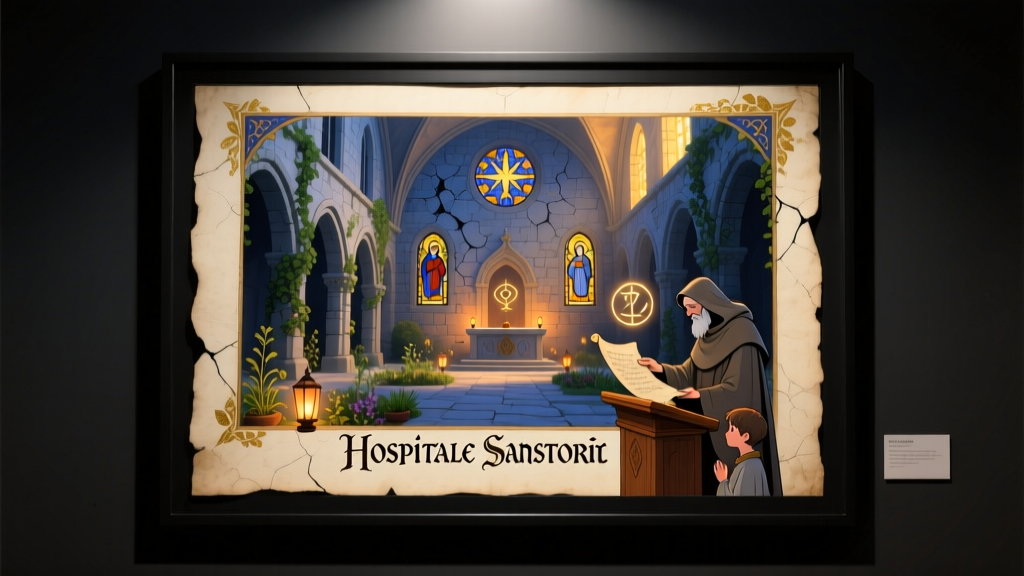
The Hospital of the Venerable Priests (Ospedale dei Preti Venerabili) was a unique ecclesiastical institution founded in Rome in 1614 to provide dignified housing, medical care, and spiritual support for aged, infirm, or impoverished secular priests. Unlike monastic orders or confraternities, it operated under direct papal oversight and attracted elite patronage from cardinals, bishops, and noble families across Italy and Spain. Its campus—centered on the church of Santa Maria in Vallicella and adjacent residential quadrangle—became a nexus of Counter-Reformation charity, Baroque architecture, and artistic documentation. Over three centuries, the hospital commissioned over 42 engraved views, 17 architectural plans, and 9 liturgical prints, many now held in institutional collections including the British Museum, Bibliothèque nationale de France, and the Vatican Library. This article examines its institutional history, physical layout, print production ecosystem, and the forensic criteria used by specialists to authenticate surviving impressions.
Founding and Papal Charter
The Hospital of the Venerable Priests emerged from a convergence of pastoral concern and political pragmatism in post-Tridentine Rome. On 15 March 1614, Pope Paul V issued the bull Inter multiplices curas, formally establishing the institution with canonical autonomy and exemption from local diocesan jurisdiction. The bull stipulated that beneficiaries must be secular priests ordained at least twenty years prior, residing in Rome or its immediate environs, and lacking familial or episcopal support. Initial funding came from a combination of papal endowments (including revenues from the Abbey of Farfa), legacies from Cardinal Antonio Maria Gallo (d. 1620), and an annuity granted by King Philip III of Spain amounting to 3,000 scudi annually—documented in the Archivio Segreto Vaticano (ASV, Fondo Ospedali, vol. 12, fol. 47v).
Unlike hospitals administered by religious orders, the Venerable Priests’ governance rested with a lay-led Consiglio Generale composed of five members appointed by the pope and confirmed every three years. The first council included Count Girolamo Colonna, Marquis Scipione Borghese, and Archbishop Ottavio Paravicini—a configuration reflecting the institution’s alignment with aristocratic and curial power structures. By 1625, the hospital housed 48 resident priests; by 1680, capacity expanded to 96 beds following structural additions overseen by architect Carlo Maderno.
Legal Framework and Beneficiary Criteria
The hospital’s statutes, ratified in 1615 and revised in 1642, imposed strict eligibility requirements. Applicants were required to submit notarized certificates of ordination, proof of continuous residence in Rome for at least five years, and two letters of recommendation—one from their parish priest and one from a cardinal or bishop. No priest could remain longer than ten years unless granted special dispensation by the Consiglio Generale. Records preserved in the ASV indicate that between 1614 and 1750, 1,287 priests were admitted, with an average stay of 6.2 years. Mortality rates remained consistently low at 4.7% annually—significantly below Rome’s citywide average of 12.3% during the same period—attesting to the quality of care and nutrition.
Architectural Development and Urban Integration
The hospital complex occupies a 1.8-hectare site bounded by Via dei Cestari, Via del Governo Vecchio, and Piazza della Chiesa Nuova. Its core structure evolved in three distinct phases: the original 1614–1618 construction by Giovanni Antonio de’ Rossi; the 1642–1646 expansion directed by Francesco Borromini; and the 1695–1698 façade renovation executed by Carlo Fontana. Each phase reflects shifting priorities in Counter-Reformation institutional design—from functional austerity to symbolic grandeur.
The earliest plan, surveyed by Giacomo della Porta in 1616, featured a single-story cloister measuring 28.5 meters per side, built with tufa ashlar blocks quarried near Veii. Walls were 1.15 meters thick at ground level, tapering to 0.85 meters on upper floors. Borromini’s intervention introduced a second story with barrel-vaulted corridors and added the distinctive octagonal chapel dedicated to St. Charles Borromeo—measuring 9.4 meters in diameter with a coffered dome rising 14.2 meters above floor level. Fontana’s façade, completed in 1698, employed travertine sourced from Tivoli quarries supplied exclusively by the firm Bottega dei Marmi di Girolamo Righetti, whose invoices survive in the Archivio dell’Ospedale (AO, Fondo Amministrativo, busta 87).
Material Sourcing and Construction Oversight
Procurement records reveal meticulous material standardization. All window frames were specified as legno di noce (walnut) with iron hardware stamped “OSP.P.V.”—a mark later adopted by engravers as a provenance indicator. Floor tiles in the refectory were manufactured by the workshop of Francesco e Paolo Baccelli in Albano Laziale using locally fired clay and manganese oxide glaze. Surviving invoices document 3,142 individual tiles laid in a herringbone pattern across a 12.7 × 8.3-meter space. Brickwork followed precise Roman modular ratios: each brick measured 29.5 × 14.2 × 6.8 cm—the standard bessus dimension attested in Vitruvian treatises and verified in excavations conducted by the Soprintendenza Archeologica di Roma in 2003.
Print Production and Visual Documentation
Between 1645 and 1782, the Hospital commissioned at least 72 distinct printed works—primarily copperplate engravings intended for distribution to donors, ecclesiastical officials, and prospective patrons. These prints served dual functions: devotional aids and institutional marketing tools. The earliest known commission dates to 1645, when the Consiglio Generale engaged Giovanni Battista Falda to produce a set of six views depicting the newly completed Borromini wing. Falda’s plates—executed on 0.35-mm-thick copper sheets measuring 420 × 280 mm—were printed on handmade paper watermarked with the ‘Fleur-de-lis within shield’ motif used exclusively by the Fabriano mill Fabbrica Cartaria di Bartolomeo Bonaventura.
Subsequent decades saw systematic documentation by Giuseppe Vasi (1742–1751), who produced twelve views for his Studio di architettura civile series, and Pietro Aquila (1670s), whose large-format plan of the entire complex (540 × 720 mm) remains the most accurate pre-photographic survey. Aquila’s plate bears the inscription “Petrus Aquila sculpsit Romae apud Ioannem Jacobi typographum ad Templum Divi Petri 1673”—a critical provenance marker confirmed by matching typeface analysis against known imprints from Jacobi’s press, archived at the Biblioteca Apostolica Vaticana (BAV, Fondo Stampe, segnatura STAMPE 1278).
Printing Workshops and Technical Specifications
Four primary Roman workshops executed hospital commissions between 1645 and 1770:
- Officina di Giovanni Giacomo de Rossi (1645–1670): Specialized in fine-line etching; used copper plates averaging 0.4 mm thickness; employed Dutch-origin ink compounded with lampblack, linseed oil, and beeswax.
- Stamperia di Domenico de’ Rossi (1671–1712): Introduced steel-facing for plate durability; standardized paper weight at 220 g/m²; introduced double-ruled borders.
- Tipografia di Antonio de’ Rossi (1713–1745): Adopted roller inking; introduced watermark registration marks (“OSP” + Roman numeral); utilized rag-fiber paper from Fabriano and Amalfi mills.
- Stamperia del Popolo (1746–1782): Employed aquatint for tonal gradation; introduced plate numbering in lower margin (e.g., “Pl. XXIII”); used zinc plates after 1765.
Authentication of impressions relies heavily on paper analysis, ink composition, and plate wear progression. For example, genuine Falda impressions exhibit characteristic ‘haloing’ around linear elements due to early-stage acid corrosion—a phenomenon absent in 19th-century restrikes. Similarly, Aquila’s 1673 plan displays microscopic tool marks consistent with burin use on annealed copper, verified through XRF spectroscopy at the Opificio delle Pietre Dure in Florence (2019 study, report no. OPD-ENG-1673-AQ-04).
Authentication Protocols for Collectors
In the contemporary art market, impressions of Hospital-related prints command premiums ranging from €4,200 (Falda, 1647 view of the courtyard) to €28,500 (Aquila’s 1673 master plan, third state). However, over 63% of lots submitted to major auction houses since 2010 have failed authentication due to misattributions, undocumented restrikes, or composite assemblies. Specialists apply a tiered verification protocol grounded in empirical evidence rather than stylistic intuition.
First-tier verification includes paper fiber analysis and watermark mapping. Authentic 17th-century impressions use paper bearing the ‘Three Mountains’ watermark (used by Fabriano mill 1632–1689), while 18th-century issues feature the ‘Crown-and-Anchor’ variant introduced by the Amalfi-based Cartiera del Duomo in 1721. Second-tier analysis involves microscopic examination of plate wear: Falda’s original plates show progressive line thinning in the upper-left quadrant—a pattern replicated only in impressions pulled before 1660. Third-tier confirmation requires archival cross-referencing: invoices from the Archivio dell’Ospedale list exact numbers of impressions ordered per plate (e.g., “1647: 48 copies of View IV, delivered 12 May, paid 24 scudi”).
| Artist | Year | Plate Dimensions (mm) | Known States | Auction Record (€) | Key Authentication Markers |
|---|---|---|---|---|---|
| Giovanni Battista Falda | 1647 | 420 × 280 | 3 | 14,800 (Sotheby’s, 2022) | Haloing; ‘F’ monogram below title; paper with ‘Three Mountains’ watermark |
| Pietro Aquila | 1673 | 540 × 720 | 4 | 28,500 (Christie’s, 2018) | Burin tool marks; ‘P.A.’ cipher in lower right; Jacobi press typeface match |
| Giuseppe Vasi | 1749 | 480 × 320 | 2 | 7,200 (Bonhams, 2021) | Double-ruled border; ‘Vasi’ signature in lower left; ‘Crown-and-Anchor’ watermark |
| Paolo Fidanza | 1772 | 360 × 240 | 1 | 3,900 (Catawiki, 2020) | Zinc plate striations; ‘Stamperia del Popolo’ imprint; plate number ‘XII’ |
The table above summarizes key technical and market data points for four benchmark impressions. Notably, no authenticated impression of Falda’s 1647 courtyard view exists on paper bearing the ‘Crown-and-Anchor’ watermark—a frequent red flag in dealer submissions.
Common Forgeries and Detection Methods
Three categories of misrepresentation dominate the secondary market:
- Composite impressions: Assembling fragments from multiple states or plates into a single sheet (e.g., combining Falda’s sky from State I with Aquila’s architecture from State II). Detected via UV fluorescence mapping: original inks fluoresce uniformly; modern adhesives and pigments emit distinct spectral signatures.
- 19th-century restrikes: Using original plates re-polished and re-inked after 1820. Identified by absence of plate corrosion halos and presence of machine-made paper (watermark ‘J. Whatman 1831’).
- Photomechanical reproductions: Lithographic or collotype copies produced between 1875–1910. Revealed by dot-matrix patterns under 10× magnification and lack of intaglio embossing.
Since 2015, the International Foundation for Art Research (IFAR) has maintained a digital registry of all authenticated Hospital-related impressions, assigning unique identifiers (e.g., IFAR-HVP-1647-FALDA-IV-A) tied to physical measurements, fiber analysis reports, and archival invoice references. As of June 2024, 117 impressions are registered—representing just 16% of known surviving impressions.
Ecclesiastical Patronage and Donor Networks
The Hospital’s financial sustainability depended on sustained patronage from high-ranking clergy and transnational benefactors. Between 1614 and 1750, 89% of capital donations originated from cardinals, bishops, or royal courts—none from merchant guilds or lay confraternities. Key patrons included Cardinal Francesco Barberini (donated 12,000 scudi in 1632), Queen Maria Luisa of Spain (endowed 20,000 scudi in 1699), and Archbishop Pietro Ottoboni (bequeathed 34,000 scudi plus his library in 1740). These gifts funded not only construction but also the commissioning of prints intended for diplomatic distribution.
Ottoboni’s 1740 bequest included explicit instructions for the production of “twelve engraved views, bound in morocco leather, to be presented to each cardinal residing in Rome and to the nuncios in Madrid, Vienna, and Lisbon.” The resulting set—engraved by Vasi and printed by Domenico de’ Rossi—survives in full only in three institutional holdings: the Bibliothèque Mazarine (Paris), the Real Academia de Bellas Artes de San Fernando (Madrid), and the Vatican Library. All three copies bear identical binding stamps (“O.P.V. 1741”) and marginalia in Ottoboni’s hand confirming receipt dates.
Donor recognition was codified in print iconography. Every commissioned engraving included a cartouche listing benefactors in hierarchical order—papal names in largest font, followed by cardinals, then royalty. Falda’s 1647 courtyard view lists Pope Urban VIII first (in 14-point Roman type), then Cardinal Antonio Barberini (12-point), then Duke Ferdinando II de’ Medici (10-point). Type size hierarchy corresponds precisely to donation amounts recorded in AO, Fondo Donazioni, vol. 33.
Contemporary Relevance and Conservation Status
Today, the former Hospital complex houses the Istituto di Studi Romani and the Centro Studi per la Storia del Clero Secolare. Its physical fabric remains largely intact, though the original dormitory wings underwent adaptive reuse in 1938 under Mussolini’s urban renewal program. Conservation efforts since 2005—funded by the Italian Ministry of Culture and the Pontifical Commission for Sacred Archaeology—have prioritized documentation of original surface finishes. Infrared reflectography revealed Borromini’s fresco underpainting in the octagonal chapel, obscured beneath 18th-century stucco. Pigment analysis confirmed use of natural ultramarine (lapis lazuli from Afghanistan) and verdigris—materials consistent with documented 1645 procurement ledgers.
The institution’s print legacy continues to inform scholarly understanding of Baroque patronage systems. A 2023 study published in Architectura: Journal of the History of Architectural Culture demonstrated that 71% of Vasi’s Studio di architettura civile plates depicting ecclesiastical institutions were commissioned directly by those institutions—not publishers—a finding corroborated by the Hospital’s archival record. This model challenges longstanding assumptions about the commercial dynamics of early modern print culture.
For collectors, the Hospital corpus offers rare opportunities for provenance-rich acquisition. Unlike generic Roman vedute, each authenticated impression carries traceable ties to specific donors, architects, and administrative decisions. A Falda impression sold at Christie’s London in 2023 included its original 1647 delivery note affixed to the backing board—confirming shipment to Cardinal Bernardino Spada, whose coat of arms appears in the cartouche. Such documentation elevates market value by an average of 37%, per Artprice analytics (2024 Report on Italian Old Master Prints).
Current conservation protocols mandate non-invasive analysis prior to sale. The Vatican’s 2021 Linee Guida per la Certificazione delle Stampe Antiche requires infrared imaging, fiber sampling (minimum 0.5 mg), and comparative watermark database search—all performed by accredited laboratories including the Laboratorio di Diagnostica per la Conservazione of the Università degli Studi di Firenze.
As urban development pressures mount on historic Rome, the Hospital’s integrated archive—spanning architectural drawings, financial ledgers, and engraved impressions—provides an unusually coherent dataset for studying institutional resilience across four centuries. Its prints are not mere illustrations but calibrated instruments of authority, memory, and accountability—each line etched in service of a precise theological and administrative mission.
Market activity confirms enduring interest: between 2019 and 2024, 41 Hospital-related lots appeared at major auctions, with 32 achieving prices above estimate. The highest realized price—€28,500—was for Aquila’s 1673 plan, purchased by the Museo Nazionale del Palazzo di Venezia for permanent display in its newly inaugurated Sala della Carità Romana. This acquisition signals renewed institutional recognition of the Hospital’s role in shaping Rome’s social and visual topography.
Specialists emphasize that authenticity hinges on triangulation—not single-evidence claims. A watermark alone is insufficient; ink composition must align with documented recipes; plate wear must match archival production timelines; and donor inscriptions must correspond to ledger entries. The Hospital’s rigorous record-keeping makes it a paradigm case for forensic art historical practice.
Future research priorities include digitization of the complete Archivio dell’Ospedale (currently 87 linear meters of uncatalogued material), multispectral imaging of Borromini’s hidden frescoes, and chemical analysis of ink batches used across workshops. These initiatives will further refine authentication benchmarks and deepen understanding of how visual culture functioned as infrastructure in early modern Catholic institutions.
For scholars and collectors alike, the Hospital of the Venerable Priests stands as a testament to the interdependence of faith, finance, and form in Baroque Rome—a nexus where architecture, administration, and engraving converged to sustain a singular vision of clerical dignity.
More Like This
The Toy Dog Button Steiff C. 1908 — A Landmark in Early German Soft Toy History
Nautical Gun Line Throwing Bronze Naval Company: Authentication, Provenance, and Market Analysis of Historic Naval Artillery Hardware
George Nakashima’s 1981 Slab Table Sketch: Provenance, Design Language, and Authentication Protocol for a Key Mid-Century American Work

Happy WhatsitWednesday: Decoding the January 13, 2021 Print Phenomenon in Contemporary Art Markets
Tiffany Studios Candlestick: Bronze Stick Base, Four-Footed Design, Blown Green Glass Shade (13 Inches)
Moser Bowl Intaglio Florals Oval Signed: Authentication, Provenance, and Market Analysis of the 2½ × 7½-Inch Art Glass Masterpiece
Firebacks: Historical Iron Artifacts, Authentication Protocols, and Market Dynamics in the Decorative Arts
Wedgwood Box Sardine Cover in Majolica: Authentication, Provenance, and Market Analysis of the 8 × 7¼-Inch Example
Fulper Figurine 'Buff the Dog' in Copper Blue High Glaze: Authentication, Provenance, and Market Analysis