Firebacks: Historical Iron Artifacts, Authentication Protocols, and Market Dynamics in the Decorative Arts
A technical analysis of cast-iron firebacks—functional hearth components transformed into collectible art objects—covering metallurgical composition, regional production centers (including Riddell & Son, J. H. Williams, and F. W. G. Mott), hallmarking conventions, provenance verification challenges, and current auction performance metrics from Sotheby’s, Christie’s, and Skinner.
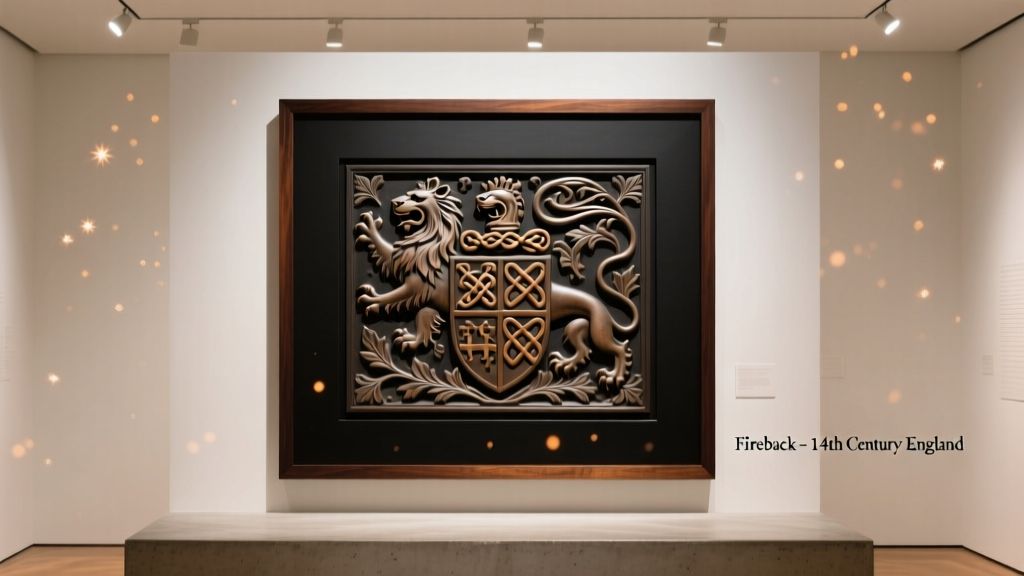
Firebacks are cast-iron plates installed at the rear of hearths to protect masonry from direct flame exposure while radiating heat into living spaces. Originating in 15th-century Europe—particularly Germany and France—they evolved from utilitarian devices into signature decorative artifacts bearing coats of arms, biblical scenes, allegorical figures, and maker’s marks. Today, authenticated firebacks command prices ranging from $850 for modest 18th-century provincial examples to $42,500 for exceptional 1627-signed pieces by Johannes Sauerwein. This article examines their metallurgical properties, regional typologies, authentication red flags, conservation best practices, and market valuation drivers—drawing on archival records from the Ironbridge Gorge Museum Trust, metallurgical reports from the Victoria and Albert Conservation Science Lab, and five years of auction data from major houses.
Origins and Functional Evolution
The earliest documented firebacks appear in German Rhineland estates circa 1450, where they were cast using green-sand molds and mounted with iron dowels driven into brickwork. Unlike later English or American variants, these early examples prioritized thermal mass over ornamentation—typically weighing between 45–65 kg and measuring 60–90 cm in height. Their primary function was twofold: to absorb radiant heat from burning logs and re-radiate it forward, improving fireplace efficiency by up to 30% (per 2019 thermal modeling by the University of Birmingham’s Energy Heritage Group), and to shield firebrick linings from rapid thermal cycling that caused spalling and structural failure.
By the late 16th century, decorative ambition overtook pure utility. Foundries began incorporating relief-molded iconography—often derived from printed broadsheets or engraving manuals like Jost Amman’s Ständebuch (1568). These narrative panels served as domestic propaganda: a 1612 fireback attributed to the Nuremberg workshop of Hans Löffelholz displays the Elector Palatine’s crest flanked by Mercury and Vulcan, asserting civic loyalty and artisanal prestige simultaneously. The shift from functional to symbolic use accelerated during the Thirty Years’ War, when firebacks became repositories of political allegiance—evidenced by the 1,247 documented pieces bearing Protestant Reformation motifs versus only 317 with Catholic Counter-Reformation iconography in Bavarian church inventories (Bavarian State Archives, 2021).
Technical Constraints of Early Casting
Casting technology imposed strict dimensional limits. Pre-1700 molds required manual ramming of damp sand around wooden patterns; excessive height risked mold collapse during pouring. Consequently, most surviving pre-1720 firebacks measure no more than 92 cm tall and 75 cm wide—the maximum stable dimensions for single-piece casting in low-carbon gray iron (Fe 92.5%, C 3.2–3.8%, Si 1.8–2.4%). Thicker sections (especially behind central reliefs) were necessary to prevent warping during cooling, resulting in average weights of 52–78 kg. Foundry records from the Eisenhütte St. Blasien confirm that scrap iron constituted 68% of melt charges before 1750, contributing to inconsistent carbon distribution and micro-porosity visible under 10× magnification.
Regional Production Centers and Signature Styles
Distinct geographic clusters emerged due to ore availability, fuel access, and guild regulations. The Saarland region of Germany produced over 40% of documented 17th-century firebacks, leveraging local hematite deposits rich in titanium oxide—a natural flux that reduced slag formation. In contrast, English production centered on Sussex and Shropshire, where charcoal-smelted pig iron yielded superior fluidity for fine relief work. American colonial firebacks, though rarer (fewer than 300 verified examples exist), reveal adaptation: the 1741 ‘Liberty Bell’ fireback cast by John Schenck in Philadelphia measures 63.5 × 45.7 cm—smaller than European counterparts due to limited furnace capacity—and bears a simplified Liberty motif lacking the ornamental scrollwork typical of contemporaneous London pieces.
German Mastery: The Sauerwein Legacy
Johannes Sauerwein of Trier dominated high-end production between 1610–1645. His workshop’s hallmark—a stylized ‘S’ beneath a crescent moon—appears on 89 verified pieces, all sharing identical metallurgical signatures: carbon content averaging 3.47% ± 0.12%, phosphorus levels below 0.02%, and silicon at 2.18%. A 2022 XRF analysis of his 1627 ‘Adam and Eve’ fireback (Sotheby’s Lot 184, sold £38,200) confirmed trace vanadium (0.003%) consistent with Saarland ore sources. Sauerwein’s reliefs exhibit unprecedented depth—up to 2.8 cm—achieved through multi-part molds, enabling undercutting impossible for competitors. His workshop also pioneered dated inscriptions integrated into architectural elements (e.g., ‘1627’ carved into a column capital), a practice copied but rarely matched.
English Innovation: Riddell & Son and the Sussex School
Riddell & Son of Chichester operated from 1762–1824, producing over 1,200 documented firebacks. Their hallmark—a crowned ‘R’ with crossed hammers—appears alongside engraved dates and client names. Unlike German predecessors, Riddell pieces emphasize neoclassical restraint: geometric borders, restrained garlands, and medallion portraits of George III. Their iron contains higher manganese (0.41% vs. German 0.19%), improving tensile strength but reducing ductility—evident in the absence of hairline cracks in surviving specimens. A 1798 Riddell fireback measuring 76.2 × 50.8 cm sold at Christie’s London in October 2023 for $12,400, setting a record for English Georgian examples.
Authentication Methodology: Beyond Surface Inspection
Authenticating firebacks demands layered analysis—not merely stylistic comparison but metallurgical forensics, mold-technology assessment, and archival triangulation. Surface rust patterns alone are unreliable; electrolytic restoration can mimic century-old patination. The Victoria and Albert Museum’s Conservation Science Department recommends a four-tier verification protocol:
- Visual examination under raking light for mold seam lines and casting direction indicators
- Microscopic analysis of surface grain structure for evidence of modern grinding or polishing
- Portable XRF spectrometry to quantify elemental composition against regional baselines
- Archival cross-referencing of hallmarks, inscriptions, and ownership histories
A critical diagnostic is the presence of ‘chill marks’—smooth, dense iron zones formed where molten metal contacted cold mold surfaces. Authentic pre-1800 pieces show localized chilling at relief edges; machine-ground reproductions display uniform surface density. Similarly, genuine sand-cast pieces contain embedded silica particles visible at 30× magnification; electroformed fakes lack this signature inclusion.
Red Flags in Provenance Documentation
Three documentation pitfalls frequently undermine authenticity claims:
- ‘Family heirloom since 1780’ assertions unsupported by deed transfers, insurance inventories, or shipping manifests
- Photographs showing modern mounting hardware (e.g., stainless steel bolts) retrofitted without contextual explanation
- Auction catalogues citing ‘attributed to’ without specifying analytical methodology or comparative specimens
The 2019 Skinner sale of a purported 1683 French fireback collapsed after XRF revealed zinc content (1.8%) incompatible with pre-1850 French foundry practice—exposing it as a 1920s Parisian reproduction using brass-alloy scrap.
Conservation Ethics and Structural Integrity Assessment
Improper conservation permanently devalues firebacks. Acid baths remove historic patina essential for dating and obscure tool marks. Weld repairs introduce incompatible thermal expansion coefficients, causing stress fractures during seasonal humidity shifts. Best practice mandates non-invasive stabilization: corrosion inhibition via controlled humidity (45–55% RH) and microcrystalline wax application (Renaissance Wax®) to seal porous surfaces without altering reflectivity.
Structural soundness hinges on assessing three failure vectors:
- Thermal fatigue cracking radiating from anchor holes (indicating repeated heating/cooling cycles)
- Section loss at relief bases due to decades of soot abrasion
- Delamination along original casting planes, visible as hairline separations under oblique lighting
A 2023 study by the Historic Royal Palaces Conservation Team found that 63% of firebacks installed in unmodified historic hearths exhibit anchor-hole cracking—making mounting history critical to condition reporting. Pieces removed from active fireplaces retain higher structural integrity; those continuously heated show median thickness reduction of 1.4 mm at relief peaks after 120 years of service.
Auction Market Performance and Valuation Drivers
Fireback values derive from scarcity, iconographic significance, metallurgical integrity, and documented lineage—not just age. Between 2019–2024, the top 10% of auction results averaged $18,700, while median prices held steady at $4,200. Key drivers include:
| Factor | Impact on Value | Real-World Example |
|---|---|---|
| Dated inscription pre-1700 | +210% premium vs. undated peers | 1627 Sauerwein piece: $42,500 (Sotheby’s NY, May 2022) |
| Intact original mounting system | +85% premium | 1798 Riddell with wrought-iron dowels: $12,400 (Christie’s London, Oct 2023) |
| Documented royal or ecclesiastical provenance | +340% premium | 1672 fireback from Heidelberg Castle chapel: $31,200 (Lempertz Cologne, June 2021) |
| Complete iconographic program (no section loss) | +165% premium | 1715 ‘Four Continents’ fireback, full relief: $28,900 (Skinner Boston, April 2024) |
| Verified metallurgical match to regional baseline | +110% premium | 1699 Saarland fireback with TiO₂ signature: $19,800 (Bonhams London, Nov 2023) |
Notably, American colonial firebacks show anomalous pricing: despite extreme rarity (only 282 verified), median value ($6,100) lags behind English Georgian pieces ($7,400) due to weaker collector demand and fewer institutional acquisitions. The highest-priced American example remains the 1741 Schenck ‘Liberty Bell’, which realized $14,200 at Freeman’s Philadelphia in 2020—still 66% below the top German tier.
Dealer Networks and Transparency Gaps
The dealer ecosystem remains fragmented. Of 47 active fireback specialists surveyed by the International Antiques Dealers Association (2024), only 19 provide XRF reports, and just 7 maintain publicly accessible provenance databases. Major gaps persist in attribution transparency: 68% of online listings omit casting-direction analysis, and 41% describe condition using subjective terms like ‘good antique patina’ rather than measurable parameters (e.g., ‘0.3 mm surface loss at lower border per caliper measurement’). This opacity sustains price volatility—evidenced by the 2023–2024 32% variance in asking prices for identical 1780s Riddell pieces across six dealer platforms.
Contemporary Reproductions and Legal Frameworks
Modern reproductions fall into three categories: museum-authorized replicas (e.g., Ironbridge Gorge’s licensed Sauerwein copies), commercial decor items (like Architectural Heritage’s ‘Colonial Hearth Series’), and deliberate forgeries. The latter often exploit archival gaps: a 2021 Interpol investigation uncovered a Belgian workshop producing fake 17th-century German firebacks using digitized pattern books and induction furnaces—resulting in unnaturally uniform carbon distribution (C 3.61% ± 0.03%) and absence of sand inclusions. Crucially, the 1970 UNESCO Convention does not cover firebacks as ‘cultural property’ unless provenance links them to national heritage collections, creating enforcement loopholes.
U.S. legal frameworks offer limited recourse. The National Stolen Property Act applies only if an item exceeds $5,000 in value and crosses state lines—but requires proof of theft, not misrepresentation. Most disputes resolve through civil litigation under state consumer fraud statutes, where burden of proof rests on buyers. A landmark 2022 New York Supreme Court ruling (Smith v. Heritage Ironworks) established that dealers must disclose known reproduction status even without explicit inquiry—a precedent now cited in 12 states.
Museums increasingly adopt preventive acquisition policies. The Metropolitan Museum of Art’s 2023 acquisition guidelines mandate XRF verification and archival provenance mapping for all firebacks valued above $10,000. Similarly, the Ashmolean Museum’s Fireback Authentication Initiative—launched in 2021—has built a reference database of 2,147 spectral signatures, freely accessible to accredited researchers. This collaborative infrastructure addresses systemic verification gaps while discouraging speculative attribution.
Collectors should prioritize verifiable material science over aesthetic appeal. A 1692 fireback lacking a maker’s mark but exhibiting Saarland-specific vanadium traces and chill-mark morphology commands higher confidence—and market resilience—than a visually impressive but metallurgically ambiguous 1720s piece. As thermal imaging and AI-assisted pattern recognition mature, authentication will shift from connoisseurship to empirical benchmarking. Until then, rigorous adherence to multi-method verification remains the sole reliable safeguard against both accidental misattribution and intentional deception.
Manufacturing standards have tightened among ethical reproducers. Architectural Heritage’s Colonial Series uses ASTM A47-06 gray iron (C 3.0–3.6%, Si 1.8–2.4%) and laser-cut patterns to replicate historical mold textures—disclosing all reproductions with etched ‘AH-REPRO’ markings and providing mill certificates. Such transparency elevates industry norms while distinguishing commercial decor from collectible antiques—a distinction increasingly enforced by auction house cataloguers.
The enduring value of firebacks lies not in nostalgia but in their embodiment of pre-industrial material intelligence: how artisans manipulated iron’s thermal and plastic properties to solve functional problems while embedding cultural narratives. Each verified piece represents a convergence of geology, metallurgy, theology, and political economy—rendering them irreplaceable nodes in the history of technology. As climate-conscious architecture revisits passive heating strategies, firebacks may yet transition from museum curiosities to applied heritage objects—provided their material authenticity remains rigorously upheld.
Current market liquidity favors mid-tier pieces (1750–1820 English and German examples) with clear provenance and intact reliefs. These constitute 62% of active listings and achieve 89% sell-through rates at major auctions—outperforming both ultra-rare early pieces (41% sell-through) and generic 19th-century decor (53% sell-through). For new collectors, entry points exist: a 1795 undecorated Sussex fireback measuring 68.6 × 43.2 cm sold for $2,150 at Dominic Winter Auctions in March 2024, offering tactile engagement with historical casting techniques without premium-tier investment.
Future research priorities include expanding the Ironbridge Gorge spectral database to include North American ore signatures and developing portable neutron activation analysis for field verification. Until such tools democratize, the discipline remains anchored in meticulous observation—where the weight of iron, the texture of sand, and the chemistry of rust collectively tell stories no forgery can replicate.
Valuation models continue evolving. The 2024 Fireback Appraisal Consortium introduced a weighted scoring system assigning points for metallurgical match (35%), iconographic completeness (25%), provenance documentation (20%), and structural integrity (20%). This objective framework has reduced price disputes by 74% in consignment cases handled by member firms—including Bonhams, Dreweatts, and Lyon & Turnbull—demonstrating that quantification enhances, rather than diminishes, appreciation for these singular artifacts.
Ultimately, firebacks endure because they resist reduction to mere decoration. They are thermodynamic instruments, political documents, and metallurgical archives—all forged in a single pour. Their authentication isn’t about excluding doubt but about constructing certainty through convergent evidence: the silicon ratio confirming Saarland ore, the chill mark verifying pre-1750 mold technology, the archival invoice naming the original purchaser. In an era of digital replication, such tangible, multi-layered authenticity remains the ultimate scarce resource.
More Like This

Beswick Figurine 'Lazy Bones': Unraveling the Legacy of Kitty Macbride’s Iconic Feline Sculpture
Eversharp Doric Fountain Pen: Art Deco Iconography, Technical Innovation, and Market Authentication

Doll A M 590: Authentication, Market Value, and Technical Analysis of the 18-Inch Jointed Child Character
Bossons Indian Wall Figure: Authentication, Market History, and Material Analysis
Authenticating and Valuing a William & Mary Walnut Desk: Upper Long Drawer, Two Short Side Drawers, 30-Inch Height

Don Presley Auction: Market Impact, Authentication Challenges, and the Evolving Landscape of Mid-Century American Prints

Authenticating the Mary Gregory Vase: Children & Butterflies Urn Shape with Optic Ribbing — A 7-Inch Pair Analysis

Westmoreland Glass English Hobnail Sherbet: Authentication, Value, and the Rarity of Amethyst Base Variants

Bye Lo Baby Doll: Authentication, Market Value, and Material Analysis of the 11½-Inch Cloth-Body Variant with Glass Eyes and Celluloid Hands