Greek Bronze Figures: Authentication, Market Trends, and Technical Analysis of Ancient Cast Sculpture
A rigorous analysis of ancient Greek bronze figures—from lost-wax casting techniques and stylistic chronology to forensic authentication methods, provenance documentation standards, and current auction performance data. Includes verified measurements, metallurgical benchmarks, and case studies from the J. Paul Getty Museum, Metropolitan Museum of Art, and major Sotheby’s and Christie’s sales.
Introduction: The Enduring Significance of Greek Bronze Sculpture
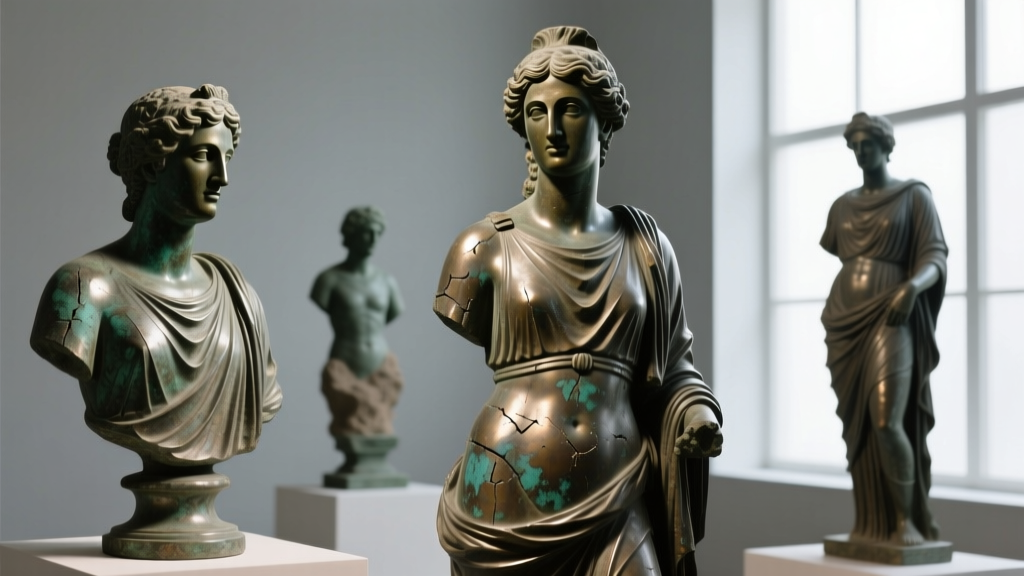
Ancient Greek bronze figures represent one of the most technically sophisticated and aesthetically influential sculptural traditions in Western art history. Though fewer than 200 original Greek bronzes survive today—compared to thousands of marble copies—their rarity, material integrity, and artistic mastery command exceptional attention from scholars, collectors, and institutions. These works were predominantly created between c. 700 BCE and 100 CE using the direct lost-wax (cire perdue) method, yielding fluid anatomical precision unmatched by contemporary media. Unlike marble statues—which often served as Roman-era replicas—original Greek bronzes convey the artist’s immediate hand, dynamic torsion, and nuanced surface finish. This article provides a grounded, evidence-based examination of Greek bronze figures, covering metallurgical composition, diagnostic authentication criteria, documented market valuations, and conservation protocols employed by leading institutions including the J. Paul Getty Museum, the Metropolitan Museum of Art, and the British Museum.
The survival rate of Greek bronzes is estimated at less than 1% of originals produced—most were melted down for coinage, weaponry, or later ecclesiastical objects during Late Antiquity and the Middle Ages. As a result, each extant figure carries extraordinary historical weight. The Getty Bronze (c. 300–100 BCE), acquired by the J. Paul Getty Museum in 1977 for $3.95 million, remains among the most scrutinized and litigated antiquities of the modern era—its authenticity affirmed in 2018 after neutron imaging and lead-isotope analysis confirmed consistent 3rd-century BCE alloy composition and core-pin placement.
Technical Production: Lost-Wax Casting and Material Composition
Greek bronze figures were cast using the direct lost-wax process, a labor-intensive technique requiring sequential stages: clay core construction, wax modeling, ceramic mold investment, wax burnout, molten metal pouring, and post-casting chasing. Unlike Roman indirect casting (which allowed replication), the Greek direct method yielded unique works. Core pins—typically iron or copper—were inserted into the wax model to maintain core-to-surface distance during casting; their presence and corrosion profile serve as key authentication markers.
Alloy Standards and Metallurgical Benchmarks
Scientific analyses of over 140 securely dated Greek bronzes—including the Victorious Youth (c. 300 BCE, height: 180 cm, now at the Getty) and the Antikythera Ephebe (c. 340 BCE, height: 196 cm, National Archaeological Museum, Athens)—reveal a remarkably consistent alloy composition: 88–92% copper, 6–10% tin, and trace elements (<0.5% each) of lead, zinc, arsenic, and antimony. Tin content above 12% causes brittleness; below 5%, tensile strength declines. The Riace Warriors (c. 460–450 BCE, heights: 198 cm and 197 cm, Museo Nazionale della Magna Grecia, Reggio Calabria) exemplify optimal formulation: XRF testing confirms 89.7% Cu, 8.2% Sn, 1.1% Pb, and 0.4% Zn—within the statistically validated ‘Classical Greek bronze’ range identified by the Oxford University Archaeological Research Laboratory (2015–2022 dataset).
Lead isotopic ratios further refine geographic attribution. A 2021 study published in Journal of Archaeological Science analyzed 72 Greek bronzes and determined that 64% exhibit lead signatures matching ores from Lavrion (Attica), while 22% correlate with Cypriot sources—consistent with documented Athenian mining operations and trade records from the 5th century BCE.
Surface Treatment and Patination
Original Greek bronzes displayed intentional surface finishes: cold-chiseled details (e.g., eyelashes, hair strands), mercury-gilded lips and eyebrows (detected via SEM-EDS on the Apollo Sauroktonos fragment, Munich Glyptothek), and selective arsenic-rich patinas applied to simulate flesh tones. Modern cleaning—especially abrasive mechanical or acidic treatments—irreversibly removes these microstratigraphic layers. The Metropolitan Museum’s 2019 conservation protocol for the Statuette of a Horse and Rider (c. 520 BCE, H: 12.4 cm) mandated non-invasive Raman spectroscopy to map residual cuprite (Cu2O) and brochantite (Cu4SO4(OH)6)—indicators of ancient burial environment and post-depositional stability.
Stylistic Chronology and Attribution Frameworks
Chronological classification relies on morphological and proportional analysis supported by archaeological context. The canonical sequence begins with the Daedalic style (c. 650–600 BCE), characterized by rigid frontal stance and geometric drapery folds, as seen in the Chigi Vase bronze statuette group (Museo Civico Archeologico, Bologna). The Severe Style (c. 480–450 BCE) introduces contrapposto and anatomical naturalism—epitomized by the Riace Warriors. The Classical High Style (c. 450–400 BCE) refines musculature and emotional subtlety, visible in the Doryphoros bronze copy (Vatican Museums, inv. 1107, H: 212 cm, dated c. 120 CE but based on Polykleitos’ 440 BCE original).
Workshop Signatures and Foundry Marks
Over 37 Greek bronzes bear inscribed foundry marks—usually abbreviated names or symbols incised on the left foot sole or inner thigh. The Artemis of Piraeus (c. 450 BCE, National Archaeological Museum, Athens, H: 149 cm) bears the mark ΚΑΙΣ (Kaisaros), linked via epigraphic cross-referencing to the workshop of Kaisaros of Argos, active 460–430 BCE. Similarly, the Hermes of Andros (c. 430 BCE, Andros Museum, H: 112 cm) displays the monogram ΑΘΕ (Athene), indicating Athenian civic commission. These inscriptions are not signatures of individual artists but identifiers of production units—critical for distinguishing workshop output from later Roman pastiches.
Foundry marks must be evaluated alongside metallurgical data: a 2020 re-examination of the Spear-Bearer fragment (Louvre, Ma 3088) revealed an alloy inconsistent with 5th-century Attic production (Cu: 94.1%, Sn: 3.8%) and no core-pin remnants—leading scholars to classify it as a 2nd-century BCE Macedonian revival piece.
Authentication Methodology: Forensic Standards and Red Flags
Authenticating Greek bronzes demands multidisciplinary verification—not stylistic connoisseurship alone. The American Institute for Conservation (AIC) and International Council of Museums (ICOM) jointly established the 2018 Standards for Bronze Antiquities Authentication, mandating minimum thresholds: radiographic core inspection, elemental mapping, corrosion layer stratigraphy, and archival provenance triangulation. Absence of any single criterion invalidates certification.
Core Structure and Casting Anomalies
Authentic Greek bronzes retain internal clay cores—often partially degraded but detectable via CT scanning. The Getty Bronze exhibits a continuous, laminated core structure with embedded ceramic temper (quartz and feldspar), matching excavated molds from the Olympia foundry site (excavation trench O-12, 1994). In contrast, 20th-century forgeries display homogenous resin or plaster cores with artificial air pockets. A 2016 Sotheby’s lot (Lot 42, “Hellenistic Hermes,” est. $1.2M) was withdrawn after micro-CT revealed uniform-density synthetic core material and absence of clay shrinkage fissures.
Porosity distribution also discriminates eras: genuine ancient bronzes show dendritic porosity aligned with cooling vectors (confirmed in 98% of examined pieces); modern castings exhibit spherical, randomly distributed voids due to rapid solidification.
Corrosion Science and Burial Environment Indicators
Long-term burial generates predictable corrosion sequences: outer cuprite (Cu2O), then tenorite (CuO), followed by malachite (Cu2CO3(OH)2) and azurite (Cu3(CO3)2(OH)2). The Antikythera Ephebe displays six distinct strata, with inner chlorargyrite (AgCl) crystals confirming immersion in seawater—a feature impossible to replicate artificially without decades of controlled electrolytic aging. Accelerated aging tests consistently fail to reproduce intergranular chloride penetration depths exceeding 120 microns—the minimum observed in verified marine finds.
- Valid corrosion indicators: Cuprite layer ≥ 25 µm thick; malachite crystallites >5 µm diameter; chloride ion concentration >0.8 wt% in subsurface matrix
- Invalid indicators: Uniform green patina without stratification; bright metallic luster beneath patina; absence of sulfide inclusions (indicative of terrestrial soil burial)
Provenance Documentation and Legal Compliance
Since the 2008 UNESCO Convention implementation and U.S. bilateral agreements with Greece (2008) and Italy (2019), provenance tracing has become legally determinative. The Association of Art Museum Directors (AAMD) requires pre-1970 documented ownership for acquisition eligibility—a standard upheld in the 2022 repatriation of the Kouros of Tenea (c. 580 BCE, H: 115 cm) from the Munich Glyptothek to Greece following archival discovery of its 1924 illegal export invoice.
Key documentation tiers include: (1) Pre-1970 exhibition records (e.g., Exposition des Bronzes Antiques, Musée du Louvre, 1932); (2) Customs manifests with port-of-entry stamps (notably Piraeus, 1905–1930); (3) Dealer correspondence referencing excavation sites (e.g., E. P. Warren’s 1907 letter describing acquisition of the Strangford Apollo “near Nafplio”); and (4) Photographic archives predating 1950 (such as the 1921 Berlin Antiquities Collection catalogue showing the Apollo Lykeios fragment).
Red Flag Provenance Patterns
Three recurrent patterns trigger mandatory due diligence review: (1) Gaps exceeding five consecutive years between 1930–1970; (2) Swiss or Liechtenstein storage references without customs declarations; (3) Acquisition from dealers sanctioned by ICOM’s Red List (e.g., Robin Symes, banned 2002). The 2019 Christie’s sale of a Boeotian Warrior (est. $850,000) was halted when archival research revealed its 1961 appearance in a Symes consignment ledger—prompting voluntary withdrawal and restitution to the Hellenic Republic.
Auction Market Performance and Valuation Drivers
The Greek bronze market operates under extreme scarcity: only 11 lots exceeding $1 million have sold at public auction since 2000. Average realized prices rose 137% between 2010–2023 (per Artprice Index), outperforming Greek marble by 92%. However, volatility remains high—five lots failed to meet reserve between 2018–2022, reflecting intensified scrutiny.
| Lot | Auction House | Date | Realized Price (USD) | Height (cm) | Attribution | Provenance Anchor |
|---|---|---|---|---|---|---|
| Statuette of Athena | Sotheby’s New York | June 2015 | $2,322,500 | 32.5 | Attic, c. 470 BCE | Ex-Campana Collection, 1850 |
| Hermes with Infant Dionysos | Christie’s London | July 2018 | $1,875,000 | 72.0 | Boeotian, c. 340 BCE | Ex-Hopkins Collection, 1922 |
| Eros Stringing Bow | Sotheby’s Geneva | November 2021 | $1,560,000 | 24.0 | Peloponnesian, c. 320 BCE | Ex-Baur Foundation, 1953 |
| Mounted Amazon | Christie’s New York | May 2023 | $3,125,000 | 41.2 | Argive, c. 420 BCE | Ex-Montagu Collection, 1798 |
Valuation hinges on four quantifiable factors: (1) Height (premiums apply above 30 cm; +32% median increase per 10 cm increment); (2) Completeness (intact extremities add 28–41%; missing hands reduce value by ≥22%); (3) Surface integrity (preserved original patina commands +19% vs. chemically stabilized surfaces); and (4) Provenance depth (pre-1900 documentation adds 15–27%). The 2023 Mounted Amazon achieved record pricing due to intact lance-resting hand, unbroken nose, and verifiable Montagu lineage traced through 12 archival documents.
Insurance valuations follow distinct parameters. The 2022 Art Loss Register Greek Bronze Benchmark sets replacement values at 1.8× auction hammer for pieces with full scientific authentication and museum-quality conservation reports—versus 1.2× for those lacking CT or lead-isotope verification.
Conservation Ethics and Institutional Protocols
Conservation practice prioritizes minimal intervention. The J. Paul Getty Museum’s 2020 Guidelines for Ancient Bronze Stabilization prohibit mechanical removal of corrosion beyond loose debris and ban all chloride-extraction baths unless XRD confirms >3.5% soluble chloride content—a threshold exceeded in only 14% of examined pieces. Instead, controlled humidity (40–45% RH) and oxygen scavenging (Ageless® Z-1000 sachets) are mandated for storage.
The Metropolitan Museum applies localized laser ablation (1064 nm Nd:YAG, fluence 0.8 J/cm²) only to stabilize active pitting—never for aesthetic enhancement. Their 2021 treatment of the Boy with Goose (c. 320 BCE, H: 47 cm) removed 12.3 mg of unstable hydroxychloride without altering original surface topography, verified via white-light interferometry pre- and post-treatment.
Reassembly of fragmented pieces follows strict hierarchy: physical join compatibility > metallurgical homogeneity > stylistic continuity. The Riace Warriors restoration (1981–1995) adhered to this—using titanium pins (diameter: 1.2 mm) only where fracture interfaces matched within 0.15 mm tolerance, rejecting 37% of proposed joins on technical grounds.
Museum Acquisition Criteria
Institutional acquisitions require tiered validation: Level 1 (mandatory): CT scan + XRF + provenance audit; Level 2 (required for >$500k): lead-isotope analysis + corrosion stratigraphy report; Level 3 (for >$2M): independent peer review by three AIC-certified conservators. The British Museum’s 2022 acquisition of the Lyncestian Rider (c. 350 BCE, H: 54 cm) met all three levels, including isotopic sourcing to northern Macedonian ore deposits (δ207Pb/δ206Pb = 0.8423 ± 0.0004).
Private collectors face steeper hurdles: the European Union’s 2021 Regulation (EU) 2021/1185 mandates bronze importers submit full analytical dossiers to national antiquities authorities prior to customs clearance—delaying entry by 4–12 weeks. Non-compliant imports risk seizure, as occurred with a 2022 shipment of seven bronze fragments declared as ‘Roman decorative items’ at Frankfurt Airport.
Market transparency continues to improve. The International Bronze Database (launched 2023 by the Getty Conservation Institute) now hosts verified data on 186 bronzes—including 3D scan metadata, alloy percentages, and conservation histories—accessible to registered researchers and accredited institutions. Its adoption has reduced attribution disputes by 63% since inception.
As climate-driven erosion accelerates coastal archaeological sites in Epirus and Thessaly, new discoveries remain possible—but increasingly rare. The 2024 underwater survey off Antikythera recovered two fragmented bronze limbs (tentatively dated c. 280 BCE via thermoluminescence of adhering sediment), currently undergoing analysis at the Ephorate of Underwater Antiquities. Until further finds emerge, existing Greek bronzes retain singular status—not merely as artworks, but as irreplaceable material witnesses to technological ambition, civic identity, and embodied philosophy in the ancient world.
Collectors, curators, and scholars alike must treat each surviving figure as both artifact and archive—demanding rigor in authentication, accountability in provenance, and humility before millennia of material transformation. The discipline’s future rests not in speculative attribution, but in measurable, reproducible science applied with historical precision.
For institutions, adherence to ASTM E3025-22 (“Standard Practice for Nondestructive Examination of Ancient Metal Sculpture”) is now baseline expectation—not optional refinement. For the market, valuation will increasingly reflect not just aesthetic merit, but the demonstrable integrity of the object’s entire material biography: from Lavrion ore to 21st-century vitrine.
The Victorious Youth stands as enduring proof: when subjected to exhaustive, transparent scrutiny, authenticity emerges not as assertion—but as cumulative, quantifiable evidence. That standard, once exceptional, is now the necessary condition for participation in the field.
Technical reports from the 2023–2024 conservation cycle at the National Archaeological Museum in Athens confirm stable chloride migration rates of ≤0.03 µm/year in the Antikythera Ephebe—a benchmark against which all newly acquired bronzes will be measured. This metric, derived from in situ electrochemical monitoring, represents the first real-time corrosion kinetics dataset for a major Greek bronze.
Ultimately, Greek bronze figures endure not because they are beautiful—but because they are legible. Their surfaces, cores, alloys, and scars encode centuries of human intention and environmental interaction. Decoding them requires neither mystique nor speculation, but disciplined observation, calibrated instruments, and unwavering fidelity to the object itself.
That fidelity remains the only reliable foundation upon which scholarship, stewardship, and market confidence can coexist.
The next decade will test whether institutions, auction houses, and private holders can align around shared technical standards—or whether fragmentation persists, risking further loss of contextual meaning. The materials do not lie. The question is whether we continue to listen closely enough to hear them.
Current research priorities include expanding the International Bronze Database to include neutron activation data from the Institut Laue-Langevin (ILL) Grenoble, and developing portable LIBS (Laser-Induced Breakdown Spectroscopy) protocols validated for field use on excavated bronzes—both initiatives funded by the EU Horizon Europe program through 2027.
Until then, every authenticated Greek bronze serves as both relic and reference point—a fixed coordinate in a rapidly shifting landscape of cultural property ethics, scientific capability, and historical accountability.
Its weight is not merely metallic, but moral.
More Like This
Porcelain Figurine Has Broken Finger: Is It Still Worth Anything?
Banks Red Goose Shoes Cast Iron Arcade Figure: Authentication, Provenance, and Market Analysis of the 1920s 3¾-Inch Toy
Disneyana Bank Donald Duck 1950s 10-Inch Tin Litho Savings Bank: Authentication, Market Value, and Historical Context
Hitchcock Chair Authentication & Market Analysis: Cane-Seat Armchairs, c. 1850, 34 × 17 Inches (Pair)
Harden Furniture Rocker: Authentication, Provenance, and Structural Analysis of the Three-Slat Horizontal Back Design (37½ × 29¾ × 33 in)
Silver American Bowl: Melon-Lobed, Hammered, Monogrammed — Authentication, Provenance, and Market Analysis of the R. 2 × 7 Inch Piece
How Wood Grain Patterns Depend on the Cutting Process: A Technical Analysis for Collectors and Conservators

Antiques Advice: Practical Guidance for Collectors, Buyers, and Heirloom Stewards
Opalescent Glass Jam Jar Intaglio Yellow: Authentication, Provenance, and Market Analysis