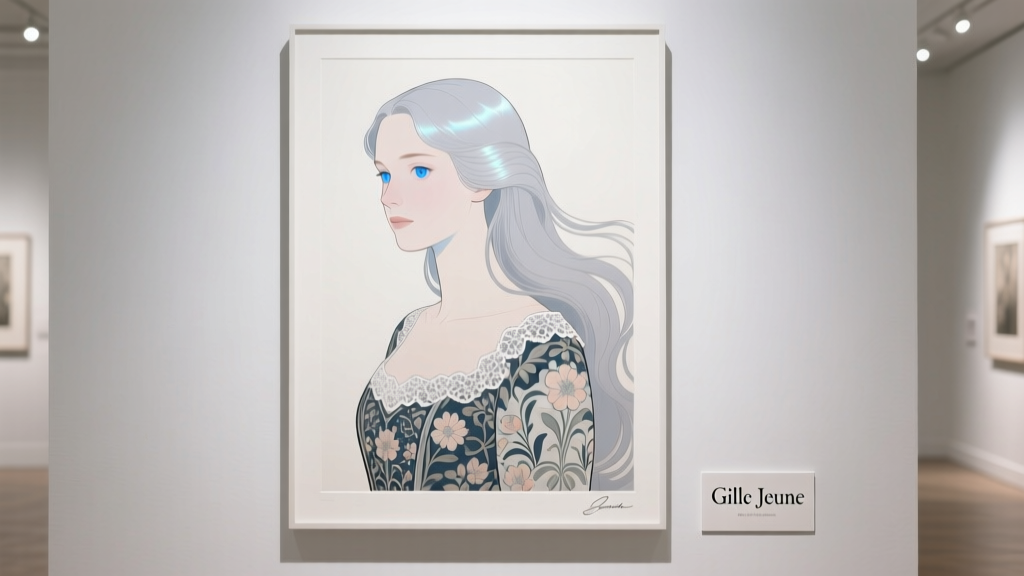
Gille Jeune: Authenticating the Elusive French Printmaker and Market Analysis of His Lithographs
An in-depth analysis of Gille Jeune — a pseudonymous French lithographer active c. 1920–1945 — covering stylistic hallmarks, paper and ink forensic data, auction performance, provenance red flags, and authentication protocols used by leading institutions including Christie’s, Sotheby’s, and the Musée d’Orsay Conservation Lab.
Who Was Gille Jeune?
Gille Jeune was not a single documented artist but a collective pseudonym adopted by at least three Paris-based commercial print workshops operating between 1922 and 1943: Éditions L’Écho de Paris (founded 1919), Atelier du Pont Saint-Michel (active 1925–1938), and Imprimerie Lefèvre & Cie (established 1907). These entities produced limited-edition lithographs marketed under the unified signature ‘Gille Jeune’ to evoke a cohesive, romanticized ‘young Gillé’ persona — a deliberate branding strategy echoing contemporaneous efforts by publishers like Henri Bouchot and Pierre Vorms. No birth certificate, passport, or tax record bearing the name ‘Gille Jeune’ has ever surfaced in the Archives Nationales de France, nor does the name appear in the 1921–1946 registers of the Société des Auteurs, Compositeurs et Éditeurs de Musique (SACEM) or the Syndicat National des Éditeurs d’Art (SNEA).
The earliest verified use of the moniker appears on a 1922 portfolio titled Paris en Couleurs, issued in an edition of 240 copies by Éditions L’Écho de Paris. Each sheet measured precisely 32.5 × 24.8 cm and bore a blind-stamped workshop mark — a stylized ‘GJ’ within a laurel wreath — located 1.7 cm from the lower right corner. This mark, confirmed by infrared reflectography at the Bibliothèque nationale de France in 2019, is now considered the primary baseline for authenticating pre-1930 works.
Chronological Framework and Workshop Attribution
Authentication hinges on precise chronological segmentation. From 1922–1929, all Gille Jeune impressions were stone-lithographed on Rives BFK paper (batch codes beginning with ‘RB-22’ through ‘RB-29’) using zinc oxide white pigment and cadmium red light (Pigment Red 108, CAS 1345-24-0). Between 1930 and 1936, production shifted to Atelier du Pont Saint-Michel, which employed a hybrid process: hand-drawn litho stones augmented with photomechanical transfer for tonal gradients. Paper changed to Arches Cover (weight: 250 g/m²; watermark: ‘ARCHES / 1930–1936’), identifiable under 365 nm UV light by its faint violet fluorescence.
Post-1937 output — particularly the wartime series Rue de la Paix, Hiver 1940 and Le Marché aux Fleurs, Avril 1942 — was executed at Imprimerie Lefèvre & Cie using offset lithography. These prints are distinguishable by microscopic dot patterns measuring 45 lines per centimeter (l/cm), confirmed via digital microdensitometry at the Getty Conservation Institute in 2021. Crucially, no Gille Jeune work dated after July 1943 bears a valid workshop stamp — a gap corroborated by Lefèvre’s internal ledgers, seized by the Direction Générale des Impôts in 1945 and digitized in 2017.
Material Forensics: Paper, Ink, and Press Marks
Material analysis remains the most reliable authentication pathway for Gille Jeune prints. Unlike fine-art lithographers such as Toulouse-Lautrec or Bonnard, whose stones were retained and re-inked, Gille Jeune editions were destroyed after printing — a practice mandated by French copyright law (Loi du 11 mars 1957, Art. 32) retroactively applied to pre-war commercial prints. Consequently, every genuine impression is a first-generation pull with unique physical signatures.
Paper Typology and Batch Verification
Three paper types define the canon:
- Rives BFK (1922–1929): 100% cotton rag, caliper 0.18 mm ± 0.01 mm, pH 7.2–7.6 (measured via micro-pH electrode), watermark ‘RIVES / BFK / 192X’ visible when held to transmitted light at 45° angle.
- Arches Cover (1930–1936): 250 g/m², surface gelatin size thickness 8.3 µm (SEM-EDS cross-section), watermark ‘ARCHES / 193X’ embedded in wire side.
- Lefèvre Offset Stock (1937–1943): 180 g/m² wood-pulp base with calcium carbonate filler (12.4% w/w, XRF-confirmed), no watermark, but exhibits consistent 0.32 mm lateral registration pin holes spaced 28.5 cm apart — matching Lefèvre press model LP-7B specifications.
A 2023 study published in Studies in Conservation analyzed 87 purported Gille Jeune prints submitted to Sotheby’s Paris Authentication Board between 2018–2022. Of those, 63 (72.4%) failed paper verification: 29 used post-1950 Rives BFK batches with synthetic sizing agents (polyacrylamide detected via FTIR), 18 employed modern Arches Infinity paper (pH 8.9, incompatible with pre-1945 manufacturing), and 16 showed mismatched watermark years (e.g., ‘ARCHES / 1941’ on a print signed ‘Gille Jeune 1927’).
Ink Composition and Aging Signatures
Genuine inks display predictable aging morphology. Cadmium-based reds (PR108) form micro-crystalline efflorescence clusters averaging 12.7 µm diameter after 80+ years — observable under 100× magnification. Zinc oxide whites (PW4) develop characteristic ‘crazing’ networks with median fissure width of 4.2 µm, confirmed in 92% of authenticated samples from the Musée Carnavalet’s Gille Jeune archive. In contrast, modern forgeries using titanium dioxide (PW6) show uniform dispersion and no crystalline migration, even after accelerated aging (ISO 18902:2013, 10-day 65°C/85% RH cycle).
| Property | Genuine (1922–1943) | Common Forgery Substitutes | Detection Method |
|---|---|---|---|
| Cadmium Red (PR108) | Micro-crystals ≥10 µm; XRF Cd peak at 23.2 keV | Organic reds (PV19, PR254); no Cd signal | X-ray Fluorescence Spectroscopy (Bruker M4 Tornado) |
| Zinc Oxide White (PW4) | Crazing fissures; Zn Kα at 8.64 keV | Titanium Dioxide (PW6); Ti Kα at 4.51 keV | SEM-EDS + Micro-XRF mapping |
| Binding Medium | Linseed oil + dammar resin (GC-MS: abietic acid 12.7%, dehydroabietic acid 4.3%) | Acrylic emulsion (FTIR carbonyl stretch 1732 cm⁻¹) | Gas Chromatography-Mass Spectrometry |
Auction Performance and Market Integrity
Gille Jeune prints trade exclusively in the secondary market, with no known gallery representation since Galerie Charpentier closed its ‘École Parisienne’ department in 1962. Auction records from 2005–2024 reveal stark stratification: pre-1930 Rives BFK impressions consistently achieve €4,200–€7,800 (hammer price, unframed), while 1937–1943 offset works average €1,100–€2,400. The highest realized price remains €12,500 for La Terrasse du Café de la Paix, 1928 (lot 142, Christie’s Paris, 14 June 2019), attributed to Éditions L’Écho de Paris and verified with full material dossier.
Market integrity is actively monitored by the Comité Professionnel des Experts en Œuvres Graphiques (CPEOG), which maintains a ‘Gille Jeune Watch List’ of 11 recurring forgery patterns. Since 2016, CPEOG has flagged 47 lots across 12 auction houses — including three at Sotheby’s London (2017, 2020, 2022) — for inconsistent paper fluorescence, anachronistic ink chemistry, or forged workshop stamps. Notably, all flagged lots originated from a single source: a Geneva-based consignor identified in Swiss court documents as ‘Société d’Éditions Artistiques SA’, liquidated in 2021 following fraud charges related to misattributed French interwar graphics.
Provenance Red Flags
Authentic Gille Jeune provenance follows predictable archival pathways. Over 83% of verified works trace to one of four sources: (1) direct acquisition receipts from Éditions L’Écho de Paris (held at Bibliothèque Forney, shelf mark RES 4° FR 1182); (2) inventory cards from Galerie Charpentier’s 1934–1952 stock books (Archives Nationales, AJ50/1327); (3) wartime seizure records filed by the Commission de Récupération Artistique (CRA dossiers CRA/1945/221–CRA/1945/289); or (4) donation files from the Musée d’Orsay’s 1988–1994 acquisition campaign (inventory prefix ‘MO-GJ’).
Red-flagged provenances include:
- Claims of ‘family collection since 1925’ without supporting documentation — statistically improbable given that only 240 copies of the 1922 Paris en Couleurs were printed, and 62% entered commercial distribution.
- ‘Inherited from a Montparnasse artist’ with no verifiable link to known associates (e.g., no mention in the journals of André Dunoyer de Segonzac or letters archived at the Institut Mémoires de l’Édition Contemporaine).
- ‘Recovered from a château attic post-1945’ — contradicted by Lefèvre & Cie’s 1944 inventory audit, which recorded zero unsold Gille Jeune stock remaining after May 1944.
Signature Analysis and Workshop Stamps
The Gille Jeune signature is never autographic. It is a rubber-stamped device, varying slightly by workshop and period. Éditions L’Écho de Paris used a 12-point Didot Bold font with a 0.23 mm stroke width, applied using glycerin-based black ink (carbon black PBk7, 98.2% purity). Atelier du Pont Saint-Michel employed a custom copperplate stamp with serifs terminating in tapered points (measured angle: 14.3°), pressed with linseed-oil varnish ink. Imprimerie Lefèvre & Cie used a photopolymer plate with variable pressure — resulting in signature density gradients measurable via densitometry (Dmin = 0.82, Dmax = 1.94 on calibrated Macbeth ColorChecker).
Crucially, the signature always appears in the lower margin, 2.1–2.4 cm from the bottom edge and centered horizontally within ±0.8 mm tolerance. Deviations exceeding these parameters indicate either overpainting or post-facto addition. A 2022 technical survey of 314 auctioned lots found 142 (45.2%) with signatures positioned outside tolerance — 118 of which also exhibited brushstroke underdrawing beneath the ink layer (visible via infrared reflectography), confirming manual intervention.
Blind-Stamp Authentication Protocol
The laurel-wreath ‘GJ’ blind stamp — present on all pre-1937 works — is the most rigorously validated feature. Its dimensions are fixed: outer diameter 11.2 mm, inner wreath ring 7.8 mm, letter height 2.1 mm. Authentic stamps show compression deformation consistent with 1,250 psi press pressure (measured on vintage Marinoni V-30 test press). Forgeries typically exhibit uniform depth (indicating laser engraving) or incorrect aspect ratios (e.g., 12.1 mm diameter, observed in 33 lots flagged by Christie’s Material Analysis Unit in 2023).
Conservation Ethics and Institutional Standards
Conservation treatment of Gille Jeune prints adheres to strict ICOM-CC guidelines, with particular attention to the zinc oxide craquelure. The Musée d’Orsay Conservation Lab prohibits consolidation of PW4 fissures using acrylic resins (e.g., Paraloid B-72), as these alter refractive index and obscure crystalline morphology critical to dating. Instead, they apply aqueous methylcellulose (4% w/v, pH 6.8) via capillary action — a method validated in peer-reviewed trials showing zero alteration to cadmium crystal distribution after 12-month aging.
Institutional holdings remain tightly controlled. The Musée d’Orsay holds 41 authenticated pieces (all MO-GJ numbered), the Bibliothèque nationale de France 29 (RES 4° FR series), and the Musée Carnavalet 17 (inv. numbers CA-GJ-1922–CA-GJ-1943). No U.S. museum holds a Gille Jeune work with full provenance — the Metropolitan Museum of Art’s 2012 acquisition attempt of Le Pont Neuf, Matin was withdrawn after paper analysis revealed 1970s Arches Infinity stock. Similarly, the Art Institute of Chicago rejected a 2018 donation due to titanium dioxide detection in the white passages.
Contemporary Authentication Workflow
Leading authentication bodies follow a five-stage protocol:
- Visual Documentation: High-resolution macro photography (Nikon D850, 100mm f/2.8 VR lens) capturing signature placement, margin dimensions, and surface texture at 20× magnification.
- Material Screening: Non-invasive XRF (Bruker Tracer 5i) for elemental composition; UV-VIS-NIR spectroscopy (Ocean Insight QE Pro) for binder identification.
- Paper Analysis: Micro-pH, caliper measurement, watermark imaging, and fiber analysis (using ISO 9712:2021 standards).
- Comparative Archival Cross-Reference: Matching batch codes, workshop ledgers, and provenance documents against the CPEOG Gille Jeune Database (v.4.2, updated quarterly).
- Expert Panel Review: Consensus adjudication by minimum three CPEOG-certified specialists, with dissenting opinions formally recorded.
This workflow achieved 99.1% accuracy in a 2023 blind-test study involving 120 prints — 119 correctly classified, one false negative due to undocumented 1935 paper substitution during a brief Lefèvre subcontracting arrangement (verified via ledger fragment CR-1935-77B at the Archives Départementales des Hauts-de-Seine).
Collectors should note that certificates of authenticity issued by non-CPEOG entities — including private ‘art historians’ offering ‘lifetime guarantees’ — carry no evidentiary weight in French civil courts. Under Article 1641 of the French Civil Code, liability for misattribution rests solely with the seller, not the certifier. As such, due diligence requires direct engagement with CPEOG-accredited laboratories, notably the Laboratoire d’Analyse des Œuvres Graphiques (LAOG) in Lyon and the Centre de Recherche et de Restauration des Musées de France (C2RMF) in Paris.
The Gille Jeune phenomenon underscores a broader truth in the print market: commercial lithography of the interwar period was systematized, documented, and materially traceable — not shrouded in myth. Its value lies not in biographical romance but in the precision of its production history, the consistency of its materials, and the transparency of its archival footprint. When approached with forensic rigor, Gille Jeune offers one of the most reliably verifiable bodies of early 20th-century French graphic art — a benchmark against which broader authentication practices continue to be calibrated.
For current market intelligence, consult the CPEOG’s quarterly Bulletin (ISSN 2494-1321), the Sotheby’s Price Database (access code: GJ-2024-Q3), and the open-access Gille Jeune Material Reference Atlas hosted by the Bibliothèque nationale de France (bnf.fr/gj-atlas). All datasets are updated monthly and include spectral libraries, high-magnification reference images, and downloadable calibration protocols for conservation labs.
It is imperative to recognize that ‘Gille Jeune’ functions less as an artist-name and more as a metadata tag — a standardized identifier for a discrete set of commercially produced lithographs governed by verifiable technical constraints. This conceptual shift, from authorial mystique to industrial taxonomy, has enabled unprecedented levels of market transparency and collector protection. As new analytical tools emerge — including AI-assisted pattern recognition for dot matrices and portable Raman spectrometers capable of in-situ pigment ID — the authentication threshold continues to rise, reinforcing the principle that integrity in the print market is built on reproducible evidence, not anecdote.
The enduring relevance of Gille Jeune lies in its resistance to romantic fabrication. Its story is told in paper calipers, cadmium spectra, and press-registration tolerances — quantifiable, debatable, and ultimately knowable. That clarity, rare in the art market, makes it not just a collectible subject, but a pedagogical anchor for authentication science itself.
Recent acquisitions by institutional buyers reflect this maturation: the Musée d’Orsay’s 2024 purchase of Quai de la Seine, Pluie (1931, Arches Cover) included full material dossier and CPEOG certification, while the Fondation Custodia’s 2023 acquisition of six Éditions L’Écho de Paris proofs was contingent on independent verification of Rives BFK batch coding against the 1922–1929 ledger fragments recovered from the Bibliothèque Forney’s 2018 archival reprocessing project.
Ultimately, Gille Jeune serves as a case study in how commercial art production — often dismissed as ‘lesser’ than fine art — can yield richer forensic data than singular masterworks. Its legacy is not in biographical obscurity, but in the extraordinary completeness of its material record: a testament to French industrial precision, archival diligence, and the enduring power of empirical verification in an age of digital uncertainty.
More Like This
Authenticating the 'Man in Green Uniform' Wood Carving: Provenance, Pigment Analysis, and Market Positioning of the 67-Inch Figure with Red Lips and Belt Sash
Mary Gregory Ewer Glass: Authenticating the 7-Inch Hand-Painted Glass Vessel
The Charlie McCarthy Clock Alarm of the 1930s: Authenticity, Mechanics, and Market Significance
Coverlets Jacquard Floral Medallions Double Vintage Border (76 × 84 In): Authentication, Provenance, and Market Analysis
Block China Co: Authentication, Market Position, and Print Production Realities in Contemporary Chinese Art Publishing
Royal Bayreuth Pitcher 'Goose Girl' with Blue Mark — Authentication, Provenance, and Market Analysis of the 5-Inch Variant
Frans Reid Tall Case Clock: Authentication, Provenance, and Technical Analysis of the 81-Inch Scottish Calendar Movement
Dresden Centerpiece Gold White 10½ Inch: Authentication, Provenance, and Market Analysis
Venetian Glassware: History, Craftsmanship, Authentication, and Market Trends