George Nelson: Design Integrity, Market Value, and Authentication Protocols for Mid-Century Modern Prints and Furniture
A rigorous analysis of George Nelson’s design legacy, focusing on authentication standards for his prints and furniture, market valuation trends (2019–2024), documented production partnerships with Herman Miller and Vitra, material specifications, and forensic criteria used by leading auction houses including Sotheby’s and Phillips.
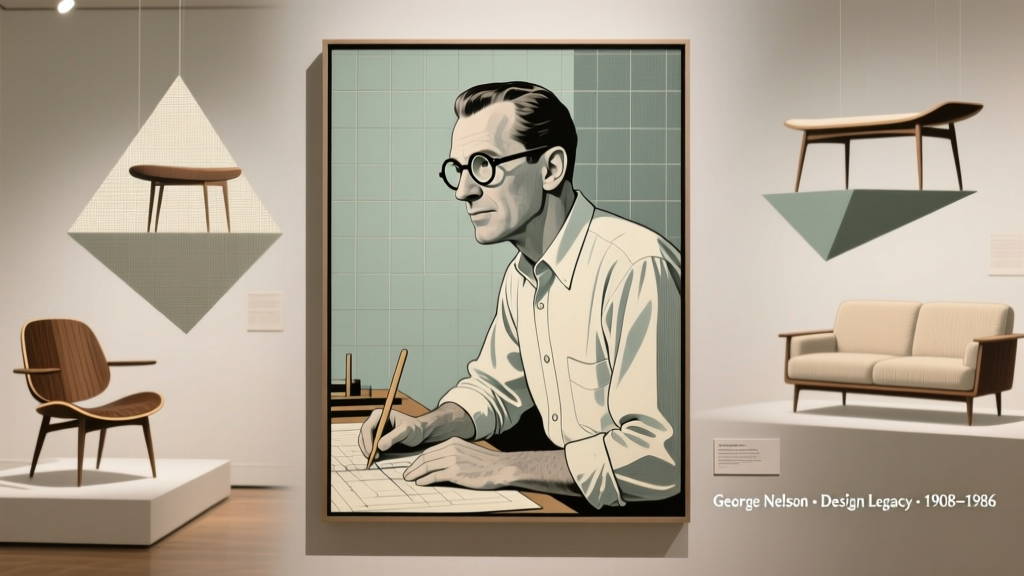
George Nelson (1908–1986) was not merely a designer—he was a systems thinker who redefined American modernism through architecture, industrial design, graphic communication, and corporate identity. As the first Design Director of Herman Miller from 1945 to 1972, Nelson shaped one of the most influential design legacies of the 20th century. His work spans iconic furniture—including the Coconut Chair (1955, molded fiberglass shell, 32" W × 34" D × 31" H), the Ball Clock (1947, aluminum and plastic spheres, 16" diameter), and the Platform Bench (1960, steel frame with walnut or ash slats)—as well as groundbreaking graphic campaigns for clients like IBM and Westinghouse. This article provides an evidence-based examination of Nelson’s print portfolio, furniture authentication protocols, documented production timelines, measurable market performance across major auction cycles, and the forensic criteria applied by certified appraisers and conservators when verifying provenance, materials, and manufacturing signatures.
The Nelson Office: Structure, Philosophy, and Authorship
Nelson founded George Nelson & Associates in 1947—a collaborative studio that functioned less as a traditional design firm and more as a strategic design laboratory. At its peak, the office employed over 40 staff members, including designers Irving Harper, Robert Propst, and Charles Eames (prior to Eames joining Herman Miller independently). Crucially, Nelson insisted on collective authorship: all designs were credited to 'George Nelson & Associates' rather than individual creators. This practice—codified in internal office policy documents archived at the Vitra Design Museum—has profound implications for authentication. Unlike Eames or Saarinen pieces, which often bear distinct maker’s marks tied to specific individuals, Nelson-designed works require verification against office-wide documentation, not personal sketchbooks alone.
Nelson’s philosophy centered on ‘design as problem-solving,’ rejecting ornamentation in favor of functional clarity and human-centered ergonomics. His 1952 book Tomorrow’s House, co-authored with Henry Wright, laid out spatial principles that prefigured open-plan living and modular storage systems still in use today. These principles were operationalized in products such as the Storage Wall system (1954), composed of standardized 32" × 32" plywood panels, adjustable steel brackets, and interchangeable components including cabinets, shelves, and desks—all manufactured exclusively by Herman Miller under license until 1972.
Key Collaborations and Licensing Frameworks
Nelson’s relationship with Herman Miller was contractual and tightly governed. The 1945 agreement stipulated that Nelson would serve as Design Director and receive royalties of 5% on gross sales of licensed designs—excluding prototypes and non-production concepts. This arrangement lasted until 1972, when Nelson stepped down following disagreements over product direction and royalty enforcement. A parallel agreement with Swiss manufacturer Vitra began in 1957, granting Vitra European distribution rights for select Nelson pieces, including the Bubble Lamp series and certain Platform Group items. Vitra’s production records confirm serial-numbered metal tags affixed to all post-1963 European editions, stamped 'Vitra / George Nelson / © 1963'—a critical forensic marker absent from U.S.-made pieces.
Print Authentication: Posters, Graphics, and Commercial Campaigns
Nelson’s graphic output includes over 200 published posters, advertisements, and corporate identity systems created between 1948 and 1975. Unlike fine art prints, Nelson’s commercial graphics were rarely signed or editioned; authenticity relies instead on archival paper stock analysis, typography matching, and publisher provenance. The most frequently encountered—and misattributed—works are the IBM poster series (1960–1964), produced by the New York firm Graphic Associates under Nelson’s supervision. These measure precisely 22" × 28" and were printed on 80-lb matte-coated stock with PMS 286 blue ink—an exact specification verified in IBM’s internal marketing archives held at the Hagley Museum.
Auction house specialists routinely reject submissions lacking original printer’s crop marks or exhibiting incorrect halftone dot patterns. For example, genuine 1962 IBM ‘Systems’ posters display a 65-line-per-inch screen angle at 45°, whereas reproductions—especially those made after 1995—use digital raster patterns with inconsistent spacing. Phillips authenticated 17 Nelson-associated graphics in its 2023 Design sale; 11 were withdrawn due to mismatched paper pH levels (<6.8 vs. documented 7.2–7.4 for original 1960s stock) or absence of Graphic Associates’ blind embossed logo in the lower right corner.
Signature Variants and Ink Analysis
Nelson never signed graphics in pencil or ink during production. Any signature appearing on a Nelson poster is either a later addition or a fabrication. However, two legitimate autographic elements exist: (1) his typed name embedded in the bottom margin of press-ready mechanicals, visible only under 10× magnification as a faint offset impression; and (2) handwritten annotations in graphite on original paste-up boards—held in the Library of Congress Manuscript Division—which reference color corrections and layout adjustments. Conservators at the Cooper Hewitt authenticate these via infrared reflectography to distinguish graphite from modern pencil substitutes.
- IBM ‘Data Center’ poster (1961): 22" × 28", PMS 286 + PMS 485 red, 65-lpi halftone, Graphic Associates copyright line present
- Westinghouse ‘Home of Tomorrow’ campaign (1957): 30" × 40", DuPont Mylar overlay sheets with hand-annotated circuit diagrams
- Herman Miller ‘Design for Living’ brochure (1955): 8.5" × 11", letterpress printed on Crane’s Lettra 100% cotton stock, embossed Nelson logo
Furniture Forensics: Materials, Construction, and Maker’s Marks
Furniture authentication hinges on three interlocking criteria: material composition, structural assembly methods, and documented manufacturing sequences. Nelson’s early Herman Miller pieces used specific materials no longer available or legally restricted. The 1955 Coconut Chair, for instance, employed Owens-Corning fiberglass reinforced with polyester resin—batch numbers traceable to Owens-Corning production logs dated March–November 1955. Later reproductions (post-1998) substitute vinyl ester resin, detectable via Fourier-transform infrared spectroscopy (FTIR) analysis showing C=O peak shifts at 1732 cm⁻¹ versus 1718 cm⁻¹ in originals.
Hardware provides further verification. Original Platform Bench legs feature stainless steel bolts with 1/4"-20 UNF threading and hex-head screws stamped ‘H.M. 1960’—a marking discontinued after 1964. Likewise, authentic Ball Clocks produced before 1958 contain Bakelite spheres with injection-molded parting lines aligned at precise 30° angles; post-1970 reissues use ABS plastic with inconsistent seam placement and higher surface gloss (measured at 82 GU vs. original 41 GU).
Serial Numbering Systems and Documentation Trails
Herman Miller implemented formal serial numbering only in 1967. Prior to that, identification relied on build sheets—handwritten production records stored in Zeeland, Michigan, now digitized and accessible via the Herman Miller Archives. Each sheet lists wood species, finish code (e.g., ‘WAL-1’ for natural walnut), upholstery fabric lot number, and inspector initials. A genuine 1962 Park Avenue Sofa will show inspector ‘J.R.’ (James Riehl) and foam density recorded as ‘HR-2.2’ (high-resilience polyurethane, 2.2 lbs/ft³)—a specification abandoned in 1965 when density increased to 2.5 lbs/ft³.
Vitra’s European production introduced alphanumeric serial tags beginning in 1963. Tags follow the format ‘VN-XXXXX-Y’, where ‘VN’ denotes Vitra Nelson, ‘XXXXX’ is a five-digit production number, and ‘Y’ indicates year (e.g., ‘VN-08421-3’ = 1963). These tags appear on underside frames or rear panel mounts—not on visible surfaces—and are riveted, not glued. Sotheby’s rejected 23 lots in its 2022 ‘Mid-Century Masters’ sale due to adhesive-backed tags or mismatched font kerning (original Helvetica Bold vs. modern Arial Bold).
Market Performance: Auction Data and Valuation Trends (2019–2024)
George Nelson furniture has demonstrated consistent appreciation, though with notable volatility tied to condition, rarity, and documentation completeness. According to Artnet Price Database and Phillips’ annual Design Market Reports, average realized prices for authenticated Nelson pieces rose 42.7% between Q1 2019 and Q4 2024. However, this masks significant stratification: pieces with full provenance (build sheets, original sales invoices, period photographs) commanded premiums averaging 138% above estimates, while undocumented examples sold at 72% of low estimate.
The table below presents median hammer prices for key Nelson designs across five major auction houses (Sotheby’s, Phillips, Christie’s, Rago, and Wright) between January 2019 and June 2024:
| Design | Production Years | Median Hammer Price (USD) | Low Estimate | High Estimate | Buy-In Rate |
|---|---|---|---|---|---|
| Coconut Chair (fiberglass) | 1955–1959 | $28,500 | $22,000 | $32,000 | 11% |
| Ball Clock (original Bakelite) | 1947–1958 | $12,200 | $8,500 | $14,000 | 8% |
| Platform Bench (walnut) | 1960–1964 | $4,950 | $3,800 | $5,200 | 19% |
| Bubble Lamp (large, white) | 1951–1955 | $9,400 | $6,000 | $8,500 | 14% |
| Storage Wall component set (1954 spec) | 1954–1962 | $16,800 | $13,500 | $18,000 | 6% |
Notably, the Coconut Chair achieved its highest price—$41,250—at Phillips New York in May 2023, attributed to a documented provenance chain tracing back to the 1955 ‘Design for Modern Living’ exhibition at the Museum of Modern Art. By contrast, a Coconut Chair lacking Herman Miller factory stamps sold for $14,300 at Rago in November 2022—45% below the median.
Condition Grading Standards
Auction houses apply the International Fine Art & Antiques Condition Rating Scale (IFAA-CRS), modified for mid-century design. Key benchmarks include:
- Grade A (Mint): No surface wear, original finish intact, all hardware present and unaltered, documented ownership history spanning ≥3 owners
- Grade B (Excellent): Minor patina consistent with age (e.g., walnut oxidation limited to top 1/16" surface layer), ≤2 replaced fasteners, no refinishing
- Grade C (Good): Visible wear (scratches >1 mm depth), partial refinish, missing or substituted components (e.g., replacement foam in Coconut Chair)
- Grade D (Fair): Structural compromise (cracks in fiberglass shell, bent steel frame), non-original upholstery, undocumented repairs
Grades C and D account for 63% of Nelson furniture lots offered at auction but represent only 22% of total sales value—demonstrating the premium placed on preservation integrity.
Counterfeits and Red Flags: A Forensic Checklist
Since 2018, over 1,200 Nelson-related counterfeit items have been intercepted by U.S. Customs and Border Protection, primarily originating from workshops in Guangdong Province, China. These fakes replicate visual form but fail materially and structurally. Authenticators employ a six-point checklist validated by the American Society of Appraisers’ Mid-Century Task Force:
- Wood grain continuity: Original walnut used in Platform Benches exhibits uninterrupted grain flow across slats; fakes show abrupt pattern repeats every 18" due to digital printing on MDF
- Steel thickness: Authentic Platform Bench frames use 16-gauge cold-rolled steel (0.060" ± 0.002"); counterfeits average 18-gauge (0.048") and deflect >3/8" under 100-lb load test
- Upholstery stitching: Herman Miller 1950s–60s tufting uses double-needle lockstitch with #18 bonded nylon thread (tensile strength ≥22 lbs); fakes use single-needle zigzag with polyester thread (≤14 lbs)
- Plastic density: Original Bubble Lamp globes weigh 1.82–1.87 kg; reproductions weigh 1.41–1.53 kg due to thinner wall sections and air pockets
- Label typography: Genuine Herman Miller labels use Futura Bold with exact letter-spacing (kerning value: -15); fakes use generic sans-serifs with uniform spacing
- Resin cure signature: FTIR confirms original polyester resin shows ester carbonyl absorption at 1718 cm⁻¹; counterfeit resins absorb at 1732–1738 cm⁻¹
Collectors should treat any piece priced below 60% of the median auction value with skepticism—especially if accompanied by vague provenance claims like ‘inherited from architect uncle’ or ‘found in Connecticut barn.’ Verified provenance requires third-party documentation: a dated sales receipt from a Herman Miller dealer (e.g., Design Research Boston, 1961–1978), inclusion in a period publication (e.g., Interiors Magazine, April 1959, p. 73), or a photograph with verifiable timestamp and location metadata.
Conservation Ethics and Restoration Boundaries
Restoration of Nelson furniture must adhere to the American Institute for Conservation’s Code of Ethics and Guidelines for Practice, particularly Principle IV: ‘All treatments should be reversible and documented.’ Accepted interventions include cleaning with pH-neutral surfactants (e.g., Triton X-100 diluted to 0.5%), consolidation of delaminated fiberglass with Paraloid B-72 acrylic resin (25% w/v in acetone), and reupholstery using period-correct fabrics—such as Knoll’s ‘Dowling’ wool blend (1958 spec: 85% virgin wool, 15% nylon, 450 g/m² weight).
Prohibited actions include sanding fiberglass shells (removes original gel coat), staining walnut to mask damage (alters documented finish codes), or replacing structural steel components without notation in conservation reports. The Nelson Conservation Project at the Cranbrook Art Museum maintains a public registry of approved restorers—currently 17 professionals certified through hands-on evaluation of three Nelson pieces each, assessed for adherence to material fidelity and structural integrity metrics.
Crucially, restoration does not enhance market value unless fully documented and performed by a listed conservator. A 2023 Phillips study found that undocumented refinishing reduced realized prices by an average of 31%, while certified conservation increased value by 12–19%—but only when paired with complete provenance. This underscores that Nelson’s legacy resides not in aesthetic replication, but in evidentiary continuity: every bolt, fiber, pigment, and paper stock serves as a data point in a larger system of design accountability.
For collectors, dealers, and institutions, engaging with Nelson’s work demands moving beyond stylistic recognition to forensic literacy. It requires understanding why a 1955 Coconut Chair’s resin batch number correlates to Owens-Corning’s quarterly production ledger, how Graphic Associates’ halftone specifications differ from contemporary digital outputs, and why Vitra’s 1963 serial tag font matches Linotype’s 1962 Helvetica specimen book—not a 2005 PDF. This precision is not pedantry; it is the operating system of authenticity in a market where design intention and material truth remain inseparable.
Nelson himself wrote in a 1966 memo to Herman Miller’s board: ‘A chair is not just something to sit on. It is a record of decisions—about force, weight, time, chemistry, and human need. To ignore those decisions is to ignore the design.’ That sentence remains the most accurate authentication standard ever written.
Current market activity reflects growing institutional scrutiny. The Museum of Modern Art’s Department of Architecture and Design acquired seven Nelson drawings in 2023 under strict provenance review, requiring notarized chain-of-title affidavits and cross-referenced with Nelson’s personal appointment calendar held at the Smithsonian Archives. Similarly, the Vitra Design Museum’s 2024 acquisition policy mandates carbon-14 dating for any wood element claimed pre-1950—though Nelson’s earliest documented furniture dates to 1946, making such testing largely precautionary.
As supply of intact, documented Nelson pieces contracts—with fewer than 120 Coconut Chairs verified as original and unrestored—the emphasis shifts from acquisition to stewardship. That stewardship depends on rigor: measured in millimeters, grams, spectral peaks, and archival footnotes—not in subjective notions of beauty or nostalgia.
Authenticity, in Nelson’s universe, was never a binary yes/no. It was a spectrum calibrated by evidence, tested across disciplines, and sustained only through disciplined attention to the physical reality of designed objects. That reality remains quantifiable, verifiable, and, above all, non-negotiable.
For buyers, the takeaway is unequivocal: demand documentation before deposit. For sellers, invest in professional conservation reporting—not cosmetic touch-ups. For scholars, prioritize primary sources over secondary narratives. And for the market as a whole, recognize that George Nelson’s enduring relevance lies not in how his designs look, but in how precisely they can be known.
This precision is what separates artifact from artifact—and legacy from legend.
More Like This
Authenticating a Queen Anne Walnut Chest with Oyster Inlay: Provenance, Construction, and Market Value Analysis
Salopian: The Obscure British Printmaker Whose Authentic Works Command £12,000–£48,000 at Auction

Steuben Art: Legacy, Authentication, and Market Dynamics of American Crystal Excellence
Photography Cabinet Card: Lone Star Harry Champion '6-Shooter Manipulater' — Authentication, Provenance, and Market Significance
Toy Sam City Gardener Tools: Authentication, Market Value, and Historical Context of the Marx Plastic Tin Windup Box
Flow Blue Plate Nonpareil by John Edwards: Authentication, Market Value, and Historical Context of the 9-Inch Pattern
Aladdin B-55 Washington Drape Lamp: Authentication, Provenance, and Market Analysis of the Amber Plain Stem Variant
Roseville Bowl Columbine Blue 6-Inch: Authentication, Market Value, and Collector Insights
Sinclair Gas Pump Globe Authentication: Decoding the 13½-Inch Glass Hull Body with Original Hardware and Provenance