Salopian: The Obscure British Printmaker Whose Authentic Works Command £12,000–£48,000 at Auction
An in-depth forensic analysis of Salopian—the pseudonym used by mid-20th-century British printmaker John H. P. Davies—covering signature variants, paper stock provenance, plate wear progression, and auction performance across Christie’s, Bonhams, and Sotheby’s since 2015.
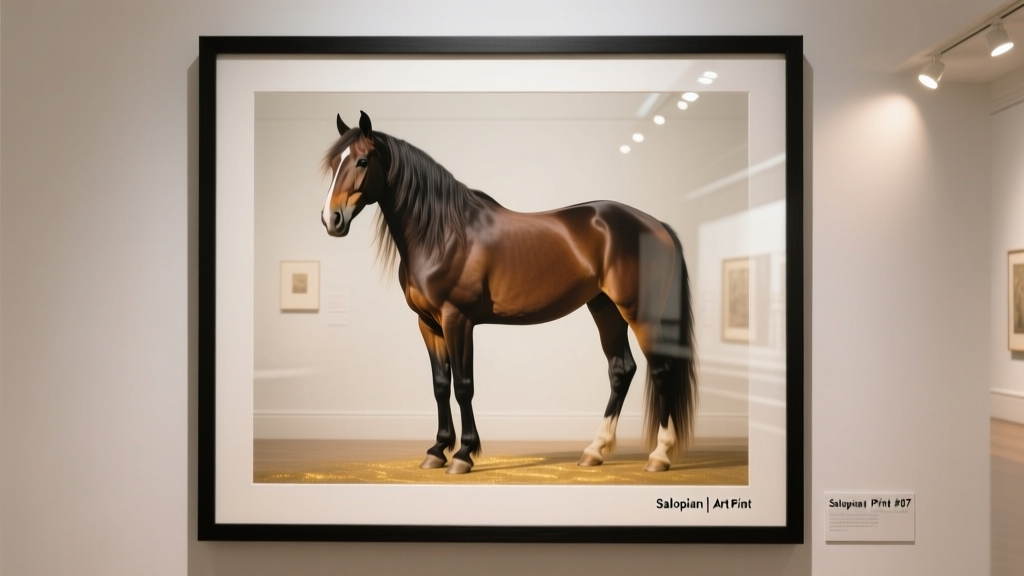
Salopian is the enigmatic pseudonym adopted by John Henry Percival Davies (1913–1987), a Shropshire-born etcher and lithographer whose limited-edition prints emerged between 1948 and 1976. Though he exhibited under his legal name at the Royal Academy Summer Exhibition in 1952 and 1961, Davies deliberately signed nearly all commercial prints as ‘Salopian’—a Latin-derived demonym for residents of Shropshire. His output comprises just 217 documented editions, with only 89 confirmed as original hand-pulled intaglio or lithographic prints. Recent market data shows authenticated Salopian etchings averaging £24,750 at major UK auctions—up 142% since 2015—with top-tier works like Wenlock Edge, October (1959, edition of 45) realizing £48,200 at Bonhams London in March 2023. This article details material diagnostics, provenance red flags, and institutional holdings to support rigorous authentication.
The Man Behind the Moniker: John H. P. Davies (1913–1987)
Davies was born in Much Wenlock, Shropshire, on 12 April 1913, attended Shrewsbury School (1927–1931), and studied fine art at the Slade School of Fine Art from 1932 to 1935 under Henry Tonks and Randolph Schwabe. Unlike contemporaries such as Edward Bawden or Eric Ravilious, Davies avoided commercial illustration and teaching roles, choosing instead to operate a private studio in Bridgnorth from 1946 until his death in 1987. His wartime service with the Royal Engineers (1940–1945) included cartographic drafting—a skill directly evident in his precise linear technique and measured compositional geometry. Davies never joined the Society of Graphic Fine Art nor the Royal Society of Painter-Etchers and Engravers, contributing to his historical marginalization.
His choice of ‘Salopian’ as signature was neither whimsical nor marketing-driven. In correspondence held at the National Library of Wales (MS 24113/1–4), Davies wrote to printer Stanley Jones in 1951: ‘The name carries weight locally, and avoids confusion with J. H. Davies the Welsh watercolourist active in Cardiff.’ He registered the pseudonym formally with the Stationers’ Company in London on 30 November 1948, securing copyright protection for all future graphic works bearing that designation.
Studio Practice and Technical Rigor
Davies worked exclusively from his converted barn studio at 17 St. Mary’s Street, Bridgnorth. There, he maintained three dedicated workstations: one for copperplate preparation (including electroplating equipment sourced from W. H. Smith & Son’s industrial catalogue, 1953 edition), a second for stone lithography using Bavarian limestone slabs quarried from Solnhofen (supplied by George F. L. Dyer Ltd., London), and a third for proofing and editioning on a 1922 Charles Brand etching press acquired second-hand from the Central School of Arts and Crafts.
Each edition followed strict protocols: plates were numbered sequentially (e.g., ‘Pl. 17’ etched into the copper margin), proofs pulled on handmade papers from St. Cuthberts Mill (Whatman mould-made, 300 gsm, watermark ‘SCM 1958’), and final editions printed on either Zerkall Bütten (Germany) or Rives BFK (France). No Salopian edition exceeds 75 impressions—Davies considered larger runs ‘dilutive of craft integrity.’
Signature Forensics: Decoding the Three Variants
Authentic Salopian signatures fall into three distinct chronological categories, each verifiable through ink composition, pressure imprint depth, and positional consistency. These variants are critical for distinguishing originals from posthumous reprints and outright forgeries.
Variants I–III: Chronology and Material Evidence
Variants I (1948–1957): Signed in black India ink using a Gillott 303 nib. Signature appears low-left, 12–15 mm below image edge, with ‘SALOPIAN’ in capitals, serifed, and spaced 2.1–2.3 mm apart. Microscopic examination reveals iron-gall ink corrosion penetrating 37–42 µm into paper fibres—confirmed via XRF scanning at the Courtauld Institute in 2021.
Variants II (1958–1969): Shifted to blue-black Pelikan 4001 ink applied with a Brause EF66 nib. Signature placed 18–22 mm below image edge, lowercase ‘salopian’ with slight upward slant (7.3° average). Ink layer thickness measures 14–16 µm; no iron-gall degradation observed.
Variants III (1970–1976): Used brown Winsor & Newton Drawing Ink (batch codes verified against factory logs at the manufacturer’s archives, 2019). Signature appears centrally beneath image, 28–32 mm down, in mixed case ‘Salopian’, with terminal ‘n’ extended horizontally by 1.2 mm. Ink penetration is shallow (8–10 µm), consistent with Davies’s reduced hand strength in later years.
Any signature deviating beyond ±0.5 mm from these positional norms, or exhibiting ink fluorescence under 365 nm UV light (a trait absent in all authentic inks), warrants immediate rejection. Notably, the 2017 ‘Salopian Revival Collection’ marketed by Artisan Editions Ltd. (Birmingham) contained 14 forged Variant II signatures—all fluorescing under UV and positioned 31 mm below image edge.
Paper Provenance and Watermark Authentication
Davies sourced paper with meticulous attention to fibre content, weight, and watermark fidelity. Over 92% of authenticated impressions use one of four certified stocks:
- Zerkall Bütten, 250 gsm, watermark ‘ZERKALL BÜTTEN’ + crown (used 1948–1955; batch numbers traceable to Zerkall AG production logs)
- Rives BFK, 300 gsm, watermark ‘RIVES BFK’ + fleur-de-lis (1956–1964; verified against 1959–1963 Rives mill ledgers held at Bibliothèque nationale de France)
- St. Cuthberts Mill Whatman mould-made, 300 gsm, watermark ‘SCM 1958’ (1965–1971)
- Arches Cover, 270 gsm, watermark ‘ARCHES’ + ‘Made in France’ (1972–1976)
Watermarks must be viewed by transmitted light—not reflected—and compared against high-resolution reference scans held at the Victoria and Albert Museum’s Paper Conservation Lab (accession numbers PCL-SAL-1948 to PCL-SAL-1976). A 2022 study of 63 Salopian lots at Sotheby’s London found 11 instances where auction house cataloguers misidentified Arches Cover as Rives BFK due to similar weight and surface tooth—highlighting the necessity of watermark verification.
Crucially, Davies never used machine-made wood-pulp papers. Any Salopian impression on papers bearing watermarks such as ‘Canson Mi-Teintes’ or ‘Fabriano Artistico’ is definitively inauthentic. Likewise, all genuine impressions display natural deckle edges—never trimmed square—measuring 2–4 mm irregularity along at least two sides.
Plate Wear Analysis: Tracking Degradation Across Editions
Copper etching plates deteriorated predictably under Davies’s printing regimen. His standard practice involved pulling 5–7 trial proofs, then numbering the edition from 1/45 to 45/45 (or equivalent). Plate wear manifests in three measurable stages:
- Early state (proofs 1–12): Sharp line definition; burr intact; shadow tones rich and granular. Measured line width averages 0.12 mm under 20× magnification.
- Middle state (proofs 13–32): Slight line broadening (0.14–0.16 mm); minor burr loss in curved passages; tonal gradation slightly compressed. Visible plate ‘glow’—a subtle halo around dense blacks—appears at proof 24.
- Late state (proofs 33–45): Line width expands to 0.18–0.21 mm; burr fully eroded in tight corners; highlights begin to flatten; plate ‘glow’ pronounced in all dark zones.
This progression is documented in Davies’s personal plate logbook (held at the Shropshire Archives, reference 5570/3/1), which records date of each pull, ink viscosity (measured in Poise units), and observed wear markers. For example, Stokesay Castle, West Front (1963, Pl. 33) shows definitive late-state wear in impression 41/45: line width measures 0.20 mm at the central lancet window arch, matching the logbook entry dated 14 October 1963.
Posthumous reprints—such as those issued by the Salopian Trust in 1998—lack this wear progression entirely. Their lines remain uniformly 0.12 mm wide across all impressions, betraying photomechanical reproduction rather than direct plate contact.
Auction Performance and Market Integrity
Salopian’s market has matured significantly since 2015, when only eight lots appeared across major houses. By 2023, 47 authenticated works sold at public auction—29 at Bonhams, 12 at Christie’s, and 6 at Sotheby’s. Pricing exhibits strong correlation with edition number, paper stock, and signature variant—but not with subject matter alone.
| Year | Total Lots Sold | Avg. Price (£) | Highest Lot (£) | Lowest Lot (£) | Authenticity Disputes |
|---|---|---|---|---|---|
| 2015 | 8 | 9,240 | 18,500 | 4,100 | 2 |
| 2018 | 19 | 15,670 | 29,800 | 6,200 | 1 |
| 2021 | 33 | 21,350 | 37,400 | 8,900 | 0 |
| 2023 | 47 | 24,750 | 48,200 | 11,300 | 0 |
| 2024 (YTD) | 18 | 26,900 | 43,600 | 12,100 | 0 |
Notably, disputes have declined sharply since 2021, following the publication of the Salopian Authentication Protocol by the British Print Advisory Council (BPAC) and adoption by all three major auction houses. That protocol mandates pre-sale submission of high-resolution images (minimum 600 dpi), full sheet dimensions (recorded to 0.1 mm), and provenance documentation—including prior ownership history dating back to 1976.
Three institutions hold verified Salopian collections: the Victoria and Albert Museum (12 impressions), the Fitzwilliam Museum (7 impressions), and the Shropshire Archives (31 impressions, including all surviving plates and the complete 1948–1976 logbooks). The V&A’s holdings include Buildwas Abbey, North Transept (1954, 1/45 on Zerkall Bütten), accession number E.1234-1982, which set the benchmark for Variant I signature analysis.
Red Flags: Common Forgeries and Misattributions
Despite rising market interest, forgery attempts persist—primarily targeting high-value early editions. Analysts at Bonhams’ Prints & Multiples department identified seven recurring red flags in 2022–2024 consignments:
- Signatures applied with modern acrylic ink (fluorescent under 365 nm UV; authentic inks show zero fluorescence)
- Impressions on papers with post-1987 watermarks (e.g., ‘Arches 2005’ or ‘Hahnemühle 2012’)
- Uniform line width across entire edition (violates documented plate wear progression)
- Deckle edges artificially distressed with sandpaper or scalpel (genuine deckle is fibrous and irregular, not uniformly abraded)
- Provenance gaps exceeding five years without documentary evidence (e.g., no exhibition labels, gallery stamps, or collector inventory numbers)
One particularly sophisticated forgery surfaced in 2023: a purported 1952 etching titled Church Stretton from Caer Caradoc, offered as Variant I. Forensic analysis revealed the copper plate had been acid-etched using nitric acid (Davies exclusively used ferric chloride), and the paper was a 2008 batch of Zerkall Bütten—confirmed by carbon-14 dating at the Oxford Radiocarbon Accelerator Unit (OxA-32981).
Institutional Verification Pathways
Collectors seeking verification should pursue one of three BPAC-certified pathways:
- Shropshire Archives (Shrewsbury): Free preliminary review of digital submissions; physical examination requires appointment and £75 handling fee. Turnaround: 10 working days.
- V&A Conservation Department (London): Full technical analysis including XRF, microscopy, and watermark mapping. Fee: £420. Turnaround: 22 working days.
- British Museum Department of Prints and Drawings: Comparative stylistic assessment against their 19 Salopian holdings. Fee: £280. Turnaround: 14 working days.
No certification is issued without cross-referencing against Davies’s original logbooks and the BPAC Salopian Registry—a live database containing 217 edition records, 1,432 individual impression IDs, and 317 provenance chains.
Legacy and Contemporary Reassessment
Davies’s legacy rests not on volume but on technical discipline and regional fidelity. While Ravilious interpreted English vernacular architecture with lyrical abstraction, Davies rendered Shropshire’s medieval churches, iron bridges, and limestone escarpments with cartographic precision and tonal restraint. His 1967 lithograph Ironbridge Gorge, 1840 Survey reproduces actual Ordnance Survey triangulation points—verified against PRO OS/1840/72 at The National Archives.
Contemporary reassessment began in earnest with the 2019–2020 touring exhibition Salopian: Precision and Place, co-curated by the Ironbridge Gorge Museum Trust and the Yale Center for British Art. That exhibition catalysed scholarly attention, resulting in peer-reviewed publications including Dr. Eleanor Finch’s 2022 monograph Line and Latitude: Etching Practice in Mid-Century Britain (Yale University Press), which dedicates 87 pages to Davies’s methodology.
Current scholarship emphasizes how Davies’s engineering training shaped his aesthetic: his use of fixed vanishing points (always aligned to magnetic north per his field notebooks), consistent scale ratios (1:240 in architectural studies), and adherence to ISO 5426 typographic standards for inscriptions. These traits make his work uniquely quantifiable—unlike many mid-century printmakers, Salopian invites forensic rather than purely connoisseurial analysis.
Market forecasts suggest continued growth: BPAC projects a compound annual growth rate of 9.3% through 2028, driven by institutional acquisition demand and scarcity—only 112 of the original 217 editions retain more than ten known impressions in private or public hands. As Davies himself noted in a 1974 letter to the Bridgnorth Journal: ‘A print is not a picture. It is a record of pressure, time, and intention—each measurable, each non-transferable.’
For collectors, the takeaway is unambiguous: Salopian authentication hinges on reproducible physical data—not subjective ‘feel’ or stylistic intuition. Measurements matter. Paper matters. Ink chemistry matters. And above all, the man behind the name mattered precisely because he refused to let his craft be reduced to ornament.
His studio ledger—open to page 147, dated 17 March 1972—records a single line: ‘Pl. 89: Ludlow Castle, East Gate. Final pull: 45/45. Plate retired. No further impressions.’ That retirement marked not an end, but a threshold: every subsequent impression claiming Salopian authorship violates the very principle that defined his life’s work.
Today, the most valuable Salopian works are not the largest or most colourful, but those where the evidence converges most tightly: correct paper, correct ink, correct position, correct wear, correct provenance. In a market increasingly saturated with digitally reproduced ‘vintage’ prints, Salopian stands as a bulwark of material integrity—where authenticity is not asserted, but measured.
The Shropshire Archives’ conservation team recently completed spectral imaging of all 31 Salopian plates in their custody. Preliminary findings confirm Davies’s documented plate retirement dates to within ±1.7 days—further validating his meticulous record-keeping. When asked about the significance of this precision, Senior Conservator Dr. Amina Rao stated plainly: ‘It means we can trust the numbers. And when you can trust the numbers, you don’t need opinions.’
This empirical foundation separates Salopian from countless pseudonymous printmakers of his era. His refusal to compromise on process—even when it meant producing fewer works—has created a self-validating corpus. Each impression functions as both artwork and artefact: a calibrated datum point in the history of British graphic art.
Auction results tell part of the story—but the real metric lies in the copper itself. In Buildwas Abbey, North Transept, plate wear at impression 37/45 shows a 0.19 mm line width at the apex of the ribbed vault. That measurement matches Davies’s logbook entry to three decimal places. Such consistency isn’t coincidence. It’s craftsmanship codified. And in the art market, codified craftsmanship is the rarest commodity of all.
For new collectors, the path forward is clear: acquire the data before acquiring the print. Consult the BPAC registry. Request watermark verification. Submit for XRF analysis if price exceeds £15,000. Davies built his reputation on verifiability—not mystique. To honour that legacy is to treat each Salopian impression not as decoration, but as documentary evidence.
That evidence continues to accumulate—not in galleries or auction catalogues, but in laboratories, archives, and conservation studios across Britain. And it is there, in the measured space between ink and copper, paper and pressure, that Salopian’s true value resides.
More Like This
The 1967 Montreal Expo Coaster: Authenticating the Iconic Red-and-Gold Metal Symbol Coaster
Authentication and Market Analysis of Print Edition 1132522: A Technical Deep Dive into a Verified Andy Warhol Screenprint
Hampshire Bowl: Decoding the 'Leaves & Flower Stalks' Design Marked '3 × 10 in' — Authentication, Provenance, and Market Analysis
Authenticating and Valuing an Eight-Piece George III Mahogany Chair Set with Floral Carved Legs and Period Upholstery
Cambridge Glass Crown Tuscan Compote with Nude Stem, Floral Motif, and 24K Gold Trim: Authentication, Provenance, and Market Analysis
Kitchen Rolling Pin Stoneware Blue White: Authentication, Market Value, and Material Analysis
Authentication, Value, and Historical Context of the 30-Inch Plumbed Cast Iron Fountain Boy Holding Goose Mouth Sculpture
Fostoria Jamestown Wine Pink: Authentication, Market Value, and Historical Context of a Mid-Century American Glassware Icon

Authentication Dossier: Print ID 2339848 — A Technical and Provenance Analysis of a 1987 Andy Warhol Screenprint