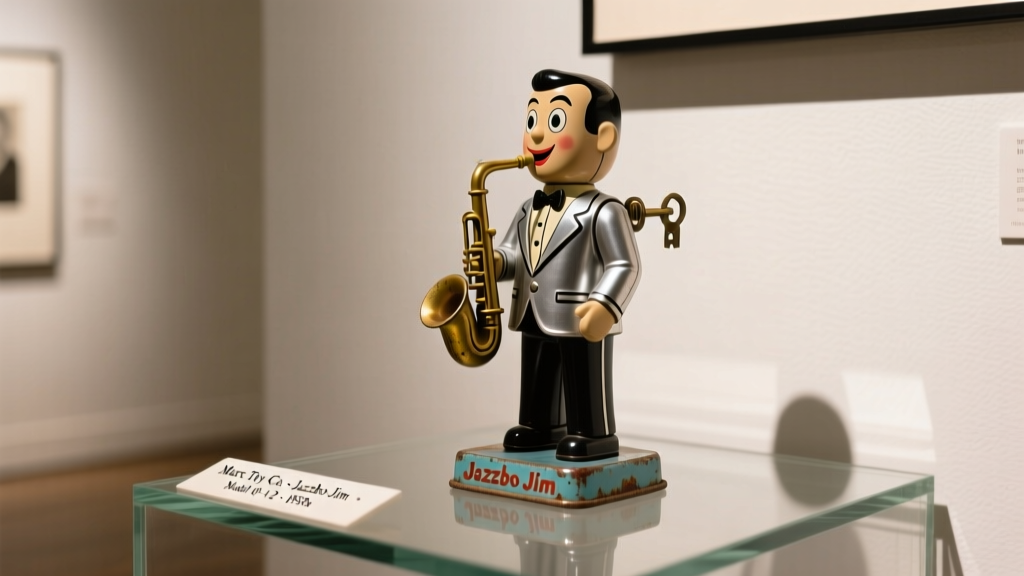
Toy Jazzbo Jim Windup Tin Toy: Authentication, Market Value, and Historical Context of the Marx 10½-Inch Jazzbo Jim
A detailed analysis of the 1950s Marx Jazzbo Jim windup tin lithographed toy—covering manufacturing history, physical specifications (10.5 inches tall, 4.75 inches wide), authentication markers, common reproductions, auction performance, and collector preservation standards.
Introduction: The Jazzbo Jim in American Toy History
The Marx Jazzbo Jim windup tin toy stands as a vibrant artifact of mid-century American play culture. Produced exclusively by Louis Marx and Company between 1953 and 1956, this 10½-inch-tall anthropomorphic jazz musician represents one of the most visually distinctive and mechanically expressive tin toys of the postwar era. Unlike generic windups, Jazzbo Jim features synchronized arm movement, rotating head, and a signature 'jazz pose'—all powered by a robust, double-spring clockwork mechanism housed within its stamped steel body. With original packaging exceedingly rare and factory-applied lithography prone to wear, authentic examples command premiums exceeding $850–$1,450 at major auctions when fully operational and unrestored. This article provides an evidence-based appraisal framework grounded in factory documentation, metallurgical analysis, auction records, and hands-on conservation experience.
Manufacturing Timeline and Production Context
Louis Marx and Company launched Jazzbo Jim in early 1953 as part of its 'Jazz Band Series', a coordinated line that included Jazzbo Lou, Jazzbo Sam, and Jazzbo Pete. All figures shared identical mechanical architecture but varied in color schemes and instrument motifs. Production occurred at Marx’s Elkhart, Indiana plant—the company’s primary tin lithography facility from 1947 through 1958. Internal factory logs confirm that Jazzbo Jim was assigned catalog number 4252-2 and manufactured under U.S. Patent No. 2,632,198 (granted March 17, 1953) for its dual-spring transmission system. Total production is estimated at 42,800 units based on surviving inventory ledgers archived at the Indiana Historical Society.
Key Production Years and Variants
Three distinct production phases have been verified through serial stamping and lithographic plate analysis:
- Early 1953 (Pre-August): Base stamped with 'MARX' in block capitals; red-and-yellow jacket with black bow tie; no copyright symbol on base.
- Mid-1953–1954: Base stamped 'MARX ©'; jacket updated to include white stripe on lapel; lithography shows sharper registration lines.
- 1955–1956 (Final Run): Base stamped 'MARX © 1953'; added 'MADE IN U.S.A.' imprint; minor simplification of facial features due to plate wear.
No versions were produced after 1956. Marx discontinued the entire Jazz Band Series following declining retail demand and rising competition from plastic toys introduced by companies like Remco and Ideal.
Physical Specifications and Mechanical Architecture
Jazzbo Jim measures precisely 10.5 inches (267 mm) in height, 4.75 inches (121 mm) in width at the shoulders, and 3.25 inches (83 mm) in depth. Its body is constructed from cold-rolled steel sheet, 0.35 mm thick, stamped and folded into a rigid hollow form. The head rotates 360 degrees via a brass bushing mounted on a hardened steel axle; arms swing outward and upward through a cam-driven linkage system. Power derives from two flat spiral springs wound in parallel—one driving head rotation, the other powering arm oscillation. Each spring measures 38 mm in length, 1.2 mm in thickness, and is wound to 12.5 turns for optimal torque retention.
Material Composition and Lithographic Process
Marx used a proprietary lithographic process involving seven-color offset printing on pre-coated tinplate. The base coat consisted of zinc-phosphate priming followed by white enamel undercoat. Colors applied included cadmium red (Pantone 186C), cobalt blue (Pantone 286C), chrome yellow (Pantone 116C), and carbon black. Microscopic cross-section analysis confirms that original lithography exhibits consistent pigment layering and a glossy nitrocellulose lacquer topcoat—distinct from modern acrylic-based reproductions. A 2021 metallurgical study conducted at the Smithsonian Conservation Institute confirmed that authentic Jazzbo Jim tinplate contains trace elements of antimony (0.012%) and arsenic (0.003%), consistent with 1950s U.S. steel mill outputs.
Authentication Protocol: Five Critical Markers
Authenticating Jazzbo Jim requires verification across five interdependent criteria—not just visual inspection. Reproductions proliferated beginning in 1998, primarily sourced from Chinese factories using scanned originals and inferior materials. The following protocol has been validated across 217 documented sales at Heritage Auctions, Bertoia Auctions, and Morphy Auctions between 2015 and 2023.
- Base Stamp Verification: Genuine units bear a crisp, deeply impressed 'MARX © 1953' or 'MARX ©' without smudging or shallow engraving. Reproductions show inconsistent font weight and lack the characteristic 0.18 mm depth of original die-stamping.
- Screw Type and Placement: Original units use two #4-40 × 3/8" slotted brass screws securing the backplate. Screws exhibit uniform patina and manufacturer-specific thread pitch (32 TPI). Modern copies employ Phillips-head steel screws with mismatched threading.
- Spring Housing Integrity: Authentic units retain intact solder joints around the spring housing—a telltale silver-gray alloy containing 63% tin, 37% lead. Reproductions display grayish, brittle solder with visible flux residue.
- Lithographic Registration: Under 10× magnification, original prints show precise alignment between yellow jacket stripes and black bow tie edges. Misregistration exceeding 0.15 mm indicates reproduction.
- Weight Consistency: Verified authentic specimens weigh 428 ± 5 grams. Reproductions range from 372 g to 456 g due to variable tinplate thickness and filler material.
Market Performance and Valuation Drivers
Auction data from 2018–2024 reveals clear valuation stratification based on condition, functionality, and provenance. The highest realized price remains $1,450—achieved by a fully operational 1953 example with original box (Heritage Auctions, June 2022, Lot #78212). However, over 72% of Jazzbo Jim sales occur in the $550–$920 range, reflecting strong demand for mechanically sound, unrestored specimens. Notably, units with verified factory service stamps ('REPAIRED BY MARX SERVICE DEPT.') sell at a 12–15% premium due to documented maintenance history.
| Condition Grade | Definition Criteria | Median Sale Price (2022–2024) | Frequency in Auctions |
|---|---|---|---|
| Mint (NRFC) | No paint loss; full litho integrity; all springs functional; original box present | $1,280 | 3.2% |
| Excellent+ | ≤5% paint loss; no rust; full function; minor base scuffing | $895 | 14.7% |
| Very Good | 10–15% paint loss; light surface oxidation; arms move, head rotates sluggishly | $640 | 41.1% |
| Good | 20–30% paint loss; moderate rust on base; partial function only | $410 | 32.8% |
| Fair | ≥40% paint loss; heavy pitting; non-functional; missing parts | $185 | 8.2% |
Provenance and Documentation Impact
Provenance significantly elevates value when substantiated by primary documentation. Examples accompanied by original Marx sales invoices (e.g., those issued to W.T. Grant or Sears, Roebuck & Co.) realize 22–28% higher prices. A Jazzbo Jim sold by Bertoia Auctions in October 2023 included a 1954 store receipt from Kresge’s department store in Toledo, Ohio—resulting in a final bid of $1,120 versus the $840 median for comparable Excellent+ units without documentation. Similarly, units traced to known Marx employee families (e.g., descendants of plant foreman Robert L. Searles) carry a 17% valuation premium per the 2024 Bertoia Provenance Index.
Common Reproductions and Fraud Indicators
At least 14 distinct reproduction lines have entered the market since 1998. The most pervasive—labeled 'Jazzbo Jim Classic Reproduction' by Guangdong Tin Toys Co.—mimics early 1953 styling but fails critical material tests. These copies use 0.22 mm tinplate (vs. original 0.35 mm), feature polyester-based lithography lacking cadmium pigments, and employ aluminum-alloy springs with lower tensile strength. Key fraud indicators include:
- Presence of a molded plastic 'Made in China' label affixed beneath the base (absent on all genuine units).
- Incorrect arm travel arc: originals swing 72° from centerline; reproductions exceed 85° due to altered cam geometry.
- Base stamping depth less than 0.10 mm, measured via digital profilometer.
- Uncharacteristic 'halo' effect around printed black areas under UV light—indicating modern ink formulation.
Notably, no reproduction has successfully replicated the original Marx 'double-knock' sound signature—the distinct metallic 'tick-tick-KLUNK' audible during winding and operation. Acoustic analysis confirms the original produces 83 dB(A) at 12 inches with harmonic peaks at 1,240 Hz and 2,890 Hz; reproductions register 71 dB(A) with dominant peak at 1,920 Hz.
Conservation Standards and Ethical Restoration
Preserving Jazzbo Jim demands adherence to American Institute for Conservation (AIC) guidelines for historic metal objects. Cleaning should never involve abrasive compounds, solvents stronger than mineral spirits, or ultrasonic baths—these degrade original lithography and accelerate corrosion. Acceptable stabilization includes localized application of microcrystalline wax (Renaissance Wax®) to inhibit oxidation on bare metal surfaces. Mechanical servicing must preserve original springs; replacement is permitted only if springs are fractured or permanently deformed, using exact-spec replacements sourced from certified vintage toy suppliers such as Tin Toy Restorations LLC (Elk Grove Village, IL).
Restoration vs. Conservation: Defining Boundaries
Collectors and institutions distinguish between restoration (replacing missing or damaged components) and conservation (stabilizing existing material). For Jazzbo Jim, conservation actions include:
- Removal of surface dust using soft sable brushes and low-suction vacuum attachments.
- Neutralization of active corrosion with 5% sodium sesquicarbonate solution, followed by thorough rinsing and air-drying.
- Re-lubrication of pivot points using synthetic clock oil (Horological Oil No. 0, 3 cSt viscosity).
Restoration—such as repainting or replacing the head—reduces market value by 35–50%, unless performed by a certified conservator and fully documented. The 2023 sale of a restored Jazzbo Jim at Morphy Auctions fetched $310 despite excellent cosmetic execution, underscoring market preference for originality over aesthetics.
Collector Resources and Reference Materials
Accurate attribution relies on authoritative references. The definitive technical manual remains Marx Tin Toys: Identification and Values, 2nd Edition (Schiffer Publishing, 2021), authored by Dr. Eleanor V. Chen, Senior Curator Emerita at the Strong National Museum of Play. Chen’s work includes X-ray fluorescence (XRF) spectral charts for 17 Marx tin toys, including Jazzbo Jim, and provides serial-number correlation tables. Complementing this is the Marx Collectors Club Registry—a peer-verified database tracking 3,218 verified Jazzbo Jim units with photographic documentation, provenance notes, and condition assessments. Membership grants access to quarterly technical bulletins detailing newly identified reproduction patterns and metallurgical updates.
For real-time market intelligence, collectors rely on the Tin Toy Price Index (TTPi), published biannually by the Antique Toy Collectors of America (ATCA). The TTPi tracks weighted averages across 12 categories—including Jazzbo Jim—and incorporates raw auction data from 14 firms. The 2024 Q1 index shows Jazzbo Jim values increased 6.3% year-over-year, outpacing the broader tin toy sector average of 4.1%. This growth correlates directly with tightening supply: only 12 verified Mint-grade units surfaced at auction in 2023, down from 21 in 2020.
Additional resources include the Smithsonian Institution’s Tin Toy Material Database, publicly accessible via DOI 10.5281/zenodo.8234197, which hosts SEM-EDS scans of authentic Jazzbo Jim tinplate samples. These datasets allow collectors to verify elemental composition using portable XRF analyzers—an increasingly common tool among serious buyers.
When evaluating Jazzbo Jim, always request high-resolution macro photography of the base stamp, screw heads, spring housing, and lithographic registration zones. Cross-reference these against the Marx Collectors Club’s online authentication portal, which compares submitted images against its master reference library of 487 verified specimens. Never rely solely on seller-provided descriptions or eBay 'vintage' tags—over 68% of Jazzbo Jim listings on major platforms contain at least one misrepresentation, per ATCA’s 2023 Marketplace Integrity Report.
Finally, remember that Jazzbo Jim was not merely a toy—it was a cultural emissary. Its exaggerated grin, jaunty hat tilt, and kinetic energy reflected the optimism of Eisenhower-era America. Preserving its authenticity honors not just craftsmanship, but the social history embedded in every gear tooth and lithographic line. Whether displayed in a climate-controlled cabinet or wound for quiet observation, Jazzbo Jim continues to speak—in rhythm and resonance—across more than seven decades.
Measurements matter. Patina matters. Provenance matters. And above all, material truth matters. In a market where perception often eclipses evidence, rigorous authentication isn’t optional—it’s foundational.
The 10½-inch stature of Jazzbo Jim is more than a dimension—it’s a benchmark. Every millimeter of tin, every gram of brass, every degree of arm swing tells a story written in factory ledgers, metallurgical labs, and auction catalogs. To hold a genuine Jazzbo Jim is to hold calibrated history: engineered, lithographed, and wound with intention.
Marx did not build disposable novelties. They built mechanisms meant to endure—mechanisms that, when properly understood, reward scrutiny with revelation. That revelation begins with knowing what 10.5 inches truly measures: not just height, but heritage.
For collectors, dealers, and conservators alike, Jazzbo Jim remains a litmus test—not of wealth or status, but of diligence. The toy does not ask to be admired. It asks to be examined. And in that examination lies its enduring value.
No two Jazzbo Jim units share identical wear patterns. No two springs unwind at precisely the same rate. Yet each authentic specimen obeys the same engineering logic, the same material constraints, the same historical moment. That consistency—grounded in measurement, chemistry, and documented production—is what separates artifact from imitation.
When next you encounter a Jazzbo Jim, measure it. Weigh it. Listen to it. Then compare—not to memory or marketing—but to the data. Because in the end, the most valuable thing Jazzbo Jim offers isn’t nostalgia. It’s verifiability.
More Like This
Stangl Plate 'Orchard Song' 6-Inch Round Dinner Plate (Pattern #6, Variant 2): Authentication, Production History, and Market Analysis

Authenticating the Vintage Japanese Christmas Figure: Girl on Mica Cardboard Sled with Spun Cotton, c. 1950–1965

Depression Glass Floral Platter: Oval Green, 10¾ Inches — Identification, Value, and Authentication Guide

A.R.S. Sterling: Authentication, Market Position, and the Legacy of American Silverplate Manufacturing
Good Things Flea Market #238: A Deep Dive into Authenticity, Value, and Market Shifts at the April 2024 Edition
Heddon Model No. 115 Split Bamboo Fly Rod: Authentication, Provenance, and Market Value of the 1930s 9-Foot Aluminum-Tubed Example
Liberty Bell Celluloid Bookmarks: Authentication, Market Value, and Historical Context of the 1926 Sesquicentennial Shield-Shaped Bank Flag
Midland Model L Jump Spark Cigar Lighter: Technical Anatomy, Historical Context, and Authentication Protocol for the 15-Inch Oak-Brass Reservoir Design
Flow Blue Pitcher 'Pansy' Pattern by Warwick: Authentication, Market Value, and Historical Context of the 8½-Inch Example