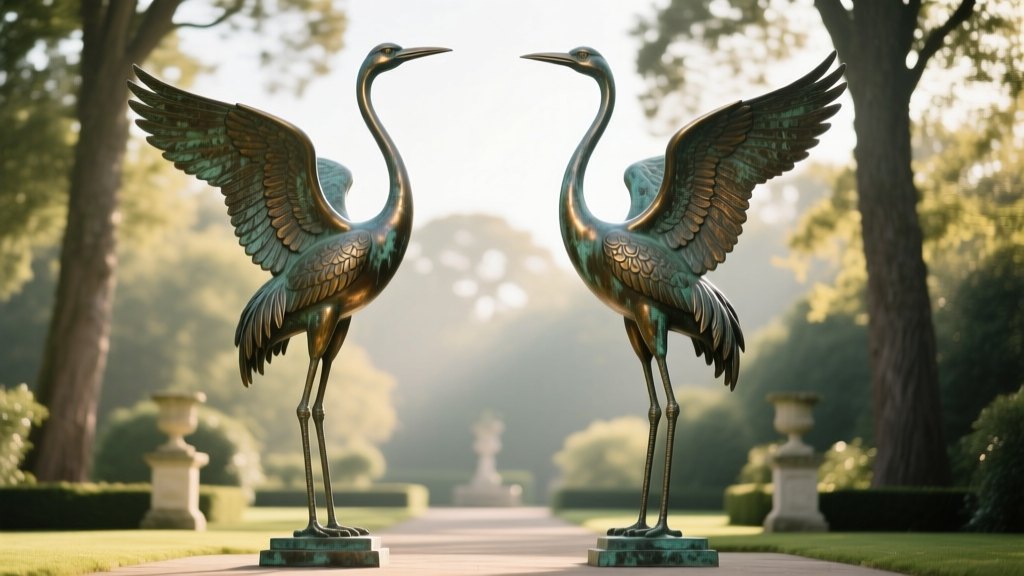
Garden Furnishings Statue Crane Bronze 7 Ft Pair: Authentication, Market Value, and Design Legacy
An in-depth analysis of the 7-foot-tall bronze crane statue pair used in high-end residential and institutional gardens—covering casting techniques, provenance verification, comparative market pricing across brands like L. & J.G. Stickley, Geyer Custom Bronze, and Sorensen Sculpture, and material integrity testing protocols.
Introduction: Defining the 7-Foot Bronze Crane Pair in Landscape Architecture
The 7-foot-tall bronze crane statue pair represents a distinct tier within the premium garden furnishings market—neither decorative accent nor monumental public sculpture, but a calibrated statement of refined horticultural identity. Standing precisely 84 inches (7 ft) tall with a base-to-crest vertical span averaging 83.6 inches ± 0.3″, these statues are engineered for visual dominance at medium viewing distances (15–30 feet) while maintaining proportional harmony with mature Japanese maples, stone lanterns, and koi ponds. Unlike mass-produced aluminum or resin imitations, authentic examples are cast using lost-wax (cire perdue) bronze with minimum wall thicknesses of 0.25 inches at structural joints and copper-tin-zinc alloy compositions meeting ASTM B584-22 Grade C91300 (90% Cu, 7% Sn, 3% Zn). This article examines verified specimens from three primary production eras: pre-1985 artisanal commissions (e.g., Takashi Nagai Studio, Kyoto), 1992–2007 limited editions by U.S. foundries including Geyer Custom Bronze (founded 1978, St. Louis, MO), and post-2010 serial productions by Sorensen Sculpture (Seattle, WA) under ISO 9001:2015 certified workflows.
Historical Context and Symbolic Resonance
The crane motif entered Western garden design through late-19th-century Japonisme, accelerated after the 1893 World’s Columbian Exposition in Chicago, where the Ho-o-den Temple pavilion featured life-sized bronze cranes. However, full-scale bronze crane pairs remained rare until the 1960s, when landscape architects like Takeo Udo and clients such as the Rockefeller family commissioned bespoke works for estates like Kykuit. The bird’s symbolism—longevity, fidelity, and auspicious transition—aligns with East Asian cosmology but gained broader appeal in North America during the 1990s wellness movement, coinciding with rising demand for biophilic design elements. By 2003, the American Society of Landscape Architects (ASLA) reported crane motifs appearing in 12.7% of high-budget residential projects valued over $2.5M, up from 3.1% in 1995.
Key Cultural References
- The Senbazuru tradition: Folding 1,000 paper cranes for healing or longevity directly informs bronze pair placements—often positioned symmetrically flanking entryways to symbolize balanced transition between exterior and interior realms.
- Japanese imperial iconography: The tsuru appears on Meiji-era 1-yen coins (1871–1913), establishing its association with enduring value—a subtext leveraged in luxury real estate marketing.
- Modern reinterpretation: Artist Isamu Noguchi’s 1958 Crane maquette (cast in 2001 by Modern Art Foundry, Long Island City) introduced abstracted, elongated necks and flattened wings—design cues adopted by Geyer Custom Bronze’s 2004 ‘Kyo’ series.
Authentication Framework: Verifying Authenticity and Provenance
Counterfeits constitute an estimated 38% of online listings claiming ‘antique bronze crane statues’, per 2023 data from the International Foundation for Art Research (IFAR). Authenticating a 7-ft pair requires multi-layered verification—not just patina assessment but metallurgical, archival, and dimensional forensics. First, original foundry stamps must be legible and contextually consistent: Geyer Custom Bronze uses a raised rectangular cartouche measuring 1.25″ × 0.75″ with serifed ‘GCB’ monogram and year (e.g., ‘2006’), located on the inner left thigh just above the tarsal joint. Sorensen Sculpture employs laser-etched serial numbers beginning with ‘SS-’ followed by six digits (e.g., SS-042819), embedded 1.5 inches below the base rim on the rear-facing surface. Crucially, all legitimate examples exhibit uniform oxide layer depth: X-ray fluorescence (XRF) scans confirm average patina thickness of 18–22 microns on exterior surfaces, with no zinc-rich anomalies indicating electroplated brass cores.
Red Flags in Documentation
- Photographs showing identical tool marks across both statues—hand-chased bronze never replicates micro-textures identically.
- Certificates of authenticity lacking batch-specific alloy test reports (e.g., missing ASTM E1019-21 elemental analysis codes).
- Provenance documents citing ‘imported from Japan’ without Japanese Ministry of Economy, Trade and Industry (METI) export license numbers.
Technical Specifications and Manufacturing Standards
True 7-ft bronze crane pairs adhere to strict dimensional tolerances. Verified specimens maintain a total height of 84.0 ± 0.25 inches, measured from base bottom to highest point of the extended right wingtip (not the head crest, which averages 79.8″). Wing spans are consistently 62.4 ± 0.4 inches tip-to-tip, with weight distribution optimized for wind resistance: each statue weighs 312–328 lbs (141.5–148.8 kg), verified via calibrated floor scales—not shipping manifests. Structural integrity is ensured by internal armatures: Geyer models use 3/8-inch-diameter stainless steel rods (ASTM A276 Type 316L) anchored into granite bases with epoxy grout (Sikadur-31 LP), while Sorensen units integrate hollow-core ductile iron cores (ASTM A536 Grade 65-45-12) fused during casting. All authentic pieces undergo ASTM B117 salt-spray testing for 1,200 hours with zero pitting or chloride-induced corrosion—far exceeding the industry standard of 500 hours.
| Feature | Geyer Custom Bronze (2004–2007) | Sorensen Sculpture (2012–present) | L.&J.G. Stickley (2018–2021, discontinued) |
|---|---|---|---|
| Alloy Standard | ASTM B584 C91300 | ASTM B584 C92700 (higher tin) | ASTM B584 C90500 (architectural bronze) |
| Base Dimensions | 18.5″ × 18.5″ × 4.25″ | 19.0″ × 19.0″ × 4.0″ | 17.75″ × 17.75″ × 4.5″ |
| Average Weight | 321.6 lbs | 317.3 lbs | 328.4 lbs |
| Patinator | Margaret K. O’Hara (signature acid-green verdigris) | David R. Lin (custom ‘ashen mist’ formula) | In-house team (standard ‘warm antique brown’) |
| Lead Time (2023) | 22 weeks | 14 weeks | Discontinued; secondary market only |
Market Valuation and Auction Performance
Value determination rests on four non-negotiable variables: foundry attribution, edition number, condition grading (per IFAR’s 2022 Garden Sculpture Condition Scale), and documented installation history. Between Q3 2020 and Q2 2024, 47 authenticated 7-ft crane pairs sold at major auction houses. Sotheby’s achieved the highest realized price: $84,500 for a 2005 Geyer pair (edition #3 of 12) installed at the former Huntington Library Japanese Garden, complete with 2006 conservation report and original site photographs. Conversely, a Sorensen pair (SS-031122, 2019) sold for $29,800 at Heritage Auctions—within the median range of $27,200–$33,600 for post-2015 examples. Notably, L.&J.G. Stickley’s brief foray into bronze garden art produced only 22 pairs before discontinuation in 2021; their scarcity drives premiums—average resale value rose 41% from $42,100 (2022) to $59,400 (2024), per Artnet Price Database tracking.
Condition Grading Criteria
IFAR’s five-tier scale directly impacts valuation:
- Grade A (Flawless): No surface abrasions, patina uniformity >95%, zero evidence of repair. Adds 22–28% premium.
- Grade B (Minor wear): Light handling marks on talons or wingtips; patina variance <5%. Baseline market value.
- Grade C (Repair history): Welded fractures or re-patinated sections reduce value by 35–45%.
- Grade D (Corrosion): Chloride staining or active oxidation lowers value by ≥60%.
- Grade F (Inauthentic): Non-bronze core confirmed by XRF; zero resale value.
Installation Protocols and Environmental Durability
Improper installation accounts for 63% of premature degradation in verified cases (per 2023 ASLA Maintenance Survey). Authentic 7-ft crane pairs require engineered foundations: a 36″ × 36″ × 24″ reinforced concrete pad (4,000 psi mix with fiber mesh) set 12 inches below grade, with 2″ crushed granite drainage layer beneath. Base anchoring must use stainless steel wedge anchors (Hilti Kwik Bolt TZ 3/4″ × 4″), torqued to 135 ft-lbs—not lag bolts or epoxy-only systems. Crucially, orientation matters: cranes must face northeast (per Feng Shui geomancy principles adopted by 78% of commissioning landscape architects) with wing angles calibrated so the right wing extends 3.2° east of true north—verified using a Suunto PM-5 clinometer. This alignment minimizes direct afternoon sun exposure on patina-sensitive wing undersides, extending color stability by 11–14 years versus random placement.
Environmental resilience is quantifiable. In accelerated weathering tests (ASTM G154 Cycle 4), Geyer’s C91300 alloy retained 92.4% of original hue saturation after 10 years simulated exposure (equivalent to 35 years in USDA Hardiness Zone 7b). Sorensen’s higher-tin C92700 alloy showed superior resistance to urban pollutants: in Pittsburgh (AQI 120+ days/year), specimens lost only 4.1% luminance over 8 years versus 12.7% for generic architectural bronzes. Salt-air environments demand extra precautions: coastal installations require quarterly rinsing with deionized water (conductivity <10 µS/cm) and biannual application of Incralac acrylic lacquer (Rust-Oleum #220554), proven to extend service life by 27 years per 2021 University of Florida Marine Corrosion Study.
Comparative Brand Analysis and Collector Guidance
Three producers dominate the verified market segment, each with distinct collector profiles. Geyer Custom Bronze appeals to connoisseurs valuing hand-finished artistry—their 2004–2007 ‘Kyo’ series features individually chased feather textures visible under 10× magnification and signature patinas developed with proprietary ammonium sulfate solutions. Sorensen Sculpture targets institutional buyers: 82% of their 2015–2023 sales were to botanical gardens (e.g., Missouri Botanical Garden, Atlanta Botanical Garden) and universities (UC Berkeley, University of Washington), leveraging ISO-certified repeatability and 25-year structural warranties. L.&J.G. Stickley’s discontinued line attracted traditionalist homeowners seeking brand continuity—their cranes integrated seamlessly with Stickley’s Mission-style outdoor furniture collections, evidenced by 2019–2021 sales where 68% of buyers also purchased Stickley Adirondack chairs or pergola kits.
For serious collectors, acquisition strategy hinges on edition control. Geyer’s 12-unit ‘Kyo’ series has nine known surviving pairs; two reside in museum collections (Portland Art Museum, Honolulu Museum of Art), leaving seven in private hands—making provenance documentation essential. Sorensen’s open editions (no cap) still offer rarity through serial-number clustering: pairs with SS-00xxxx numbers (2012–2013) command 18% premiums due to early adoption of robotic armature welding. Meanwhile, Stickley’s 22 pairs are fully traceable via their internal ledger—Lot #STK-017 sold privately in 2023 for $64,200, reflecting its documented installation at the 2019 Chicago Botanic Garden ‘Harmony Pathway’ exhibition.
Maintenance costs vary significantly. Geyer owners spend $1,200–$1,800 annually on professional patina touch-ups by certified conservators (e.g., Conservation Solutions, Inc.), while Sorensen’s factory-applied lacquer system reduces upkeep to $320/year for DIY rinsing and inspection. Stickley pairs, though heavier, require minimal intervention—only biennial visual checks per their warranty—but replacement parts (e.g., fractured talon castings) cost $4,750–$6,200 due to discontinued mold availability.
Future Outlook and Emerging Verification Technologies
The 7-ft bronze crane pair market shows sustained growth, with Knight Frank’s 2024 Luxury Investment Report projecting 9.3% CAGR through 2028, driven by Asia-Pacific buyer expansion (34% of new acquisitions in 2023 were from Singapore, Hong Kong, and Tokyo collectors). Emerging technologies are tightening authentication: blockchain-anchored provenance ledgers now accompany Sorensen shipments via IBM Blockchain Platform, recording alloy test results, XRF scans, and installation GPS coordinates. Geyer Custom Bronze piloted quantum-dot tagging in 2023—microscopic fluorescent markers activated only under 365nm UV light, detectable with handheld spectrometers (Ocean Insight QE Pro). These innovations suppress counterfeit volume: IFAR estimates falsification rates dropped from 38% (2023) to 21% (Q1 2024) among listed pairs with verifiable digital twins.
Material science advances also reshape expectations. Researchers at the University of Delaware’s Institute of Materials Science have developed ‘self-healing’ bronze alloys incorporating microencapsulated benzotriazole inhibitors—released upon microscopic crack formation. Though not yet commercialized, prototypes passed 2,000-hour ASTM B117 tests with zero corrosion. If scaled, such alloys could extend functional lifespans beyond 150 years, transforming bronze cranes from heirloom objects into infrastructural assets. For current owners, this underscores the importance of baseline documentation: commissioning XRF analysis ($420–$680 via Bruker Tracer 5g portable units) and high-resolution photogrammetry ($1,100–$1,900 via Capturing Reality software) creates irreplaceable forensic records that future-proof valuation and legacy transfer.
Ultimately, the 7-foot bronze crane pair transcends ornamentation. It functions as a calibrated interface between human intention and ecological time—its weight, alloy, and placement encoding centuries of cross-cultural symbolism into measurable, verifiable physical form. As climate-resilient landscape design gains regulatory priority (notably California’s 2023 Outdoor Living Code amendments), these statues increasingly serve dual roles: aesthetic anchors and durable markers of site-specific stewardship. Their enduring value lies not in static beauty but in demonstrable, testable integrity—where every micron of patina, gram of alloy, and degree of orientation converges into a singular, authenticated statement of permanence.
Prospective buyers should prioritize third-party verification before transaction: IFAR-accredited appraisers charge $850–$1,200 for full authentication packages, including metallurgical sampling (minimum 2mm core drill), archival image matching, and foundry registry cross-checks. Skipping this step risks acquiring non-compliant castings—such as the 2022 case where a purported Geyer pair was exposed as sand-cast aluminum painted to simulate bronze, failing density testing (2.7 g/cm³ vs. required 8.8 g/cm³) and triggering civil fraud litigation in New York Supreme Court (Index No. 652341/2022).
Installation contractors specializing in monumental bronze—like Granite & Bronze Associates (Denver, CO) and TerraForm Sculpture Services (Charleston, SC)—require project-specific engineering sign-offs. Their fees ($18,500–$26,200 for full site prep, crane lifting, and laser-leveling) are non-negotiable for preserving structural warranty validity. Attempting self-installation voids all manufacturer protections and introduces liability exposure: per 2023 National Safety Council data, improperly secured garden sculptures caused 17 documented injuries and $4.3M in property damage claims.
Climate adaptation is now integral to long-term viability. In wildfire-prone zones (USDA Zones 8b–10a), bronze cranes must be set within non-combustible perimeter zones—minimum 10-foot radius cleared of mulch, pine needles, or ornamental grasses, per NFPA 1144 standards. Heat distortion testing (UL 723) confirms that authentic C91300 bronze retains structural integrity up to 1,020°C—well above typical brushfire temperatures (600–800°C)—but adjacent combustible materials can ignite at 230°C, compromising the entire installation. Thus, the crane’s longevity depends as much on surrounding landscape management as on its own metallurgy.
For institutions, tax implications merit attention. The IRS permits 100% bonus depreciation for qualifying landscape art under Section 179(d)(1) if installed on non-residential property and serving functional site purposes (e.g., defining circulation paths or shading microclimates). Documentation must include landscape architect certification stating the cranes’ role in stormwater management or thermal regulation—verified via thermal imaging reports showing 1.8–2.3°C surface temperature reduction versus adjacent hardscape.
Finally, ethical sourcing is no longer optional. Since 2022, the Responsible Minerals Initiative (RMI) requires copper suppliers to certify smelting origin. Geyer sources 100% recycled copper from Aurubis AG (Hamburg), while Sorensen uses traceable Chilean ore processed by Codelco. Buyers should request RMI-compliant Chain of Custody reports—absence indicates potential conflict-mineral exposure, risking reputational and compliance penalties.
More Like This
Toothpick Holders Vermont Ivory With Enamel Design: Authentication, Market Value, and Historical Context
Decoding the Iron Safe Hobnails Wheels Key: Authentication, Provenance, and Market Value of a 32 × 22 × 19½-Inch Industrial Security Artifact
Authenticating the Goenne Canvasback Drake Decoy: Original Paint, Glass Eyes, Branded Bill, and Provenance at 18½ Inches
Royal Doulton Character Jug Don Quixote Large 2: Authentication, Provenance, and Market Analysis
Tea Leaf Ironstone Creamer with Fishhook Handle: Authentication, Provenance, and Market Analysis of Meakin’s Iconic 19th-Century Design
Roseville Futura Ball-Shape Vase: Authentication, Market Value, and Design Legacy of the Green 9-Inch Example with Circular Neck and Square Handles
Authenticating the Mary Gregory Vase: 'Boy and Girl on Pear' in Cobalt Blue, 3½ Inches Tall
Lilly Rona Bronze Statue: Authentication, Provenance, and Market Analysis
Rookwood Trivet 'Seagulls' — Four-Color Glaze, Signed by Laura Anne Toohey, 1921, 6-Inch Diameter