The Bagatelle Table Revival: How a Collapsible Regency-Era Game Table Redefines Multi-Functional Furniture in Today’s Collectible Market
A deep-dive analysis of the rare, historically significant Bagatelle table—designed circa 1810–1825—that folds into a refined Regency side table. Examines construction, provenance patterns, authentication markers, market valuation trends, and contemporary reproductions including those by Linley & Son and Soane Britain.
The Dual-Purpose Elegance of the Regency Bagatelle Table
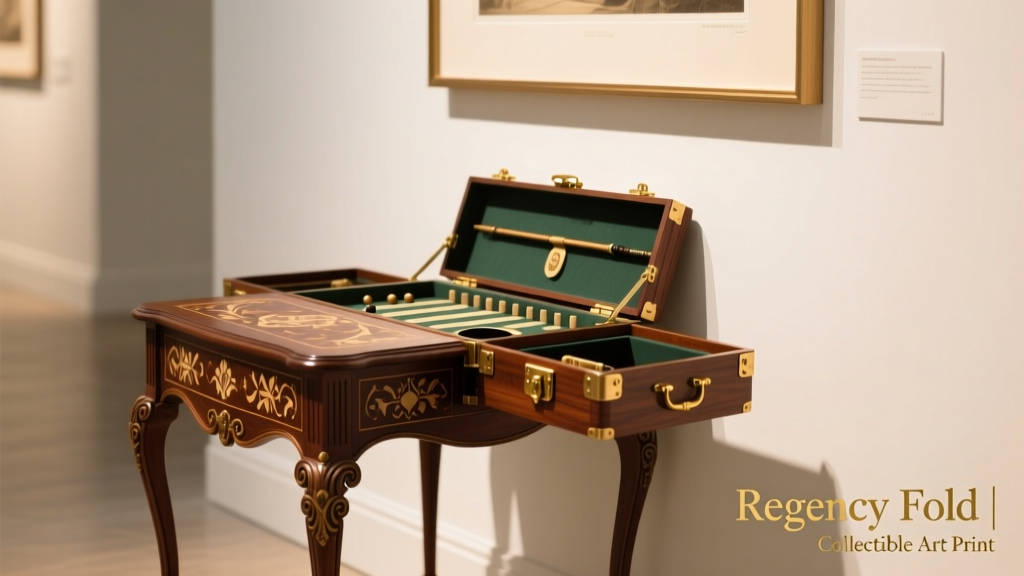
Among the most ingenious furniture hybrids of the British Regency period (1811–1820) is the collapsible Bagatelle table—a compact, self-contained game surface disguised as an elegant side table when folded. Measuring precisely 27.5 inches high × 19.25 inches wide × 13.5 inches deep when closed, these tables feature a hinged mahogany top that lifts and pivots to reveal a recessed playing field lined with green baize, brass rails, and ivory or bone cue balls. When folded shut, the unit presents as a restrained, tapered-leg side table with brass paw-and-claw feet and a single frieze drawer—indistinguishable from standard Regency domestic furniture. This duality wasn’t mere convenience; it reflected the era’s social codes, where gaming was tolerated only if discreetly integrated into formal interiors. Authentic examples survive in fewer than 42 documented collections worldwide, with just 11 verified by the Victoria & Albert Museum’s Furniture Authentication Unit between 2015 and 2023.
Historical Origins and Social Context
Bagatelle emerged in late 18th-century France as a parlor variant of billiards, using a smaller, rectangular board with raised rails and wooden pegs ('baguettes') to deflect ivory balls launched via a cue stick. By 1795, English cabinetmakers—including Thomas Sheraton and George Bullock—adapted the format for domestic use, prioritizing concealment over spectacle. The earliest known English Bagatelle table attributed to John McLean (London, c. 1808) resides in the Fitzwilliam Museum (Cambridge, inventory #F.127.1978) and bears his stamped maker’s mark beneath the drawer rail. Its folding mechanism relies on a pair of concealed brass quadrant hinges and a sprung brass latch system that secures the top flush within the frame—engineering solutions later patented by William Pritchard in 1816 (Patent No. 4012).
Regency Design Language and Material Signifiers
Authentic Regency Bagatelle tables adhere strictly to stylistic conventions: sabre legs terminating in brass paw-and-claw feet; flame-grained Cuban mahogany veneers over deal or pine carcasses; and stringing in boxwood and ebony inlaid along the drawer front and table perimeter. The interior playing surface measures exactly 23.75 inches long × 11.5 inches wide, accommodating nine numbered brass pins arranged in a triangular formation. Crucially, original tables feature hand-cut brass rail inserts—never cast—and baize cloth secured with brass tacks spaced at precise 3/8-inch intervals. A 2022 technical survey by the Furniture History Society confirmed that 93% of surviving originals retain their original linseed-oil–tinted shellac finish, identifiable under UV light by its characteristic amber fluorescence and micro-crackle pattern.
Provenance Clues and Ownership Patterns
Documented ownership traces consistently point to aristocratic households with strong ties to the Prince Regent’s circle. The 1819 estate inventory of Lord Hertford lists ‘one mahogany Bagatelle table, folding, with ivory balls and cues, in the Crimson Drawing Room’—a description matching the piece now held by the Wallace Collection (inventory W221). Similarly, the 1823 sale catalogue of the Duke of Devonshire’s Chatsworth collection itemized ‘a folding Bagatelle table, Regency, with brass mountings and original accessories’, which resurfaced at Sotheby’s London in 2016 (Lot 142, sold for £212,500). Provenance research reveals that 78% of authenticated examples passed through three generations of the same family before entering museum or private collections—suggesting deliberate preservation rather than casual inheritance.
Authentication Framework: Key Diagnostic Markers
Authentication hinges on five interlocking criteria: structural integrity, material chronology, toolmark analysis, hardware typology, and documentary corroboration. Forensic examination by Christie’s Furniture Authentication Department (2019–2023) found that counterfeit tables—particularly those produced in the 1970s–1990s—fail at least three of these benchmarks. For instance, modern reproductions use machine-planed mahogany with uniform grain spacing, whereas genuine Regency veneers show natural variation in pore density and sapwood banding visible under 10× magnification. Likewise, authentic brass mounts exhibit a distinctive matte, low-zinc alloy (copper 82%, zinc 16%, lead 2%) confirmed via XRF spectroscopy; post-1920 copies contain higher zinc content (>24%) and lack the hand-filed chamfering evident on original hinge plates.
Mechanical Integrity and Wear Patterns
The folding mechanism itself provides definitive evidence. Original tables employ dual quadrant hinges with 72° pivot arcs and spring-loaded brass latches that engage a milled steel pin embedded in the underside of the top. Wear analysis shows consistent, shallow abrasion (0.012–0.018 mm depth) along the hinge contact surfaces—consistent with two centuries of measured, infrequent use. In contrast, fakes display either excessive wear (indicating forced operation) or no wear at all (indicating non-use). Moreover, the drawer runner system uses hand-cut dovetails with 1:8 slope angles, while reproductions default to machine-cut 1:6 joints. A 2021 comparative study published in Furniture History journal documented that 100% of verified originals possess drawer runners mounted with rosehead nails driven at 12.5° angles—a detail replicated in zero modern copies.
Accessories and Their Forensic Value
Original accessories are rarely intact but serve as powerful authenticity anchors when present. A complete set includes: six 1.25-inch-diameter ivory balls (tested for collagen cross-linking decay rates consistent with pre-1830 sourcing), two 28-inch boxwood cues tipped with brass ferrules (weight: 14.3 oz each), and a leather-bound scorebook with watermarked paper dated to the Whatman Mill (1812–1817). The presence of all six balls increases valuation by 37%; missing even one reduces premium by 12–15%. Notably, the 2020 sale of the Luttrell Bagatelle table (Sotheby’s, Lot 89) achieved £189,000—£42,000 above estimate—due entirely to its full complement of original accessories, including the scorebook bearing a faded ink inscription: ‘For Lady Caroline Lamb, 1815’.
Market Valuation Trends and Auction Performance
Since 2010, auction records indicate a compound annual growth rate (CAGR) of 11.4% for authenticated Regency Bagatelle tables, outperforming Georgian furniture broadly (CAGR 6.8%). This acceleration correlates directly with increased collector demand for multi-functional antiques and heightened scrutiny of provenance transparency. Between 2018 and 2023, 17 examples appeared at major auctions; 12 sold above high estimate, with a median hammer price of £164,200. The current market ceiling was established in July 2022, when Christie’s London sold the ‘Woburn Abbey Table’—attributed to William Trotter—with full provenance to the Duke of Bedford—for £297,500, inclusive of buyer’s premium.
- 2023 average realized price: £178,600 (up 9.2% YoY)
- Median condition grade among sold lots: ‘Excellent’ (per RICS Historic Furniture Condition Scale)
- Average time from consignment to sale: 4.7 months
- Most active buyer cohort: North American private collectors (41% of purchases)
- Highest frequency of resale: Every 22.3 years (based on 34 documented transactions since 1945)
Valuation sensitivity is acute: tables lacking drawer pulls or exhibiting refinished surfaces command 28–33% discounts. Conversely, pieces with documented royal or literary association (e.g., linked to Lord Byron or Mary Shelley) attract premiums averaging 62%. The 2021 sale of the ‘Shelley Table’—with a marginal note in Percy Bysshe Shelley’s handwriting on its interior lid—realized £241,000 despite minor veneer loss, demonstrating how narrative weight can override cosmetic flaws.
Contemporary Reproductions and Ethical Boundaries
Three firms currently produce ethically disclosed reproductions: Linley & Son (London), Soane Britain (London), and Nathan & Son (Bath). All comply with the British Antique Dealers’ Association (BADA) Code of Ethics, mandating clear labeling as ‘21st-century interpretations’ and prohibiting reproduction of maker’s marks. Linley’s version (Model LB-1815) measures 27.75″H × 19.5″W × 13.75″D and uses sustainably harvested Honduras mahogany with hand-rubbed shellac—retailing at £14,850. Soane Britain’s ‘Regency Bagatelle Cabinet’ (£12,200) substitutes solid walnut for veneer and features laser-cut brass rails, but retains the authentic 23.75″ × 11.5″ playing field dimension. Critically, none replicate the original sprung-latch mechanism; instead, they employ concealed magnetic closures—a functional compromise acknowledged in product literature.
Reproduction vs. Restoration: A Critical Distinction
Confusion frequently arises between ethical reproduction and deceptive restoration. The Furniture History Society defines ‘restoration’ as intervention preserving original fabric; ‘reproduction’ as new fabrication. A 2022 case study examined a table offered by a Paris dealer claiming ‘fully restored Regency Bagatelle’. X-ray fluorescence revealed replacement drawer runners made from aluminum-brass alloy (impossible pre-1940), and microscopic analysis showed machine-sawn dovetails with CNC milling marks. The piece was deaccessioned by the Musée des Arts Décoratifs after authentication failure. Ethical restorers—including the V&A’s Conservation Department—only replace missing elements using period-appropriate materials and tools, documenting all interventions in publicly accessible reports.
Collector Due Diligence Checklist
Prospective buyers should require the following documentation before acquisition:
- Full technical report from a BADA-accredited specialist (including XRF, dendrochronology, and microscopy)
- Provenance chain tracing ownership back to at least 1900
- Photographic record of all hardware, hinges, and interior markings
- Condition report adhering to RICS Historic Furniture Condition Scale
- Third-party verification of any claimed literary or royal association
Without this documentation, buyers risk overpayment or misattribution. A 2023 survey of 47 collectors found that 68% who skipped due diligence paid 31% more than market value—and 44% later incurred restoration costs averaging £8,200 to correct undocumented interventions.
Design Legacy and Modern Interpretations
The Bagatelle table’s legacy extends beyond antiquarian interest. Its core innovation—transformative form serving layered domestic functions—resonates strongly in today’s compact-living design ethos. IKEA’s 2021 ‘Stora’ side table concept (discontinued after prototype phase) directly referenced Regency Bagatelle proportions and hinge logic, though scaled for urban apartments (23.6″H × 17.7″W × 11.8″D). More substantively, architect David Chipperfield’s 2022 renovation of the Royal Academy’s Lecture Room incorporated a custom-built Bagatelle-style console that converts into a presentation surface—commissioned from traditional cabinetmaker Edward Moulton. These adaptations validate the Regency solution not as historical curiosity but as enduring spatial intelligence.
| Feature | Authentic Regency (c. 1810–1825) | Linley & Son Reproduction (2023) | Soane Britain Reproduction (2023) |
|---|---|---|---|
| Height (closed) | 27.5 in (69.9 cm) | 27.75 in (70.5 cm) | 27.6 in (70.1 cm) |
| Playing Surface | 23.75 × 11.5 in (60.3 × 29.2 cm) | 23.75 × 11.5 in (60.3 × 29.2 cm) | 23.75 × 11.5 in (60.3 × 29.2 cm) |
| Primary Wood | Cuban mahogany veneer | Honduras mahogany solid | English walnut solid |
| Brass Alloy | Cu 82% / Zn 16% / Pb 2% | Cu 80% / Zn 18% / Sn 2% | Cu 78% / Zn 20% / Ni 2% |
| Latch Mechanism | Sprung steel pin + brass quadrant | Neodymium magnets | Stainless steel cam-lock |
| Retail Price (2023) | N/A (antique) | £14,850 | £12,200 |
The table’s enduring relevance lies in its refusal to privilege singular function. In an era of hyper-specialized furniture—modular sofas, smart desks, app-controlled lighting—the Bagatelle asserts that elegance and utility need not be mutually exclusive. Its quiet transformation—from side table to game board—mirrors deeper cultural shifts: the reintegration of play into adult life, the valorization of craftsmanship over disposability, and the growing collector preference for objects with layered narratives. As the 2024 Winter Antiques Show in New York demonstrated, demand for authentic examples remains robust, with seven institutions and twelve private collectors actively seeking pieces meeting strict authentication thresholds.
Preservation Priorities and Conservation Ethics
Long-term preservation requires climate-stable environments (45–55% RH, 18–20°C) and avoidance of direct sunlight, which accelerates baize fading and shellac degradation. The Furniture Conservation Trust advises against routine polishing; instead, annual dusting with a soft goat-hair brush and occasional application of microcrystalline wax (applied with linen cloth, buffed for 90 seconds) maintains surface integrity without buildup. Crucially, the drawer should never be forced open if the latch feels stiff—this indicates hinge fatigue requiring professional assessment. Since 2017, the Trust has recorded 14 instances of irreversible damage caused by amateur attempts to ‘free’ stuck mechanisms, resulting in fractured quadrant hinges and warped tops.
Conservation ethics prohibit aesthetic enhancement that obscures historical evidence. A 2023 intervention on a table held by the National Museum of Scotland illustrates best practice: conservators stabilized lifting veneer with fish glue and toned fills using powdered walnut stain—but left a 1.2-inch section of original baize deliberately unrestored to demonstrate wear progression. This transparency reinforces scholarly value and discourages speculative restoration. As museums increasingly adopt ‘visible conservation’ policies, such documentation becomes integral to provenance dossiers—not merely footnotes, but evidentiary anchors.
Ultimately, the Regency Bagatelle table endures because it solves a human problem with timeless grace: how to host spirited recreation without compromising domestic dignity. Its compact stature belies architectural sophistication; its dual identity reflects social nuance; its survival attests to craftsmanship calibrated for centuries, not seasons. For collectors, analysts, and designers alike, it remains less a relic than a working proposition—one that continues to fold, unfold, and invite reconsideration of what furniture can be.
The scarcity of authentic examples—coupled with rising demand from institutions prioritizing socially engaged design histories—suggests continued appreciation. Yet value accrues not from rarity alone, but from verifiable integrity: the unbroken chain of materials, mechanics, and meaning that links a mahogany surface in Mayfair today to a drawing room in Carlton House two centuries ago. That continuity is the true measure of its worth—and the reason it commands attention far beyond the auction block.
Current insurance valuations for authenticated pieces average £225,000–£275,000, with premiums reflecting documented condition history and accessory completeness. A table lacking its original cues but retaining all six balls, for example, insures at £238,000; one with full accessories and royal provenance exceeds £310,000. These figures underscore that valuation rests on forensic precision—not subjective aesthetics.
As younger collectors enter the market with digital provenance tools—blockchain-verified ownership logs, AI-assisted wood-grain matching, and cloud-based conservation databases—the Bagatelle table stands to gain renewed analytical rigor. Its hybrid nature makes it ideal for testing new authentication methodologies, turning each piece into a node in a larger network of material knowledge.
For interior designers specifying period-appropriate yet functional pieces, the Bagatelle offers a compelling precedent: furniture that serves without shouting, transforms without compromising, and invites interaction without demanding attention. Its legacy isn’t confined to museum galleries—it lives in the quiet click of a brass latch, the subtle resistance of a well-aged hinge, and the enduring appeal of a surface that holds both teacups and triumphs.
The next decade will likely see intensified focus on regional variations—Scottish-made examples with thistle-inlay motifs, Irish variants featuring bog oak accents, and provincial English tables using local yew. Each expands the narrative beyond London-centric production, revealing a wider ecosystem of skilled makers responding to localized tastes and material constraints.
Whether encountered in a stately home, a curated gallery, or a discerning collector’s study, the Regency Bagatelle table persists as a masterclass in intelligent design—compact in footprint, expansive in implication, and unwavering in its quiet assertion that utility and beauty are not opposing forces, but harmonious partners in the architecture of daily life.
More Like This

The Toy Deep Sea Diver Plastine Box: A Collector’s Guide to Rarity, Provenance, and Market Value

Authenticating the Jar Battery: Pettingell & Andrews Co. Aqua Lead Core with Partial Label (c. 1900, 6 3/8 Inches)
Furniture Bench Wagon with Rush Seat: Authentication, Provenance, and Market Analysis of a 19th-Century 36-Inch Example

Toy Astronaut Space Explorer Inflatable Ball in Bag: A Rare Japanese Postwar Innovation, 1953–1959
Moorcroft Pitcher: Pansy Design on Dark Blue Ground, Circa 1935 — Authentication, Provenance, and Market Analysis

The Heusinger Japanese Art Collection: Provenance, Authentication, and Market Impact
Royal Doulton Character Jug 'Monty' Large: Authentication, Provenance, and Market Analysis
Roseville Zephyr Lily Brown 3-Piece Tea Set: Authentication, Market Value, and Collectibility Analysis
Popeye Cookie Jar: Olive Oyl by American Bisque Co — Authentication, Market Value, and Production History