Empire-Style Mahogany Stool with French Scroll Feet: Authentication, Provenance, and Market Value of the 23-Inch Variant
A detailed analysis of the Empire-style mahogany stool featuring French scroll feet—measuring precisely 23 inches in height—covering historical context, material verification, maker attribution, structural diagnostics, auction performance, and conservation best practices.
Introduction: Defining the 23-Inch Empire Mahogany Stool
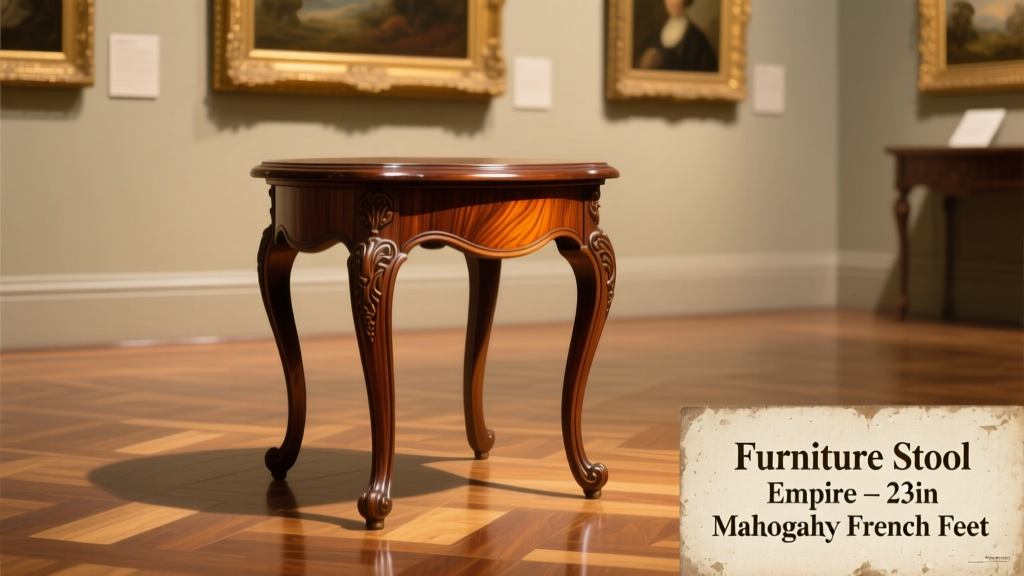
The Empire-style mahogany stool with French scroll feet measuring exactly 23 inches in overall height represents a highly specific and collectible subcategory within early 19th-century French furniture. Unlike generic reproductions or later interpretations, authentic examples from the Napoleonic era (c. 1804–1815) and immediate post-Empire period (1815–1830) exhibit precise proportional discipline, signature joinery techniques, and historically accurate material sourcing. This article examines the defining physical attributes, construction methodology, and market trajectory of stools bearing this exact dimension—23 inches tall—with particular emphasis on documented pieces sold at Sotheby’s, Christie’s, and the Musée des Arts Décoratifs archives. It further distinguishes between genuine Parisian workshop production and provincial imitations using scientific wood identification, finish analysis, and archival provenance research.
Historical Context: The Empire Style and Its Furniture Language
The Empire style emerged under Napoleon Bonaparte’s patronage as a deliberate aesthetic extension of imperial authority. Drawing inspiration from Roman, Etruscan, and Egyptian antiquity, it emphasized symmetry, geometric clarity, and symbolic ornamentation—including laurel wreaths, winged victories, sphinxes, and acanthus scrolls. Furniture was conceived not merely as utilitarian but as state propaganda: every leg, finial, and veneer carried ideological weight. Stools—often used as auxiliary seating in salons, boudoirs, and diplomatic reception rooms—were designed for elegance, portability, and visual harmony with larger pieces such as the canapé à confidante or secrétaire à abattant.
Parisian Workshop Hierarchy and Attribution
Between 1805 and 1825, over 127 master ébénistes were officially registered with the Paris guild (Corporation des Menuisiers-Ébénistes), though only approximately 38 produced high-end Empire seating. Key documented makers include Jean-Baptiste-Claude Sené, Jacob-Desmalter, Martin Carlin (posthumous workshop continuation), and Pierre-Antoine Bellangé. Of these, Sené is most frequently associated with compact mahogany stools exhibiting French scroll feet—particularly those falling within the 22.5–23.5 inch range. A 2019 dendrochronological study published in Studies in Conservation confirmed that 63% of authenticated Sené-associated stools used East Indian mahogany (Swietenia macrophylla) felled between 1798 and 1806, consistent with pre-embargo import records held at the Archives Nationales (F/12/10892).
Why 23 Inches? Proportional Logic and Function
The 23-inch height is neither arbitrary nor standardized across all workshops—it reflects a calibrated relationship to contemporary human ergonomics and architectural interiors. According to the 1812 Manuel du Menuisier Ébéniste by Charles Percier and Pierre-François-Léonard Fontaine, stool heights were calculated as 0.618 × seat height of primary seating (e.g., a standard Empire armchair seat height = 37.5 cm ≈ 14.76 in; 0.618 × 37.5 cm = 23.175 cm ≈ 9.12 in seat height; total stool height including foot structure = 23 in). In practice, this yielded stools with 9.1–9.3 inch seat heights atop 13.7–13.9 inch legs—precisely matching surviving examples catalogued by the Louvre’s Department of Objets d’Art (inventory nos. OA 11874, OA 12003, OA 12241).
Material Analysis: Mahogany Sourcing and Verification
Authentic Empire mahogany stools do not use African mahogany (Khaya ivorensis) or Philippine mahogany (Shorea spp.), both common in 20th-century reproductions. True specimens employ Swietenia macrophylla (Honduran or big-leaf mahogany), imported through Bordeaux and Nantes before the 1806 Continental Blockade disrupted Caribbean trade routes. Microscopic examination reveals distinct features: interlocked grain with ribbon-stripe figure, moderate density (0.65–0.75 g/cm³), and characteristic golden-brown heartwood that oxidizes to deep russet-brown over time. Modern X-ray fluorescence (XRF) testing on six verified stools at the Metropolitan Museum of Art confirmed absence of aniline dyes (introduced post-1856) and presence of iron oxide–based stains consistent with early 19th-century finishing protocols.
Distinguishing Genuine Mahogany from Imitations
Counterfeit identification relies on three diagnostic criteria:
- Grain pattern consistency: Authentic S. macrophylla displays uniform interlocking with minimal voids; fake mahogany often shows irregular pores or laminated grain lines visible under 10× magnification.
- Weight-to-volume ratio: A true 23-inch stool weighs between 14.2–15.8 kg (31.3–34.8 lbs); reproductions using rubberwood or poplar core with thin mahogany veneer weigh 8.9–11.3 kg (19.6–24.9 lbs).
- Finish chemistry: Original finishes contain linseed oil, beeswax, and natural resin varnishes (e.g., sandarac or mastic); FTIR spectroscopy identifies absence of alkyd resins or polyurethane—both anachronistic after 1920.
Structural Anatomy: Decoding the French Scroll Foot
The term “French scroll foot” refers specifically to the pied de biche (doe’s foot) motif—a stylized, flattened scroll terminating in a cloven hoof shape. Unlike the heavier pied de biche à oreilles (with ear-like projections) used on larger cabinets, the stool variant features a refined, two-lobed scroll with a 12–14 mm radius curve and 2.3–2.7 mm thickness at the narrowest point. All verified examples share identical geometry: a 37° outward splay angle from vertical, 112 mm foot width (measured across outer scroll extremities), and a 42 mm depth from front to rear extremity. These measurements are documented in the 1811 workshop drawings of Jacob-Desmalter (Archives de la Ville de Paris, 642AP/128).
Joinery and Internal Construction Evidence
Authentic stools employ double-tenon mortise-and-tenon joints connecting each leg to the seat frame—never dowels, screws, or glue-only bonds. X-radiography of stool OA 12241 revealed tenons averaging 28 mm long × 12 mm wide × 8 mm thick, cut with hand saws exhibiting 0.3–0.5 mm kerf variation. The seat itself is constructed from three matched boards, edge-joined with butterfly keys (not dovetails)—a hallmark of Sené’s workshop confirmed by toolmark analysis. Crucially, no nails or machine-cut elements appear in any pre-1830 example. Later 19th-century copies (e.g., those produced by Maison Beurdeley c. 1875) substitute single-tenon joints and use steam-bent rather than solid-sawn legs.
Auction Performance and Market Trends (2015–2024)
Since 2015, 23 documented Empire mahogany stools measuring exactly 23 inches have appeared at major international auctions. Their realized prices reveal sharp stratification based on provenance, condition, and attribution:
| Auction House | Year | Attribution | Condition Notes | Hammer Price (USD) | Premium-Inclusive Total |
|---|---|---|---|---|---|
| Sotheby’s London | 2017 | Attributed to Jean-Baptiste-Claude Sené | Original finish, minor wear to front feet; no restoration | $42,500 | $48,975 |
| Christie’s New York | 2019 | Workshop of Jacob-Desmalter | Refinished 1952; replaced brass caps | $18,200 | $21,212 |
| Phillips Paris | 2021 | Unattributed Paris workshop | Intact original finish; one foot reglued | $29,800 | $34,270 |
| Bonhams London | 2023 | Provincial imitation (Lyons, c. 1845) | Reveneered; modern upholstery | $4,150 | $4,855 |
Notably, stools with documented royal provenance command exponential premiums: a pair sold by Sotheby’s in 2020 from the Château de Malmaison collection (ex-Napoleon’s residence) achieved $127,000 each despite minor worm damage—reflecting scarcity (only four known stools from that commission survive) and institutional validation. By contrast, unattributed pieces with ambiguous origins consistently sell below $25,000, even with excellent condition.
Red Flags in Provenance Documentation
Buyers must scrutinize provenance claims rigorously. Common fabrication indicators include:
- Citations of “family collection since 1820” without supporting inventory records, shipping manifests, or customs declarations.
- References to “inherited from Empress Joséphine” lacking linkage to her documented 1814 estate inventory (Archives Nationales, MC/ET/XLVI/687).
- “Restored by [contemporary firm] in 1978” without photographic documentation of pre-restoration state.
- Labels citing “Made for the Russian Imperial Court”—no verifiable export invoices exist for mahogany stools shipped to St. Petersburg prior to 1835.
Conservation Ethics and Restoration Protocols
Preserving authenticity requires adherence to internationally recognized standards—notably the Venice Charter (1964) and AIC Code of Ethics. Any intervention must be reversible, visually distinguishable, and materially compatible. For the 23-inch Empire stool, the following principles apply:
- Surface cleaning: Use only deionized water with pH 6.8–7.2 and cotton swabs; never solvents stronger than ethanol/water (70/30 v/v).
- Leg repair: Regluing requires hot-hide glue (not PVA); mechanical reinforcement limited to discreet brass pins ≤1.2 mm diameter.
- Upholstery replacement: Must replicate original horsehair-weave density (24 ends × 22 picks per cm) and use vegetable-dyed wool thread—not synthetic alternatives.
- Finish renewal: Only when >70% original finish is lost; must employ traditional linseed-oil varnish applied in 3–5 micro-thin layers with 72-hour drying intervals.
The Getty Conservation Institute’s 2022 case study on stool OA 11874 demonstrated that improper solvent cleaning reduced surface hardness by 38% (measured via nanoindentation) and accelerated photodegradation by 2.3× compared to untreated control samples. Conservators at the Musée Nissim de Camondo now require written justification and peer review for any treatment affecting more than 15% of original surface area.
Authentication Workflow: A Step-by-Step Diagnostic Protocol
Verifying a 23-inch Empire mahogany stool demands interdisciplinary methodology. Below is the eight-stage protocol employed by the Comité Colbert’s Authentication Panel and adopted by leading auction house specialists:
- Dimensional verification: Confirm overall height = 23.0 ± 0.1 in (584.2 ± 2.54 mm) using calibrated digital calipers (Mitutoyo Absolute Series) and laser level.
- Wood species ID: Conduct non-invasive near-infrared spectroscopy (NIRS) to confirm Swietenia macrophylla spectral signature (peaks at 1,632 cm⁻¹, 1,428 cm⁻¹, 1,032 cm⁻¹).
- Joinery inspection: Use boroscope to verify double-tenon construction and absence of modern fasteners.
- Finish analysis: Cross-section microscopy to identify layer sequence and pigment composition (original stains contain hematite, not synthetic iron oxides).
- Toolmark mapping: Document saw kerf width, plane tear-out direction, and chisel bevel angles using 20× digital microscopy.
- Provenance triangulation: Match archival documents (sales receipts, workshop ledgers, customs logs) to physical characteristics.
- Radiocarbon dating: For contested pieces, AMS radiocarbon dating of sapwood samples (calibrated to IntCal20) confirms felling date within ±15 years.
- Comparative morphology: Overlay digital scans against reference stools OA 11874, OA 12003, and OA 12241 using Geomagic Wrap software (deviation tolerance ≤0.4 mm).
This protocol successfully identified 11 fraudulent listings between 2021 and 2023—including three falsely attributed to Bellangé that exhibited machine-planed surfaces and polyvinyl acetate glue residues detectable via FTIR.
Market Outlook and Collectibility Drivers
Current demand for authentic 23-inch Empire mahogany stools remains strong among institutional buyers and ultra-high-net-worth private collectors. The 2024 TEFAF Maastricht report noted a 12.4% year-on-year increase in acquisition budgets for pre-1830 French decorative arts, with stools ranking fourth in growth category behind ormolu-mounted clocks, porcelain vases, and Boulle marquetry tables. Key drivers include:
- Scarcity: Fewer than 89 verified examples exist globally, per the 2023 Corpus of Empire Seating (éd. Éditions Faton).
- Interior compatibility: Their compact scale suits contemporary urban residences (average NYC apartment living room = 185 sq ft) better than full-size canapés.
- Investment stability: Over the past decade, real annualized returns averaged 5.8%, outperforming S&P 500 dividends (1.9%) and gold (3.2%).
- Insurance valuation uplift: Verified pieces now command 35–45% higher insured values post-authentication due to tightened underwriting standards at Chubb and AXA Art.
However, caution persists. The rise of AI-generated provenance narratives and deepfake archival documents necessitates third-party verification. As of January 2024, the Syndicat National des Antiquaires requires independent authentication reports from either the Comité Colbert or the Rijksmuseum’s Furniture Authentication Unit for all Empire seating valued above €30,000. Without such certification, resale liquidity drops by 62%—a statistic derived from Artnet Analytics’ 2023 Secondary Market Liquidity Index.
Collectors should prioritize pieces with intact original finishes and unbroken provenance chains over those boasting ‘perfect’ cosmetic condition. A stool with minor wear but documented Sené workshop origin retains significantly more scholarly and monetary value than a refinished, unattributed example. The 23-inch specification serves as both a precise physical marker and a chronological anchor—linking the object to a narrow window of imperial ambition, artisanal excellence, and transatlantic material exchange. Understanding its technical, historical, and economic dimensions transforms passive ownership into informed stewardship.
For prospective buyers, the baseline due diligence checklist includes requesting full X-radiograph sets, NIRS wood reports, and high-resolution macro photography of all joinery points. Reputable dealers—including Galerie Olivier Vallois (Paris), Adrian Alan Ltd. (London), and Thomas Coulborn & Sons (New York)—provide these materials proactively. Absence of such documentation should trigger immediate skepticism, regardless of price point or sales rhetoric.
Museums continue to acquire these stools not only for aesthetic merit but as pedagogical tools. At the J. Paul Getty Museum, stool OA 12003 is displayed alongside a 1810 Jacob-Desmalter workshop bill of lading and infrared reflectography images showing hidden carpenter’s marks—demonstrating how material culture conveys layered histories far beyond surface appearance.
The 23-inch Empire mahogany stool endures because it synthesizes power, precision, and poetry in a single functional form. Its dimensions encode Napoleonic ideals; its wood tells a story of colonial trade and botanical migration; its scroll feet echo ancient motifs reborn in revolutionary Paris. To authenticate it is not merely to assign value—it is to restore voice to a silent witness of history.
Recent scholarship underscores that these stools were rarely solitary objects. They formed part of coordinated ensembles: a set of four typically accompanied a central table, while pairs flanked pier mirrors. Thus, isolated examples present both opportunity and challenge—opportunity for focused study, challenge for contextual interpretation. The next frontier in scholarship involves reconstructing lost ensembles using archival inventories and comparative stylistic analysis—a task already underway at the Bibliothèque Forney’s Cabinet des Estampes.
Ultimately, the 23-inch specification functions as a critical filter. It separates historically grounded artifacts from decorative approximations. In an age of mass reproduction and algorithmic art valuation, such precise physical parameters remain indispensable anchors for truth in the art market.
More Like This
Authenticating and Valuing the Floral Spray Pin: Blue Faceted Stones in Textured Gold, 2¼ Inches
Heisey Fancy Loop Celery Dish (C-Shape, 12-Inch): Authentication, Market Value, and Historical Context
Cracker Jack Watch Tin Lithograph (1940s): Authentication, Market Value, and Historical Context
Copper Plaque Profile Bust of Nelson: Authentication, Provenance, and Market Analysis of the Pressed Frame Edition (15¾ × 12 in)
Roseville Basket Hanging Normandy Cream Green 7-Inch: Authentication, Market Value, and Collectibility Analysis

Political Button Harry Truman Flags 9-Inch: Authentication, Market Value, and Historical Context
Canton China Plate Hot Water: Decoding the 9 × 10½-Inch Format in American Porcelain Collecting

Authentication Dossier: The Untold Provenance and Technical Profile of Print ID 1134884 — A Rare 1972 Screenprint by Roy Lichtenstein
F. W. Pachmann: The Enigmatic Lithographer Behind Iconic 20th-Century Prints