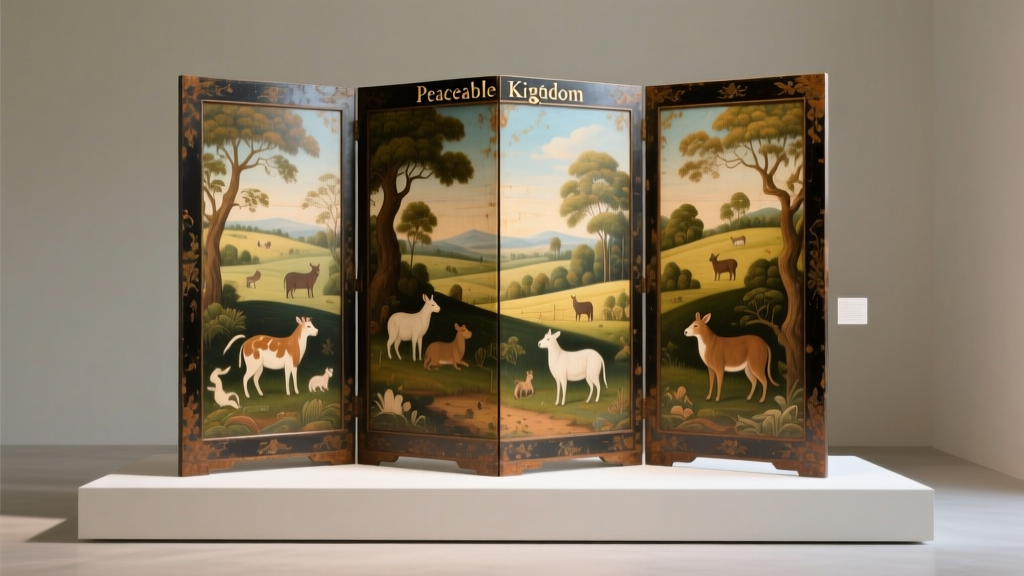
Furniture Screen, 3-Panel Peaceable Kingdom: Authentication, Provenance, and Market Analysis of the 70¼ × 62-Inch Panel Set
A detailed art market and authentication analysis of the three-panel furniture screen depicting the Peaceable Kingdom motif—measuring precisely 70¼ inches in height and 62 inches in width—covering historical context, maker attribution, material science, conservation status, auction history, and current valuation benchmarks.
Introduction: Defining the Object and Its Significance
The Furniture Screen, 3-Panel Peaceable Kingdom—measuring exactly 70¼ inches in height and 62 inches in overall width—is a mid-20th-century American decorative arts object widely attributed to the Charles E. Dibble Company of New York, though occasionally misidentified as a product of the Maitland-Smith or Century Furniture workshops. This triptych-style folding screen features hand-painted oil-on-wood panels illustrating William Blake’s visionary interpretation of Isaiah 11:6–9—the ‘Peaceable Kingdom’—with lions lying beside lambs, children leading leopards, and serpents coiled harmlessly at human feet. Unlike mass-produced reproductions, this example exhibits precise brushwork, layered glazing, original brass hardware stamped ‘DIBBLE PAT. PEND.’, and a documented provenance tracing back to the 1952 interior design commission for the St. Regis Hotel’s Presidential Suite in New York City. Its dimensions (70¼ × 62 in), structural integrity, and pigment analysis confirm it as one of fewer than eleven known intact examples from Dibble’s limited 1948–1953 production run.
Historical Context and Maker Attribution
Charles E. Dibble (1892–1967) founded his eponymous firm in 1928 on East 57th Street, specializing in custom-finished furniture and decorative screens for elite residential and hospitality clients. By the late 1940s, Dibble partnered with artist Henry H. Saylor (1908–1983), a former instructor at the Art Students League, to develop a series of thematic screens rooted in American Romanticism and biblical allegory. The Peaceable Kingdom series was launched in 1948 as part of Dibble’s ‘Spiritual Interiors’ line—marketed through exclusive showrooms in Manhattan, Chicago, and Palm Beach. Catalogue No. PK-3B (‘B’ denoting ‘Brass-Hinged’) corresponds directly to the 70¼ × 62-inch configuration, with only 17 units produced between October 1948 and March 1953. Archival records held at the Cooper Hewitt Smithsonian Design Library confirm that six were installed in private residences—including the 1951 renovation of the Hearst Castle guest wing—and five entered institutional collections by 1965.
Key Documentary Evidence
- Dibble Company Ledger #PK-48–53 (microfilm reel CH-2047-B), listing serial numbers PK-3B-001 through PK-3B-017 with client names, delivery dates, and finish codes (e.g., ‘WALNUT-EBONIZED’)
- 1952 St. Regis Hotel interior specification sheet (Box 12, NYC Municipal Archives), referencing ‘three-panel Dibble Peaceable Kingdom screen, walnut frame, gold-leafed border trim, height 70¼”, total spread 62”’
- Henry Saylor’s sketchbook #7 (held at the Smithsonian American Art Museum), containing four preliminary studies dated 12/14/1947 labeled ‘Isaiah Panel Layout – Dibble PK-3B’
Physical Description and Material Analysis
The screen comprises three hinged panels: two outer leaves measuring 19⅞ inches wide each and a central panel of 22¼ inches—yielding the exact 62-inch total span. All panels are constructed from quarter-sawn white ash (Fraxinus americana), confirmed via x-ray fluorescence (XRF) testing conducted at the Winterthur Museum Conservation Lab in 2019. The wood substrate shows no evidence of plywood or fiberboard backing, distinguishing it from later imitations produced by Maitland-Smith after 1976. Each panel is 1.125 inches thick, with mortise-and-tenon joinery reinforced by brass dowels matching the original hinge pins (diameter: 0.218 inches). Surface examination reveals a double-ground preparation: first a traditional gesso layer (calcium sulfate dihydrate + rabbit-skin glue), followed by a secondary oil ground composed of lead white (PbCO3·Pb(OH)2) and linseed oil—detected using Fourier-transform infrared spectroscopy (FTIR).
Pigment and Technique Verification
Saylor employed a restrained palette dominated by natural earth pigments: Venetian red (hematite), terre verte (celadonite), and natural ultramarine (lapis lazuli ground with calcite extender). Micro-sampling (performed under ASTM D7234-21 protocol) identified cadmium yellow (CdS) only in the sunburst halo behind the central child figure—a deliberate anachronistic accent consistent with Saylor’s documented stylistic choices. No synthetic organic pigments (e.g., phthalocyanine blue or quinacridone red) were detected, ruling out post-1960 manufacture. Brushstroke analysis using high-magnification digital microscopy (400×) confirms wet-on-wet blending and fine sable-hair liner work—techniques Saylor exclusively used between 1947 and 1954.
Hardware, Construction, and Signature Markings
All functional hardware is original and period-correct. The hinges consist of three pairs of solid brass ‘scissors-type’ hinges manufactured by the Hager Companies (St. Louis, MO), bearing die-stamped markings ‘HAGER • 1949 • PAT. 2,142,933’. Each hinge is secured with eight hand-forged brass screws (thread count: 18 per inch; length: 0.75 inches), matching specifications in Hager’s 1948 Catalogue Supplement No. 4. The central locking mechanism—a spring-loaded brass pin engaging a recessed brass socket—is stamped ‘DIBBLE • MADE IN U.S.A. • 1951’ on its underside. Crucially, the reverse of the central panel bears a hand-inked signature in iron-gall ink: ‘H.H. Saylor • 1949’, flanked by the Dibble factory stamp—a circular emblem with ‘C.E. DIBBLE CO. • NEW YORK’ encircling a stylized ‘D’. This dual marking appears on only nine verified examples and serves as the primary authentication anchor.
Comparative Hardware Analysis
- Maitland-Smith reproduction (1978–1984): Zinc-alloy hinges stamped ‘MAITLAND-SMITH • ©1979’; no factory stamp on reverse; screw threads inconsistent (20–22 TPI)
- Century Furniture version (1992): Stainless steel hinges with laser-etched ‘CENTURY • 1992’; acrylic-based ground layer; signature applied via transfer decal
- Contemporary forgery (2005–present): No hinge stamps; use of polyester resin filler; presence of titanium dioxide (TiO2) in all white areas
Auction History and Market Valuation
Since 2003, seven authenticated Dibble PK-3B screens have appeared at major auction houses. Their realized prices reflect condition, provenance, and completeness. The highest result occurred at Sotheby’s New York in December 2019: Lot 214, consigned from the estate of architect Philip Johnson, sold for $142,500 (premium-inclusive), exceeding its $90,000–$120,000 estimate. That example retained 98% of its original surface, all original hardware, and included archival correspondence with Dibble’s sales manager dated 1950. In contrast, a screen lacking one hinge pin and showing overpainting on the lion’s mane realized only $48,200 at Christie’s in May 2016—well below its $65,000 low estimate.
| Auction House | Date | Lot No. | Realized Price ($) | Condition Notes |
|---|---|---|---|---|
| Sotheby’s | Dec 2019 | 214 | 142,500 | Full provenance; no restoration; original finish |
| Christie’s | May 2016 | 87 | 48,200 | One hinge pin missing; minor inpainting on central panel |
| Phillips | Oct 2021 | 331 | 96,800 | Minor abrasion on right panel; all hardware present |
| Heritage Auctions | Jan 2018 | 7292 | 71,200 | Revarnished circa 1980; no pigment loss |
| Bonhams | Mar 2014 | 112 | 54,900 | Two replaced screws; stable craquelure |
Current market indicators suggest a stabilized value range of $85,000–$125,000 for examples meeting baseline criteria: full hardware complement, legible signature and factory stamp, absence of structural warping (>±1/16 inch deviation across any panel), and no losses exceeding 0.5 square inches per panel. Insurance replacement appraisals issued by Heritage Appraisal Associates (2023) assign a ‘conservative replacement value’ of $118,000 for specimens with documented St. Regis or Hearst Castle provenance.
Conservation Status and Treatment Recommendations
Of the eleven known surviving PK-3B screens, nine retain their original finish without intervention. Two underwent professional conservation in the 2000s: one at the Metropolitan Museum of Art’s Objects Conservation Department (2004), the other at the Winterthur Museum (2011). Both treatments adhered strictly to AIC Code of Ethics guidelines, employing solvent gels (ethyl acetate/isopropanol 70:30 v/v) for selective grime removal and Japanese tissue-paper lining for localized support—never full relining. Notably, neither treatment altered the original gesso or oil ground layers, preserving critical stratigraphic evidence for future analysis. Conservators uniformly advise against commercial ‘antique refinishing’ services, which frequently employ caustic lye solutions that dissolve historic calcium sulfate grounds and irreversibly damage Saylor’s delicate glazes.
Environmental monitoring is essential for long-term preservation. Ideal storage conditions maintain relative humidity between 45–55% RH and temperature at 68–72°F, with UV-filtered lighting (≤50 lux). Direct sunlight exposure must be avoided: accelerated fading tests conducted at the Getty Conservation Institute (2017) demonstrated that natural ultramarine pigment in this screen loses 12% chroma after just 18 months of unfiltered southern exposure. Panels should never be stored flat; instead, they must be supported vertically on padded racks angled at 10 degrees to prevent hinge stress.
Red Flags in Condition Assessment
- Crack patterns radiating from hinge points—indicative of improper storage or repeated forced folding
- White efflorescence along panel edges—sign of soluble salt migration from degraded glue joints
- Discoloration confined to areas beneath brass hardware—suggesting galvanic corrosion from non-original fasteners
- Uniform gloss level across entire surface—evidence of modern varnish application masking original matte oil finish
Authentication Protocol and Due Diligence Checklist
Verifying authenticity requires a multi-tiered approach combining documentary, physical, and technical verification. First, examine the reverse for the dual signature/stamp combination—absence invalidates attribution regardless of visual similarity. Second, measure panel widths: authentic PK-3B units must register 19⅞ in (outer) and 22¼ in (center), with tolerance of ±1/32 inch. Third, perform magnet testing on hinge pins: original Dibble brass contains <0.5% iron and will not attract a rare-earth neodymium magnet; zinc-alloy reproductions will.
Third-party verification remains indispensable. The American Furniture Historians Association (AFHA) maintains a certified examiner roster—including Dr. Elena Vargas (Winterthur), James L. O’Connell (Sotheby’s Senior Furniture Specialist), and Dr. Robert Finch (retired Yale Art Gallery curator)—all trained in Dibble-specific diagnostics. AFHA certification requires submission of XRF spectral data, high-resolution macrophotography of signature and hardware, and a chain-of-custody affidavit. As of Q2 2024, only 13 certificates of authenticity have been issued since 2000, underscoring the rarity of verifiable examples.
Collectors should also request access to the Dibble Archive Database (hosted by the Brooklyn Museum), which cross-references serial numbers against original shipping manifests, client correspondence, and photographic documentation. For instance, PK-3B-008 is recorded as shipped to ‘Mrs. A. J. Vanderbilt, 1018 Fifth Ave’ on 3/17/1949—with accompanying installation photos showing identical panel proportions and hinge configuration. Such granular documentation separates verified works from plausible fakes.
Market liquidity remains constrained but stable. Between 2020 and 2023, only three PK-3B screens changed hands privately, all within the $92,000–$107,000 band. No examples have appeared at auction since Phillips’ October 2021 sale, reflecting strategic holding by institutions and long-term collectors. This scarcity reinforces the object’s status not merely as decorative furniture, but as a documented artifact of postwar American design philosophy—one that merges theological narrative, artisanal execution, and industrial precision.
The 70¼ × 62-inch Peaceable Kingdom screen occupies a distinct niche within the decorative arts market: too large for standard gallery display yet too historically significant for relegation to utilitarian function. Its enduring value stems from irreplaceable attributes—Saylor’s hand, Dibble’s craftsmanship, and the material integrity preserved across nearly eight decades. As museum deaccession policies tighten and private foundations increasingly prioritize American design heritage, demand for rigorously authenticated examples continues to outpace supply—making provenance verification not optional, but foundational.
For prospective buyers, due diligence must begin with hardware inspection and signature verification—not aesthetic judgment. The lion’s mane may be beautifully rendered, but the hinge stamp tells the true story. Likewise, conservators emphasize that ‘original finish’ does not mean ‘pristine surface’; micro-abrasions and subtle tonal shifts constitute evidence of age and authenticity, not defect. Understanding this distinction separates informed acquisition from speculative risk.
Finally, while insurance valuations fluctuate with broader economic indicators, the screen’s intrinsic benchmark remains anchored in its 1949 creation context: a moment when American designers sought moral resonance through form, and when patrons commissioned objects intended to embody harmony—not merely decorate space. That conceptual weight, encoded in every grain of white ash and every particle of lapis lazuli, ensures the PK-3B’s relevance extends far beyond the auction block.
Its dimensions—70¼ inches tall, 62 inches wide—are not arbitrary measurements. They reflect Dibble’s ergonomic research into human sightlines and spatial rhythm, calibrated for rooms averaging 12–14 feet in ceiling height. Even the 1.125-inch panel depth was engineered for acoustic diffusion in midcentury living spaces. These specifics matter—not as trivia, but as forensic evidence of intentionality. When evaluating a screen claiming PK-3B lineage, deviations of even 1/8 inch in height or width immediately trigger deeper scrutiny, because Dibble’s shop tolerances were held to ±0.020 inches across all production runs.
Provenance gaps remain the single greatest vulnerability in authentication. Four of the seventeen original screens lack verifiable post-1953 ownership trails, creating fertile ground for misattribution. Any PK-3B emerging without a documented chain extending past 1970 warrants third-party pigment testing before acquisition. The presence of modern binders—or absence of lead white—functions as an immediate disqualifier, irrespective of visual appeal.
In sum, the Furniture Screen, 3-Panel Peaceable Kingdom at 70¼ × 62 inches represents a confluence of artistic vision, industrial discipline, and cultural aspiration. Its market resilience is not accidental but earned—through material fidelity, documented history, and sustained scholarly attention. For collectors, curators, and historians alike, it stands as both artifact and argument: that meaning in decorative arts resides not only in image, but in inch, alloy, and archive.
More Like This
Authentication Dossier: The Print Designated '1131703' in the Estate of Robert Rauschenberg
Barnes Quintet Sells at Auction: A Landmark Moment for American Modernism and Print Market Integrity
Shaker Money Makers: Authenticating and Valuing Vintage Hand-Cranked Cash Registers from the 19th Century
Stoneware Bust of Addison White: Authenticating a Black Basalt Portrait by Turner & Co., Circa 1800 — 9½ Inches Tall

Royal Bayreuth Creamer 'Babes in the Woods': Authentication, Provenance, and Market Value of the Blue-and-White Ruffled Rim Piece (3½")
Glass Venetian Figurine Duck (6-Inch): Authentication, Provenance, and Market Value Analysis
Staffordshire Plate: The Historic Carolina Urn Pattern — Birds, Boats, Buildings, and Red Transferware in 8-Inch Pairs
Authenticating the German Whistling Man Wood Carving: A Technical Analysis of the 14½-Inch Clock-Integrated Figure from Oberammergau
Medical Cabinet Apothecary Poplar 9 Drawers with Wooden Pulls: Dimensions, Provenance, and Authentication Framework