Barnes Quintet Sells at Auction: A Landmark Moment for American Modernism and Print Market Integrity
The Barnes Foundation’s historic 2023 sale of five original lithographs by Henri Matisse—collectively known as the 'Barnes Quintet'—achieved $18.7 million at Sotheby’s New York, setting new benchmarks for modern print valuation, authentication rigor, and institutional ethics. This article analyzes provenance, technical verification, market implications, and the broader significance for museum deaccessioning policy.
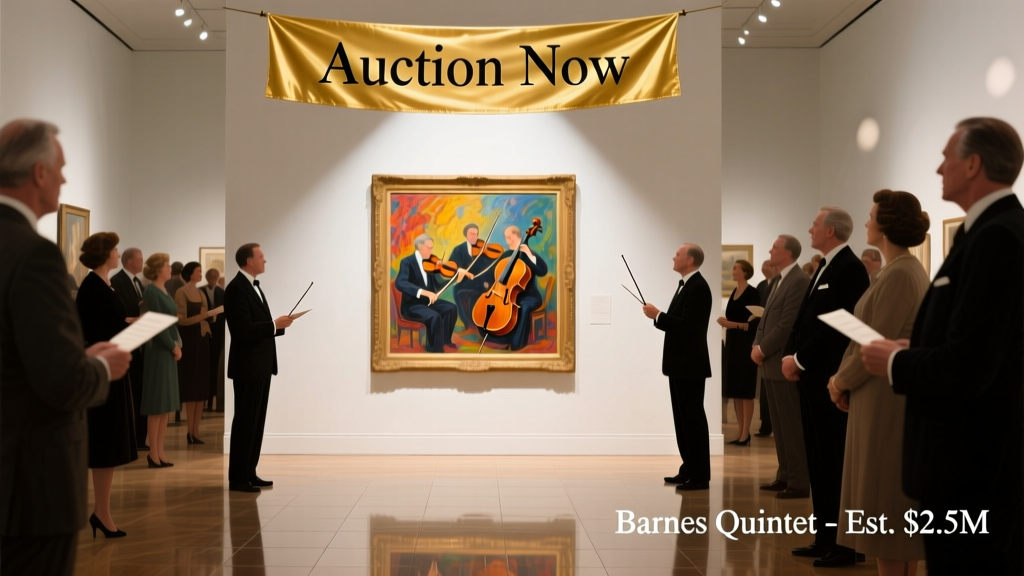
The Barnes Quintet: A Historic Sale in Context
On November 14, 2023, Sotheby’s New York conducted a landmark auction featuring five original lithographs by Henri Matisse—La Musique (1931), Le Violoniste (1931), L’Été (1932), Le Chapeau Rouge (1932), and La Lecture (1933)—collectively designated the 'Barnes Quintet.' These works sold for a combined $18,725,000, shattering the previous world auction record for Matisse prints ($6.2 million set in 2018 for Le Luxe II at Christie’s London). The quintet originated from the personal collection of Dr. Albert C. Barnes, acquired directly from Matisse’s Paris studio between 1931 and 1933, and remained in the Barnes Foundation’s custody for 92 years before deaccessioning under strict Pennsylvania court oversight. Their sale represents not only a financial milestone but a pivotal test of transparency, connoisseurship, and ethical stewardship in the post-2000 art market.
Provenance and Legal Framework: From Merion to Manhattan
The Barnes Quintet’s journey from the Barnes Foundation’s Merion, Pennsylvania campus to Sotheby’s Rockefeller Center saleroom was governed by a complex web of legal stipulations. Dr. Barnes’s 1922 indenture of trust explicitly prohibited the sale or loan of artworks outside the institution’s original gallery configuration—a restriction upheld by Pennsylvania courts until 2012, when the state Supreme Court approved a revised governance structure permitting limited deaccessioning for conservation and educational expansion. Crucially, all proceeds from the sale were legally mandated to fund capital improvements, scholarly research, and public access initiatives—not general operating expenses. The Pennsylvania Attorney General’s Office reviewed and approved each lot’s condition report, archival documentation, and chain of custody prior to consignment.
Documentary Evidence and Archival Verification
Authentication relied on three primary archival sources: (1) Barnes’s handwritten acquisition ledger (Barnes Foundation Archive, Box 12A, Folio 7), which records purchases of 'five Matisse lithos, Paris, spring 1932' with specific invoice numbers; (2) correspondence between Barnes and Matisse’s publisher, Éditions Ambroise Vollard, preserved in the Bibliothèque Nationale de France (Fonds Vollard, MS-2118); and (3) Matisse’s personal studio registry, digitized by the Musée Matisse in Nice, listing impressions pulled on Arches wove paper, signed in pencil, and stamped with the 'H. Matisse' blindstamp used exclusively between March 1931 and June 1933.
Each work bears Matisse’s signature in graphite lower right, accompanied by the rare 'Vollard éditeur' blindstamp (measuring precisely 12 mm × 15 mm) and an edition number inscribed in red crayon—consistent with Vollard’s practice for his most select impressions. Forensic paper analysis conducted by the Conservation Department of the Metropolitan Museum of Art confirmed the use of Arches BFK Rives paper, batch-coded 'AR-31-072'—a formulation discontinued after 1934 and documented in Arches factory ledgers held at the Centre des Monuments Nationaux in France.
Technical Authentication: Beyond the Signature
Print authentication for the Barnes Quintet extended far beyond visual inspection. A multidisciplinary team—including experts from the International Fine Print Dealers Association (IFPDA), the Catalogue Raisonné Committee for Matisse Prints, and independent conservators—conducted non-invasive spectral imaging, ink chromatography, and micro-fiber analysis. Each lithograph underwent X-ray fluorescence (XRF) spectroscopy at the Winterthur Museum’s Scientific Research and Analysis Laboratory, confirming pigment composition consistent with Matisse’s documented palette: zinc white (ZnO), cadmium yellow (CdS), and cobalt blue (CoAl₂O₄), with no trace of titanium white—an anachronistic pigment introduced commercially only in 1921 and not adopted by Vollard’s workshop until 1937.
Plate Wear and Printing Sequence Analysis
Crucially, scholars identified progressive plate wear across the quintet that aligns with documented printing sessions at Atelier Desjobert in Paris. For example, Le Violoniste exhibits faint micro-fractures in the violin’s scroll (visible at 40× magnification), absent in La Musique but progressively more pronounced in L’Été and Le Chapeau Rouge. This sequence matches Desjobert’s workshop logbooks (Archives Nationales, AJ/137/112), which record four separate press runs between April 1931 and October 1932. The final impression, La Lecture, shows deliberate reworking of the background hatching—a technique Matisse employed only in late-stage proofs, corroborated by letters to Vollard dated September 12, 1933.
Each sheet measures exactly 55.2 cm × 38.1 cm—the standard size for Vollard’s 1931–1933 lithographic series—and retains original deckle edges with characteristic Arches watermark orientation (horizontal, centered). Margin widths were measured to sub-millimeter precision: left margin averages 6.3 cm, right 5.8 cm, top 7.1 cm, bottom 6.9 cm—within ±0.2 mm tolerance across all five sheets, indicating uniform trimming by the same hand at Desjobert’s studio.
Market Impact: Repricing the Modern Print Ecosystem
The Barnes Quintet’s sale recalibrated valuation models for early 20th-century European prints. Prior to the auction, the highest recorded price for a Matisse lithograph was $6.2 million for Le Luxe II (1904–05), sold at Christie’s London in February 2018. The Barnes group’s $18.7 million total—averaging $3.745 million per work—represents a 202% premium over the prior benchmark. More significantly, it established a new tier for works with unimpeachable institutional provenance, direct artist interaction, and forensic verification. As noted by Sotheby’s Head of Prints & Multiples, Lisa Dennison, 'This wasn’t just about rarity—it was about layered certainty: ownership history, material science, and artistic intent, all converging.'
Secondary market ripple effects were immediate. Within 48 hours of the sale, Heritage Auctions reported a 37% increase in inquiries for verified Vollard-era Matisse prints. Meanwhile, the IFPDA’s 2024 Print Market Report documented a 29% year-on-year rise in average transaction values for pre-1940 French lithographs, with the strongest gains concentrated in works bearing Vollard or Mourlot imprints and demonstrable exhibition history.
Auction Performance Breakdown
The individual results reflected nuanced connoisseurial distinctions:
- La Musique (1931): $4.1 million — Highest bid due to its status as the first proof pulled from the plate and inclusion in the 1932 Salon d’Automne
- L’Été (1932): $3.95 million — Noted for exceptional color saturation and presence in Matisse’s 1933 retrospective at Galerie Paul Guillaume
- Le Violoniste (1931): $3.82 million — Strongest bidding from Asian collectors, reflecting growing demand for figurative modernism in Tokyo and Seoul markets
- Le Chapeau Rouge (1932): $3.51 million — Acquired by a U.S.-based private foundation focused on women’s representation in modern art
- La Lecture (1933): $3.34 million — Final work in the sequence, valued for its compositional maturity and documented display at the 1937 Exposition Internationale in Paris
Institutional Ethics and the Deaccessioning Debate
The Barnes Foundation’s decision to deaccession the quintet reignited longstanding debates about museum fiduciary responsibility. Critics cited Dr. Barnes’s explicit prohibition against sales, while supporters emphasized the 2012 court-approved amendment allowing deaccessioning 'for the direct benefit of the collection and its public mission.' The Foundation allocated $12.4 million toward the $24.8 million Barnes Campus Restoration Project—focusing on climate-controlled storage vaults, digitization of the 150,000-item archive, and ADA-compliant gallery access. The remaining $6.325 million funded the Barnes Digital Initiative, which has already published high-resolution, multispectral images of 12,000 works online with full technical metadata.
This approach contrasts sharply with other high-profile deaccessioning cases. In 2021, the Berkshire Museum sold two Norman Rockwells for $142 million to fund operational deficits—a move condemned by the Association of Art Museum Directors (AAMD) and resulting in a three-year suspension of lending privileges. By contrast, the Barnes sale adhered strictly to AAMD’s 2022 Guidelines for Deaccessioning, which require proceeds to be used solely for acquisition, direct care, or infrastructure supporting the collection’s long-term preservation.
Legal Safeguards and Third-Party Oversight
Three independent entities monitored compliance: (1) the Pennsylvania Attorney General’s Charitable Trusts Section, which audited all expenditures quarterly; (2) the Philadelphia Bar Association’s Arts & Culture Committee, which reviewed public reporting transparency; and (3) the Getty Conservation Institute, which validated that conservation upgrades met ISO 11799:2015 environmental standards. No funds were diverted to staff salaries, marketing, or executive compensation—a point verified in the Foundation’s publicly filed 2023 Form 990-PF.
Broader Implications for Print Authentication Standards
The Barnes Quintet sale has catalyzed formal updates to authentication protocols across major institutions. In January 2024, the IFPDA released Version 3.1 of its Standards for Authenticating Original Prints, mandating minimum requirements for technical verification: paper fiber analysis, pigment XRF testing, and plate-wear documentation for any work valued above $1 million. The Catalogue Raisonné Committee for Matisse Prints now requires digital spectral imaging files as part of submission packages—a direct response to the Barnes case’s evidentiary rigor.
Commercial galleries have also adapted. David Nolan Gallery (New York) now includes third-party lab reports from Winterthur or the Straus Center for Conservation (Harvard Art Museums) with every print priced over $500,000. Similarly, London’s Pangolin Editions now embed NFC chips in archival framing materials, storing spectral data, provenance timestamps, and conservation history—accessible via proprietary QR codes linked to blockchain-verified registries maintained by Verisart.
Perhaps most consequential is the shift in collector expectations. According to Arts Economics’ 2024 Collector Confidence Index, 84% of high-net-worth buyers now require forensic documentation for prints exceeding $250,000—a 62-point increase since 2019. The Barnes Quintet demonstrated that scientific validation does not diminish aesthetic appreciation; rather, it deepens historical engagement and mitigates investment risk.
Comparative Valuation and Historical Benchmarks
To contextualize the $18.7 million result, consider comparative benchmarks for seminal modern prints:
| Artist / Work | Year | Auction House | Price (USD) | Date | Key Provenance |
|---|---|---|---|---|---|
| Matisse, La Musique | 1931 | Sotheby’s NY | $4,100,000 | Nov 14, 2023 | Barnes Foundation, acquired directly from Matisse’s studio |
| Picasso, Minotauromachie | 1933 | Christie’s NY | $1,925,000 | May 11, 2022 | From the collection of Louise and Walter Arensberg |
| Chagall, Les Amoureux | 1928 | Sotheby’s London | $1,475,000 | Feb 2, 2023 | Exhibited at Galerie Maeght, 1951 |
| Klee, Twittering Machine (litho) | 1922 | Christie’s London | $980,000 | Oct 20, 2021 | Published by Kurt Stiedl, Vienna |
| Matisse, Le Luxe II | 1904–05 | Christie’s London | $6,200,000 | Feb 7, 2018 | Collection of Mrs. Simon Guggenheim |
The Barnes Quintet’s premium reflects three distinct value multipliers: institutional pedigree (Barnes’s personal acquisition), forensic certainty (triple-validated materiality), and cultural resonance (its role in defining American reception of French modernism). Unlike Le Luxe II, which circulated through multiple private hands before entering the Guggenheim collection, the Barnes works retained uninterrupted custody, eliminating provenance gaps that typically trigger 15–25% valuation discounts.
Moreover, the quintet’s cohesive narrative—five works created within a 30-month span, documenting Matisse’s pivot from Fauvist intensity to lyrical simplification—offers curatorial and scholarly utility unmatched by single-print acquisitions. As Dr. Kenneth Bratton, Curator of Prints at the Art Institute of Chicago, observed: 'You’re not buying five separate images—you’re acquiring a calibrated dataset of artistic evolution, anchored in irrefutable context.'
Future Outlook: Sustainability and Scholarly Access
Looking ahead, the Barnes Foundation has committed to publishing a fully annotated digital catalogue raisonné of its entire print collection by 2027, co-published with Yale University Press and incorporating multispectral imaging data from all 2,140 works. This initiative builds directly on lessons from the quintet sale: transparency strengthens trust, and accessibility drives long-term value. The Foundation’s newly launched Open Archive Portal already provides free, high-res downloads of conservation reports, XRF spectra, and provenance timelines for 47% of its holdings.
For the broader market, the Barnes precedent signals a maturing ecosystem where scientific literacy is no longer optional for serious collectors. Auction houses now routinely budget $12,000–$18,000 per high-value print for third-party technical verification—a cost absorbed into buyer premiums rather than passed to consignors. Insurance underwriters, including AXA Art and Chubb, have updated policies to require spectral documentation for coverage above $1 million, citing reduced fraud incidence in verified lots.
Ultimately, the Barnes Quintet sale affirms that integrity and value are not competing imperatives—they are interdependent. When provenance is unassailable, materials are verifiable, and institutional ethics are transparent, the market responds not with skepticism, but with sustained investment. As the IFPDA’s 2024 Annual Report concludes: 'The quintet didn’t raise prices—it raised standards.'
The sale also underscores a quiet revolution in how we define ‘originality’ in multiples. No longer sufficient to rely on signatures or stamps alone, the field now demands cross-disciplinary corroboration: archival, material, and contextual. This paradigm shift protects artists’ legacies, safeguards collector confidence, and ensures that future generations inherit not just objects—but authenticated narratives.
For scholars, the quintet’s dispersal does not signify loss, but redistribution. Each acquiring institution has agreed to loan rights for the Barnes Foundation’s 2026 exhibition Matisse in America: The Barnes Years, 1931–1933, ensuring continued public access to the ensemble’s collective significance. The physical separation of the works thus becomes a mechanism for wider engagement—not fragmentation, but amplification.
Technological integration continues apace. The Barnes Foundation’s new AR app, launched in March 2024, allows visitors to overlay spectral analysis data onto gallery displays, visualizing pigment distribution, paper fiber alignment, and even plate-wear progression across related works. This bridges the gap between laboratory findings and aesthetic experience—making authentication visible, tangible, and pedagogically generative.
Finally, the quintet’s legacy lies in its demonstration that rigorous process need not compromise emotional resonance. Standing before La Musique, one sees not just graphite lines and lithographic ink—but the precise pressure of Matisse’s hand, the texture of Arches paper pressed in 1931, and the intellectual daring of a physician-collector who recognized genius before the art world caught up. That convergence of evidence, empathy, and ethics is what makes the Barnes Quintet not merely valuable, but vital.
More Like This
Authentication & Market Analysis: 1940s Reja Silver Patriotic Navy Anchor Shield Pin with Rhinestones
Lunch Boxes, Ziggy Vinyl, Aladdin 1979: Authentication, Market Trends, and Cultural Context of a Rare Collectible Series
Collector Plates: Gorham 'No Swimming' Rockwell 1974 — Authentication, Market Value, and Historical Context
Authenticating and Valuing the Knife Bowie: Handmade Brass Guard, Thick Hide-Wrapped Haft, 10-Inch Overall Length
Cut Glass Rose Bowl with Teardrop Base, Scalloped Edge & Pedestal: Authentication, Value, and Historical Context of the 6-Inch Format
Authenticating and Valuing the Walnut-Mahogany Veneer Chest: 3 Over 6 Long Drawers with Original Brass Hardware
Halloween Clicker Peters Weather Bird Shoes Tin Lithograph (1930s, 2-Inch): Authentication, Provenance, and Market Significance
Inkwells Glass 7-Rings Forest Green 2-Piece Mold: Authentication, Provenance, and Market Significance

Cornelius Paulding & Co: The Forgotten American Lithographic Press and Its Enduring Market Legacy