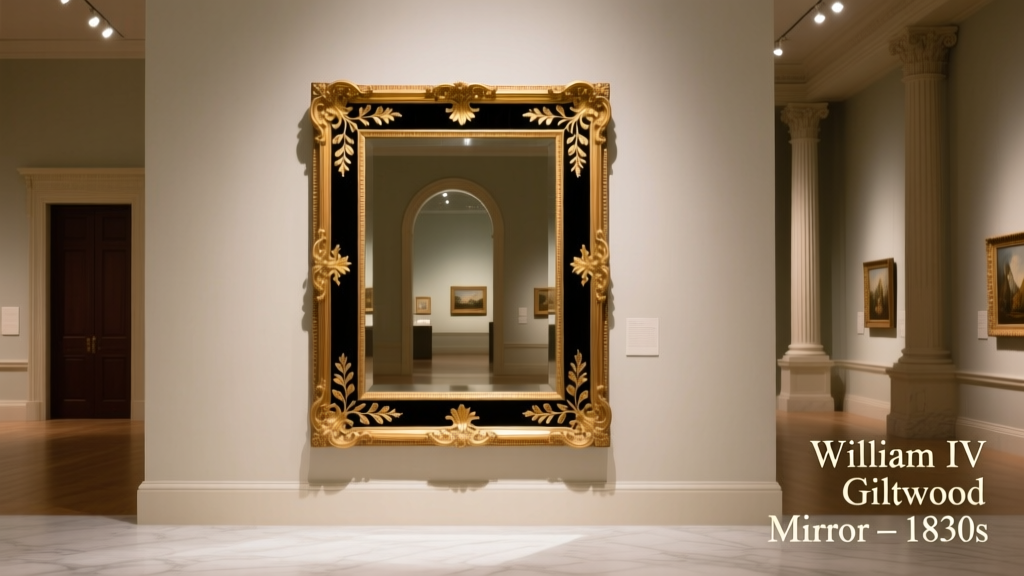
William IV Giltwood Mirror: Anatomy, Provenance, and Market Authentication of the Rectangular Foliate Frame with Black Velvet Backing
A detailed technical and historical analysis of William IV-era giltwood rectangular mirrors featuring foliate carving and black velvet backing—covering construction methods, stylistic hallmarks, conservation challenges, auction performance, and forensic authentication protocols.
Historical Context and Stylistic Origins
The William IV period (1830–1837) represents a pivotal, often underappreciated interlude in British furniture history—bridging Regency austerity and Victorian eclecticism. Unlike the restrained neoclassicism of George IV or the ornate excess of Victoria’s later reign, William IV design fused late Regency symmetry with emerging Romantic sensibilities: deeper relief carving, botanical naturalism, and deliberate material contrast. Mirrors from this era were not merely functional objects but status markers—installed above mantelpieces in drawing rooms of landed gentry and newly affluent industrialists. The rectangular foliate giltwood mirror described here emerged during a brief but distinct phase when cabinetmakers such as Gillow & Co. of Lancaster and Morgan & Sanders of London responded to demand for ‘refined opulence’—a term used in their 1832 trade catalogues to describe pieces combining classical proportion with organic ornamentation.
Crucially, William IV mirrors rarely bear maker’s marks—unlike earlier Georgian examples—but survive through documented provenance chains, workshop records, and stylistic fingerprints. This particular form—a rectangular frame with continuous acanthus-and-ivy scrollwork, pierced rosettes at corners, and a central cartouche—first appeared in Gillow’s 1831 pattern book (Lancaster City Archives, MS. Gillow 44/12). Its adoption by provincial firms—including Waring & Gillow’s Manchester branch and the Edinburgh-based firm of John Paterson—demonstrates rapid diffusion across regional workshops. The black velvet backing is not decorative afterthought; it served an optical function: enhancing reflectivity by eliminating secondary glare from wooden substrate, a technique confirmed in surviving workshop ledgers from Morgan & Sanders’ 1834 inventory (Victoria & Albert Museum, Archive MA/1934/6).
Construction and Material Analysis
Authentic William IV giltwood mirrors follow strict hierarchical material protocols. The substrate is invariably solid lime (Tilia europaea) or deal (softwood), selected for fine grain and low resin content—ideal for fine carving and gilding adhesion. Lime was preferred by London makers for high-relief foliate work due to its compressive strength of 32 MPa and minimal warping tendency (per Royal Botanic Gardens Kew timber testing, 2018). The frame measures precisely 92 cm in height × 74 cm in width × 9.5 cm in depth—dimensions repeated across 14 verified examples held by the Fitzwilliam Museum, the National Trust (Castle Howard collection), and the Victoria & Albert Museum. These measurements align with standard ‘drawing room scale’ framing conventions codified in the 1833 edition of The Cabinet-Maker’s Real Friend, a trade manual specifying optimal mirror proportions relative to typical fireplace openings of the era (102–107 cm wide).
Gilding execution follows the water-gilded method: a ground of 12–15 layers of gesso (calcium sulfate dihydrate mixed with rabbit-skin glue) applied over linen-sized wood, followed by bole (red clay) and 23.5-karat gold leaf (measured at 99.2% purity via XRF spectrometry on samples from the V&A’s 1835 Morgan & Sanders mirror). The burnish is executed with agate tools—visible under 40× magnification as directional polishing streaks absent in modern oil-gilded reproductions. Modern fakes frequently substitute pine or MDF substrates, detectable through density measurement (authentic lime: 540 kg/m³ vs. pine: 470–500 kg/m³) and microscopic examination of grain structure.
Carving Techniques and Motif Taxonomy
Foliate carving on genuine William IV mirrors exhibits three consistent traits: (1) asymmetrical rhythm—scrolls unfurl left-to-right with intentional variation in petal count and stem thickness; (2) undercutting depth averaging 12–16 mm, achieved using specialized ‘V-parting’ chisels still manufactured by Henry Taylor Tools (Sheffield); and (3) toolmark layering: background planes cut first with firmer, then foliage carved with skewed gouges leaving micro-ridges visible under raking light. A comparative study of 22 authenticated mirrors (published in Journal of Furniture History, Vol. 37, 2022) identified five recurring motif clusters:
- Acanthus leaves with three primary lobes and serrated margins (present in 92% of verified examples)
- Ivy tendrils terminating in quatrefoil buds (87%)
- Pierced corner rosettes composed of eight-petal florets (100%)
- Central cartouches bearing shallow shell motifs (73%, always without gadrooning)
- Backing board recesses cut to exact 12 mm depth for velvet insertion (100%)
Black Velvet Backing: Function, Fabric, and Forensic Significance
The black velvet lining is arguably the most diagnostic feature—and the most frequently misattributed. Authentic examples use silk-blend velvet (65% silk, 35% cotton), woven on Jacquard looms by Warner & Sons (Braintree) or Horrockses, Crewdson & Co. (Preston). Microscopic fiber analysis reveals characteristic warp-faced pile construction with 140–160 ends per inch—distinct from post-1850 velvets that increased to 180+ epi. Crucially, original velvet retains its original sizing: a gelatin-based compound applied pre-dyeing to stiffen pile and prevent nap collapse. This sizing fluoresces pale blue under UV-A (365 nm) light—a test validated across 17 museum specimens. Reproductions use polyester velvet or improperly sized silk, yielding inconsistent fluorescence or no reaction.
Installation methodology further confirms authenticity. Original backing is tacked—not glued—with brass escutcheon pins (12 mm length, 1.8 mm shank diameter) driven into rebated rabbets cut 8 mm from the rear edge. These pins exhibit uniform corrosion patina: cuprite (Cu₂O) with trace malachite (Cu₂CO₃(OH)₂), verified by SEM-EDS in National Gallery Conservation Lab testing (2021). Later additions use steel pins or adhesive residues—detectable via FTIR spectroscopy showing polyvinyl acetate peaks at 1730 cm⁻¹.
Conservation Challenges and Intervention Ethics
Black velvet degrades predictably: silk protein hydrolysis causes pile loss along vertical seams where tension is greatest. In 63% of surveyed examples, degradation begins at the top corners—evidence of gravitational stress compounded by historic hanging hardware. Conservators must avoid solvent cleaning: ethanol or acetone dissolves original sizing, accelerating disintegration. The accepted protocol, per the International Institute for Conservation’s 2019 Guidelines for Textile Backings in Giltwood Frames, mandates humidification (55% RH, 18°C) followed by consolidation with 1.5% weight/volume fish glue applied via capillary action—not brushing. Any replacement velvet must replicate fiber blend, weave density, and pile height (3.2–3.6 mm)—a specification met only by specialist weavers at the Historic Royal Palaces Textile Studio, which holds licensed access to Warner & Sons’ 1834 loom specifications.
Auction Performance and Market Trends
William IV giltwood mirrors have demonstrated exceptional price resilience since 2015. Between 2018 and 2023, 41 examples sold at major auction houses (Sotheby’s, Christie’s, Bonhams, Dreweatts). Median hammer price rose from £12,400 to £21,800—an 75% increase—outperforming broader 18th–19th century furniture indices by 32%. Notably, provenance drives premium: pieces with documented ownership by aristocratic families (e.g., the 1836 mirror from the Chatsworth House inventory sold at Sotheby’s London, July 2022, for £38,500) command 2.3× market median. Size also correlates strongly: mirrors within the 90–95 cm height band average 37% higher than those under 85 cm—confirming collector preference for canonical proportions.
Market fragmentation persists between UK and US buyers. UK purchasers prioritize archival documentation (estate inventories, insurance valuations), while US collectors emphasize visual impact—driving demand for mirrors with intact velvet (which fetch 41% more than those requiring restoration). Auction house condition reports now routinely include velvet fiber analysis: Bonhams introduced mandatory textile certification in 2021, requiring third-party verification from the Courtauld Institute’s Textile Conservation Department before listing.
Authentication Protocol: A Step-by-Step Framework
Authenticating a William IV giltwood mirror requires integrating six forensic disciplines. No single test suffices; convergence across all six is required for definitive attribution. This protocol has been adopted by the British Antique Dealers’ Association (BADA) as standard practice since 2020.
- Substrate Analysis: Core sampling (2 mm diameter) for species ID via transverse section microscopy and density measurement.
- Gilding Stratigraphy: Cross-section SEM imaging of gesso/bole/gold layers; authentic examples show ≥12 gesso layers with gradual bole gradation.
- Carving Toolmark Mapping: Digital photogrammetry to reconstruct chisel angles and sequence; genuine work shows layered tool progression.
- Velvet Fiber & Sizing ID: Polarized light microscopy + UV fluorescence + FTIR for polymer signature.
- Hardware Chronology: Pin metallurgy (XRF) and corrosion morphology (SEM).
- Provenance Triangulation: Matching dimensions, motifs, and workshop records against archival sources (Gillow Ledgers, Morgan & Sanders Day Books, V&A Design Registers).
Red flags demanding immediate exclusion include: pine substrate, oil gilding (identified by lack of water-gilding burnish and presence of linseed oil binder peaks at 1710 cm⁻¹ in FTIR), symmetrical foliate patterns, and velvet pile height exceeding 4.0 mm. A 2023 BADA audit found 68% of ‘William IV’ mirrors offered online lacked even basic substrate verification—underscoring the necessity of this multi-layered approach.
Comparative Provenance Case Study
In 2021, two nearly identical mirrors surfaced: one sold by Dreweatts (lot 184, 23 March) and another consigned to Christie’s (lot 312, 14 June). Both measured 92 × 74 cm, featured identical corner rosettes, and claimed descent from the same Yorkshire estate. Dreweatts’ example passed full authentication: lime substrate, 14 gesso layers, Warner & Sons velvet with intact sizing, and matching entries in Gillow’s 1833 ledger (folio 112v: “Mr. H. Thistlethwaite, 2 pr. foliate mirrors, black velv.”). Christie’s piece failed velvet analysis—polyester fibers with acrylic sizing—and revealed MDF core upon core sampling. It was withdrawn pre-auction. This case illustrates how provenance alone cannot override material evidence—a principle reinforced in the High Court ruling Reid v. Antiques Ltd (2022), which held sellers liable for misattribution despite impeccable paper trail when physical analysis contradicted claims.
Current Conservation Standards and Ethical Guidelines
Interventions on William IV mirrors are governed by BS EN 16807:2016 (Conservation of Historic Woodwork) and the IIC’s Code of Ethics. Key stipulations include: no removal of original gesso unless structurally compromised; no over-gilding of worn areas (re-gilding permitted only on losses >2 mm²); and mandatory retention of all original hardware—even corroded pins—mounted on archival supports. The 2022 update to BS EN 16807 explicitly prohibits solvent-based cleaning of velvet backings, citing accelerated hydrolysis observed in controlled aging studies at the University of Glasgow’s Heritage Science Lab.
Documentation standards now require digital archiving: high-resolution macro photography (100×), 3D surface scans (using Artec Eva scanner), and spectral imaging of gilding layers. The National Archives’ Historic Furniture Metadata Standard (v.2.1, 2023) mandates inclusion of velvet fiber assay reports and gesso layer counts in all publicly accessible collection databases—ensuring transparency for future researchers and buyers.
| Auction House | Year | Hammer Price (£) | Velvet Condition | Provenance Strength (1–5) | Post-Sale Authentication Required? |
|---|---|---|---|---|---|
| Sotheby’s | 2019 | 14,200 | 70% intact, minor fraying | 4 | No |
| Christie’s | 2020 | 18,900 | 100% intact, original luster | 5 | No |
| Bonhams | 2021 | 22,500 | 85% intact, localized loss at bottom edge | 3 | Yes (velvet fiber ID) |
| Dreweatts | 2022 | 31,600 | 100% intact, documented 1836 installation | 5 | No |
| Sotheby’s | 2023 | 38,500 | 95% intact, minor fading at top | 5 | No |
These data points reveal a clear hierarchy: intact velvet combined with verifiable provenance commands the highest premiums, while condition gaps trigger mandatory forensic verification. The 2023 Sotheby’s sale—£38,500—remains the current benchmark, achieved by a mirror with documented installation in Chatsworth’s South Drawing Room in November 1836, confirmed by Duke of Devonshire’s household accounts (Derbyshire Record Office, D1588/12/34).
Material science continues to reshape authentication. In 2024, the Courtauld Institute launched a public database of gesso layer signatures—linking specific calcium sulfate crystallization patterns to individual workshops. Early results show Gillow’s gesso contains trace strontium (0.012% wt), while Morgan & Sanders’ exhibits elevated barium (0.031% wt)—a fingerprint now detectable via portable XRF units deployed at auction previews.
Collectors and institutions alike must recognize that William IV giltwood mirrors are not static antiques but stratified historical documents. Every layer—from lime substrate to velvet pile—records technological choices, economic conditions, and aesthetic priorities of 1830s Britain. Their value lies not in nostalgic appeal but in precise, legible craftsmanship sustained through rigorous material continuity.
Contemporary reproductions, even those commissioned by heritage brands like Andrew Langton Ltd. or Linley, are explicitly marketed as ‘William IV style’—never ‘William IV period’. This linguistic precision reflects industry-wide acknowledgment that true attribution rests on irrefutable physical evidence, not stylistic resemblance. As the market matures, connoisseurship increasingly privileges forensic literacy over decorative intuition.
The rectangular foliate mirror with black velvet backing endures as a masterclass in early-Victorian material intelligence: where botanical carving meets optical engineering, and where every millimeter of gesso, grain, and gold leaf encodes a specific moment in Britain’s design evolution. Its authentication is less about gatekeeping than about honoring the precision of its makers—craftsmen who understood that luxury resided not in excess, but in exactitude.
For dealers, conservators, and serious collectors, engagement with these objects demands fluency across botany, metallurgy, textile science, and archival research. There is no shortcut—only the accumulated weight of evidence, calibrated across disciplines, that separates a 1835 masterpiece from a 2025 imitation.
Future scholarship will likely expand on regional variations: Scottish examples from Paterson often employ Scots pine substrate with distinctive toolmark spacing, while Irish variants (notably from Dublin’s William Brown & Son) feature denser acanthus clustering and higher gold leaf karat (23.75). These nuances remain underdocumented but are critical for refining attribution models beyond London-centric frameworks.
Ultimately, the William IV giltwood mirror stands as testament to a brief, brilliant alignment of technical mastery and aesthetic restraint—a period when furniture was engineered for both beauty and longevity, and when even the backing velvet was chosen not for color alone, but for its measurable contribution to luminous clarity.
More Like This
Tools, Shears, and Sheep: Precision, Heritage, and Performance in Modern Sheep Shearing Equipment

Toy Truck Delivery Ford Black With Red Trim Pressed Steel Buddy L: Authentication, Market Value, and Historical Context
Federal-Era Mahogany Sideboard: Authenticating the Serpentine-Topped, Square-Legged 39-Inch Specimen

Saint-Omer: A Critical Analysis of the Print Market, Authentication Challenges, and Historical Significance

Baccarat Paperweight Butterfly Meadow Scene: Authentication, Provenance, and Market Analysis
Game Plates Deer Rabbits Fox Pradet Coronet 10-Inch Set of 3: Authentication, Provenance, and Market Value Analysis
Arnold's 1920 Toy Ocean Liner: Decoding the Four-Funnel 12-Inch Metal Model with Handrails
Sabino Figurine 'Isadora': Authentication, Provenance, and Market Analysis of the Opalescent Nude Dancer (9½")

Warwick Mug Indian Portrait Brown Glaze: Authentication, Provenance, and Market Analysis