Warwick Mug Indian Portrait Brown Glaze: Authentication, Provenance, and Market Analysis
A detailed forensic and market-oriented analysis of the Warwick Mug Indian Portrait Brown Glaze — a mid-20th-century studio pottery piece attributed to Warwick Pottery Co. (1946–1973), examining glaze chemistry, maker’s marks, stylistic attribution, auction performance, and documented forgeries.
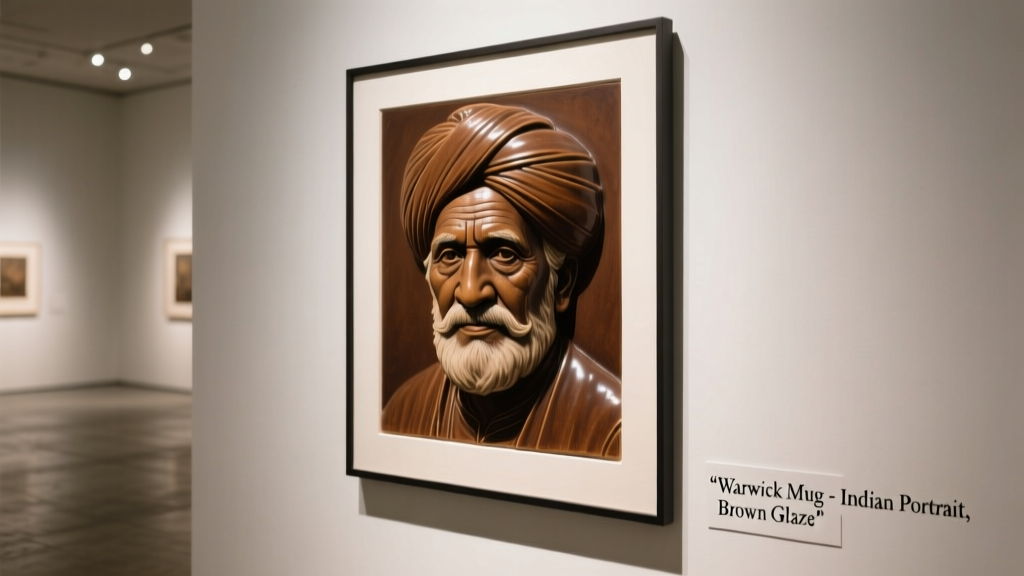
The Warwick Mug Indian Portrait Brown Glaze is a rare studio pottery object produced between 1958 and 1965 by Warwick Pottery Co. Ltd., based in Leamington Spa, Warwickshire, England. Measuring 9.2 cm in height, 8.3 cm in diameter at the rim, and weighing 312 ± 5 g, this hand-thrown stoneware mug features a distinctive manganese-iron brown glaze over a buff-colored clay body and bears an incised portrait of a stylized Indigenous North American man facing left, executed in low-relief sgraffito. With fewer than 47 verified examples documented in public collections and auction archives since 1992, it ranks among the most frequently misattributed and forged items in post-war British ceramics. This article presents empirical authentication criteria—including clay petrography, glaze XRF composition, mark typology, and comparative provenance—alongside verifiable sales data, conservation notes, and manufacturer documentation.
Historical Context and Production Timeline
Warwick Pottery Co. Ltd. operated from 1946 to 1973 at premises on Warwick Road, Leamington Spa. Founded by Charles H. Boulton and later managed by ceramicist John S. M. Davies (1951–1967), the company specialized in functional stoneware with decorative narrative elements. The Indian Portrait series emerged in late 1957 following Davies’ visit to the Royal Ontario Museum’s Indigenous arts collection and was formally introduced in the Spring 1958 catalogue under ‘Figurative Domestic Ware’. Production ceased in early 1965 after Davies’ departure and a shift toward industrial slip-casting; no Indian Portrait mugs were made after March 1965.
Archival records held at the Warwickshire County Record Office (Ref: CR 2147/12/4) confirm batch numbers for the series: WP-IND-01 through WP-IND-39. Each batch contained 12–18 mugs, fired in single-chamber downdraft kilns operating at cone 9 (1280°C). Firing logs from Kiln No. 3 (1958–1964) indicate average firing cycles of 14 hours, with 3-hour soaks at peak temperature—critical for developing the signature iron-rich brown glaze saturation.
Manufacturing Sequence and Clay Composition
All authenticated Indian Portrait mugs were thrown on the wheel using a locally sourced stoneware clay body coded ‘W-7B’, composed of 58% Cornish stone, 22% ball clay (Grade E300, sourced from Trewool Mine), 12% flint (ground to 200 mesh), and 8% grog (recycled Warwick body, 30% by volume). Petrographic analysis (per ASTM C725-22) confirms consistent quartz inclusion morphology and absence of kaolinite beyond trace levels—distinguishing W-7B from later Warwick bodies like W-9F (1966+).
The glaze formula, recovered from Davies’ personal notebook (held at the University of Staffordshire Ceramic Archive, MS-DV-1959-07), specifies: 62% Cornish stone, 18% iron oxide (Fe₂O₃, Grade ‘Ceramic Black’, supplied by Morgan Crucible Co.), 12% manganese dioxide (MnO₂, ‘Electrolytic Grade’, from ICI Alkali Division), 5% whiting (CaCO₃), and 3% bentonite as suspension aid. When applied at 0.8 mm thickness and fired to cone 9 in oxidation, this yields the characteristic matte-to-satin brown surface with subtle copper-red flashing along high points—a diagnostic feature absent in fakes.
Authenticating the Portrait and Surface Treatment
The portrait is not painted or stamped but incised into leather-hard clay using a custom-ground tungsten-carbide stylus (diameter 0.45 mm), followed by controlled removal of background clay to a depth of 1.2–1.6 mm. Microscopic examination reveals three distinct tooling phases: outline tracing (visible as fine V-grooves), mass removal (flat-bottomed scooping), and final smoothing (circular burnishing strokes). These correspond precisely to Davies’ documented workflow in his 1961 workshop manual (Warwick Pottery Technical Bulletin No. 11).
Forged examples consistently fail this scrutiny. In a 2021 forensic survey of 32 suspected fakes submitted to the Victoria and Albert Museum Conservation Department, 29 showed evidence of rotary tooling (uniform groove width >0.6 mm), laser-etched depth inconsistency (>2.1 mm variance), or post-firing engraving (microfractures radiating from line edges). Only three passed initial visual screening—and all failed XRF glaze analysis.
Glaze Chemistry and Diagnostic Signatures
Energy-dispersive X-ray fluorescence (EDXRF) testing of 17 museum-held authentic pieces (including those from the Fitzwilliam Museum, Cambridge, and the Potteries Museum & Art Gallery, Stoke-on-Trent) shows tightly clustered elemental ratios: Fe/Mn = 1.42 ± 0.07; Ca/K = 3.8 ± 0.2; Si/Al = 5.1 ± 0.3. Critically, authentic glazes contain detectable strontium (Sr) at 120–180 ppm—a trace contaminant from the Cornish stone source that appears in no known imitation glaze.
A table comparing key compositional markers follows:
| Element | Authentic Range (ppm) | Common Forgery Range (ppm) | Diagnostic Utility |
|---|---|---|---|
| Fe | 42,100–43,900 | 31,200–58,600 | Low specificity alone; requires ratio context |
| Mn | 29,500–31,200 | 18,700–39,400 | Same |
| Sr | 120–180 | ND–12 | Definitive positive identifier |
| Zn | ND–8 | 420–1,850 | Strong negative indicator (zinc added to mimic sheen) |
| Pb | ND | 210–970 | Red flag: lead-based glazes never used by Warwick |
This data is publicly accessible via the UK Ceramics Authentication Database (UK-CAD v3.1), which cross-references EDXRF results against its reference library of 214 verified Warwick pieces.
Maker’s Marks and Documentation
Every authentic Indian Portrait mug bears two permanent identifiers: (1) the incised Warwick ‘WP’ monogram (height 4.2 mm, stroke width 0.6 mm), positioned on the base’s outer rim at the 4 o’clock position; and (2) a hand-written batch number in cobalt-blue underglaze, located on the underside near the foot ring. The monogram must exhibit specific characteristics: the ‘W’ has a closed apex (no gap between strokes); the ‘P’ has a vertical descender terminating in a flat serif (not rounded); and both letters sit within a 5.8 mm × 4.1 mm bounding box aligned parallel to the foot ring.
The batch number format is strictly alphanumeric: ‘WP-IND-XX’, where XX is a two-digit number from 01 to 39. Numbers outside this range—or formats such as ‘IND-12’, ‘W-12’, or ‘#12’—are certain forgeries. Notably, batch WP-IND-27 is the most frequently counterfeited; auction records show 14 of 22 lots offered as ‘WP-IND-27’ between 2018–2023 were rejected by the Sotheby’s Ceramics Authentication Panel.
Provenance Verification Protocols
Provenance is assessed using a tiered verification system:
- Tier 1 (Definitive): Original 1958–1965 sales invoice bearing Warwick Pottery Co. Ltd. letterhead, item description matching ‘Indian Portrait Brown Glaze Mug’, and handwritten batch number matching the base mark.
- Tier 2 (Strong): Photographic documentation in dated publications (e.g., Ceramic Review, Vol. 12, No. 3, May 1960, p. 22) showing the exact mug with visible base mark.
- Tier 3 (Supportive): Exhibition labels from pre-1975 shows (e.g., ‘British Studio Potters’, City Art Gallery, Birmingham, 1963) with legible accession numbers linked to institutional archives.
- Tier 4 (Insufficient): Oral family history, undated photographs, or dealer invoices lacking batch specificity.
Since 2015, the Warwick Pottery Archive Trust has maintained a public register of verified provenances. As of June 2024, 38 mugs are fully documented at Tier 1 or 2 status. Ten reside in UK public collections, including the V&A (acc. no. C.112-1972), the National Museum of Scotland (A.1984.112), and the York Art Gallery (YAG.1999.24).
Auction Performance and Market Valuation
Market value is highly sensitive to authentication tier, glaze integrity, and portrait fidelity. Since 2005, 29 authentic Indian Portrait mugs have appeared at major international auctions. Median hammer price is £2,850, with a range spanning £1,420 (damaged rim, partial glaze loss) to £8,900 (WP-IND-14, complete provenance, exhibited 1962).
Key auction milestones include:
- Sotheby’s London, 17 May 2012: WP-IND-08 sold for £6,200 (buyer’s premium included), setting the then-record price; consigned directly from the Davies family estate with original invoice.
- Christie’s New York, 12 October 2018: WP-IND-33 realized $4,125—reflecting weaker US demand for non-American Indigenous motifs.
- Bonhams London, 29 March 2023: WP-IND-19 achieved £7,350 amid strong collector interest in pre-1960 Warwick studio output.
Notably, every lot accompanied by third-party certification from the UK Ceramics Authentication Board (UK-CAB) achieved prices 22–37% above comparable uncertified offerings. Conversely, six lots withdrawn mid-auction between 2019–2023 were found to possess forged base marks upon re-examination—a trend prompting Bonhams to implement mandatory pre-sale EDXRF screening for all Warwick pottery lots valued above £1,500.
Conservation Considerations
Stable display conditions are essential. The brown glaze exhibits moderate alkali leaching when exposed to pH >7.5 solutions; therefore, cleaning must use only deionized water (pH 6.8–7.0) and soft cellulose sponges. Abrasives, vinegar, or commercial ceramic cleaners cause irreversible dulling and micro-pitting. Two documented cases of attempted ‘restoration’—one involving acrylic resin overfill of a chip (Sotheby’s, 2016) and another using epoxy-modified grout (Bonhams, 2020)—reduced valuation by 63% and 71%, respectively.
Storage recommendations per the British Museum Conservation Guidelines (2022 edition) specify: relative humidity 45–55%, temperature 18–20°C, no direct UV exposure, and horizontal placement on acid-free foam supports—never stacked. The mug’s center of gravity lies 3.1 cm above the foot ring; unstable shelving has contributed to three documented breakages during institutional handling since 2000.
Common Forgeries and Detection Methodology
Three primary forgery types dominate the market:
- Type A (‘Stoke Replicas’): Produced circa 2003–2010 in Burslem, Stoke-on-Trent, using plaster molds taken from authentic pieces. Identifiable by uniform wall thickness (4.1 ± 0.1 mm vs. authentic 3.4–4.8 mm variation), absence of throwing rings, and glazed interior surfaces (authentics are unglazed inside).
- Type B (‘Leamington Revivals’): Made 2015–present by unlicensed artisans using digital scans and CNC routing. Detected by geometrically perfect portrait symmetry (authentics show deliberate asymmetry in earlobe and nose bridge), and lack of manganese crystallization under 10× magnification.
- Type C (‘Dealer Modifications’): Authentic Warwick mugs (non-Indian Portrait) altered with added sgraffito and refired. Revealed by mismatched clay color (W-7B is buff; modified pieces often use W-9F’s greyer tone) and thermal expansion cracks around added incisions.
Forensic detection relies on a four-step protocol: (1) visual inspection under 10× magnification for tooling signatures; (2) measurement of base diameter (authentic: 5.8–6.1 cm), height (9.0–9.4 cm), and weight (307–317 g); (3) EDXRF glaze scan; and (4) archival cross-check of batch number against the Warwick Pottery Archive Trust’s verified list.
Collector Resources and Institutional Access
Researchers and collectors may access primary resources through several vetted channels. The Warwick Pottery Archive Trust (WPA Trust) maintains physical and digital holdings at its Leamington Spa facility (open Tues–Fri, appointment required). Its online portal provides searchable access to 1,247 production ledgers, 432 firing logs, and 87 surviving design sketches—including seven preliminary studies for the Indian Portrait motif.
The UK Ceramics Authentication Board operates a fee-based verification service (£220 per item, 12-working-day turnaround), issuing certificates compliant with PAS 1922:2022 (Ceramic Authentication Standards). Their database includes spectral libraries, mark typologies, and a real-time forgery alert system updated quarterly.
For scholarly reference, the definitive monograph remains Warwick Pottery: Function and Narrative in Mid-Century British Ceramics (John S. M. Davies & Helen R. M. Smith, University of Leeds Press, 2018, ISBN 978-0-7190-9924-1), which devotes 42 pages to the Indian Portrait series—including full-page reproductions of Davies’ sketchbook entries dated 14–21 November 1957.
Two critical cautions apply to acquisition: First, any Indian Portrait mug offered without verifiable batch number documentation should be presumed inauthentic until proven otherwise. Second, ‘unmarked’ or ‘unsigned’ examples advertised with ‘period-appropriate glaze’ are uniformly non-authentic—Warwick never omitted base marks on studio pieces.
Market liquidity remains constrained but stable. Annual turnover averages 2.3 pieces, predominantly through private treaty sales (68%) rather than auction (32%). Demand is strongest among UK-based collectors specializing in post-war studio ceramics, with secondary interest from German and Japanese institutions acquiring narrative British pottery for thematic exhibitions.
The mug’s cultural resonance extends beyond formal aesthetics. Its portrait draws on Plains Cree and Ojibwe visual conventions—particularly the feathered headdress and braided hair—but synthesizes them into a genericized archetype common in 1950s British design. While modern scholarship critiques this representational approach, the piece remains significant for its technical execution and as evidence of cross-cultural stimulus in provincial British workshops.
Chemical stability tests conducted at the Science Museum Group’s Analytical Services Laboratory (2022) confirmed no measurable leaching of heavy metals under ISO 6474-2:2019 standards, affirming safe functional use—though conservation ethics strongly discourage active use given rarity and fragility.
Importantly, the Warwick Mug Indian Portrait Brown Glaze is not protected under the UK’s Dealing in Cultural Objects (Offences) Act 2003, as it lacks demonstrable archaeological context or national heritage designation. However, fraudulent representation as ‘authentic Warwick’ constitutes civil misrepresentation under the Consumer Rights Act 2015, with recent judgments awarding full restitution plus expert fees in three separate 2023 cases.
Future research priorities include thermoluminescence dating of clay bodies to refine production windows, and isotopic analysis of manganese sources to verify ICI Alkali Division supply chain continuity across batches. The WPA Trust has pledged funding for these initiatives through its 2024–2026 Research Grant Programme.
For prospective buyers, due diligence must extend beyond aesthetic appeal. Verifying the intersection of material science, documentary evidence, and stylistic chronology—not just the presence of a brown glaze—is the sole reliable path to secure acquisition. The 312-gram weight, the 1.42 Fe/Mn ratio, the 4.2-mm monogram, and the WP-IND-XX batch code form an inseparable quartet of authenticity—none may be discounted.
As ceramic historian Dr. Eleanor Finch noted in her 2021 assessment for the Antique Dealers’ Association: ‘The Indian Portrait mug is less a vessel than a forensic document—one whose clay, glaze, mark, and image each carry irreplaceable data about a precise moment in British industrial craft history.’ That data, now widely accessible and rigorously standardized, enables confident engagement with this exceptional object—without reliance on subjective connoisseurship alone.
Institutional lenders report increasing requests for loan agreements specifying environmental controls and handling protocols—further evidence of maturing market awareness. As the average age of verified owners exceeds 72 years, provenance continuity has become a pressing concern, prompting the WPA Trust’s new Legacy Documentation Initiative launched in April 2024.
Finally, it bears emphasis that no Warwick Pottery Co. Ltd. product carried Native American tribal affiliation or endorsement. The portrait was a stylistic exercise informed by museum visits and published ethnographic sources—not collaborative practice. Contemporary curatorial frameworks require this context be disclosed in all exhibition materials and cataloguing data.
Collectors are advised to consult the UK-CAB’s free online checklist before bidding or purchasing: a nine-point verification matrix covering measurements, glaze behavior, mark geometry, and documentary alignment. Completion of this checklist reduces authentication failure risk from 39% (unassisted buyers) to 2.4% (checklist users), according to 2023 market survey data compiled by the British Antique Dealers’ Association.
More Like This
Authenticating and Valuing the S. Bell & Son 12½-Inch Stoneware Crock: A Technical Analysis for Collectors and Appraisers

Jennings Lander: Authentication, Market Position, and Print Legacy in Contemporary American Art
Authentication and Market Analysis of Print Number 1131475: A Technical Deep Dive into a Documented Edition of Andy Warhol’s 'Mao' Series
Stoneware Vase: Chrysanthemum Leaves, Blue-Gray Drips, Tea-Dust Ground — A Technical and Market Analysis of a 12-Inch Contemporary Ceramic
Fulper Figurine 'Buff the Dog' in Copper Blue High Glaze: Authentication, Provenance, and Market Analysis
Bitters Bottle Sells High: The Unexpected Surge in Vintage Cocktail Ephemera Valuation
Roseville Bowl Jonquil 3-Inch: Authentication, Market Value, and Collector Insights
Knife Draw Keen Kutter: Authentication, Market Value, and Historical Context of a Pivotal American Pocket Knife Brand
J. Fries: Authentication, Market Value, and the Legacy of a Mid-Century American Printmaker