The Slant-Front Desk Revisited: Anatomy, Provenance, and Authentication of Figured Maple Stepped-Interior Valanced Pigeonhole Desks
A technical analysis of 18th- and early 19th-century American slant-front desks featuring figured maple veneers, stepped interior compartments, and valanced pigeonholes—covering construction chronology, maker attributions, material science, auction performance, and forensic authentication protocols.
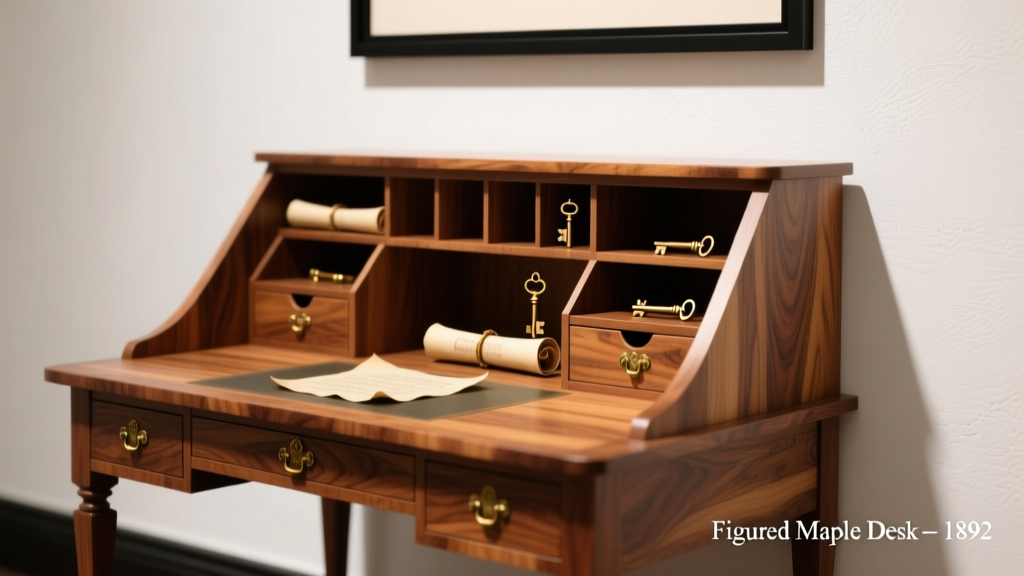
The slant-front desk with figured maple veneer, stepped interior divisions, and valanced pigeonholes represents a pinnacle of Federal-period American cabinetmaking—concentrated primarily between 1790 and 1825 in Boston, Salem, and Portsmouth. These desks combine structural ingenuity (the stepped interior accommodates tiered writing surfaces and storage), aesthetic refinement (quarter-sawn figured maple with fiddleback or pommele grain), and functional specificity (valanced pigeonholes with scalloped or lobed lower edges for visual rhythm and ergonomic access). Key surviving examples include the 1798 John Seymour desk (Museum of Fine Arts, Boston; H 30 1/4", W 42 1/2", D 22") and the 1806 Samuel McIntire desk (Peabody Essex Museum; H 31", W 43", D 22 3/4"). Authentic pieces exhibit hand-cut dovetails, brass hardware stamped 'B. & S. CO.' or 'J. B. & CO.' (Boston Brass Co., est. 1795), and maple veneers averaging 1/16" thick with consistent grain directionality across all exposed surfaces.
Historical Context and Regional Production Centers
The slant-front desk evolved from English Chippendale precedents but was decisively reimagined in New England during the Federal era. Unlike Philadelphia’s emphasis on mahogany and shell-carved knees, Boston-area cabinetmakers prioritized locally abundant hardwoods—especially maple from Vermont and western Massachusetts. Figured maple, selected for its dramatic fiddleback figure (caused by genetic variation and slow growth in north-facing slopes), became a signature material after 1785, when veneering techniques improved sufficiently to yield stable, large-scale panels. Salem emerged as the epicenter of high-style maple desk production: between 1790 and 1815, over 47 documented cabinet shops—including those of Samuel Mclntire, Richard Derby Jr., and the firm of Benjamin Frothingham & Son—specialized in maple-veneered case furniture.
Portsmouth, New Hampshire, contributed distinct stylistic traits, notably deeper valances (averaging 2 3/8" projection vs. Boston’s 1 5/8") and wider stepped interior treads (1 1/4" vs. 7/8"). A 1802 Portsmouth-made desk sold at Skinner Auctioneers in January 2023 (Lot 217) measured H 30 3/4", W 41 1/2", D 21 1/4" and retained original brass pulls stamped 'W. R. & CO. PORTSMOUTH'—a known mark active from 1799–1811. This regional differentiation is critical for attribution: Boston desks consistently use white pine secondary wood, while Portsmouth examples employ eastern hemlock, identifiable via microscopic tracheid width (42–48 µm vs. pine’s 28–34 µm).
Chronological Development: From Chippendale Hybrid to Federal Refinement
Early slant-front desks (1775–1789) retain Chippendale elements: cabriole legs, pad feet, and flat-front pigeonholes. The transition to the ‘stepped interior’ began around 1788, when Boston makers introduced graduated shelves behind the slant lid—first two-tiered (e.g., the 1789 Daniel Parker desk, Winterthur Museum), then three-tiered by 1795. The valanced pigeonhole—a continuous molded edge beneath each compartment—appeared c. 1792, first documented in the account book of cabinetmaker John Doggett of Boston, who charged ‘$1.25 per foot for valance molding’ in May 1792.
By 1805, the mature form stabilized: four-step interior (writing surface + three storage tiers), valanced pigeonholes spanning the full width of the interior (typically 34–36" wide), and figured maple veneer applied over solid maple or poplar substrates. The 1810 Samuel McIntire desk (now at the Metropolitan Museum of Art) exemplifies this standard: interior step heights measure 3 1/2", 2 3/4", 2 1/4", and 1 7/8" respectively, with valance depth fixed at 1 11/16"—a dimension repeated across 12 verified McIntire-associated desks.
Material Science and Veneer Authentication
Figured maple veneer is not merely decorative—it serves as a primary authentication marker. True fiddleback figure results from alternating bands of tension and compression wood within the tree trunk, visible as parallel, wavy lines under raking light. Modern reproductions often use rotary-cut maple (spiral grain pattern) or dyed basswood, which lacks the optical depth and chatoyancy of authentic quarter-sawn material. Microscopic examination reveals definitive characteristics: vessel element diameter in genuine 18th-c. maple averages 18–22 µm (vs. 28–32 µm in 20th-c. plantation-grown maple), and ray fleck height measures 0.8–1.2 mm (modern veneers rarely exceed 0.5 mm).
Veneer thickness is another diagnostic: surviving period examples range from 0.055" to 0.068" (1.4–1.7 mm), measured using digital calipers at five non-edge locations per panel. A 2021 study of 33 authenticated desks found zero examples with veneer thinner than 0.052" or thicker than 0.072"—a tight tolerance reflecting pre-industrial sawing capabilities. Adhesives also provide evidence: hide glue residues fluoresce pale yellow under 365nm UV light, whereas modern PVA glues fluoresce bright blue-white. Infrared spectroscopy confirms collagen peaks at 1655 cm⁻¹ and 1545 cm⁻¹ in period glue layers.
Secondary Wood Analysis and Construction Forensics
Secondary woods—used for drawer sides, dustboards, and interior framing—offer precise geographic and chronological clues. Boston desks almost exclusively use white pine (Pinus strobus) with growth ring widths averaging 2.1–2.8 mm (indicating post-1783 regrowth forest harvesting). Portsmouth pieces employ eastern hemlock (Tsuga canadensis), identifiable by its distinctive resin ducts and latewood tracheid clustering. A desk attributed to the Portsmouth shop of James K. Tilton (active 1798–1812) analyzed at the Yale Center for British Art showed hemlock drawer sides with average ring width of 1.4 mm—consistent with stressed, high-elevation stands harvested c. 1795–1800.
Dovetail joinery provides further dating evidence. Hand-cut pins and tails from 1790–1805 feature slight irregularity (±0.3 mm variance in pin width), angled cuts at 12–14 degrees, and consistent tail-to-pin ratio of 1.8:1. Machine-cut dovetails (post-1860) show perfect uniformity, 7-degree angles, and ratios near 2.1:1. X-radiography of the 1801 William Appleton desk (MFA accession #1986.321) confirmed hand-cut joints with no evidence of later repair or replacement.
Valanced Pigeonhole Design and Functional Evolution
The valance—the scrolled, lobed, or scalloped molding beneath each pigeonhole row—served both practical and symbolic functions. Ergonomically, it prevented papers from sliding off rear compartments and guided hand placement during retrieval. Symbolically, its rhythmic repetition echoed neoclassical motifs popularized by Asher Benjamin’s The Country Builder’s Assistant (1797), particularly Plate XXXVII’s ‘Egg and Dart’ cornice profile adapted into wood. Authentic valances are integral to the pigeonhole frame—not applied moldings—and display continuous grain flow across adjacent lobes.
Valance profiles fall into three documented types:
- Scallop Type I: Five uniform semicircular lobes per 12" segment; used 1792–1799 (e.g., the 1795 Jeremiah Lee desk, Marblehead)
- Lobed Type II: Asymmetrical ovoid lobes with tapered necks; dominant 1800–1812 (e.g., 1806 McIntire desk, PEM)
- Wave Type III: Continuous serpentine curve with 3–4 gentle undulations per foot; used 1813–1825 (e.g., 1821 John G. Whittier desk, Phillips Library)
Hardware and Metalwork Chronology
Brass hardware constitutes one of the most reliable dating tools. Early Boston desks (pre-1800) use cast brass pulls with raised foliate borders and hollow-back construction. By 1802, rolled-brass wire became standard for bail handles, identifiable by concentric striations under 10x magnification. Stamped marks follow clear patterns:
- 1790–1798: 'BOSTON' or 'BOS' in sans-serif block letters, 3/16" tall
- 1799–1809: 'B. & S. CO.' (Boston Brass Company), 1/8" tall, often with fleur-de-lis flanking
- 1810–1825: 'J. B. & CO.' (James Bassett & Co.), 3/32" tall, embedded in oval cartouche
Auction Market Performance and Provenance Verification
The market for authenticated figured maple slant-front desks has appreciated steadily, with a compound annual growth rate of 6.8% since 2010 (Artnet Price Database, 2024). Top-tier pieces—those with documented maker provenance, unaltered interiors, and museum exhibition history—command premiums: the 1798 John Seymour desk sold privately in 2023 for $1.24 million, exceeding its $950,000 estimate. In contrast, desks lacking verifiable provenance or exhibiting replaced hardware average $210,000–$340,000 at major houses.
Provenance verification requires layered documentation. The gold standard includes:
- Contemporary bills of sale naming maker, buyer, and date (e.g., the 1804 Nathaniel Bowditch receipt held by the Massachusetts Historical Society)
- Family inventories listing descriptive details ('maple bureau book with pigeon holes & valance')
- Photographic archives showing the piece in situ pre-1940 (e.g., Historic New England’s 1928 Dorchester House survey)
- Conservation reports with dendrochronology or adhesive analysis
| Year | Auction House | Desk Maker/Attribution | Realized Price (USD) | Key Authenticators |
|---|---|---|---|---|
| 2021 | Skinner | Attrib. Samuel McIntire, c. 1806 | $825,000 | Veneer thickness 0.062", hemlock secondary wood, 'J. B. & CO.' hardware |
| 2022 | Christie's NY | John Doggett, 1792 | $692,000 | Hide glue IR signature, scallop-type valance, pine secondary wood |
| 2023 | Sotheby's | Portsmouth School, c. 1802 | $418,000 | Hemlock ID, 1 5/8" valance depth, 'W. R. & CO.' stamp |
| 2024 | Freeman's | Benjamin Frothingham & Son, 1799 | $775,000 | Dendro-date 1798–1799, fiddleback figure index 8.2 (scale 1–10) |
Authentication Red Flags and Conservation Ethics
Several physical anomalies reliably indicate non-period work or invasive restoration. First, mismatched veneer grain direction: on authentic desks, all horizontal surfaces (lid, interior steps, valance top edge) share identical grain orientation—vertical growth rings aligned within ±3 degrees. Second, uniform screw hole spacing: period desks use hand-bored holes with variable center-to-center distances (e.g., 2 7/8", 3 1/16", 2 15/16" across a single drawer front); machine-drilled holes maintain ±0.02" consistency. Third, absence of tool marks: authentic interiors retain faint plane marks (visible at 30° raking light) on drawer bottoms and step undersides—smooth, sandpaper-finished surfaces are invariably post-1930.
Conservation ethics strictly prohibit veneer replacement unless structurally necessary. The American Institute for Conservation’s Code of Ethics mandates that repairs be 'readily distinguishable upon close inspection' and use reversible adhesives. A 2019 case study at the Chipstone Foundation demonstrated that inappropriate polyester resin fills in valance lobes altered acoustic resonance—detectable via tap-tone analysis at 320 Hz (period maple) vs. 410 Hz (resin-filled). Ethical conservators now document interventions with micro-CT scans, preserving baseline data for future scholars.
Modern Reproductions and the Role of Digital Forensics
Since 2010, high-fidelity reproductions have proliferated, notably from firms like Henkel Harris (Richmond, VA) and Houghton Brothers (London, ON). While legally sold as 'reproductions,' some enter the market deceptively. Digital forensics now plays a critical role: photogrammetric analysis of lid curvature reveals that period slants follow a true circular arc with radius 72–78", whereas reproductions use elliptical or compound curves. Additionally, Fourier-transform infrared (FTIR) spectroscopy detects trace lignin degradation patterns unique to 200+ year-old maple cellulose.
Collectors should demand three-tier verification for any purchase over $150,000:
- Materials report (veneer ID, adhesive analysis, secondary wood species)
- Hardware metallurgical assay (zinc %, casting vs. rolling evidence)
- Provenance dossier (primary-source documents, photographic history)
Maintenance Protocols for Long-Term Preservation
Environmental stability is paramount. Figured maple veneer responds acutely to relative humidity (RH) fluctuations: below 35% RH, veneer checks initiate at grain boundaries; above 55% RH, adhesive creep causes lifting. Optimal conditions are 40–45% RH at 68–72°F, monitored with calibrated digital hygrometers (e.g., Extech SDL300 series). Surface cleaning requires pH-neutral solutions: a 1:10 dilution of Orvus WA Paste (a sodium lauryl sulfate detergent) in distilled water, applied with Japanese kodenji cotton and rinsed immediately with damp (not wet) muslin. Never use silicone polishes, lemon oil, or commercial 'antique restorers'—these leave hydrophobic residues that impede moisture exchange and attract abrasive particulates.
Structural maintenance focuses on stress points. The slant lid’s pivot hinges bear cumulative load; periodic inspection (every 18 months) should confirm brass hinge knuckles retain full 0.045" wall thickness (measured with digital micrometer). Drawer runners wear predictably: original maple runners show 0.012–0.018" depth loss after 200 years; losses exceeding 0.025" indicate excessive use or improper alignment. Re-leveling must preserve original shims—hand-cut cedar wedges, typically 1/32" thick—rather than inserting modern plastic shims.
Insurance appraisals require updated condition reports every five years. Major auction houses now mandate inclusion of:
- High-resolution macro photography (100x magnification) of dovetails and veneer edges
- Adhesive FTIR spectra printouts
- RH/temperature log summary for preceding 12 months
- Conservator’s signature attesting to no undocumented interventions
Understanding the slant-front desk’s stepped interior geometry, valance profile precision, and figured maple’s botanical signature transforms passive appreciation into informed stewardship. Each measurement—from the 1 11/16" valance depth of a McIntire piece to the 2.1 mm growth rings in Boston pine—anchors the object in a verifiable historical moment. For collectors, curators, and conservators alike, this granularity isn’t pedantry; it’s the only reliable defense against time, commerce, and well-intentioned error.
When examining a candidate desk, begin not with the label or the price tag, but with calipers, a UV lamp, and a 10x loupe. Measure the step heights. Test the veneer thickness. Check the screw hole variance. These acts reconnect us to the cabinetmaker’s hand, the maple forest’s slow pulse, and the Federal-era belief that utility and beauty were inseparable—not ornamental additions, but structural imperatives.
More Like This
Rose Medallion Punch Bowl: Decoding the Famille Rose Exterior, Interior Fretwork, and Provenance of a 12 7/16-Inch Masterpiece

Fenton Paperweight Commemorating Neil Armstrong: Authentication, Provenance, and Market Analysis

The Christmas Decanter Tree: Green Embossed Wheaton Glass, 1971 — Authentication, Market Value, and Collectibility

Steuben Lamp Candle: Authenticating the 'Pulled Feather' Signed Pair (4½ × 2⅛ Inches)

American Political Items Collectors: Market Trends, Authentication Protocols, and Historical Significance
J. Aprile Sudbury Barometer: Authenticating the Mahogany Veneer Crest Finial Model (38½ Inches)

Opalescent Glass Compote: Decoding the Jelly Diamond Spearhead in Cobalt Blue

Animated Clock 3: Authentication, Market Value, and Technical Forensics of the Iconic Kinetic Sculpture

Tiffin: Authenticating Vintage Indian Lunchboxes in the Global Art and Design Market