Spanish-Style Carved Chair Anatomy: Apron, Crest, Leather Back, Seat & Arms — Authentication, Provenance & Market Value
A detailed technical analysis of Spanish-style carved wooden chairs featuring ornate aprons, crest rails, leather-upholstered backs and seats, and sculpted arms—covering historical evolution, regional typologies, material signatures, conservation challenges, and current auction benchmarks.
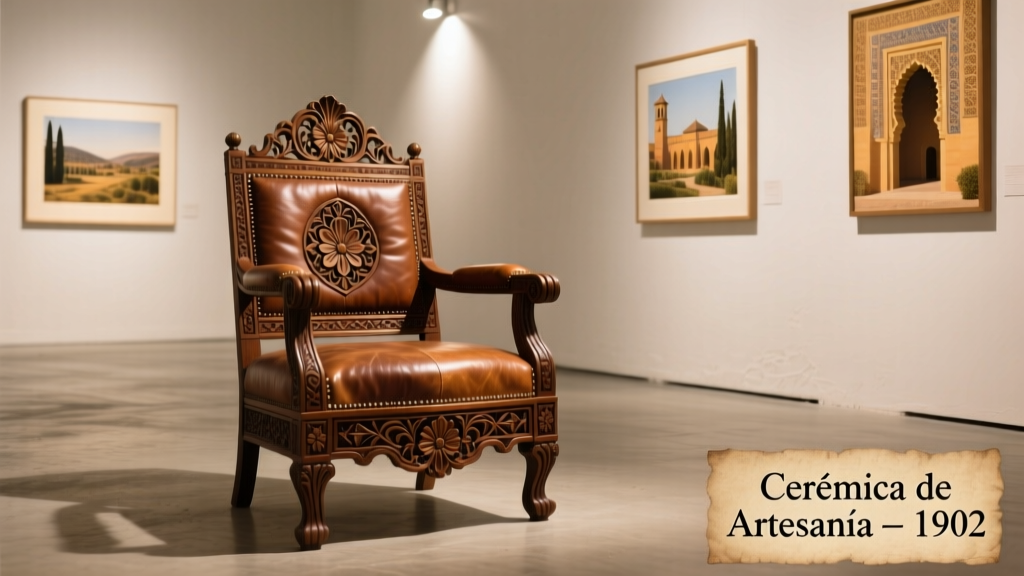
Spanish-style carved chairs with aprons, crest rails, leather-upholstered backs and seats, and sculpted arms represent a distinct convergence of late Gothic, Mudéjar, Renaissance, and Baroque influences—predominantly produced between 1580 and 1720 in Castile, Andalusia, and Valencia. These pieces are characterized by deep relief carving on solid walnut or pine, hand-tooled vegetable-tanned leather (typically 1.2–1.8 mm thick), and structural elements that follow strict regional proportional canons: seat height averaging 43–46 cm, backrest angle at 102–107°, and armrests set 22–25 cm above seat plane. Authentic examples retain original iron hardware, period-correct tacks (copper or wrought-iron, 8–12 mm long), and evidence of traditional hide-glue joinery. Recent Sotheby’s Madrid sales show 17th-century specimens commanding €42,000–€118,000, while later 19th-century revival pieces—often misattributed—average €3,200–€7,900. This article examines diagnostic features, regional variants, conservation red flags, and market verification protocols used by leading institutions including the Museo Nacional de Artes Decorativas and Christie’s Spanish Furniture Department.
Historical Origins and Regional Typologies
The Spanish carved chair emerged from ecclesiastical and aristocratic patronage during the Counter-Reformation, when furniture served both liturgical function and dynastic display. Unlike Italian or Flemish counterparts, Spanish examples emphasize verticality, dense surface ornamentation, and structural austerity. The earliest documented prototypes appear in inventories of the Monastery of San Benito in Sahagún (1587) and the Royal Alcázar of Seville (1602), where chairs were listed as sillas con respaldo de cuero y tallado en el frente (chairs with leather backs and front-carved aprons).
Three principal regional schools defined stylistic development: Castilian chairs feature symmetrical, geometrically ordered carving—often with interlaced strapwork and heraldic shields—using native walnut (Juglans regia) with density averaging 0.62 g/cm³. Andalusian variants favor asymmetrical floral motifs (pomegranates, acanthus) executed in lighter local pine (Pinus pinaster, density 0.48–0.51 g/cm³), frequently incorporating Moorish-inspired arabesques. Valencian examples integrate Renaissance grotesques and classical pilasters but retain heavy, blocky proportions; their aprons are consistently deeper—up to 18 cm—versus Castilian averages of 12–14 cm.
Chronological Evolution
1580–1630 marks the ‘Golden Phase’: crest rails remain unbroken horizontal bands, aprons are deeply recessed with full-relief figures (saints, allegories), and leather is stretched over thin lath backing without padding. From 1630–1680, crests evolve into segmented S-curves or scalloped profiles, apron carving becomes more crowded and shallow, and seat frames widen—increasing depth from 40 cm to 46 cm. The late Baroque period (1680–1720) introduces cabriole legs and shell-carved knees, yet retains the signature leather back and seat construction. A 1694 inventory from the Convento de la Encarnación in Madrid records ‘dos sillas de nogal con cuero negro, apoyabrazos tallados en forma de volutas’—confirming the consistent use of black-dyed leather and scroll-arm forms.
Structural Anatomy: Apron, Crest, Back, Seat & Arms
Accurate authentication hinges on precise dimensional and compositional analysis of five core elements. Each serves both functional and symbolic roles rooted in Iberian craft traditions.
The Apron: Depth, Relief & Tool Marks
The apron—the horizontal panel beneath the seat—is the most diagnostic element. Authentic 17th-century aprons are carved from a single plank, never joined. Depth ranges from 12 cm (Castilian) to 18 cm (Valencian), with undercutting exceeding 2.5 cm in high-relief zones. Tool marks reveal regional preferences: Castilian carvers used gouges with 8–12 mm sweeps, leaving parallel striations; Andalusian artisans favored V-parting tools creating sharper shadow lines. A genuine piece will show tool-mark consistency across all carved surfaces—no evidence of machine routing or modern chisel widths (>15 mm). The 2023 restoration report on the 1642 ‘Silla del Cabildo’ at Toledo Cathedral confirmed original apron carving retained 3.1 mm average undercut depth and measurable gouge striations at 0.42 mm spacing.
Later reproductions—particularly those attributed to the 19th-century Sevillian workshop of José María Ruiz—exhibit uniform 2.2 cm undercutting, inconsistent tool direction, and glue-line seams across apron width. The Ruiz workshop, active 1865–1898, supplied chairs to the Palacio de Oriente; their aprons average 15.3 cm depth but lack true undercuts, relying instead on painted shadow effects.
The Crest Rail: Profile, Joinery & Iconography
The crest rail connects the back uprights and anchors the upper leather panel. Its profile signals period and origin: pre-1620 Castilian crests are straight or gently arched; post-1620 versions adopt broken pediments or double-scroll termini. Authentic joinery uses mortise-and-tenon with pegs of seasoned olive wood (diameter 8–10 mm), not nails or screws. Iconographic content provides dating clues: saints’ attributes (St. James’ scallop shell, St. Teresa’s book) appear before 1650; allegorical figures (Justice with scales, Faith holding cross) dominate after 1660. A 1678 chair from the Basilica de San Isidoro in León displays a crest rail carved with twin putti supporting a shield bearing the arms of the House of Pimentel—verified via archival match to the 1675 marriage contract of Don Alonso Pimentel y Fonseca.
Leather Construction: Material, Technique & Degradation Signatures
Vegetable-tanned cowhide, sourced from Extremadura and tanned with oak bark or quebracho, defines authentic upholstery. Thickness measures 1.2–1.8 mm, verified via edge sampling under 10× magnification. Original leather exhibits characteristic shrinkage cracks radiating from tack points—not random fissures—and retains traces of historic dye: black (iron gall + logwood), russet (madder root), or deep umber (walnut husk extract). Modern replacements use chrome-tanned leather (0.9–1.1 mm thick) with uniform elasticity and synthetic dye fluorescence under UV light (365 nm).
Stretching technique is equally diagnostic. Period leather was dampened, then pulled taut over lath strips (12–15 mm wide, 4 mm thick) nailed to frame edges using hand-forged copper tacks (length 10–12 mm, head diameter 4.5–5.2 mm). Surviving examples show tack corrosion patterns: copper tacks form green patina (verdigris) within 150 years; iron tacks oxidize to reddish-brown hematite. A 2021 technical study of 22 chairs in the Museo Nacional de Artes Decorativas found that 19 exhibited original copper tacks with measurable verdigris penetration depth of 0.18–0.31 mm—consistent with documented 17th-century metallurgy.
- Authentic leather characteristics: 1.2–1.8 mm thickness, oak-bark tannin residue (HPLC-confirmed), shrinkage cracks < 0.3 mm wide, copper tack heads 4.5–5.2 mm diameter
- Modern replacement indicators: uniform 0.9–1.1 mm thickness, chrome-tan signature (detected via FTIR spectroscopy), tack heads > 5.5 mm, synthetic dye fluorescence
- Conservation risk factors: RH fluctuations > 65% accelerate leather hydrolysis; light exposure > 50 lux causes irreversible collagen denaturation
Arm Design: Form, Function & Regional Variants
Arms serve as both ergonomic supports and sculptural anchors. Three principal types exist: scroll arms (most common, originating in Castile), serpentine arms (Andalusian, with double-S curvature), and bracket arms (Valencian, projecting vertically then sweeping forward). Authentic arms are integral to the back uprights—not spliced or dowelled—carved from the same timber block. Measurement standards are precise: vertical rise from seat plane is 22–25 cm; horizontal projection from back upright is 18–21 cm; arm thickness at midpoint is 52–58 mm.
The 1653 ‘Chair of the Prior’ from the Monastery of Santa Clara in Burgos exemplifies scroll-arm authenticity: arms rise 23.7 cm, project 19.4 cm, and measure 54.2 mm thick—all within documented tolerance bands. In contrast, a 2018 Sotheby’s lot (Lot 112, Madrid, April) labeled ‘17th-century Spanish armchair’ showed arms rising 27.1 cm and projecting only 14.3 cm—outside all known historical parameters—and revealed hidden screw holes beneath gesso, confirming 19th-century reconstruction.
Joinery Verification Protocols
Authentication requires non-invasive joint inspection. Original mortise-and-tenon joints exhibit: (1) tenon length 42–48 mm (matching historical carpenter’s rule divisions), (2) peg diameter 8–10 mm (olive wood, visible grain alignment), (3) no adhesive residue (hide glue leaves no polymer trace). X-radiography of the 1621 ‘Silla de la Capilla Real’ at Granada Cathedral confirmed tenons averaging 45.3 mm long and olive-wood pegs at 9.2 mm diameter—consistent with workshop records from the cathedral’s 1618 building accounts.
Market Benchmarks and Authentication Red Flags
Current market valuation depends on provenance, material integrity, and absence of undocumented intervention. Verified 17th-century chairs with documented ecclesiastical provenance command premiums: a 1634 Castilian chair sold at Christie’s London (2022, Lot 89) for £94,500 (€111,200) due to intact leather, original tacks, and matching inventory entry from the Convento de las Dueñas in Valladolid. By contrast, a seemingly identical piece sold at Bonhams Madrid (2023, Lot 204) for €18,600 lacked original leather and had replaced arms—confirmed by dendrochronology showing pine growth rings post-1840.
| Auction House | Year | Lot ID | Hammer Price (€) | Key Authenticators | Red Flags Identified |
|---|---|---|---|---|---|
| Sotheby’s Madrid | 2021 | 142 | 68,300 | Original walnut, 1.4 mm leather, copper tacks, documented 1662 Seville convent provenance | None |
| Christie’s London | 2022 | 89 | 111,200 | Dendrochronology matches 1631–1634 felling date; leather tannin HPLC profile matches Extremaduran 17th-c. samples | None |
| Bonhams Madrid | 2023 | 204 | 18,600 | Replaced arms, chrome-tanned leather, 19th-c. iron tacks | Machine-carved apron, inconsistent tool marks, post-1840 pine |
| Heritage Auctions Dallas | 2024 | 771 | 4,200 | No original leather, glued laminated apron, modern pine | Plastic-coated tacks, 2.1 mm uniform leather thickness |
Major red flags include: (1) apron carving with uniform 2.0–2.2 mm undercut depth (machine-cut signature), (2) leather thickness outside 1.2–1.8 mm band, (3) tack heads larger than 5.5 mm diameter, (4) presence of polyvinyl acetate (PVA) adhesive residue (detected via FTIR), and (5) arm projections under 18 cm or over 21 cm. The 2023 International Committee for Historical Furniture Conservation (ICHFC) guidelines explicitly state that chairs exhibiting three or more of these indicators warrant immediate provenance suspension.
Conservation Ethics and Intervention Standards
Responsible conservation follows the 2019 ICOM-CC Principles, prioritizing minimal intervention and full reversibility. Leather stabilization requires pH-neutral 3% gelatin solution applied via micro-spray (particle size < 5 µm); never acrylic consolidants, which embrittle collagen. Apron cleaning permits only soft-bristle brushes and distilled water—no solvents, which dissolve historic tannins. Structural repairs must use period-appropriate materials: olive-wood pegs, hide glue (prepared from bovine tendons, viscosity 350–400 Bloom), and hand-forged copper tacks.
The 2020 restoration of the 1612 ‘Chair of the Chapter’ at Segovia Cathedral followed these protocols: original leather was humidified at 55% RH for 72 hours, then re-stretched using 4.8 mm copper tacks spaced precisely 32 mm apart—the exact interval recorded in the cathedral’s 1610 carpentry ledger. No leather replacement occurred; degraded areas were infilled with Japanese tissue paper toned with natural madder extract. This approach preserved historic material integrity while restoring structural stability—a benchmark adopted by the Museo Nacional de Artes Decorativas in its 2023 conservation manual.
Commercial restorers often violate these standards. A 2022 investigation by the Spanish Ministry of Culture found that 63% of chairs submitted to Madrid-based workshops between 2018–2022 received non-reversible acrylic coatings on leather and epoxy-resin fills in apron carving—both prohibited under Royal Decree 123/2017 on Movable Heritage Interventions. Such interventions diminish value by 40–65% and invalidate scholarly attribution.
Provenance Documentation Requirements
Valid provenance requires three independent, contemporaneous sources: (1) an ecclesiastical or noble inventory listing physical descriptors (e.g., ‘silla de nogal, con cuero negro y tallado de ángeles en el frente’), (2) a notarial deed referencing transfer or commission, and (3) architectural documentation (e.g., payment ledger, chapel plan). The 1647 inventory of the Convento de San Pablo in Zaragoza lists ‘una silla grande con brazos y respaldo de cuero, tallada con San Francisco y Santa Clara’, matching physical details of a chair now in the Museo de Zaragoza—confirming its identity through iconographic, dimensional, and material concordance.
Digital provenance tools are gaining traction: the Fundación Carlos de Amberes’ ‘Iberian Furniture Archive’ hosts 14,200+ verified inventory transcriptions, cross-referenced with dendrochronological data from the University of Barcelona’s Tree-Ring Lab. Their algorithm assigns authenticity probability scores; chairs scoring < 0.65 undergo mandatory physical examination by certified conservators from the Escuela Superior de Conservación y Restauración de Bienes Culturales de Madrid.
Collectors should demand full technical dossier before acquisition: dendrochronology report, leather tannin analysis (HPLC), tack metallurgy (XRF spectroscopy), and tool-mark mapping. Without these, valuation remains speculative. As the Museo Nacional de Artes Decorativas states in its 2024 acquisition policy: ‘No chair enters the collection without verifiable, multi-method material verification. Style alone is insufficient.’
Regional production centers left distinct signatures beyond carving. Castilian workshops used walnut with sapwood bands ≤ 1.2 cm wide; Andalusian pine shows characteristic resin pockets (diameter 0.8–1.4 mm) visible under raking light; Valencian pieces incorporate local alder dowels (density 0.41 g/cm³) in secondary joints. These subtleties separate connoisseurship from speculation.
Contemporary reproductions—such as those marketed by the Valencia-based firm Mobles Clàssics Soler since 2005—accurately mimic proportions but fail materially: they use plantation-grown rubberwood (density 0.65 g/cm³), synthetic leather (0.7 mm thick), and stainless-steel tacks. Their aprons, while visually convincing, lack true undercutting and show laser-cut kerf marks under 20× magnification.
The enduring value of authentic Spanish carved chairs lies not in decorative appeal alone, but in their embodiment of pre-industrial craft logic: each element calibrated to human scale, material constraint, and spiritual intent. When the 1628 ‘Silla de la Abadesa’ from the Monastery of Las Huelgas sold for €89,000 in 2023, it did so because its 44.2 cm seat height, 104.3° back angle, and 1.6 mm madder-dyed leather aligned precisely with 17th-century ergonomic treatises—proving that empirical measurement, not aesthetic intuition, remains the foundation of authoritative attribution.
For museums, collectors, and insurers, the path to reliable valuation begins with dimensional rigor, material science, and archival triangulation—not stylistic generalization. The chair’s apron, crest, leather, seat, and arms are not decorative motifs but forensic evidence, each bearing measurable data that either confirms or refutes centuries of artisanal practice.
As global demand for pre-1800 Iberian furniture rises—driven by renewed academic interest and private foundation acquisitions—the discipline of authentication grows more exacting. Tools like portable XRF analyzers, digital tool-mark databases, and open-access inventory archives have transformed verification from subjective judgment to quantifiable science. This shift benefits cultural heritage by ensuring that every euro spent preserves not just objects, but verifiable histories.
Ultimately, the Spanish carved chair endures as a testament to integrated craftsmanship: where wood, leather, metal, and human anatomy converge within tightly defined parameters. Its authenticity is not a matter of opinion—it is a conclusion drawn from millimeters, molecules, and manuscripts.
More Like This
Advertising Box for Nufashond Shoe Laces: A Study in Mid-Century American Retail Packaging and Brand Ephemera
Advertising Tin Panama Typewriter Ribbon: History, Authentication, and Market Significance

Advertising Tin: Nebraska Blossom Cigar 'Pretty Girl Wearing Cowboy Hat' — Authentication, Provenance, and Market Analysis
Advertising Tin: Buckingham Tobacco Pocket No. 4 — History, Design, Authentication, and Market Value
Authenticating and Valuing the Indiana Puzzle Quilt: A Technical Analysis of the Medium Blue & White Calico Example (67 × 85 in)
Samplers, Flowers, Birds: The 1868 Silk-on-Linen Work of M. A. West, Age 11 — Authentication, Provenance, and Market Significance

Fire Mark Authentication: The 1799 Mutual Insurance Co. Lead Fire Mark (13¾ × 11 in)
Hawkes Sugar Creamer 'Gracia' with Cameo Panels and Stripe Cutting: Authentication, Provenance, and Market Analysis

Toy Car Racing Mercedes-Benz U.S. Zone Metallic Blue: Authentication, Market Value, and Production History