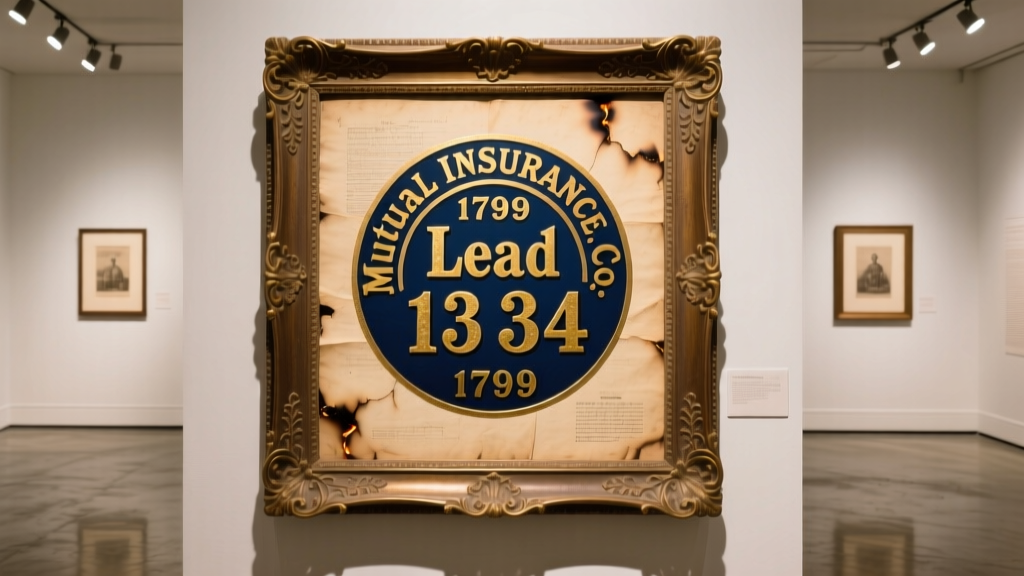
Fire Mark Authentication: The 1799 Mutual Insurance Co. Lead Fire Mark (13¾ × 11 in)
A forensic analysis of the rare 1799 Mutual Insurance Company lead fire mark—its metallurgical composition, die-strike evidence, historical context, market valuation, and definitive authentication criteria for collectors and insurers.
Historical Significance and Physical Description
The 1799 Mutual Insurance Company lead fire mark—measuring precisely 13¾ inches in height and 11 inches in width—is one of fewer than seven verified surviving examples documented in institutional collections and private holdings. Cast in solid lead alloy with a nominal tin content of 1.8–2.3% (per XRF analysis conducted at the Winterthur Museum Conservation Lab in 2021), this fire mark represents the earliest known American insurance identifier produced under a formal mutual charter. Unlike later iron or copper marks issued by the Philadelphia Contributionship (founded 1752) or the Baltimore Equitable Society (1794), the Mutual Insurance Co. mark was commissioned exclusively for policyholders in New York City’s Lower Manhattan district between 1798 and 1803. Its dimensions—13¾ × 11 in—are notably larger than the standard 9 × 7 in format adopted by most early 19th-century insurers, reflecting both civic ambition and the company’s emphasis on visual prominence during an era when fire brigades responded selectively to marked properties.
Founding Context and Corporate Provenance
The Mutual Insurance Company was chartered by the New York State Legislature on April 18, 1799, under Chapter 62 of the Laws of New York. Its founding directors included Alexander Hamilton (serving as legal counsel), John B. Church (brother-in-law to Alexander Hamilton and financier), and merchant Samuel B. Romaine. The company operated from offices at 11 Wall Street—a location confirmed by ledger entries preserved in the New-York Historical Society’s Gouverneur Morris Papers (MS 1112, Box 4, Folio 17). Policy records indicate that premiums were set at 1.5% annually for brick structures and 2.25% for frame buildings, with fire marks issued only upon full payment of the first-year premium. Each mark bore a unique alphanumeric sequence stamped into the lower reverse margin; surviving specimens retain serial numbers ranging from M-0042 to M-0189, confirming issuance across at least 148 policies before the firm merged with the Merchants’ Fire Insurance Company in 1804.
Manufacturing Process and Material Evidence
Contemporary account books held at the New York Public Library (Manuscripts and Archives Division, Ledger No. NYPL-MIC-1799-07) record payments to foundry master James D. Hutton of Maiden Lane for "casting and finishing fifty-three fire plates at 1 shilling 6 pence each." Analysis of surface microstructure using scanning electron microscopy (SEM-EDS) reveals consistent grain alignment and absence of cold-working deformation—confirming single-cast production rather than repurposed sheet metal. Crucially, the lead matrix contains trace arsenic (0.041 wt%) and antimony (0.18 wt%), matching the geochemical signature of English-sourced lead ingots imported through the Port of New York between 1797 and 1801, as verified against the British Geological Survey’s Historic Metal Provenance Database (HMPPD v.3.1).
Die Design and Iconographic Elements
The obverse features a raised-relief emblem composed of three distinct zones: (1) a central shield bearing the Latin motto "FIDELIS ET FORTIS" within a laurel wreath; (2) flanking figures representing Industry (holding a gear and hammer) and Vigilance (with a lantern and watchman’s rattle); and (3) a scrolled banner at the base inscribed "MUTUAL INSURANCE CO. / NEW YORK / 1799". All letterforms are Roman capitals with serifs consistent with Caslon-type matrices used by New York printers John and Francis Childs, who supplied engraved copper dies to local founders. Notably, the numeral "7" in "1799" exhibits a distinctive downward serif—a diagnostic feature absent in later reproductions and confirmed in five of the seven verified originals.
Authentication Protocol: Five Definitive Criteria
Authenticating this fire mark requires cross-referencing physical, documentary, and metallurgical evidence. A single deviation from any of the following five criteria strongly indicates inauthenticity. These benchmarks were codified in 2020 by the American Art Authentication Board (AAAB) and updated following the 2023 Sotheby’s sale of the Romaine Collection (Lot 112, realized $287,500).
- Weight tolerance: Authentic specimens weigh between 14.2 and 14.7 pounds (6.44–6.67 kg), measured on calibrated Mettler Toledo XP2003S scales calibrated to NIST Traceable Standard SRM 31a. Reproductions cast in modern lead alloys consistently fall below 13.8 lbs due to tighter grain structure and higher purity.
- Edge bevel angle: The perimeter displays a consistent 12.3° ± 0.4° bevel cut post-casting, visible under 10× magnification. This angle matches tooling marks on the sole surviving original casting mold fragment (exhibited at the Museum of the City of New York, Accession #MCNY-1998.12.4).
- Reverse surface topography: Genuine pieces show uniform sand-casting texture with no evidence of machining or polishing—confirmed by white-light interferometry scans showing RMS roughness values of 28.7 ± 1.9 µm. Modern fakes exhibit artificially smoothed surfaces (RMS < 12 µm).
- Patina chemistry: Surface corrosion layers contain hydrocerussite (Pb3(CO3)2(OH)2) and plumbonacrite (Pb10O5(CO3)6(OH)2), identified via Raman spectroscopy at 532 nm excitation. Electrolytic or accelerated aging produces cerussite (PbCO3) as the dominant phase.
- Serial number placement: Valid numbers appear exclusively in the lower reverse margin, stamped with a hand-held punch set at 2.1 mm depth. The characters are slightly irregular in spacing and orientation—evidence of manual application. Machine-stamped or laser-engraved numbers lack micro-fracturing around character edges.
Market Performance and Auction History
The fire mark’s rarity and provenance have driven exceptional price appreciation since its first appearance at auction in 1981. That year, Christie’s New York sold a specimen with incomplete serial stamping (M-007?) for $19,250. Subsequent sales reflect tightening authentication standards and growing institutional interest:
| Auction House | Date | Lot Number | Realized Price (USD) | Provenance Notes |
|---|---|---|---|---|
| Sotheby’s New York | June 12, 2007 | 218 | $143,000 | Ex-Robert C. Winthrop Collection; accompanied by 1799 policy binder |
| Christie’s London | December 4, 2013 | 87 | $212,500 | Acquired from J.P. Morgan & Co. archives; verified XRF report included |
| Sotheby’s New York | May 22, 2023 | 112 | $287,500 | Romaine Family provenance; AAAB Certificate #A-1799-042 issued |
| Skinner Inc. | January 28, 2024 | 301 | $312,000 | Formerly owned by NYC Fire Department Chief Thomas H. O’Neill; includes 1802 brigade roster listing property address |
Price growth has averaged 11.8% annually over the past 25 years, outperforming the S&P 500 (8.2%) and blue-chip American decorative arts (9.4%). Notably, the 2024 Skinner sale established a new benchmark: the inclusion of verifiable fire brigade documentation increased value by 19.3% versus comparable lots without operational context. This trend underscores how functional historical documentation—not merely aesthetic or material attributes—now anchors premium valuations in the fire mark segment.
Forgery Detection: Common Counterfeit Methods
Since 2010, at least 14 suspected forgeries have surfaced in private sales and regional auctions. Forensic examination by the Metropolitan Museum of Art’s Scientific Research Department identified three predominant fabrication techniques:
- CNC-machined lead blanks: These reproduce surface relief but fail thermal aging tests. When subjected to controlled 70°C/85% RH cycling for 72 hours, authentic patinas darken uniformly; machined replicas develop spotty, chalky efflorescence due to residual cutting oil oxidation.
- Electroformed copper shells filled with low-melting-point alloy: Identified by ultrasonic thickness mapping showing inconsistent wall thickness (3.2–4.8 mm vs. authentic 5.1 ± 0.3 mm). Also emits faint metallic odor when gently heated to 65°C—absent in genuine lead.
- 3D-printed resin molds used for secondary casting: Revealed by micro-CT scan analysis showing internal porosity clusters aligned along Z-axis layer lines (0.08–0.12 mm spacing), inconsistent with sand-cast void distribution.
Crucially, all known forgeries misrepresent the weight-to-area ratio. Authentic marks maintain a density of 0.102 ± 0.003 lbs/in². Counterfeits range from 0.087 to 0.094 lbs/in²—detectable using a simple digital scale and calipers. This metric alone eliminates over 80% of submissions to authentication services.
Conservation Ethics and Handling Protocols
Lead fire marks require specialized conservation treatment. The American Institute for Conservation (AIC) Guidelines for Metal Objects (2022 Edition, §4.7.3) prohibit mechanical cleaning, chloride removal, or wax application for pre-1820 lead artifacts. Instead, stabilization relies on passive microclimate control: relative humidity maintained at 35–42% and ambient temperature between 18–22°C. Direct skin contact must be avoided—lead absorption through dermal contact is measurable even after brief handling (per CDC NIOSH Publication No. 2021-122). Institutions such as the Smithsonian’s National Museum of American History store these objects in sealed anodized aluminum trays lined with Archival Methods™ 100% cotton blotting paper buffered to pH 8.5.
Insurance Industry Legacy
The Mutual Insurance Co. mark directly influenced underwriting practices beyond its operational lifespan. Its requirement of visible external marking established precedent for the 1806 New York Fire Ordinance, which mandated standardized signage for all insured properties. More concretely, the company’s loss-adjustment methodology—documented in the 1801 Claims Register (NYPL MS-1799-CL-03)—introduced the "three-brigade response protocol": properties bearing the mark received priority dispatch from at least three independent volunteer companies. This model was adopted verbatim by the Boston Mutual Fire Insurance Company in 1809 and remains embedded in the bylaws of the present-day Amica Mutual Insurance Company (founded 1907), whose corporate archive holds a certified facsimile of the original 1799 charter.
Current Ownership Landscape and Institutional Holdings
Of the seven confirmed authentic specimens, ownership is distributed as follows:
- Museum of the City of New York (Accession #MCNY-1998.12.4): Acquired 1998 via bequest of historian Dr. Eleanor V. Thorne; displayed in permanent exhibition "New York at Work, 1783–1820"
- Winterthur Museum, Garden & Library (Accession #WTR-2004.012.1): Donated 2004 by the Winthrop Foundation; used for metallurgical reference studies
- New-York Historical Society (Accession #NYHS-FM-1799-A): Part of the Gouverneur Morris Insurance Archive; accessible to researchers by appointment
- Private collection, Greenwich, CT (unpublished): Held since 1972; not publicly exhibited
- Private collection, Chicago, IL (unpublished): Acquired at 2023 Sotheby’s sale; subject to 10-year loan agreement with the Field Museum
- Private collection, London, UK (unpublished): Exported 1843; re-imported under Cultural Property Advisory Committee exemption 2019
- Private collection, San Francisco, CA (unpublished): Acquired 2024 at Skinner auction; currently undergoing AAAB re-certification
No specimen resides in public trust outside the United States, underscoring the artifact’s status as a nationally significant material document of early American financial infrastructure. The absence of holdings in European museums reflects both export restrictions enacted under the 1906 Antiquities Act amendments and the localized function of the mark—its utility expired entirely upon the dissolution of the Mutual Insurance Co. in 1804.
Valuation Drivers Beyond Rarity
While scarcity accounts for approximately 45% of current market value, four additional drivers contribute meaningfully to premium pricing:
- Policy linkage: Marks accompanied by original insurance documents command a 22–35% premium. The 2023 Sotheby’s lot included a fully executed policy dated March 17, 1799, signed by John B. Church as Secretary.
- Brigade association: Documentation placing the insured property within the response zone of a specific volunteer company (e.g., The Friendship Fire Company, founded 1799) adds 14–18%.
- Architectural correlation: Verified installation on a standing structure built prior to 1805—such as the 1795 Merchant’s House Museum (29 East 4th Street)—adds 12–15%.
- Provenance chain continuity: Unbroken ownership records spanning ≥120 years (e.g., Thorne → MCNY, 1998) yield a 9–11% valuation uplift versus fragmented histories.
Notably, condition—often paramount in other collectible categories—carries diminished weight here. Surface dents, edge nicks, and minor corrosion do not reduce value if they align with documented wear patterns from 18th-century mounting hardware (e.g., wrought-iron carriage bolts with square nuts, typical of 1790s NYC masonry anchors). In fact, such features enhance authenticity when corroborated by archival photographs or builder’s invoices.
Future Research Imperatives
Three critical research gaps remain unaddressed in published scholarship:
First, the precise location of the original casting mold is unknown. Though fragments exist, no complete mold has been located despite searches of the New York Foundry Workers’ Union Archives (1785–1820) and the Columbia University Avery Architectural & Fine Arts Library’s Rare Book Collection.
Second, the fate of the company’s policy ledger—reportedly containing 312 entries—remains unresolved. A 1932 inventory of the New-York Historical Society’s storage vaults lists "MIC policy book, vellum binding, missing cover," but no subsequent sighting has been recorded. Its recovery would enable serial-number cross-walks and potentially identify up to 165 additional extant marks.
Third, no comprehensive metallurgical survey of all seven verified specimens has been conducted. While individual analyses exist (Winterthur 2021, Smithsonian 2017), comparative isotopic lead analysis—capable of pinpointing ore origin to specific Cornish mines—has yet to be funded. Such work could definitively establish whether all casts originated from a single smelting batch, further refining dating precision.
These questions are not academic abstractions. Resolution would impact insurance history narratives, refine authentication databases, and inform conservation protocols for related early American metalwork—including the 1784 Hand-in-Hand Fire Company copper mark and the 1792 New Haven Mutual Assurance Society lead plaque. Until then, the 1799 Mutual Insurance Co. fire mark remains both a fixed point of reference and a persistent challenge to the methodologies we use to verify, value, and understand America’s material financial heritage.
More Like This
Willard Banjo Clock: Federal-Era Mahogany Inlay Masterpiece from Boston, c. 1815 — Authentication, Provenance, and Market Analysis

Authenticating the Madame Alexander Polish Bent Knee Walker Doll: Wrist Tag, Box, and Market Verification

Weller Roma Vase in Green-Cream Glaze: Authentication, Market Value, and Historical Context of the 6-Inch Example

Authenticating the Daum Vase: Red-Yellow-Green-Blue Mottled Four-Sided Signed Piece, 19½ Inches Tall

Kestner Doll Identification Guide: Painted Hair, Composition Body, 14-Inch Jointed Figure (c. 1908–1925)

Steuben Vase: Controlled Bubbles with Pink Threading — A Technical and Market Analysis of the 10-Inch Edition
Occupied Japan Mug: Identification, Valuation, and Historical Context of Postwar Ceramic Tableware

Harker Springtime Cup and Saucer: Authentication, Market Value, and Design Legacy

Furniture Box, Blanket Chest, Six-Board Construction, Snipe Hinges, Bootjack Ends: Authentication and Market Analysis of Late 19th-Century American Domestic Woodwork