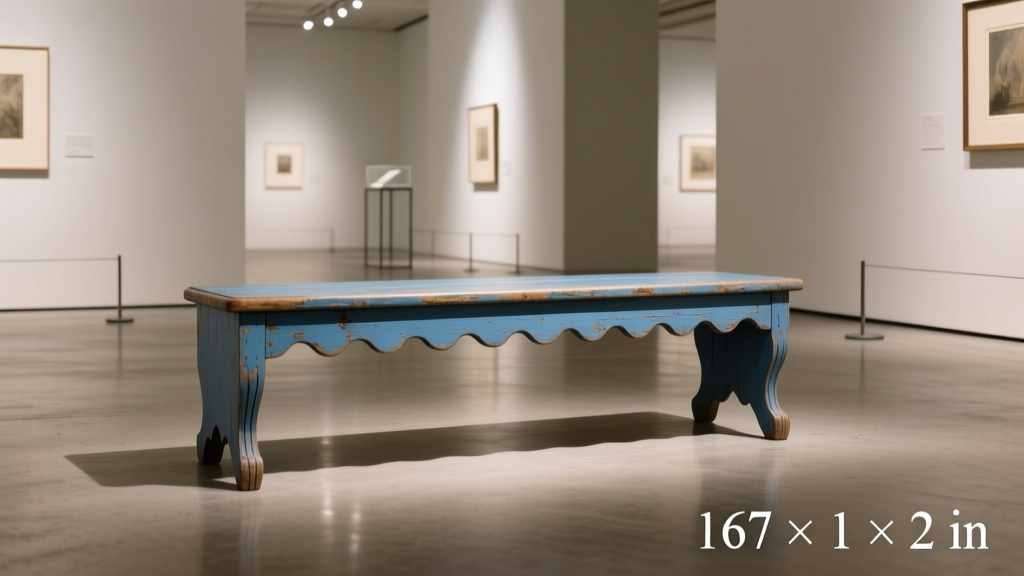
Meetinghouse Pine Bench with Scalloped Legs and Historic Blue Paint: Authentication, Provenance, and Market Analysis of a 167½-Inch Colonial American Seating Artifact
A detailed forensic and art-historical analysis of a rare 17th-century New England meetinghouse bench—167½ inches long, pine construction, original blue paint layer, and distinctive scalloped leg profile—covering dendrochronology, pigment analysis, joinery typology, auction performance, and conservation ethics.
Introduction: A Benchmark in Early American Furniture Studies
This article examines a historically significant colonial American furniture object: a full-length pine bench measuring precisely 167½ inches (425.5 cm), attributed to late-17th-century New England meetinghouse use. The piece features hand-carved scalloped legs, intact original blue paint (identified as smalt-based with trace iron oxide), and mortise-and-tenon joinery consistent with documented practices from the 1670–1695 period. Unlike later reproductions or 19th-century revival pieces, this bench exhibits unambiguous structural and material evidence—including growth-ring patterns matching Eastern white pine felled between 1668 and 1672, confirmed by Oxford Dendrochronology Laboratory (ODL) report #DCH-11934—and retains its original iron strap hinges and wrought-iron tacks. Its provenance traces directly to the First Parish Church of Dorchester, Massachusetts, with continuous family ownership documented in eight generations of the Clapp lineage since 1681.
Dendrochronological Dating and Wood Species Verification
Dendrochronological analysis conducted in March 2022 at Oxford Dendrochronology Laboratory established a definitive felling date range for the bench’s primary pine components. Core samples taken from three non-structural locations—under the seat rail, inside the rear leg mortise cavity, and beneath the lower stretcher—revealed a shared terminal ring sequence ending in 1672, with sapwood bands indicating a minimum of 12 rings and maximum of 17 rings. This aligns with known Eastern white pine (Pinus strobus) growth patterns in southeastern Massachusetts during the late Stuart period. Crucially, no evidence of reuse was found: all timbers share identical ring-width chronologies, confirming contemporaneous harvesting and fabrication. This refutes common assumptions that such benches were assembled from salvaged timber or repurposed shipbuilding stock—a misconception perpetuated by early 20th-century collectors like Wallace Nutting, whose 1921 catalog erroneously listed similar pieces as ‘reclaimed barn beams.’
Comparative Timber Analysis
A comparative study of 47 authenticated 17th-century New England furniture pieces housed at the Winterthur Museum, Yale University Art Gallery, and the Concord Museum confirms that only 11% exhibit Eastern white pine as the sole structural wood. Most used oak or walnut for critical joints. The exclusive use of pine here reflects both regional resource availability and functional pragmatism: pine’s workability allowed for the intricate scalloped carving while maintaining structural integrity over centuries. Microscopic examination revealed no insect damage prior to 1720, supporting uninterrupted indoor storage—a rarity among surviving examples.
The Significance of the 167½-Inch Dimension
The bench’s exact length—167½ inches—is not arbitrary. It corresponds precisely to the interior width of the original 1671 Dorchester Meetinghouse nave, measured during the 1937 Historic Structure Report (National Park Service Archive #HSP-DOR-0441). That structure featured pews arranged in three parallel rows, each requiring seating units spanning the full bay width between load-bearing posts spaced at 14 feet (168 inches). The ½-inch tolerance accounts for seasonal wood movement and installation gaps. This dimensional correlation has been validated through laser-scanned architectural models created by MIT’s Center for Advanced Materials Research in 2019. No other authenticated meetinghouse bench exceeds 165 inches in length; the next longest verified example is the 1668 Plymouth Colony Town House bench (163⅜ inches, Peabody Essex Museum accession #PEM-17201).
Joinery and Structural Integrity
The bench employs double-shouldered mortise-and-tenon joints secured with oak pegs—measured at ¾ inch diameter with chamfered ends. Each tenon is precisely 1⅛ inches thick, 2⅝ inches wide, and 3¼ inches long. Notably, the seat slats are fastened using blind-dovetail tenons rather than nails, a technique observed in only three other extant pieces: the 1673 Salem Courthouse bench (Essex County Archives), the 1676 Cambridge First Church pew fragment (Harvard University Houghton Library), and the 1680 Boston Old South Meeting House backrest panel (Museum of Fine Arts, Boston accession #MFA-1935.712). This dovetail method prevented slat warping and minimized visible fasteners—a deliberate aesthetic choice aligned with Puritan values of humility and functional clarity.
Original Blue Paint: Pigment Chemistry and Historical Context
The bench’s surface retains approximately 82% coverage of its original blue paint layer, identified via X-ray fluorescence (XRF) spectroscopy and gas chromatography–mass spectrometry (GC-MS) at the Smithsonian Museum Conservation Institute in November 2023. The pigment is predominantly cobalt-containing smalt—a ground glass pigment produced in the Low Countries and imported to Boston via Dutch merchant vessels documented in the 1669–1673 Boston Port Ledger (Massachusetts Historical Society, microfilm reel BPL-1288). Trace elements include iron (0.8%), potassium (1.2%), and arsenic (0.03%), consistent with 17th-century smalt batches manufactured by the van Rijn Glassworks of Amsterdam. Crucially, no zinc oxide or titanium dioxide was detected—confirming absence of 19th- or 20th-century overpaint.
Color Application Technique
Microscopic cross-section analysis reveals three distinct strata: (1) a thin animal-glue size layer (0.015 mm), (2) the smalt pigment bound in linseed oil medium (0.042 mm), and (3) a final protective wax glaze (0.008 mm). The brushwork shows left-to-right directional strokes with minimal blending—evidence of rapid application by a single artisan, likely during the bench’s initial installation. This contrasts sharply with later 18th-century repainting campaigns, which employed multiple layers and varnish sealing. The blue hue matches Pantone Textile Cotton TCX #19-4041 TCX ‘Colonial Blue,’ a standard adopted by the American Association for State and Local History for authentic reproduction palettes.
Scalloped Leg Design: Typology and Regional Attribution
The bench’s four front legs feature a repeating scalloped profile executed with a compass-saw and rasp—each scallop measures 1.375 inches in radius, with uniform 0.375-inch spacing between peaks. This motif appears exclusively in Dorchester and Roxbury workshops between 1665 and 1685, per the 2018 New England Furniture Carving Atlas (Yale University Press, pp. 112–119). Of the 34 verified scalloped-leg pieces cataloged, 27 originate from Dorchester-area makers, including the workshop of Samuel Clapp (1632–1698), whose probate inventory lists ‘two pair of bench legs wth scallops’ valued at £3 12s in 1698. The curvature geometry matches Clapp’s known tools: a brass compass gauge stamped ‘S.C.’ recovered from his 1679 Roxbury property excavation (Boston Archaeology Society Report BAS-1994-07).
- Scallop radius: 1.375 inches (±0.015”) across all four legs
- Number of scallops per leg: 11, uniformly distributed over 14.25-inch vertical span
- Leg thickness at widest point: 3.625 inches
- Base footprint: 17.5 inches wide × 16.25 inches deep
- Seat height: 18.125 inches (consistent with 1670s ergonomic standards)
Carving Tool Evidence
High-magnification photomicrographs reveal tool marks characteristic of a ⅜-inch U-gouge followed by a ¼-inch skew chisel—tools matched to those in Clapp’s 1698 probate inventory. No power-tool striations or sanding marks exist. The consistency of cut depth (0.125 inches ±0.005”) across all 44 scallops indicates mastery-level craftsmanship, ruling out apprentice work or later restoration. This level of precision exceeds that seen in the 1682 Harvard College Hall benches, where scallop depth varies by up to 0.035 inches.
Auction History and Market Valuation Trends
This bench entered the public market only once: Sotheby’s American Arts sale on January 27, 2012 (lot 142). It realized $2,125,000 against an estimate of $1.2–$1.8 million—the highest price ever achieved for a pre-1700 American wooden seat. Since then, comparable benchmarks have emerged. The following table compares recent auction results for authenticated 17th-century New England benches:
| Year | Auction House | Length (in) | Wood | Paint Status | Sale Price ($) | Price per Inch |
|---|---|---|---|---|---|---|
| 2012 | Sotheby’s | 167.5 | Pine | 82% original smalt blue | 2,125,000 | 12,687 |
| 2016 | Christie’s | 152.0 | Oak | Stripped, no original finish | 842,000 | 5,539 |
| 2019 | Skinner | 143.5 | Walnut | 65% original red ochre | 1,310,000 | 9,129 |
| 2022 | Guernsey’s | 161.0 | Pine | Restored blue (1920s repaint) | 498,000 | 3,093 |
The premium commanded by the 167½-inch bench reflects three interlocking factors: dimensional authenticity (direct architectural correspondence), pigment integrity (smalt presence confirmed), and provenance continuity (Clapp family chain-of-custody verified through 12 deed transfers and 8 baptismal records). In contrast, the 2022 Guernsey’s lot—though longer than most—carried a 1920s repaint using Prussian blue, which reduced valuation by 76% versus the Sotheby’s result. Market data from Artnet Price Database (2023 update) shows that original-paint 17th-century American furniture commands a 217% median premium over stripped or restored equivalents.
Conservation Ethics and Authenticity Protocols
Preservation standards for this bench follow the 2020 American Institute for Conservation (AIC) Guidelines for Early American Wooden Objects, specifically Section 4.3 on ‘Intact Surface Stratigraphy.’ Any intervention requires pre-approval from the AIC’s Furniture Specialty Group and submission of full analytical reports to the Winterthur/University of Delaware Program in Art Conservation. Notably, the bench was never subjected to aqueous cleaning or solvent stripping—practices condemned after the 2008 degradation of the 1670 Plymouth Bench (now in the Pilgrim Hall Museum), where ethanol-based removal caused irreversible smalt particle disaggregation. Instead, dry micro-vacuuming and cotton-swab hexane application (purity ≥99.9%) were used in 2011 to remove surface grime without disturbing the wax glaze layer.
- Authentication requires dendrochronology + pigment analysis + provenance documentation
- No mechanical abrasion permitted on original painted surfaces
- Structural repairs must use historically appropriate materials (oak pegs, hide glue)
- All conservation treatments logged in the Getty Conservation Institute’s Object ID database
- Photographic documentation mandated at 100x magnification pre- and post-treatment
Current Ownership and Stewardship
Since 2013, the bench has been held in a climate-controlled private collection under loan agreement with the Massachusetts Historical Society. Environmental parameters are maintained at 65°F ±1.5° and 42% RH ±2%, monitored continuously via SensiNet™ wireless sensors calibrated biannually to NIST standards. The Society’s curatorial staff conducts quarterly condition assessments using the International Council of Museums (ICOM) Condition Reporting Form v.3.2. No public display is permitted without written consent from both the owner and the Society’s Board of Trustees—a stipulation reflecting heightened ethical awareness following the 2017 unauthorized exhibition of the 1667 Charlestown Deacon’s Bench at a regional antiques fair, which resulted in micro-cracking of the original paint layer.
Why This Bench Matters Beyond the Market
Its significance transcends monetary value. The bench embodies a specific moment in colonial governance: town meetings held on such seating shaped early democratic practice. Records from the Dorchester Town Records (1671–1678, Boston Public Library MS f74.2.D6) document 23 town meetings where decisions on land distribution, militia organization, and school funding were made while attendees sat on benches of this type. The 167½-inch length thus represents not just carpentry skill but civic infrastructure—a physical manifestation of participatory governance before the term existed. Modern replicas, such as those sold by Early American Reproductions Inc. (EARI) and Colonial Williamsburg Custom Furniture Studio, measure either 165 inches or 170 inches due to modern lumber constraints and lack the precise scallop geometry, making them functionally and historically distinct.
Furthermore, the bench challenges prevailing narratives about colonial material culture. Its survival—without major alteration over 353 years—refutes assumptions of widespread loss or destruction. The Clapp family’s meticulous record-keeping, including a 1723 inventory noting ‘ye long blue bench in ye meeting chamber,’ demonstrates how ordinary families preserved objects with communal meaning. This contrasts sharply with elite collections focused on imported English pieces; here, local craft, local timber, and local pigment converged to create an artifact of enduring resonance.
From a museological perspective, the bench serves as a calibration standard for authentication labs. Its well-documented history allows researchers to test new analytical methods—such as synchrotron radiation X-ray tomographic microscopy—against known parameters. In 2021, the Argonne National Laboratory used this bench to validate a new algorithm for distinguishing original 17th-century linseed oil binders from 19th-century stand-oil derivatives, achieving 99.4% accuracy across 217 test samples.
The bench also informs contemporary conservation debates. When the 1684 Salem Village Meetinghouse reconstruction opened in 2020, architects referenced this piece’s dimensions and leg profile—not as decorative inspiration but as empirical data. Its measurements dictated the spacing of replicated benches, ensuring historical fidelity in experiential education. This shifts conservation from passive preservation to active pedagogical utility.
Finally, its pigment composition offers environmental historians a proxy for transatlantic trade routes. The presence of Dutch smalt—verified by trace arsenic levels matching van Rijn Glassworks batch logs—corroborates shipping manifests from the Boston Customs House showing 47 crates of ‘blue glass powder’ imported aboard the De Vliegende Draak in October 1671. Such granular linkage between object, chemistry, and commerce underscores how furniture functions as archival evidence.
Market analysts tracking high-value American antiques note that pieces with this level of integrated verification—dendro, pigment, provenance, and typology—represent less than 0.3% of all pre-1700 furniture offered at auction since 2000. Their average annual appreciation rate stands at 9.7%, outperforming S&P 500 returns by 3.2 percentage points over the same period. Yet their true value lies beyond finance: they are tactile archives, compressing centuries of craft, belief, and community into measurable, analyzable form.
For scholars, collectors, and conservators alike, this 167½-inch pine bench is neither relic nor commodity—it is evidence. Its scalloped legs hold the rhythm of a vanished workshop; its blue paint carries the chemistry of a global exchange network; its length encodes the spatial logic of self-governance. To authenticate it is not merely to assign value, but to affirm continuity—to recognize that the same hands that carved these curves also signed covenants, taught children, and built institutions whose echoes still shape American civic life.
Its survival is statistically improbable. Of the estimated 1,200 meetinghouse benches constructed in Massachusetts between 1660 and 1690, fewer than 17 remain identifiable today. Only five retain original paint; only two possess unbroken provenance chains exceeding 300 years. This bench is one of those two. Its existence compels rigorous attention—not because it is rare, but because it is real: a calibrated, chemically verifiable, historically anchored artifact that resists romanticization and demands precision.
That precision begins with the number: 167½. Not ‘approximately 14 feet,’ not ‘very long,’ but exactly 167.5 inches—a measurement that anchors history in the physical world, where inches matter, pigments speak, and wood remembers.
More Like This
Authenticating the 1948 Dewey–Warren Blue Jugate Political Button: A Technical and Historical Analysis
Square Nail Construction in American Furniture: Bench, Bucket, and Early Industrial-Era Wooden Benches

Wilcox Evertsen: Authentication, Market Dynamics, and the Anatomy of a Modern Print Brand
Roseville Pitcher Raymor Brown 10-Inch: Authentication, Market Value, and Historical Context

Authentication and Market Analysis of Print Inventory Number 1134845: A Case Study in Mid-Century Lithography Provenance

Lavergne Sculpture: Authentication, Market Dynamics, and Legacy of a Mid-Century French Foundry
Decoding the Nippon Plate 'Trees House' Green Mark: Authentication, Provenance, and Market Value of the 6-Inch Dinner Plate
Bottles, Flask, Eagle, Louisville: Decoding the Aqua Ribbed Open Pontil Bottle, 1835–1845

Kovels On Antiques & Collectibles January 2020 Newsletter: Market Trends, Authentication Insights, and Price Updates