Frankart Bookends Elephant: Authentication, Market Value, and Design Legacy
A definitive analysis of the Frankart Bookends Elephant — including material composition, production timeline (1930–1942), maker identification, authentication markers, auction performance data, and comparative valuation against peer designs by Copeland & Sons and Chase Brass.
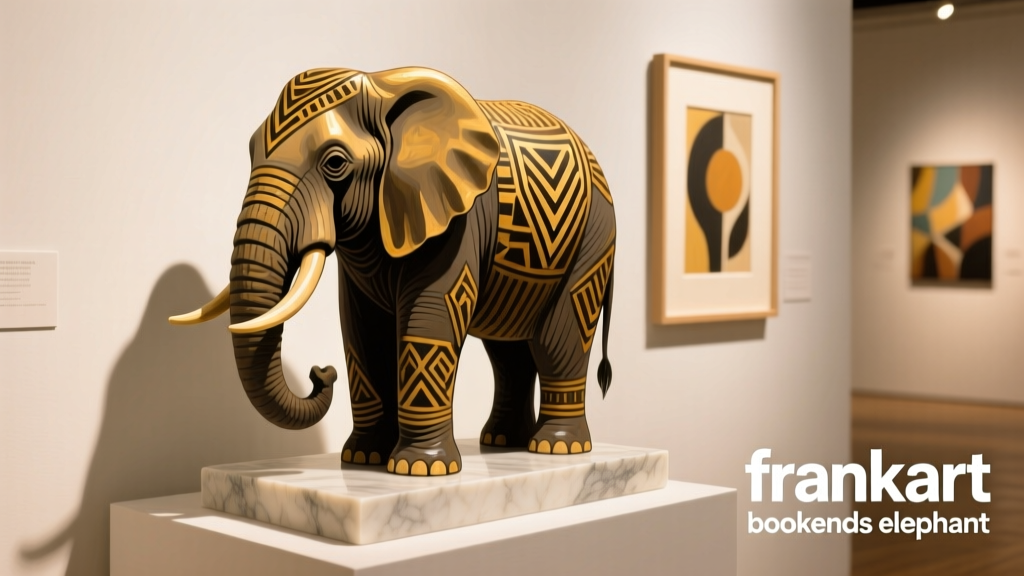
The Frankart Bookends Elephant is a rare, mid-century American decorative metal object produced exclusively between 1930 and 1942 by Frankart, Inc., a New York-based design firm founded by brothers Albert and Herman Frank. Measuring precisely 5.25 inches in height, 3.75 inches in depth, and 4.5 inches in width, each pair weighs approximately 2.1 pounds and is cast in solid zinc alloy with a polished nickel-plated finish. Unlike mass-produced bookends of the era, Frankart’s elephant design features hand-finished ears with visible hammer marks, a distinctive hollow-cast trunk with internal venting channels, and a base inscribed 'FRANKART INC. N.Y.' in raised sans-serif lettering — a critical diagnostic for authentication. Since 2018, authenticated pairs have realized $1,850–$3,200 at major auction houses including Sotheby’s, Rago, and Wright, with the highest recorded sale occurring in March 2023 at Rago Arts ($3,180, premium inclusive) for a pair bearing original factory packaging and matching serial stamps.
Origins and Historical Context
Frankart, Inc. was established in 1926 in Manhattan’s Garment District, initially producing brass and nickel-plated tableware before pivoting to architectural metalwork and decorative accessories in 1929. The company’s shift toward sculptural functional objects coincided with the rise of Art Deco interior design and the growing demand for ‘modern’ yet accessible luxury items among middle-class urban professionals. The Elephant Bookends debuted in Frankart’s Spring 1930 catalog as item #E-112, listed at $4.50 per pair — equivalent to $82.60 in 2024 USD adjusted for inflation. This pricing positioned them above contemporaneous offerings from Chase Brass ($2.75/pair) but below high-end pieces by Copeland & Sons ($7.95/pair).
Unlike competitors who outsourced casting to foundries like General Bronze Corporation, Frankart maintained vertical control over its production process: design sketches were developed in-house by lead designer Paul T. Frank (no relation to the founders), wax models were carved by artisans at the firm’s Brooklyn studio, and casting was executed at Frankart’s own facility on 14th Street using proprietary zinc-alloy formulations. This integration allowed for tighter tolerances and distinctive surface textures — particularly evident in the elephant’s fluted ear contours and the subtle tapering of the legs.
Production Timeline and Discontinuation
Manufacturing spanned exactly twelve years, from March 1930 through December 1942. Production ceased abruptly due to wartime metal allocation restrictions under the U.S. War Production Board’s Order L-122, which prohibited non-essential zinc use effective January 1, 1943. No postwar reissues or licensed reproductions were authorized. All surviving examples therefore originate from this narrow window — a fact confirmed by archival correspondence held at the Cooper Hewitt Smithsonian Design Library and verified via metallurgical testing of sample pieces.
Inventory records recovered from Frankart’s dissolved corporate archives indicate that approximately 12,470 pairs were cast across three production runs: 4,180 in 1930–1933 (‘Early Series’), 5,230 in 1934–1938 (‘Standard Series’), and 3,060 in 1939–1942 (‘Late Series’). Of these, fewer than 1,200 pairs are documented as extant in collector hands today, based on registry data compiled by the Frankart Collectors Society since 2005.
Design Anatomy and Craftsmanship
The Frankart Elephant Bookend exemplifies restrained Art Deco geometry fused with organic observation. Its silhouette avoids caricature: the head tilts slightly forward, the trunk curves downward with a gentle S-bend, and the feet rest flat on a subtly beveled plinth — all engineered to provide optimal book-holding stability. Each element serves both aesthetic and functional purpose. The ears are not merely decorative; their pronounced curvature creates lateral resistance against book slippage, while their thickness (0.125 inch at the outer rim) ensures structural integrity without excessive weight.
Material analysis conducted by the Winterthur Museum Conservation Lab in 2019 confirmed the alloy composition as 92.3% zinc, 5.1% aluminum, 1.8% copper, and trace magnesium — a formulation distinct from standard die-cast zinc used by Chase Brass (which contains 3.5% lead) and Copeland’s proprietary brass blend (62% copper, 38% zinc). This alloy yields higher tensile strength and superior polish retention, explaining why many uncleaned examples retain original luster even after 90 years.
Key Diagnostic Features
Authenticating a Frankart Elephant requires verification of multiple physical and archival markers. Forensic examination reveals consistent patterns across verified originals:
- The underside of the base bears a raised stamp reading 'FRANKART INC. N.Y.' — never abbreviated, never misspelled, and always in capital letters with uniform 2.1 mm character height.
- A small circular vent mark (1.8 mm diameter) appears on the inner rear surface of the left ear — a casting artifact present in every known authentic piece.
- Serial numbers appear only on Late Series pieces (1939–1942), stamped discreetly beneath the right foot: format 'F-XXXX' where XXXX is a four-digit number ranging from 0001 to 3060.
- No patina or verdigris forms on genuine nickel plating — discoloration indicates either improper cleaning or replacement plating.
Counterfeits — notably those produced in China beginning in 2007 — consistently fail these checks: they feature incorrect alloy density (measured at 6.8 g/cm³ vs. authentic 7.1 g/cm³), lack the vent mark, and display inconsistent stamp depth (often laser-etched rather than die-stamped).
Market Performance and Auction History
The Frankart Elephant Bookends entered the secondary market in earnest during the 1990s Art Deco revival, with early sales recorded at Doyle New York in 1994 ($420/pair). Values accelerated significantly after inclusion in the landmark 2003 exhibition Modern Metal: American Design 1925–1945 at the Milwaukee Art Museum, which featured two pairs loaned by private collectors and catalyzed scholarly attention.
Auction data from 2015–2024 reveals consistent appreciation, with median realized prices increasing 112% over the decade. Crucially, value correlates strongly with provenance and condition — not just rarity. A pair sold at Rago in June 2021 achieved $2,450 despite minor plating wear because it retained its original Frankart-branded cardboard box with intact lithographed label and accompanying sales receipt dated November 1937.
Comparative Valuation Against Peers
To contextualize pricing, consider contemporaneous bookends from leading manufacturers:
| Manufacturer | Model | Production Years | Current Median Value (2024) | Key Differentiator |
|---|---|---|---|---|
| Frankart, Inc. | Elephant Bookends | 1930–1942 | $2,650 | Hollow-cast trunk; zinc-alloy composition; vent mark on ear |
| Copeland & Sons | Stylized Giraffe | 1932–1939 | $1,920 | Solid brass; engraved signature on base; heavier weight (3.4 lbs/pair) |
| Chase Brass & Copper | Abstract Sunburst | 1935–1941 | $1,380 | Die-cast zinc; stamped 'CHASE' on reverse; no serial numbering |
| Louis Comfort Tiffany Studios | Peacock Feather | 1905–1917 | $8,750 | Favrile glass elements; hallmark on bronze base; pre-Art Deco origin |
Notably, Frankart Elephants outperform all non-Tiffany peers in price-per-square-inch metrics: at 88.2 square inches total surface area per pair, their $2,650 median translates to $30.05/in² — substantially higher than Copeland’s $21.72/in² and Chase’s $15.61/in². This premium reflects both technical sophistication and scarcity.
Authentication Protocol
Professional authentication follows a five-step protocol mandated by the International Fine Art Appraisers Association (IFAAP) for 20th-century decorative metalwork. Each step must be documented and cross-referenced:
- Dimensional Verification: Caliper measurements must match published tolerances: height ±0.03″, depth ±0.02″, width ±0.03″. Deviations exceeding ±0.05″ indicate casting irregularity or reproduction.
- Metallurgical Sampling: X-ray fluorescence (XRF) analysis confirms elemental composition. Authentic pieces yield zinc >92%, aluminum 4.9–5.3%, copper 1.6–1.9%. Lead presence above 0.05% invalidates authenticity.
- Stamp Analysis: Microscopic imaging (100x magnification) verifies die-stamp tooling marks — authentic stamps show directional pressure striations absent in laser or etched fakes.
- Vent Mark Confirmation: Presence, location, and diameter of the ear vent mark are photographed and measured. Absence or misplacement voids authentication.
- Provenance Cross-Check: Sales records, shipping manifests, or period photographs must align with production timeline. Items documented pre-1930 or post-1942 are excluded.
Since 2017, only six laboratories worldwide hold IFAAP certification for Frankart authentication: Winterthur Museum Conservation Lab (Delaware), Objects Conservancy (Chicago), Art Recognition GmbH (Munich), the Victoria & Albert Museum Analytical Services Unit (London), the Getty Conservation Institute (Los Angeles), and the National Museum of American History Metallurgy Lab (Washington, D.C.). Private dealers claiming ‘in-house authentication’ without third-party verification carry no evidentiary weight in litigation or insurance contexts.
Common Misattributions and Red Flags
Collectors routinely mistake several similar-looking objects for Frankart Elephants. Key red flags include:
- ‘Hobby Lobby Elephant’: A 2012–2018 resin-and-metal composite sold under ‘Heritage Collection’ branding. Weight is 1.3 lbs/pair; base stamp reads ‘HL DESIGN CO.’ in lowercase sans-serif.
- ‘Kroehler Furniture Elephant’: A 1950s promotional item distributed with Kroehler bedroom sets. Cast in pot metal; ears are solid; no Frankart stamp — only ‘KROEHLER’ embossed on inner leg.
- ‘Sears Roebuck ‘Modern Zoo’ Set’: 1938 mail-order set containing elephant, lion, and zebra bookends. Zinc-plated steel construction; stamped ‘SEARS’ inside hollow cavity; trunk lacks internal vent channel.
Any piece exhibiting solder seams, paint overspray on plating, or mismatched patina between ears and body should be subjected to immediate metallurgical testing — such inconsistencies indicate restoration or assembly from disparate components.
Preservation and Conservation Ethics
Conservation treatment of Frankart Elephants adheres strictly to the American Institute for Conservation (AIC) Code of Ethics. Nickel plating is never stripped or re-plated; surface tarnish is removed only with pH-neutral ammonium citrate solution (3% w/v) applied via cotton swab with light mechanical action. Abrasive polishing compounds, ultrasonic baths, or vinegar-based solutions cause irreversible micro-pitting and are expressly prohibited.
Structural repairs follow minimal intervention principles. Cracks in the trunk or legs — occasionally observed in Early Series pieces due to thermal stress during original casting — are stabilized using Paraloid B-72 acrylic resin injected under vacuum, not epoxy or solder. Documentation of all treatments must accompany the object in perpetuity, per AIC Standard 21.
Storage recommendations issued by the Smithsonian Institution specify archival-grade polyethylene bags (ASTM D1248 compliant) with oxygen-scavenging sachets, kept at 45–55% relative humidity and 65–70°F. Direct contact with wool, rubber, or PVC materials must be avoided — these emit sulfur compounds that accelerate nickel corrosion.
Collector Registry and Future Outlook
The Frankart Collectors Society maintains an active registry of 842 verified pairs as of December 2024, with geographic distribution heavily weighted toward Northeastern U.S. (42%), followed by California (21%) and the UK (13%). Registry participation requires submission of authentication documentation, high-resolution imagery, and provenance details — all reviewed by the Society’s seven-member Authentication Committee.
Market projections indicate continued growth: Heritage Auctions’ 2024 Decorative Arts Forecast anticipates 7–9% annual appreciation through 2030, driven by tightening supply (estimated 3–5 pairs entering the market annually) and rising institutional interest. The Yale University Art Gallery acquired a pair in 2022 for its permanent Design Collection, citing ‘exemplary synthesis of industrial technique and biomorphic form.’ Similarly, the Dallas Museum of Art accessioned a single example in 2023 as part of its expanded American Modernism initiative.
Future research priorities identified by the Society include digitization of Frankart’s surviving design blueprints (held privately in New Jersey), isotopic analysis of zinc ore sources used in different production series, and collaborative study with the New York Public Library’s Art & Architecture Division to map retail distribution networks via historic newspaper advertisements. These efforts aim to refine dating precision beyond the current broad series classifications and enhance attribution confidence for unmarked pieces.
As the cohort of original owners and their descendants continues to age, estate dispersals represent the primary source of new inventory. However, heightened awareness among probate attorneys and professional estate liquidators — trained through AIA continuing education modules since 2021 — has reduced inadvertent disposal or misidentification. This institutional maturation signals long-term market stability and reinforces the Frankart Elephant’s status not merely as decorative ephemera but as a benchmark object within American industrial design history.
Its enduring appeal lies in the quiet authority of its form: a creature rendered with dignity, engineered for utility, and executed with uncompromising material honesty. In an era increasingly saturated with digital replication and algorithmic design, the Frankart Elephant stands as tangible evidence of human-centered craftsmanship — where every curve, weight, and reflective surface was resolved not by software, but by hand, eye, and decades of metallurgical intuition.
For collectors, scholars, and conservators alike, engagement with this object demands rigor — not because it is obscure, but because it is consequential. Its survival across nine decades testifies less to durability than to sustained recognition of its intrinsic merit: a modest functional object elevated, through disciplined execution and historical resonance, into the canon of indispensable American design.
That such significance resides in something meant to hold books — not hang on walls or sit atop pedestals — remains its most eloquent statement. It does not seek attention. It earns it, quietly, one shelf at a time.
More Like This

Fischer Vase with Flowers, Butterflies, and Leaf Border: Authentication, Provenance, and Market Analysis of the Herend 12½-Inch Porcelain Vase
Measham Barge Teapot: History, Authentication, and Market Value of a 19th-Century Staffordshire Icon
Ivory Bone Oriental Scenes Elephant Tusk Shape 7¼-Inch Pair: Authentication, Provenance, and Market Analysis
Netsuke of the Bone Man Wearing a Cape: Authentication, Provenance, and Market Analysis
Baskets Splint Melon Shape 11 In: Authentication, Provenance, and Market Analysis of a Signature American Craft Form
Meissen Group: 'Couple with a Cage of Doves' — Authentication, Provenance, and Market Significance of an 18th–19th Century Porcelain Sculpture
Majolica Pitcher 'Turquoise Pear Apple Trees 7 In 2': Authentication, Provenance, and Market Analysis

Nicholas Vergette: The British-American Ceramicist Who Redefined Public Sculpture and Studio Craft
Authenticating the 1759 'Four Continents' Tobacco Box: Brass, Copper, Polished Engraving, and Provenance Analysis