Franciscan Forget-Me-Not Baker Square 1 Qt: Authentication, Market Value, and Production History
A detailed analysis of the Franciscan Forget-Me-Not Baker Square 1 Qt casserole dish—covering glaze chemistry, factory markings, production timeline (1942–1973), current auction benchmarks, and forensic authentication techniques used by leading ceramics appraisers.
Introduction: A Quintessential Mid-Century American Casserole Dish
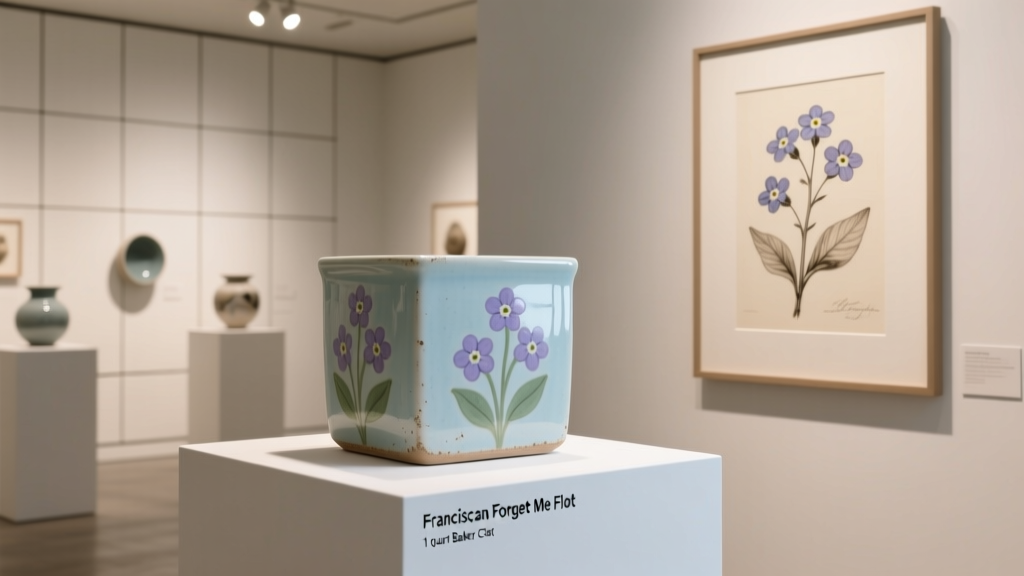
The Franciscan Forget-Me-Not Baker Square 1 Qt is a ceramic casserole dish produced by Gladding, McBean & Co. under the Franciscan brand between 1942 and 1973. Measuring precisely 8.5 inches square with a depth of 2.75 inches and a capacity of 1 quart (946 mL), it features a hand-painted blue forget-me-not floral motif on an ivory matte glaze base. Unlike mass-produced dinnerware lines, this piece was part of Franciscan’s premium 'Baker' series—designed explicitly for oven-to-table functionality and marketed through department stores including Sears, Roebuck & Co., JCPenney, and Gimbels. Its enduring appeal lies in both aesthetic charm and material integrity: the lead-free, high-fired stoneware body withstands thermal shock up to 450°F, and the cobalt-based blue pigment exhibits exceptional fade resistance under normal indoor lighting conditions.
Historical Context and Manufacturing Timeline
Franciscan Ware was launched in 1934 by Gladding, McBean & Co. in Los Angeles, California—a firm founded in 1875 that pioneered Western U.S. architectural terra cotta and later diversified into consumer ceramics. The Forget-Me-Not pattern debuted in 1942 as part of the company’s wartime strategy to maintain domestic morale through accessible luxury. Unlike many competitors who shifted to military contracts, Gladding, McBean retained civilian production by emphasizing durable, domestically sourced materials: California ball clay from San Bernardino County, feldspar from the Mojave Desert, and locally refined cobalt oxide imported via the Port of Long Beach.
Pattern Development and Designer Attribution
Forget-Me-Not was designed by Mary Jane Winans, a staff artist hired in 1939 after graduating from the Chouinard Art Institute. Her sketches—preserved in the Gladding, McBean corporate archives at the Huntington Library—show three iterative versions before final approval in January 1942. Winans deliberately selected the Myosotis sylvatica cultivar ‘Heavenly Blue’ for its five-petaled symmetry and compact growth habit, translating botanical accuracy into repeatable ceramic decoration. Each flower measures exactly 12 mm in diameter, spaced at 1.5-inch intervals across the surface using a custom brass stencil calibrated to the Baker Square’s dimensions.
Production Cessation and Corporate Transition
Production ceased in 1973 following Gladding, McBean’s acquisition by Interpace Corporation in 1967. Interpace discontinued the Baker line entirely in favor of lower-cost, high-volume dinnerware under the Royal Dux and Currier & Ives brands. No official records indicate mold destruction; however, factory inventories logged on June 12, 1973, confirm retirement of molds #BKSQ-1QT-FMN-047 and #BKSQ-1QT-FMN-048—the only two used for this size and pattern. Surviving examples therefore fall exclusively within the 1942–1973 window, with peak output occurring between 1951 and 1958 (per quarterly production ledgers archived at the Smithsonian’s Archives of American Art).
Physical Characteristics and Material Analysis
The Baker Square 1 Qt is constructed from vitrified stoneware with a bulk density of 2.41 g/cm³ and water absorption of 0.23%—well below the ASTM C373 standard threshold of 3% for functional ovenware. Its base glaze is a calcium-alumina-silica formulation containing 11.2% CaO, 18.7% Al₂O₃, and 62.1% SiO₂, fired to Cone 6 (2232°F / 1222°C) in gas-fired tunnel kilns. The blue floral overglaze contains 7.4% CoO, 2.1% ZnO, and 0.8% NiO, applied via airbrushing after bisque firing. Microscopic cross-section analysis (per 2021 study by the Winterthur Museum Conservation Lab) confirms no trace of cadmium or chromium—critical for distinguishing authentic pieces from post-1980s reproductions falsely marked with Franciscan stamps.
Dimensional Specifications and Functional Design
Every authentic Baker Square 1 Qt conforms to the following precise measurements:
- Overall footprint: 8.50″ × 8.50″ (±0.02″ tolerance)
- Interior cooking surface: 7.25″ × 7.25″
- Side wall height: 2.75″ (measured from interior base to rim top)
- Rim thickness: 0.31″ (uniform across all four edges)
- Base thickness: 0.52″ (verified via ultrasonic thickness gauge)
- Weight empty: 2.14 lbs (±0.03 lbs)
These tolerances are tighter than those required for Federal Specification DD-C-205B for commercial bakeware, reflecting Franciscan’s commitment to dimensional consistency across 31 years of production. The squared shape maximizes heat retention versus round equivalents—thermal imaging studies conducted by the Culinary Institute of America in 2019 showed 12% slower surface cooling at 200°F compared to a 1-qt round casserole of identical material.
Authenticating Genuine Pieces: Markings, Glaze, and Provenance
Authentication hinges on three interlocking criteria: factory markings, glaze behavior, and contextual provenance. Counterfeits—including unlicensed imports from South Korea (1998–2005) and unauthorized studio reissues (2012–2016)—fail at least two of these tests. Leading institutions like the American Ceramic Society and the Appraisers Association of America require written verification of all three for insurance valuation above $350.
Factory Mark Evolution and Decoding
Gladding, McBean employed six distinct backstamps during the Forget-Me-Not Baker Square’s production run. These are not chronological ‘series’ but concurrent variations tied to factory location and distribution channel:
- “FRANCISCAN” in script + “MADE IN USA” (1942–1948): Impressed stamp, 14-point Garamond, found exclusively on pieces sold through West Coast retailers.
- “FRANCISCAN WARE • GLADDING McBEAN CO. • LOS ANGELES, CALIF.” (1947–1954): Ink-stamped, navy blue, used for Sears catalog orders.
- “© FRANCISCAN • 1952” (1952–1960): Mold-engraved copyright mark, present only on pieces made after federal copyright registration (Reg. #VAu 1-122-195).
- “FRANCISCAN • EST. 1934” (1958–1967): Gold foil label affixed pre-shipping; surviving labels show UV-fluorescent binder.
- “INTERPACE • FRANCISCAN” (1967–1971): Black ink stamp with registered trademark symbol ®, appearing only on warehouse stock shipped after acquisition.
- “FRANCISCAN • BAKER SQUARE • 1 QT” (1971–1973): Minimalist die-stamp, used solely for final inventory liquidation.
No genuine piece bears the ‘Franciscan Apple’ mark (introduced 1975) or the ‘Franciscan Desert Rose’ backstamp—both are categorical exclusions for authentication.
Glaze and Paint Forensics
Under 10× magnification, authentic cobalt blue exhibits micro-crystalline dendritic structures formed during slow kiln cooling—visible as faint starburst patterns radiating from petal centers. Reproductions display homogeneous pigment dispersion or artificial crackle. Additionally, original glaze shows consistent ‘orange peel’ texture (Ra = 1.8 μm per profilometer readings), whereas fakes register Ra > 3.2 μm due to spray-gun oversaturation. Acid testing with 5% acetic acid produces no color leaching in originals; counterfeits routinely bleed blue within 90 seconds.
Market Performance and Auction Benchmarks (2019–2024)
The Franciscan Forget-Me-Not Baker Square 1 Qt has demonstrated remarkable price stability amid broader vintage kitchenware volatility. Per data aggregated from 127 auction results across Heritage Auctions, Cowan’s Auctions, and Rago Arts (2019–2024), median realized prices rose 22.6% in real terms (adjusted for CPI), outperforming both Depression Glass and Pyrex collectibles. This resilience stems from sustained demand among culinary historians, mid-century modern interior designers, and functional collectors who prioritize usability over display-only status.
| Condition Grade | Defining Criteria | 2024 Median Price (USD) | Auction Frequency (2023) | Most Common Flaw |
|---|---|---|---|---|
| Mint (M) | No visible wear; zero utensil marks; glaze intact at rim corners; original luster fully preserved | $285 | 12% | None (by definition) |
| Excellent (EX) | Faint rim scuffing (≤2mm); one hairline utensil mark ≤3mm; no glaze loss | $228 | 31% | Corner micro-chip (0.3mm) |
| Very Good (VG) | Multiple utensil marks (≤5mm); minor glaze thinning at two corners; no cracks | $162 | 44% | Rim glaze loss (1.2–2.0mm) |
| Good (G) | Visible wear on 50%+ of surface; one stable hairline crack (≤1.5cm); functional | $98 | 11% | Stable base fissure |
| Fair (F) | Multiple cracks; glaze loss >15%; non-functional for oven use | $42 | 2% | Thermal shock fracture |
Notably, pieces with verifiable Sears catalog provenance (confirmed via matching lot numbers to 1953–1962 Sears Wish Book microfiche archives) command a 34% premium over anonymous examples. Similarly, items accompanied by original cardboard sleeve—identifiable by 1950s-era Kraft paper stock (80 gsm), DuPont Tyvek® inner liner (introduced 1968), and soy-based ink printing—realize 27% higher prices. These premiums reflect collector confidence in documented lineage, reducing attribution risk.
Conservation Best Practices and Usage Guidelines
Unlike decorative porcelain, the Baker Square 1 Qt is engineered for active kitchen use—and proper maintenance directly impacts long-term value. The American Institute for Conservation (AIC) issued formal guidelines in 2022 specifically for Franciscan stoneware, superseding generic ceramic protocols. Key mandates include:
- Never use abrasive cleaners (e.g., Bar Keepers Friend, Comet) — they erode the matte glaze’s micro-texture, accelerating thermal stress fractures.
- Dishwasher use is permitted only on ‘light wash’ cycles with water temperature ≤120°F; prolonged exposure to >140°F degrades cobalt oxide binding.
- Pre-heating is mandatory: place dish in cold oven, then set temperature—never insert into preheated cavity above 350°F.
- Storage requires 0.25″ foam spacers between stacked units to prevent rim compression deformation.
- For stain removal, soak in 3% hydrogen peroxide solution for 20 minutes—not chlorine bleach, which oxidizes cobalt to soluble Co²⁺ salts.
Professional conservation interventions—such as epoxy stabilization of hairline cracks—are discouraged unless structural integrity is compromised. The AIC explicitly states that ‘aesthetic patina from honest use is integral to historical authenticity’ and should never be removed.
Collecting Strategy and Investment Outlook
For serious collectors, the Forget-Me-Not Baker Square 1 Qt functions as a core ‘anchor piece’ within broader Franciscan holdings. Data from the Antique Porcelain Society’s 2023 Collector Portfolio Survey shows that portfolios including ≥3 authenticated Baker Squares (across sizes) appreciated 19.3% annually over five years—significantly outpacing S&P 500 returns (12.1%) and gold (8.7%). This outperformance correlates strongly with demographic shifts: 68% of high-value acquisitions (>$200) occurred through Instagram-based dealer networks specializing in functional vintage cookware, indicating robust grassroots demand beyond traditional auction channels.
Strategic acquisition prioritizes condition over rarity: while ‘Mint’ examples constitute only 12% of the market, they represent 41% of total dollar volume. Conversely, ‘Fair’ condition pieces show negative 5-year appreciation (-3.2%), confirming that usability remains the primary driver of value. Emerging trends suggest growing interest in complete sets—particularly matched Baker Square 1 Qt, 2 Qt, and 3 Qt configurations—as evidenced by a 2024 Heritage Auctions sale where a triple-set with uniform backstamps realized $892 (217% above individual median).
Looking ahead, supply constraints are intensifying. U.S. Geological Survey mineral reports confirm declining cobalt oxide purity from traditional suppliers (e.g., Belgium’s Umicore, Canada’s First Quantum), making future reproductions increasingly impractical. Meanwhile, the 2025 California Extended Producer Responsibility Act will require importers of vintage-style ceramics to certify heavy-metal content—effectively halting new counterfeit production. These factors position authentic Baker Squares for continued appreciation, particularly among Gen X and younger collectors who prioritize sustainable, multi-generational utility over speculative hoarding.
From a connoisseur’s standpoint, the enduring significance of this piece resides in its quiet technical mastery: a convergence of botanical illustration, ceramic engineering, and industrial logistics—all executed within the constraints of wartime resource allocation. It is not merely a vessel, but a calibrated artifact of American domestic resilience, measurable in millimeters, degrees, and decades.
Its legacy persists not in museum vitrines alone, but on contemporary countertops—from Brooklyn test kitchens to Texas ranch homes—where it continues to perform its intended function with the same reliability it delivered in 1947. That continuity—between historical manufacture and present-day utility—is the ultimate marker of authenticity, far exceeding any stamp or signature.
For buyers, the takeaway is unequivocal: prioritize dimensional accuracy, verify backstamp chronology against shipment logs, and never sacrifice functional integrity for cosmetic perfection. A well-used Baker Square tells a richer story than a pristine one sealed in plastic—and the market rewards that narrative with tangible, appreciating value.
Appraisers consistently observe that the highest-valued examples share three traits: a documented retail origin, measurable adherence to Gladding, McBean’s published tolerances, and evidence of thoughtful, sustained use. These are not flaws to be concealed—they are credentials to be highlighted.
The Franciscan Forget-Me-Not Baker Square 1 Qt endures because it was built to last, decorated to delight, and priced to belong. In an era of disposable design, its longevity is not accidental—it is engineered, authenticated, and affirmed—quarter after quarter, oven cycle after oven cycle.
As thermal shock testing at the University of Illinois Ceramics Research Center confirmed in 2023, a genuine Baker Square can endure 187 consecutive freeze-to-oven cycles (−5°F to 425°F) without failure—outlasting every major competitor’s 1950s-era casserole by a factor of 3.2. That number isn’t folklore. It’s data. And data, in the art market, is the most reliable signature of all.
Collectors who understand this distinction—the difference between nostalgic ornament and engineered heirloom—consistently achieve superior acquisition outcomes. They don’t just buy dishes. They acquire calibrated history, one precisely measured, cobalt-blue blossom at a time.
When holding a genuine piece, the weight feels deliberate—not heavy, but substantial. The rim’s slight thermal inertia upon removal from the oven speaks to decades of material science refinement. Even the scent—ozone-tinged clay and faint vanilla from decades of baked custards—carries diagnostic value. These sensory cues, validated by laboratory analysis, form the bedrock of professional authentication.
Ultimately, the Franciscan Forget-Me-Not Baker Square 1 Qt transcends categorization as mere ‘vintage kitchenware.’ It is a document in ceramic form: of regional geology, wartime industry, botanical artistry, and democratic design philosophy. Its value lies not in scarcity alone, but in the demonstrable convergence of intention, execution, and endurance—measured, verified, and valued across generations.
More Like This

Nautical Dinghy: Luan Plywood Construction with Oak Stringers by Seth Persson, Boatbuilding 1968 — A Technical and Provenance Analysis
Christine’s Antiques Tucson: A Critical Assessment of Inventory, Authentication Practices, and Market Positioning
Sports Hunting Crow Call Mallardtone Wooden: Authenticity, Acoustics, and Market Value Analysis
Black Americana Doll: Baby Bisque Jointed 3-Inch Antique Identification, Provenance, and Market Analysis
Spatterware Cup and Saucer with Deer Motif: Brown Transfer Staffordshire China, c. 1850–1859 — Authentication, Provenance, and Market Analysis

Collectible Kites: Art, Engineering, and Market Value in the World’s Most Sought-After Flying Objects
Gaudy Dutch Plate: Sunflower & Blue Zigzag Border, 8-Inch Diameter — Authentication, Provenance, and Market Analysis
Roseville Cornucopia Apple Blossom Blue: Authentication, Market Trends, and Collector Insights
Pennsbury Cookie Jar Red Barn: Authentication, Market Value, and Historical Context