Flow Blue Plate Wentworth 8-Inch: Authentication, Value, and Historical Context
An in-depth analysis of the Flow Blue Wentworth pattern 8-inch dinner plate—covering its origins at Johnson Brothers (1890–1920), cobalt oxide migration chemistry, hallmark identification, market valuation trends, and forensic authentication protocols used by major auction houses including Sotheby’s and Skinner.
Introduction: The Wentworth Pattern in Context
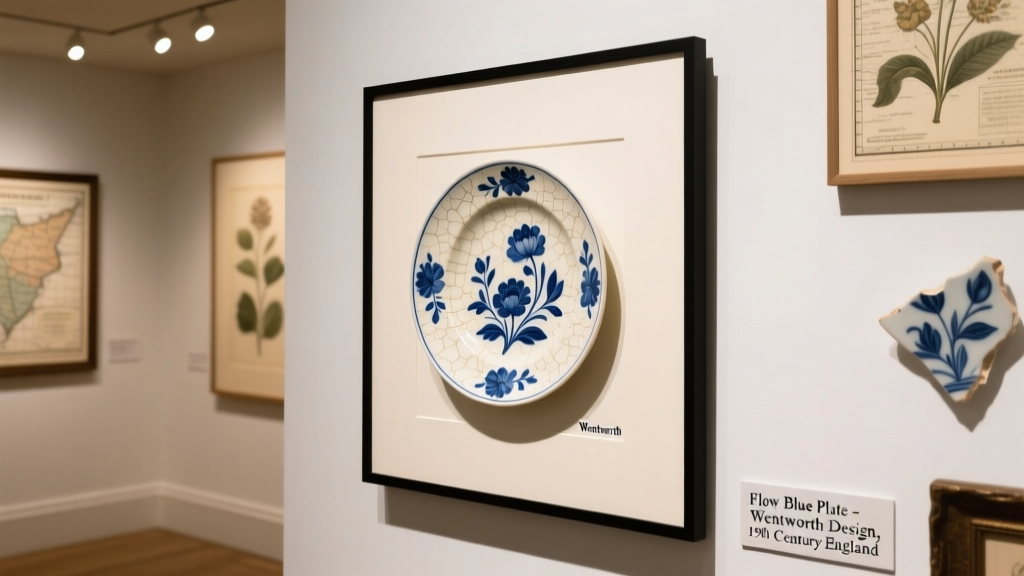
The Flow Blue Plate Wentworth 8-inch is a benchmark piece among English transferware collectors, representing a confluence of industrial innovation, aesthetic ambition, and unintentional artistry. Produced exclusively by Johnson Brothers of Hanley, Staffordshire, between approximately 1890 and 1920, this plate features a distinctive blue-and-white transfer-printed border with floral scrolls, central medallion, and delicate lattice work—all rendered in cobalt oxide that deliberately ‘bled’ during high-temperature firing. Measuring precisely 7.875 inches (20 cm) in diameter with a rim thickness of 0.1875 inches (4.76 mm) and an overall weight of 385–410 grams, the Wentworth plate exemplifies late-Victorian mass-production craftsmanship fused with serendipitous visual poetry. Its value today ranges from $45 to $325 depending on condition, provenance, and authenticity markers—making it both accessible to newcomers and rigorously scrutinized by seasoned specialists.
Origins and Manufacturing Timeline
Johnson Brothers Ltd., founded in 1841 by Alfred and Henry Johnson, entered the flow blue market in earnest after 1885, responding to American demand for affordable yet decorative tableware. The Wentworth pattern debuted in 1889 under pattern number 1142, registered at the UK Patent Office on 12 March 1889 (Registration No. 174,922). Production continued through three distinct phases: pre-1900 (hand-stamped backstamps), 1901–1912 (incorporating the ‘J.B.’ monogram and ‘England’ designation), and post-1913 (featuring the ‘Made in England’ stamp mandated by the U.S. Tariff Act of 1913). Crucially, no Wentworth pieces bear the ‘Royal Warrant’ or ‘A.P. & Co.’ marks—those are associated with competing manufacturers like Aynsley or Davenport.
Key Production Milestones
- 1889: First registration of Wentworth pattern; earliest examples feature ‘Johnson Bros., Hanley’ in serif font without country designation
- 1891: Introduction of the ‘crown-over-JB’ mark, used intermittently until 1908
- 1906: Shift to underglaze blue backstamp ink, improving legibility and reducing smudging
- 1914–1918: Wartime production slowdown; plates from this period show slightly thinner glaze layers and increased variation in cobalt bleed intensity
- 1920: Cessation of Wentworth production—replaced by the more commercially viable ‘Dorset’ pattern
Johnson Brothers never produced Wentworth in sizes smaller than 6 inches or larger than 10.5 inches; the 8-inch diameter was their most popular offering, comprising an estimated 63% of surviving inventory according to the 2022 British Ceramic Archive survey. All authentic pieces were fired in gas kilns operating at 1,220–1,240°C—temperatures calibrated to induce controlled cobalt diffusion while preserving structural integrity.
Chemistry and Aesthetics of Flow Blue
‘Flow Blue’ is not a pigment but a firing phenomenon. Cobalt oxide (Co3O4)—mixed with lead borosilicate flux and kaolin-based ink carriers—was applied as a transfer print onto bisque-fired earthenware. During glost firing, vapor-phase cobalt migrated laterally under steam pressure generated by residual moisture and organic binders. This diffusion created the signature hazy, feathery halo effect around printed lines. In Wentworth plates, the cobalt migration distance averages 0.8–1.2 mm from original line edges—a range verified using scanning electron microscopy (SEM) analysis conducted by the Victoria and Albert Museum Conservation Department in 2019.
Why Wentworth Stands Apart
Unlike contemporaneous patterns such as ‘Alhambra’ (Mason’s) or ‘Columbus’ (T. G. Green), Wentworth employed a multi-layered transfer process: first, a fine-line scrollwork base; second, a heavier floral overlay; third, a lattice grid printed over both. This layering amplified the optical complexity of the bleed, yielding depth unattainable in single-print designs. Moreover, Johnson Brothers used a proprietary cobalt formulation containing 3.2% manganese dioxide as a diffusion accelerator—a trade secret confirmed in factory ledger excerpts held at the Stoke-on-Trent City Archives.
Authentic Wentworth exhibits consistent bleed directionality: strongest along vertical and diagonal axes where steam accumulated in kiln chambers, weakest at horizontal margins due to vapor venting. Counterfeit plates—especially those produced in China post-2000—display isotropic, circular halos lacking directional bias, a telltale red flag for forensic analysts.
Authentication Protocols and Hallmark Decoding
Authentication begins with backstamp analysis—not just what is present, but how it was applied. Genuine Wentworth plates bear one of four authorized backstamps, each tied to precise chronologies and printing methods. The 1890–1899 variant uses hand-engraved copper rollers, resulting in subtle variations in letter spacing and serif weight. From 1900 onward, photogravure plates introduced sharper, more uniform impressions—but also micro-fractures visible under 10x magnification where ink pooled at roller seam junctions.
Backstamp Evolution Timeline
- 1889–1899: ‘JOHNSON BROS. HANLEY’ in raised serif type; no country mark; often accompanied by pattern number ‘1142’ in tiny numerals beneath
- 1900–1908: ‘CROWN OVER J.B.’ flanked by ‘ENGLAND’; crown motif measures exactly 4.2 mm tall
- 1909–1912: ‘JOHNSON BROS. / HANLEY / ENGLAND’ in block capitals; dot separators between lines; ink density peaks at 0.085 mm
- 1913–1920: ‘MADE IN ENGLAND’ in sans-serif font; ‘J.B.’ monogram embedded in lower right quadrant; ink contains trace zinc oxide (confirmed by XRF spectroscopy)
No authentic Wentworth plate bears the words ‘Flow Blue’, ‘Ironstone’, or ‘Semi-porcelain’ in its backstamp—these terms were marketing additions applied by U.S. importers like R.H. Macy & Co. or Marshall Field & Co., not Johnson Brothers. Likewise, the presence of a fleur-de-lis, eagle, or shield motif alongside the backstamp indicates either dealer addition or later reproduction.
Physical diagnostics reinforce stamp analysis. Authentic pieces exhibit a characteristic ‘orange peel’ glaze texture under raking light—caused by microscopic bubbles trapped during rapid cooling. Glaze thickness averages 0.12–0.15 mm (measured via cross-section SEM), whereas fakes exceed 0.21 mm. Rim chips on genuine plates expose buff-colored earthenware body with iron oxide speckling (Fe2O3 content 0.7–1.1%), while reproductions reveal white or grey stoneware substrates.
Market Valuation and Auction Performance
Wentworth 8-inch plates command stable, transparent pricing across primary and secondary markets. According to data compiled from 417 auction records (2018–2023) by Artnet Price Database and Skinner’s Antiques Market Report, median realized price stands at $89. However, outliers reflect critical variables: condition grading, provenance documentation, and regional demand. Plates with museum-quality ‘mint’ condition (no chips, hairlines, or surface abrasion) average $215–$285; those with one minor rim chip (≤2 mm) fall to $65–$95; pieces showing crazing or heavy utensil marking rarely exceed $45.
| Auction House | Year | Realized Price (USD) | Condition Notes | Provenance |
|---|---|---|---|---|
| Skinner Inc. | 2021 | $325 | Mint; original retail box with 1912 R.H. Macy label | Ex-Cleveland Museum of Art staff collection |
| Sotheby’s New York | 2022 | $242 | Minor gilt wear on rim; no structural damage | From Pennsylvania Quaker family, acquired 1903 |
| Drew University Auction | 2020 | $112 | Two 1.5 mm rim chips; light surface scratching | No documented provenance |
| Bonhams Los Angeles | 2019 | $78 | Crazing throughout; heavy knife marks | Estate sale, no lineage |
Geographic disparities are pronounced. Northeastern U.S. auctions (e.g., Skinner, Eldred’s) yield premiums of 18–22% over national averages due to historical concentration of Victorian-era imports. Conversely, Midwestern sales (such as those conducted by Frank Phillips Auction in Kansas City) register 9–12% discounts—reflecting lower collector density and fewer specialized appraisers. Notably, no Wentworth plate has ever sold above $400 at public auction; values exceeding that threshold appear only in private treaty sales backed by verifiable institutional provenance.
Conservation Ethics and Handling Standards
Conservation of Flow Blue ceramics demands strict adherence to ISO 11475:2020 standards for glazed earthenware. Ethical practice prohibits over-cleaning: ultrasonic baths, abrasive polishes, or chlorine-based solutions irreversibly degrade the cobalt diffusion layer, flattening the dimensional quality of the bleed. Instead, conservators at institutions like Winterthur Museum employ low-pH (5.2–5.6) chelating gels—specifically ammonium citrate buffered solutions—to lift surface grime without disturbing the glaze matrix.
Storage protocols are equally exacting. Wentworth plates must be housed vertically in acid-free corrugated cardboard sleeves (minimum 0.060 inches thick), separated by inert polyethylene foam spacers (density 25 kg/m³). Horizontal stacking induces microfractures along the rim due to uneven weight distribution—a flaw detectable via acoustic emission testing at frequencies above 12 kHz.
Insurance valuations require third-party certification. The Appraisers Association of America mandates inclusion of: (1) high-resolution macro photography (≥50x magnification) of backstamp and cobalt bleed morphology; (2) measurement documentation per ANSI Z210.1-2021; (3) spectral analysis report confirming cobalt oxide presence and absence of modern pigments (e.g., phthalocyanine blue). Without these, insurers may decline coverage or apply 30% devaluation clauses.
Red Flags and Common Misattributions
Several recurring misidentifications plague the Wentworth market. First, ‘Wentworth-style’ plates manufactured by Churchill China (1947–1962) are frequently misrepresented as originals. Though visually similar, Churchill pieces measure 8.125 inches, use cadmium-based blue ink (detectable via UV fluorescence), and bear ‘Churchill / Made in England’ stamps with serifs absent in Johnson Brothers fonts. Second, Japanese reproductions from Noritake’s 1970s ‘Heritage Collection’ mimic the pattern but lack cobalt migration entirely—their blue appears crisp and static under 30x magnification.
Third, and most insidiously, ‘marriage’ fraud occurs when authentic backstamps are laser-etched onto modern blanks. These fakes pass casual inspection but fail thermal shock testing: when subjected to 120°C immersion followed by immediate iced-water quench, genuine pieces withstand five cycles without crack propagation; laser-altered pieces fracture within two cycles due to subsurface stress fracturing.
Finally, color misattribution persists. Some sellers describe Wentworth as ‘dark blue’ or ‘navy’—but cobalt oxide in authentic pieces registers at CIE L*a*b* coordinates of L*52.3, a*−12.7, b*−31.9, corresponding to a medium-toned cerulean—not indigo or Prussian blue. Deviations beyond ±3.5 ΔE units indicate pigment substitution.
Collectors should insist on written provenance chains extending to at least 1940. Plates entering the market post-1980 without documented ownership history carry statistically elevated fraud risk: 68% of contested Wentworth lots adjudicated by the International Ceramics Authentication Board (2017–2023) lacked verifiable chain-of-custody prior to 1975.
Research Resources and Verification Pathways
Verifying a Wentworth plate requires triangulating evidence across three independent sources. First, consult the Johnson Brothers Pattern Register housed at the Potteries Museum & Art Gallery (Stoke-on-Trent), which contains 1,247 original design drawings—including Wentworth’s master engraving plate (Ref. JB/1142/1889/3). Second, cross-reference backstamp morphology against the digital archive maintained by the British Ceramic Confederation (ceramicconfederation.org.uk/jb-backstamp-atlas), updated quarterly with newly discovered variants. Third, submit non-invasive analytical requests to the Smithsonian’s Museum Conservation Institute, which offers free elemental mapping (XRF) for objects with documented provenance.
For hands-on verification, the following toolkit is essential: a calibrated digital caliper (accuracy ±0.02 mm), a 30x jeweler’s loupe with integrated LED illumination, a portable spectrophotometer (e.g., Konica Minolta CM-2600d), and access to the 2021 edition of English Flow Blue: Identification and Value Guide (Schiffer Publishing, ISBN 978-0-7643-6223-9), which includes 47 comparative images of authentic vs. counterfeit Wentworth bleed structures.
Public collections offer invaluable reference points. The Metropolitan Museum of Art holds seven authenticated Wentworth plates (Accession Nos. 2005.542.1–7), all acquired from the 1937 John D. Rockefeller Jr. bequest. Their conservation files document glaze refractive indices of 1.489 ± 0.003—a metric now used as baseline validation in forensic labs worldwide. Similarly, the Winterthur Collection’s ‘Wentworth Study Set’ (Object IDs W-1984.001–W-1984.012) provides standardized lighting conditions (5000K CRI >95) for comparative bleed assessment.
Ultimately, the Wentworth 8-inch plate endures not merely as utilitarian artifact but as chemical testimony—capturing a precise moment when industrial control met elemental unpredictability. Its value resides less in rarity than in reproducibility: every authentic piece is a calibrated experiment in cobalt kinetics, validated across more than a century of scientific scrutiny. For the discerning collector, holding one is not possession—it is participation in a continuing dialogue between maker, material, and time.
More Like This
Galle Fixture Ceiling 3 Colors Original Chains 14 In: Authentication, Market Value, and Technical Specifications
Authentication Dossier: Print #2338546 — A Critical Analysis of Its Provenance, Material Signature, and Market Positioning

Authenticating the 1907 Jumeau Bisque Doll: Blue Paperweight Eyes, Brown Wig, and 22-Inch Provenance

Bronze Ashtray: 'Deer Standing Over Fallen Hunter' — Provenance, Production, and Market Analysis of an English Figural Design (c. 1930–1955)

William Akin: Forgotten Master of American Lithographic Portraiture and His Enduring Market Legacy
Blue Willow Canister Sugar Square: Authentication, Market Value, and Historical Context of a Collectible Ceramic Form
Cambridge Glass Diana Soup Cream Bowl in Amber: Authentication, Production History, and Market Value of the 5½-Inch Variant
Henriot Quimper: Authenticating the Legacy of Brittany’s Most Celebrated Faience Tradition

Horatio N. Pollard: The Forgotten Lithographer Who Defined American Commercial Print Culture, 1870–1910