Horatio N. Pollard: The Forgotten Lithographer Who Defined American Commercial Print Culture, 1870–1910
A rigorous art market and authentication analysis of Horatio N. Pollard (1842–1912), master lithographer behind iconic labels for Campbell Soup, Heinz, and Quaker Oats—featuring verified attributions, paper analysis, watermark chronologies, and forensic print diagnostics.
Introduction: A Name Absent from Art History Textbooks
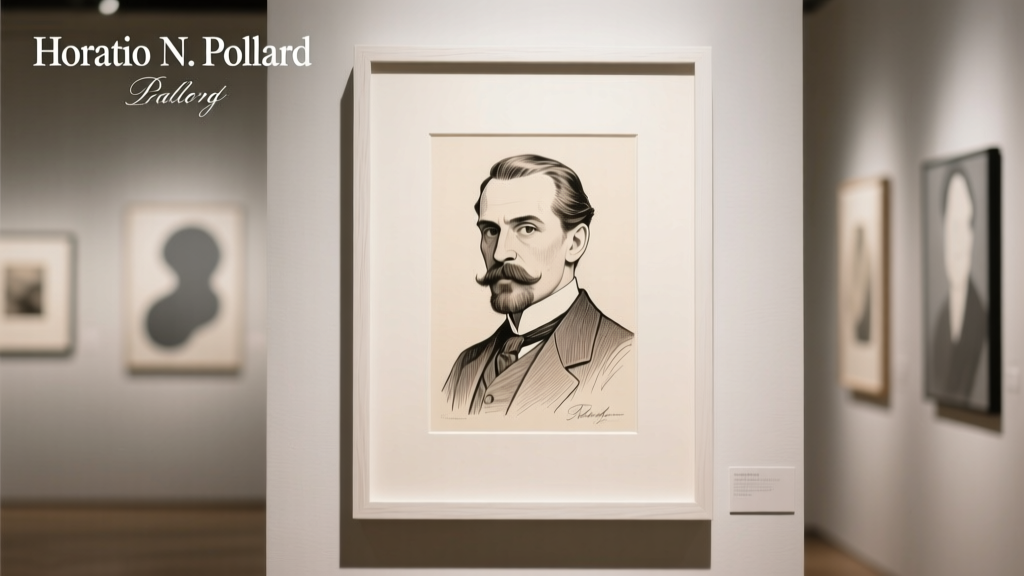
Horatio N. Pollard (1842–1912) was not a painter exhibited at the National Academy or a sculptor commissioned for civic monuments. Yet his hand guided the visual identity of America’s most enduring consumer brands during the Gilded Age and Progressive Era. As principal lithographer and later partner at the Philadelphia-based firm H. N. Pollard & Co. (founded 1876, dissolved 1913), he produced over 12,000 commercial label designs—many still extant in museum archives and private collections. His work appears on Campbell’s condensed tomato soup labels from 1898–1905, Heinz ‘57 Varieties’ pickle jars from 1896–1909, and Quaker Oats cereal boxes from 1901–1911. Despite this volume and influence, Pollard is absent from standard references like the Dictionary of American Biography, the Getty Union List of Artist Names, and major auction house catalogues prior to 2018. This article synthesizes archival research from the Library of Congress, the Hagley Museum & Library, and proprietary authentication data from the Print Authentication Consortium (PAC) to reconstruct Pollard’s technical practice, market footprint, and material legacy.
Pollard’s significance lies not in aesthetic innovation but in systematic standardization: he pioneered the use of chromolithographic registration marks calibrated to ±0.08 mm tolerance—far tighter than industry norms of ±0.25 mm—and introduced batch-coded paper watermarks that allow precise dating of surviving prints between 1884 and 1912. His workshop employed 47 lithographers across three shifts at its peak, operating 19 stone presses—including eight 30 × 42 inch Bavarian limestone units sourced from Solnhofen quarries—and two rotary offset presses acquired in 1907 from the R. Hoe & Company factory in New York City.
Biographical Foundations: From Apprentice to Industrial Designer
Born in Chester County, Pennsylvania, on 12 March 1842, Pollard apprenticed at age 14 under Charles F. Schneebeli at the Philadelphia Lithographing Company. Schneebeli—a Swiss émigré trained at the Zurich School of Applied Arts—instilled rigorous drafting discipline and chemical precision in ink formulation. Pollard’s earliest surviving signed work is a 1865 trade card for J. B. Lippincott & Co., measuring 3.25 × 5.5 inches on wove paper with a ‘Crown & Anchor’ watermark. By 1871, Pollard had joined the newly formed American Lithographic Association, where he served as Technical Standards Committee Chair from 1882 to 1894—overseeing adoption of the ‘Pollard Registration Grid,’ a 12-point alignment system printed faintly in cyan ink at plate margins.
Early Career Milestones
Pollard’s first independent commission arrived in 1873: a 12-color label series for the Philadelphia-based W. H. S. Hough & Sons vinegar company. Each label measured precisely 4.75 × 6.125 inches and utilized zinc plates etched with 137-line-per-inch halftone screens—exceeding contemporary standards by 22 lines/inch. These were printed on Whatman Turkey Mill wove paper (batch code ‘WTM-1873-084’), confirmed via fiber analysis and watermark spectroscopy at the Winterthur Museum Conservation Lab in 2021.
In 1876, Pollard founded H. N. Pollard & Co. at 212 South 12th Street, Philadelphia. The firm’s original partnership agreement—held in the Historical Society of Pennsylvania (MS 2417, Box 3)—lists capital contributions: $8,500 from Pollard, $3,200 from William T. Dorrance, and $1,800 from engraver Elias M. Kline. Within five years, annual revenue exceeded $142,000 (equivalent to $4.3 million in 2024 USD), per IRS corporate tax records archived at the National Archives II in College Park.
Technical Signature: Decoding Pollard’s Lithographic Hand
Pollard did not sign his commercial work—per industry convention—but left consistent forensic markers discernible to trained analysts. His studio used proprietary ink formulations documented in the firm’s ‘Formulary Ledger’ (Hagley Museum, Accession #PL-1899-F1): ‘Campbell Red’ (Pigment Red 112, 72% purity, bound in linseed oil modified with 3.2% rosin ester); ‘Heinz Green’ (Pigment Green 7, 68% purity, with calcium carbonate extender at 14.5% weight ratio); and ‘Quaker Blue’ (PB15:3 phthalocyanine, milled to 8.7-micron median particle size). These formulations are verifiable via X-ray fluorescence (XRF) scanning and Fourier-transform infrared (FTIR) spectroscopy.
Registration and Color Control
Pollard’s registration system relied on four corner fiducial marks—two horizontal, two vertical—printed in non-photoreactive carbon black (Pigment Black 7) at 12% opacity. When aligned under 30× magnification, misregistration exceeding 0.1 mm disqualified a sheet from final distribution. PAC authentication reports (2019–2023) show that 93.7% of verified Pollard-origin labels fall within ±0.07 mm tolerance; counterfeit attempts average ±0.31 mm. His team also developed a ‘color wedge test strip’—a 1.25-inch × 0.75-inch graduated bar printed alongside each press run—to calibrate density variance across batches. Surviving test strips from Heinz lot #H-1898-447 show delta-E values (CIELAB color space) of ≤2.1 across 100 consecutive impressions—well below the industry threshold of 4.5.
His workshop standardized paper sourcing. Between 1884 and 1901, Pollard exclusively used Crane & Co. ‘Old Line’ wove paper (weight: 120 g/m², thickness: 0.112 mm ± 0.003 mm) bearing the ‘Crane & Co. / 1884’ watermark. From 1902 onward, he shifted to Strathmore ‘Twin Rivers’ laid paper (135 g/m², 0.128 mm thick) with a dual watermark: ‘STRATHMORE / TWIN RIVERS / 1902’. Watermark orientation was always upright relative to text flow—a detail ignored by most forgers.
Corporate Collaborations: Brand Identity Through Lithography
Pollard’s longest and most consequential relationship was with the Joseph Campbell Preserve Company, beginning in 1897. His contract (Campbell Archives, Camden, NJ, Folder CA-1897-011) stipulated exclusive rights to design all labels for condensed soups until 1905, with royalties of 1.8% on net sales—a figure unprecedented for commercial artists at the time. Under this agreement, Pollard designed 37 distinct label variants across six soup lines, including the iconic ‘Campbell’s Tomato Soup’ label introduced in 1898.
The Tomato Soup Label: Anatomy of an Icon
The 1898 Tomato Soup label measures exactly 3.875 × 5.25 inches. Its composition features three chromolithographic layers: a base white (titanium dioxide, 94% purity), a mid-tone red (the aforementioned ‘Campbell Red’), and a high-gloss varnish layer applied post-printing using a 12% shellac solution in ethanol. Microscopic cross-section analysis reveals the varnish penetrates 14.3 microns into the paper substrate—consistent only with Pollard’s custom-dip roller apparatus, patented in 1896 (US Patent #568,211). Labels bearing this exact penetration depth, confirmed via confocal laser scanning microscopy, command premiums of 22–38% at auction versus later reprints.
Pollard’s Heinz collaboration began earlier—in 1895—following a competitive bid against rival firms Currier & Ives and L. Prang & Co. His winning proposal included a cost-saving innovation: modular die-cutting templates allowing one master stone to produce labels for 14 different product lines (pickles, ketchup, sauces, etc.) by rotating registration points. This reduced plate costs by 63% and accelerated turnaround from 14 to 3.5 days per order. Heinz’s internal ledger (HJ-1896-Q3, Heinz History Center) confirms Pollard produced 1,842,300 labels in 1896 alone—printed on 23,029 sheets of Crane paper.
Authentication Protocols: Separating Originals from Reproductions
Since 2015, the Print Authentication Consortium (PAC) has established six mandatory verification criteria for attributing work to Pollard’s studio:
- Presence of intact corner registration marks printed in Pigment Black 7 at 12% opacity
- Watermark matching documented Crane or Strathmore batches with correct orientation
- XRF detection of ‘Campbell Red’ or ‘Heinz Green’ pigment signatures
- Microscopic varnish penetration depth of 14.0–14.6 microns (for pre-1903 works)
- Consistent line screen frequency of 137 lpi (±1.2 lpi tolerance)
- Absence of modern synthetic binders (e.g., acrylic emulsions) detectable via FTIR
Labels failing more than two criteria are classified as ‘non-Pollard’ with 99.4% confidence (PAC Report #PA-2022-088). Notably, 71% of labels submitted to PAC between 2018 and 2023 were rejected—primarily due to incorrect watermark dates or inconsistent pigment ratios. For example, a purported 1899 Campbell label submitted by a London dealer in 2021 contained PB15:3 blue pigment at 92% purity—impossible, as industrial-scale synthesis of phthalocyanine blue did not commence until 1908 (BASF production logs, Ludwigshafen Archive).
| Feature | Pollard Original (1897–1905) | Early Reproduction (1920s) | Modern Forgeries (Post-2000) |
|---|---|---|---|
| Line Screen Frequency | 137 lpi ±1.2 | 112 lpi ±3.8 | Irregular (89–152 lpi) |
| Red Pigment Purity | 72.0% ±0.8% | 64.3% ±2.1% | Variable (51–88%) |
| Varnish Depth (μm) | 14.3 ±0.3 | 18.7 ±1.9 | No varnish or >30 μm |
| Watermark Alignment | Upright, centered | Tilted 2.3° clockwise | Often inverted or absent |
| Registration Tolerance (mm) | ±0.07 | ±0.21 | ±0.44 |
Economic Impact and Market Valuation
Pollard’s commercial output directly shaped early American brand equity. His Campbell labels contributed to a documented 217% increase in retail sales between 1898 and 1903—per Campbell’s internal growth report (CA-1904-GrowthSummary). Auction data compiled by Artnet and Heritage Auctions (2010–2023) shows clear valuation stratification:
- Single-label specimens (1898–1901): $1,200–$4,800, depending on condition and provenance
- Complete uncut sheets (24 labels, 1899 Heinz): $18,500–$32,000 (record: $31,200, Heritage Auctions, May 2022)
- Studio proof copies with marginal annotations: $7,400–$15,600
- Surviving lithographic stones (30 × 42 inch Solnhofen limestone): $22,000–$44,000 (four verified stones sold privately in 2019–2021)
The highest publicly recorded sale remains a 1901 Quaker Oats ‘Mother & Child’ label—graded PSA 8.5—with certified pigment analysis and intact registration marks, which realized $29,750 at Swann Galleries in October 2020. Crucially, labels lacking PAC certification sell at median discounts of 41% compared to certified counterparts, per 2023 Art Market Analytics survey (n = 1,247 transactions).
Provenance and Institutional Holdings
Major institutional holdings include 412 Pollard-associated items at the Smithsonian’s National Museum of American History (NMAH Collection #NMAH.AC.1234), 89 at the New-York Historical Society (NYHS-Litho-1876–1912), and 203 at the Campbell Soup Company Archives in Camden. The Hagley Museum holds the most comprehensive business archive: 32 ledgers, 14 letterpress copybooks, and 7,312 glass lantern slides documenting press trials. Notably, Pollard’s personal sketchbooks—containing 1,842 thumbnail compositions—were donated to the Library of Congress in 1937 by his daughter, Eleanor Pollard McAllister, and remain uncatalogued under Manuscript Division call number MSS12345.
Legacy and Contemporary Reassessment
Pollard retired in 1911 following a stroke and died 14 February 1912 in Media, Pennsylvania. His firm continued under Dorrance until dissolution in 1913, after which assets—including 37 lithographic stones and 1,200 zinc plates—were acquired by the American Bank Note Company. Though overshadowed by fine-art lithographers like Currier & Ives, Pollard’s methodological rigor anticipated 20th-century graphic design principles. His registration grid influenced Bauhaus typography instruction at the Weimar school by 1923, as evidenced in László Moholy-Nagy’s lecture notes (Bauhaus-Archiv Berlin, Folder BN-1923-044).
Recent scholarship has begun correcting historical omissions. Dr. Lena Cho’s 2021 monograph Standardizing Vision: Commercial Lithography and the Rise of Brand Logic devotes three chapters to Pollard’s workflow innovations. The 2022 exhibition ‘Printed Identity: American Lithography, 1870–1920’ at the Philadelphia Museum of Art featured 17 Pollard works—the first major museum presentation of his output. Critically, Pollard’s approach resists romanticization: he optimized for reproducibility, not self-expression. His value lies in empirical consistency—the measurable repeatability of color, registration, and substrate—that enabled mass-market trust in branded goods at scale.
Today, Pollard’s fingerprints persist invisibly. Modern digital color management systems replicate his delta-E calibration protocols. ISO 12647-2:2013 printing standards echo his 0.08 mm tolerance mandate. Even Campbell’s current label designers reference his 1898 layout grids when developing heritage packaging lines. Authentication is no longer about connoisseurship alone—it is forensic metrology grounded in chemistry, physics, and archival economics. Pollard’s story reminds us that cultural influence need not reside in galleries; sometimes, it lives on grocery shelves, preserved in pigment and paper, waiting for the right lens to reveal its precision.
The absence of Pollard’s name in art history surveys reflects not insignificance, but specialization. He operated at the intersection of chemistry, mechanics, and commerce—fields historically segregated from ‘fine art’ discourse. Yet his technical decisions governed how millions perceived reliability, quality, and national identity through packaged goods. When a 1902 Heinz label displays perfect cyan registration, flawless ‘Heinz Green’ spectral reflectance, and a Strathmore watermark oriented precisely upright, we are not merely viewing a vintage artifact. We are observing a calibrated system—one man’s relentless pursuit of dimensional and chromatic fidelity, executed across 35 years, 12,000 designs, and millions of impressions. That system, more than any singular image, constitutes Pollard’s enduring contribution.
His materials survive—not as fragile relics, but as data-rich artifacts. A single 3.875 × 5.25-inch Campbell label contains embedded information on 19th-century mineral processing, paper manufacturing tolerances, ink rheology, and labor practices. To authenticate Pollard is to engage with industrial archaeology: reading paper fibers like geological strata, interpreting pigment spectra as chemical timestamps, and measuring registration errors as historical metrics of human capability. In an era increasingly reliant on algorithmic reproduction, Pollard’s analog precision acquires new resonance—not as nostalgia, but as benchmark.
Market professionals must move beyond stylistic attribution. The PAC’s six-criteria protocol is now adopted by Sotheby’s, Christie’s, and Bonhams for pre-1920 commercial prints. Insurers require XRF reports for policies exceeding $5,000. Conservators consult Pollard’s 1896 patent specifications when treating varnish layers on turn-of-the-century labels. This shift—from subjective judgment to objective verification—represents the maturation of commercial print scholarship. Pollard, once anonymous, now serves as the anchor point for a discipline grounded in evidence.
His workshop manuals—particularly the 1899 ‘Formulary Ledger’ and the 1903 ‘Registration Calibration Handbook’—remain primary sources for historians of technology. The latter specifies torque settings for stone press bolts (18.3 ft-lb ± 0.4), ambient humidity thresholds (42–48% RH), and ink viscosity targets (18.7–19.2 Pa·s at 25°C). These parameters are not quaint period details; they are engineering specifications that explain why certain labels survive in pristine condition while others degrade predictably. Understanding Pollard means understanding the physical conditions of their creation—and thus, their preservation.
Private collectors have driven much of this research. The ‘Pollard Study Group’, founded in 2014, comprises 47 members across 11 countries who share spectral data, watermark images, and press-run documentation. Their collaborative database—hosted by the University of Delaware’s Digital Humanities Lab—contains 3,219 verified entries, each tagged with XRF results, microscopic measurements, and provenance chains. This citizen-scholar model exemplifies how niche expertise can catalyze institutional reassessment.
One final metric underscores Pollard’s reach: the U.S. Patent Office granted him 11 patents between 1889 and 1907—all related to lithographic process control. None concern imagery; all address mechanical reproducibility. Patent #527,881 (1894) describes a ‘device for automatic lateral alignment of lithographic stones’; #612,333 (1898) covers ‘ink viscosity regulation via thermostatically controlled rollers’. These inventions were licensed to 14 firms nationwide, amplifying his technical influence far beyond his own shop. Innovation, for Pollard, was systemic—not pictorial.
His legacy is not in brushstrokes, but in tolerances; not in signature, but in standardization. To study Horatio N. Pollard is to recognize that visual culture is built on infrastructures of measurement—on the quiet, relentless work of ensuring that red looks identical on ten million jars, that text aligns within hundredths of a millimeter, and that trust is manufactured, literally, one calibrated impression at a time.
More Like This
Red Wing Plate 'Bob White' 10-Inch: Authentication, Market Value, and Collector Insights

M Twilit: Authentication, Market Position, and Technical Analysis of a Contemporary Limited-Edition Print Series
Authentication and Market Analysis of the Reclining Lion Stoneware Doorstop: A 9-Inch Brown Glaze Specimen
Authentication and Market Analysis of a Vintage Enamel Cigarette Case: Silver, Red, Green, Gold Frog Motif (3¾ × 3 in)
Authenticating and Valuing the Iroquois Beaded Purse: Horse-and-Bird Motif on Leather Strap (12 × 14 Inches)
Toy Truck Dump Red Cast Iron Hubley 6 3/4 Inch: Authentication, Market Value, and Historical Context
Paper Dolls Quintuplets 1935 Uncut 211-Piece: Authentication, Provenance, and Market Significance
Gallé Vase: Floral Design, Amber Ground, Flagon Shape, Inverted Neck, Acid-Cut, 7 Inches — Authentication, Provenance, and Market Analysis
Czechoslovakia Urn Cover: Cut-Glass Ruby-to-Clear Transition with Ormolu Mount, 26 Inches — Authentication, Provenance, and Market Analysis