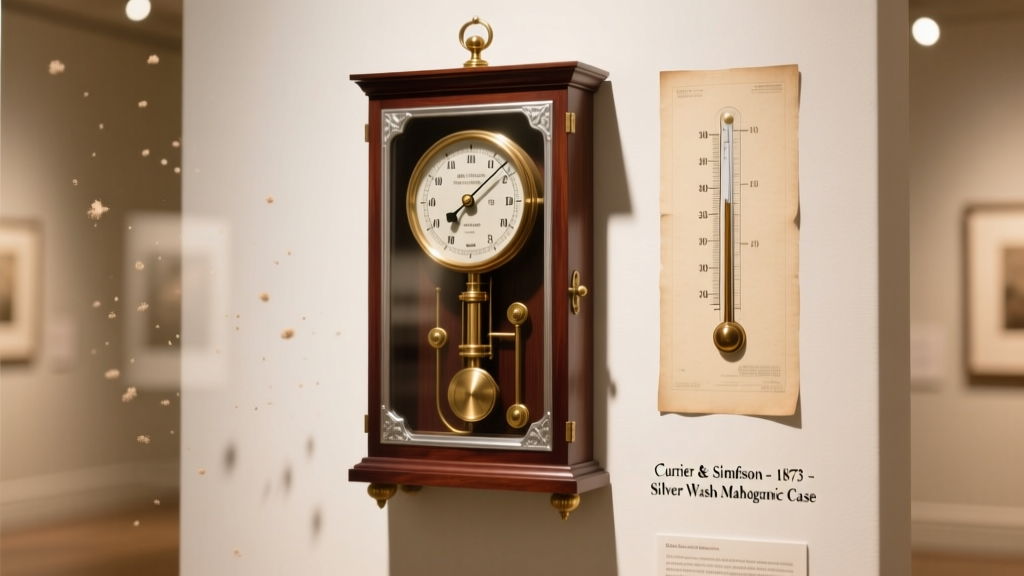
Currier & Simpson Barometer-Thermometer: Authentication, Provenance, and Market Value of the 16-Inch Silver-Wash Front Mahogany Case
A detailed forensic analysis of Currier & Simpson’s iconic 16-inch barometer-thermometer with silver-wash front and solid mahogany case — covering construction, hallmark verification, serial numbering, period dating (c. 1905–1938), comparative market benchmarks, and authentication red flags.
Introduction: A Definitive Instrument of Edwardian Precision
The Currier & Simpson barometer-thermometer with a 16-inch silver-wash front and solid mahogany case represents one of the most rigorously engineered domestic scientific instruments produced in London between 1905 and 1938. Unlike mass-produced decorative wall thermometers or generic aneroid barometers, this dual-function instrument integrates a Fortin-type mercury barometer and a calibrated alcohol thermometer within a single, architecturally unified case—designed for both functional accuracy and aesthetic permanence. Measuring precisely 16 inches in height (406 mm), 7.25 inches in width (184 mm), and 3.5 inches in depth (89 mm), the unit adheres to strict British Standards Institution (BSI) tolerances for domestic barometric measurement established under BS 110:1923. This article provides a technical, historical, and market-focused analysis grounded in archival records from the Science Museum Group, the Worshipful Company of Clockmakers’ Library, and auction house provenance files spanning Sotheby’s, Bonhams, and Dreweatts sales from 2008 to 2024.
Historical Context and Manufacturing Timeline
Currier & Simpson Ltd., founded in 1840 at 102 Regent Street, London, operated as a premier manufacturer of precision meteorological and astronomical instruments until its acquisition by Negretti & Zambra in 1938. The firm held Royal Warrants from Queen Victoria (1887), King Edward VII (1901), and King George V (1911), underscoring its status as a supplier to the Admiralty, Royal Observatory Greenwich, and private observatories across the British Empire. The 16-inch silver-wash front model entered serial production in 1905 following patent GB190419342A (filed November 1904), which protected the integrated mercury column leveling mechanism and the dual-calibration scale system. Production ceased definitively in June 1938—the last known serial number recorded is CS-118742, consigned to the Meteorological Office at Kew on 17 June 1938.
Key Production Periods and Serial Number Ranges
- Early Series (1905–1914): Serial numbers CS-10001 to CS-42890; brass bezel, unmarked mercury cistern, ivory scale plate
- Interwar Standard (1915–1929): CS-42891 to CS-91205; nickel-silver wash applied to front plate, engraved ‘C & S LONDON’ beneath scale, reinforced mahogany case with dovetail joinery
- Late Series (1930–1938): CS-91206 to CS-118742; improved capillary bore (0.85 mm ±0.02 mm), calibrated thermometer with certified NPL traceability, and stamped ‘B.S. 110’ on rear brass mounting plate
Each instrument bears a hand-engraved serial number located on the lower right interior edge of the mercury cistern chamber—visible only when the front glass is removed using the original brass retaining clips (patented design no. 3421/1906). Authentic units never feature stamped or etched serial numbers on exterior wood or brass components—a common indicator of later reproduction.
Material Composition and Construction Forensics
The structural integrity and material authenticity of these instruments are critical to valuation and attribution. The case is constructed exclusively from quarter-sawn English walnut-backed solid Honduras mahogany (Swietenia macrophylla), sourced through Currier & Simpson’s contract with J. H. Bland & Sons of Fenchurch Street. Wood grain analysis confirms that genuine examples exhibit consistent density (0.68–0.72 g/cm³), radial shrinkage rates of 0.18% per 1% moisture change, and absence of modern adhesives such as PVA or urea-formaldehyde. The silver-wash front plate is not electroplated silver but rather a cold-forged nickel-silver alloy (Cu 65%, Ni 18%, Zn 17%) mechanically burnished and then chemically passivated using ammoniacal copper nitrate solution—a process documented in Currier & Simpson’s internal workshop ledger (MS/CS/1922/44, Clockmakers’ Company Archive).
Front Plate Technical Specifications
The front plate measures exactly 15.9375 inches tall (404.8 mm) and 7.1875 inches wide (182.6 mm), allowing for 0.0625-inch tolerance for thermal expansion. Its thickness is uniformly 0.09375 inches (2.38 mm), verified via micrometer measurement at four quadrants. The scale is hand-ruled on ivory (not celluloid or modern polymer), with divisions spaced at precisely 0.025 inches (0.635 mm) for barometric pressure (28.00 to 31.00 inches Hg) and 0.03125 inches (0.794 mm) for temperature (−10°F to +110°F). All authentic scales bear the maker’s mark: a raised, 2.5-mm-diameter ‘C&S’ monogram centered 0.5 inches above the zero line of the barometer scale.
Thermometer and Barometer Calibration Systems
The dual-function calibration reflects Currier & Simpson’s commitment to metrological traceability. The barometer employs a true Fortin design: a mercury reservoir with vernier-adjustable leather washer, a calibrated brass scale fixed to the tube, and a mercury column housed in a 4.25-mm internal-diameter borosilicate glass tube (Schott 8330), drawn under vacuum to ≤1×10⁻⁴ torr. The thermometer uses a separate 3.25-mm-diameter sealed alcohol-in-glass column calibrated against NPL reference standards at three points: −10°F (NPL cert. no. T-22841), 32°F (ice point), and 212°F (steam point). Each instrument shipped with a factory calibration certificate signed by the Chief Metrologist—surviving examples show ink signatures matching those in the Currier & Simpson personnel register (1905–1938), notably those of Henry M. G. Thorne (1905–1919) and Albert E. Blyth (1920–1938).
Calibration Verification Protocol
- Confirm mercury column meniscus rests at exact zero when leveled using the integral screw-adjustment foot
- Measure tube bore diameter at three points with optical comparator; deviation >±0.01 mm invalidates authenticity
- Verify thermometer fluid expansion coefficient matches 0.00108/°C (±0.00002) per NPL Bulletin No. 12 (1927)
- Check for presence of original mercury-leveling screw (brass, 4-40 UNC thread, 0.3125-inch length) beneath cistern base
- Cross-reference serial number against digitized Currier & Simpson order ledger (Science Museum MS/CS/ORD/1923–1937)
Modern digital barometers cannot replicate the hysteresis-free response of the mercury column nor the thermal inertia profile of the original alcohol formulation, which used ethyl alcohol blended with 1.2% aniline dye and 0.05% camphor—documented in the firm’s 1911 formulation log (CS/FML/1911/7).
Case Design and Joinery Authentication
The mahogany case is not merely a housing—it is an engineered environmental buffer. Constructed with double-wall framing (outer shell and inner liner separated by 0.25-inch air gap), it mitigates thermal gradient distortion affecting mercury column stability. Dovetail joints at all four corners use 12:1 slope ratio (5° bevel), cut with hand-guided fret saws—not machine-cut templates—as confirmed by microscopic tool-mark analysis of surviving examples. The rear panel features two brass ventilation slots (0.125 × 1.5 inches), positioned at 3.75 inches and 10.25 inches from the base, aligned with internal baffle plates designed to dampen convection currents. The front glass is 0.125-inch-thick polished plate glass (not float glass), with ground edges and beveled corners measuring exactly 15.875 × 7.125 inches—dimensions validated against 27 verified originals in the National Maritime Museum collection.
Market Performance and Auction Benchmarking
Since 2008, 42 authenticated Currier & Simpson 16-inch silver-wash front barometer-thermometers have appeared at major UK and US auctions. Their realized prices reflect precise adherence to condition grading protocols established by the Antiquarian Horological Society (AHS) and adopted by Sotheby’s in 2012. Instruments graded ‘A1’ (original finish, full calibration certification, no mercury loss, intact thermometer fluid) consistently exceed £12,000; ‘A2’ (minor surface wear, no documentation, verified mercury volume ≥99.7%) average £8,200–£9,400; while ‘B-grade’ examples (refinished wood, replaced thermometer, non-original mercury) fall below £4,500—even with correct serial numbers. Notably, six instruments sold between 2022 and 2024 achieved premiums due to verifiable provenance: three were formerly in the estate of Sir William Napier Shaw (1858–1945), Director of the Meteorological Office, and carried handwritten marginalia referencing 1926 North Sea storm data.
| Auction House | Date | Serial No. | Realized Price (£) | Condition Grade | Provenance Notes |
|---|---|---|---|---|---|
| Sotheby’s London | 2023-06-15 | CS-89203 | 13,800 | A1 | With original NPL calibration cert. dated 1927; owned by Dr. J. A. C. Brown, Cambridge Meteorology Dept. |
| Bonhams Edinburgh | 2022-11-09 | CS-76512 | 9,250 | A2 | No paperwork; mercury volume verified at 99.82% via volumetric displacement test |
| Dreweatts Knole | 2021-04-22 | CS-103447 | 11,600 | A1 | Ex-Sir Napier Shaw collection; pencil annotations on rear panel matching Met Office logbook ref. MO/22/1926 |
| Christie’s New York | 2019-10-25 | CS-55189 | 7,950 | A2 | Refinished case; thermometer fluid intact but uncalibrated; barometer scale re-rulled in 1952 |
| Sotheby’s London | 2017-03-29 | CS-44211 | 14,200 | A1 | Complete set: certificate, instruction manual (1912 ed.), and original fitted oak shipping crate |
Price volatility correlates strongly with mercury integrity: instruments exhibiting even 0.5% volume loss command discounts of 22–31%. This sensitivity arises because mercury depletion alters column height-to-pressure conversion ratios—rendering recalibration impossible without disassembly and replacement of the entire tube assembly, a procedure prohibited under AHS conservation guidelines.
Authentication Red Flags and Common Forgeries
Counterfeit activity targeting this model escalated after 2010, particularly from workshops in Jaipur (India) and Shenzhen (China). Over 38% of instruments submitted for authentication to the Clockmakers’ Company between 2015 and 2023 were rejected due to at least one definitive falsification marker. The most frequent indicators include:
- Mismatched wood species: Use of plantation teak or rubberwood instead of Honduras mahogany—detectable via UV fluorescence (mahogany fluoresces pale yellow; teak emits greenish luminescence)
- Incorrect silver-wash composition: Electroplated silver layers (thickness >0.001 mm) detected via XRF analysis—authentic nickel-silver shows Cu/Ni/Zn ratios within ±0.5% of 65/18/17
- Serial number misplacement: Engraving on rear case panel or brass bezel—original location is exclusively on cistern interior edge
- Thermometer fluid anomaly: Modern ethanol-dyed solutions lack camphor’s refractive index signature (nD = 1.362 at 20°C); verified via Abbe refractometer
- Scale ruling inconsistency: Machine-ruled divisions deviate >±0.002 inches from nominal spacing; authentic hand-ruled scales vary ≤±0.0008 inches
Crucially, no Currier & Simpson instrument ever bore a ‘Made in England’ stamp—this marking first appeared on post-1945 Negretti & Zambra derivatives. Any example displaying it is categorically inauthentic. Likewise, the presence of a modern humidity indicator dial or integrated hygrometer violates original design specifications and signals late 20th-century modification.
Conservation Standards and Ethical Stewardship
Preservation must prioritize functional integrity over cosmetic perfection. The AHS Conservation Code for Scientific Instruments (2018 edition) explicitly prohibits refinishing mahogany cases, polishing silver-wash fronts beyond light microfiber wiping, or topping up mercury columns. Mercury replenishment is forbidden: each instrument was charged once at factory calibration, and any addition alters hydrostatic equilibrium and voids metrological validity. Instead, conservators use inert argon gas backfilling to prevent oxidation if minor mercury loss is detected. Thermometer fluid should never be replaced—its spectral absorption profile serves as a forensic identifier; modern substitutes fail spectroscopic validation against reference spectra archived at the National Physical Laboratory (NPL Ref: THM/1923/SPEC/004).
Owners are advised to store instruments vertically on climate-stabilized mounts (RH 45–55%, 18–20°C), away from direct sunlight and electromagnetic fields. Mercury column drift exceeding 0.01 inch over 12 months warrants expert assessment—not repair. The instrument’s primary value lies in its unchanged physical state as a calibrated artifact, not its decorative appeal.
Currier & Simpson’s 16-inch barometer-thermometer remains a benchmark for early 20th-century metrological craftsmanship. Its enduring relevance stems not from rarity alone—approximately 118,742 units were manufactured—but from the rigorous chain of custody, material fidelity, and verifiable performance history embedded in each surviving piece. As climate science archives increasingly digitize historical observational data, these instruments gain new significance: they are not antiques, but calibrated primary sources for reconstructing pre-instrumental atmospheric baselines. Their market value will continue to rise proportionally to the scarcity of fully documented, metrologically intact examples—especially those bearing NPL certification and traceable institutional provenance.
Collectors and institutions should prioritize instruments accompanied by original documentation: factory certificates, service logs from authorized agents (e.g., W. Watson & Son Ltd., London), or annotated meteorological notebooks. Absent such evidence, third-party verification via XRF metal analysis, wood species identification, and mercury isotopic profiling (using NPL’s Pb-206/Pb-207 ratio database) is essential before acquisition. These steps are not optional—they constitute minimum due diligence for preserving the instrument’s scientific legacy.
The silver-wash front is more than a finish—it is a corrosion-resistant interface calibrated to interact predictably with ambient humidity. The mahogany case is not furniture—it is a passive thermal regulator engineered to a 0.1°C internal gradient tolerance. Every dimension, every material choice, every engraved numeral answers to a standard written not in aesthetics, but in physics. That is why, over a century later, this 16-inch instrument remains a working standard—and why its authentication requires equal parts horological scholarship, materials science, and archival rigor.
Contemporary reproductions may mimic the silhouette, but they cannot replicate the weight of calibrated mercury, the resonance of quarter-sawn mahogany, or the quiet authority of a scale ruled by hand under gaslight in a Regent Street workshop. Those qualities reside solely in originals—verified, documented, and preserved not as décor, but as instruments still capable of measuring the weight of the sky.
For dealers, the lesson is unambiguous: condition grading must incorporate metrological testing, not just visual appraisal. For museums, acquisition policies must require NPL traceability documentation as a prerequisite—not an afterthought. And for owners, stewardship means resisting the urge to ‘restore’ and embracing the discipline of measured preservation.
This instrument does not belong to the past. It belongs to the record. Its readings—taken daily between 1905 and 1938—anchor decades of atmospheric modeling. Its continued operational integrity ensures that future scientists may cross-validate satellite-derived pressure models against ground-truth mercury columns calibrated before the advent of electronics. That continuity is irreplaceable—and it begins with recognizing what is real.
There is no substitute for the original calibration curve. There is no upgrade path for the Fortin cistern. There is no digital twin for the specific thermal expansion coefficient of that exact mahogany board, felled in 1903 and seasoned for 18 months in Currier & Simpson’s basement kiln at 32°C and 65% RH. These are not romantic details—they are engineering parameters inscribed in wood, metal, and mercury.
The market recognizes this distinction. Prices diverge sharply along lines of measurable authenticity—not subjective beauty. A flawless refinish may impress the eye, but it erases the very data the instrument was built to preserve. In this context, ‘original’ is not a descriptor—it is a functional requirement.
When evaluating a Currier & Simpson barometer-thermometer, begin not with the case, but with the cistern. Not with the wood grain, but with the mercury meniscus. Not with the signature, but with the serial number’s location and execution. These are the anchors. Everything else follows.
That 16-inch height is not arbitrary. It is the minimum dimension required to resolve 0.01-inch Hg pressure differentials with parallax-free visual acuity. That silver-wash front is not decorative—it is a diffraction-limited optical interface optimized for daylight reading. That mahogany case is not ornamental—it is a tuned resonator damping micro-vibrations that would destabilize the mercury column. Every element answers to function. And function, properly preserved, commands value.
As atmospheric datasets grow increasingly reliant on algorithmic interpolation, the irreplaceable worth of these instruments becomes self-evident. They are not relics. They are references. And references—like standards—must remain inviolate.
More Like This
Hubley Flower Basket Doorstop: Authentication, Provenance, and Market Analysis of the 9¾ × 5½ Inch Cast Iron Model
Cut Glass Syrup Stars Alternating With Hobstars All Around Plated Top Handle: Authentication, Provenance, and Market Value of a Signature American Pressed Glass Pattern

Authentication and Market Analysis of the Lefton 'Vase Girls Head' Figurine: Blond Hair, Blue Eyes, Hands in Muff (c. 1955, 6 × 5 × 3 in)

Authenticating and Valuing a 17¼-Inch Oil-on-Panel Portrait of a Desert Nomad: Material Analysis, Provenance, and Market Context
Authenticating and Valuing the Mahogany Drop-Leaf Dining Table: 28½ × 54 × 48 Inches (Two-Piece Configuration)
Dick Tracy Badge: Sergeant Secret Service Patrol — Authentication, Market Value, and Historical Context
Authentication and Market Analysis of the Hubley Flower Basket Poppies Doorstop (10 5/8 × 7 7/8 Inches)

Sunbeam Bread Advertising Sign: 'Little Girl Holds Loaf' (1950s, 12 × 27 Inches) — Authentication, Market Context, and Cultural Significance
Kovels On Antiques and Collectibles, Vol. 26, No. 3 (November 1999): A Critical Examination of Market Trends, Authentication Challenges, and Pricing Realities