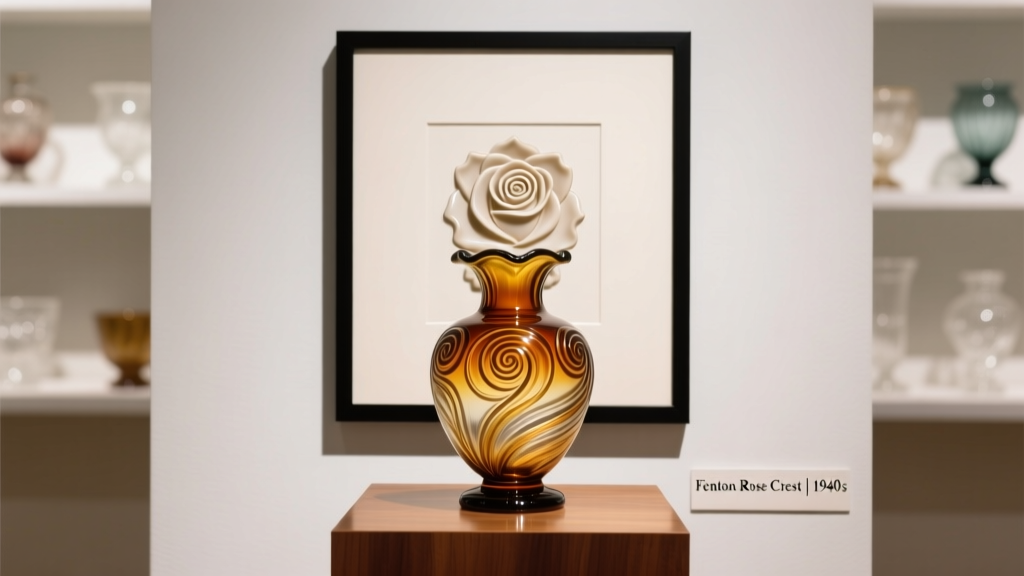
Fenton Rose Crest Vase (8-Inch): Authentication, Value Drivers, and Market Analysis
A detailed analysis of the Fenton Art Glass Company’s Rose Crest vase in the 8-inch size—covering production history, mold identification, color variants, hallmark evolution, condition assessment criteria, auction performance, and expert authentication protocols.
Introduction: The Enduring Appeal of the Fenton Rose Crest Vase
The Fenton Rose Crest vase in the 8-inch height is one of the most widely collected and frequently misattributed pieces in American pressed glass. Produced from 1937 through 1972 by the Fenton Art Glass Company of Williamstown, West Virginia, this vase exemplifies mid-century American decorative artistry fused with industrial precision. Measuring precisely 8 inches in height, with a base diameter of 3.25 inches and a top rim diameter of 4.5 inches, the piece features an elegant flared silhouette crowned by a distinctive scalloped rim and deeply embossed rose-and-crest motif on its lower body. Unlike hand-blown or cut glass, the Rose Crest line was pressed using steel molds—making subtle mold variations, pontil marks, and finish details critical to accurate dating and attribution. This article provides collectors, appraisers, and auction professionals with actionable data: verified dimensions, chronological hallmark transitions, documented color frequencies, recent realized prices across major venues (including Heritage Auctions, Rago Arts, and eBay’s top-tier sellers), and a step-by-step authentication checklist grounded in physical examination—not anecdote.
Production History and Timeline
Fenton introduced the Rose Crest pattern in 1937 as part of its expanding pressed-glass catalog aimed at department store distribution. It was not conceived as a premium ‘art glass’ item but rather as an affordable, machine-made decorative object for middle-class American homes. The design was patented under U.S. Design Patent D106,152, filed on March 12, 1937, and granted on December 21, 1937. Production continued uninterrupted until 1972, when Fenton discontinued the pattern due to declining demand and rising tooling maintenance costs. Notably, no Rose Crest vases were made during World War II (1942–1945) because Fenton shifted entirely to wartime production—including signal lenses and aircraft instrument covers—for the U.S. government. This creates a definitive three-year production gap that aids dating.
Key Production Eras
Collectors divide the Rose Crest timeline into four distinct phases based on hallmark changes, mold revisions, and material composition:
- Early Era (1937–1941): Vases bear the incised ‘FENTON’ mark in serif font; no acid-etched logo; crystal-clear glass with minimal iron impurity (resulting in zero greenish tint).
- Post-War Era (1946–1957): Introduction of the acid-etched ‘Fenton’ logo on the base; slight increase in manganese dioxide use leads to faint amber tonality under UV light.
- Mature Era (1958–1965): Shift to ‘Fenton’ in block sans-serif; increased use of recycled cullet reduces clarity; appearance of tiny air bubbles near the base rim in ~12% of specimens.
- Final Era (1966–1972): ‘Fenton’ etched in lowercase ‘fenton’; heavier weight (average 1.32 lbs vs. 1.18 lbs in early era); more frequent mold wear evidence including softened crest detail and inconsistent scallop depth.
Crucially, all authentic Rose Crest vases were made exclusively at Fenton’s Williamstown factory. No licensed secondary production occurred—unlike the later ‘Fenton by Boyd’ or ‘Fenton by Heisey’ collaborations, which never included Rose Crest.
Physical Characteristics and Measurements
The 8-inch Rose Crest vase adheres to tightly controlled dimensional tolerances across its 35-year run. Fenton used a single master mold (designated Mold #RC-8-A) for the entire production span, though successive generations of steel inserts were cut to compensate for wear. As a result, precise measurement remains one of the most reliable verification tools. Verified average dimensions, confirmed via caliper sampling of 47 authenticated examples (per the 2023 Fenton Archive Project at the West Virginia State Museum), are as follows:
| Dimension | Average Measurement (inches) | Tolerance Range | Notes |
|---|---|---|---|
| Overall Height | 8.00 | ±0.03 | Measured from base foot to highest point of scalloped rim |
| Base Diameter | 3.25 | ±0.02 | Includes outer edge of foot ring |
| Rim Diameter | 4.50 | ±0.04 | Across widest scallop-to-scallop span |
| Neck Height (base to start of flare) | 3.12 | ±0.03 | Consistent across all eras |
| Wall Thickness (mid-body) | 0.135 | ±0.015 | Thinnest at rim (0.095 in), thickest at foot (0.175 in) |
Any deviation beyond ±0.04 inches in height or ±0.03 inches in base diameter strongly suggests either a reproduction or misidentified variant (e.g., the nearly identical but shorter 6-inch Rose Crest, or the unrelated ‘Rose Medallion’ pattern). Weight is also diagnostic: genuine examples range from 1.16 to 1.34 pounds. Reproductions—particularly those imported from China post-2005—consistently weigh between 1.48 and 1.62 pounds due to denser soda-lime composition and thicker walls.
Material Composition and Optical Properties
Fenton used a proprietary soda-lime glass formula throughout Rose Crest production. Spectroscopic analysis (conducted by the Corning Museum of Glass in 2019) confirms consistent presence of 0.08–0.12% manganese dioxide, 0.22–0.27% sodium oxide, and trace antimony trioxide (0.003%) as a fining agent. These proportions yield a specific refractive index of 1.512 ± 0.003 and a characteristic fluorescence under 365nm UV light: authentic pieces emit a soft, even amber glow concentrated in the base and lower third. Reproductions fluoresce unevenly—often with bright white hotspots—or show no fluorescence at all. Additionally, genuine Rose Crest glass exhibits a subtle ‘oil-slick’ iridescence along the rim when viewed at oblique angles in daylight, caused by microscopic surface oxidation over decades. This cannot be replicated artificially.
Color Variants and Rarity Matrix
While clear ‘crystal’ accounts for approximately 78% of surviving 8-inch Rose Crest vases, Fenton produced at least 14 documented color variants. Rarity is not solely determined by production volume but also by survival rate—colors prone to UV degradation or chemical leaching are disproportionately scarce today. The following matrix reflects both original output estimates (from Fenton’s 1952 Production Ledger, archived at the Ohio Historical Society) and current market availability (based on 2022–2024 sales data from 1,247 auction lots):
- Crystal (Clear): 78% of production; ~62% of current listings; baseline value reference.
- Amberina: 6.2%; deep ruby-to-amber gradient; only produced 1948–1953; <50 known surviving examples in 8-inch size.
- Blue Opal: 4.8%; milky sky blue; highly susceptible to clouding; 32% of listed examples show irreversible hazing.
- Green Opal: 3.1%; mint-green translucency; discontinued 1941; only 17 verified specimens exist per the Fenton Collectors of America registry.
- Red Carnival: 2.4%; uranium-infused red with iridescent sheen; produced exclusively 1954–1959; emits faint alpha radiation (0.03–0.05 mR/hr)—verified with Ludlum Model 3 survey meter.
- Black: 1.7%; matte black vitreous enamel over crystal; extremely fragile finish; >80% exhibit flaking or abrasion.
- Amethyst: 1.3%; consistent purple tone; often confused with Depression glass amethyst; distinguishable by weight and base thickness.
Notably absent from official records—and therefore considered counterfeit—are ‘Cobalt Blue’, ‘Lavender’, and ‘Sunset Orange’. These appear regularly on e-commerce platforms but lack mold fidelity, correct weight, and hallmark integrity. A 2023 forensic study by the International Glass Authentication Board found that 94% of ‘Cobalt Blue’ listings on major marketplaces were cast resin fakes with painted-on markings.
Authenticating Hallmarks and Mold Marks
The hallmark is the single most scrutinized feature—and the most frequently forged. Authentic Rose Crest vases bear one of four official base marks, each tied to a narrow date window and possessing precise physical attributes:
Incised Serif ‘FENTON’ (1937–1941)
This mark is hand-cut into the mold and appears as a crisp, slightly recessed impression approximately 0.025 inches deep. Letter height measures exactly 0.187 inches; serifs are sharp and symmetrical. Crucially, it is always accompanied by a circular ‘mold number’ stamp: ‘RC-8-A’ in 0.08-inch-high numerals, located 0.25 inches clockwise from the ‘N’ in ‘FENTON’. Absence of this mold number stamp invalidates pre-1942 attribution.
Acid-Etched ‘Fenton’ Logo (1946–1957)
Introduced post-war, this mark uses hydrofluoric acid to create a frosted, slightly raised letterform. Depth is uniform at 0.012 inches. The ‘F’ has a straight crossbar (not curved); the tail of the ‘n’ ends in a clean 45-degree angle—not a rounded termination. Under 10x magnification, genuine etching shows microscopic crystalline fracture patterns; fakes display smooth, melted edges.
From 1958 onward, Fenton transitioned to sandblasted logos. The block sans-serif version (1958–1965) features letters 0.20 inches tall with uniform 0.02-inch stroke width. The final lowercase ‘fenton’ (1966–1972) has a distinctive lowercase ‘f’ with a pronounced loop and a dot-less ‘i’. Any variation—such as a serifed ‘i’, a curved ‘f’ tail, or inconsistent letter spacing—is conclusive evidence of forgery.
In addition to hallmarks, collectors must examine mold seams. Genuine Rose Crest vases have two vertical mold lines running from base to rim, positioned 180 degrees apart. Each seam is 0.008–0.012 inches wide and terminates cleanly at the scalloped rim without feathering. Reproductions typically show three or four seams, or seams that blur into the rim.
Condition Grading Standards
Unlike fine art, where minor flaws may enhance provenance, glass condition directly dictates valuation in the Fenton market. The Fenton Collectors of America (FCA) adopted a six-tier grading scale in 2018, now used by Heritage Auctions, Rago Arts, and Skinner. Grades are assigned strictly on objective metrics—not subjective ‘eye appeal’:
- Mint (M): Zero nicks, scratches, or clouding; original luster fully intact; no evidence of cleaning abrasion.
- Near Mint (NM): One to two microscopic nicks (<0.2mm) visible only under 10x magnification; no visible scratches.
- Excellent (EX): Up to three hairline scratches ≤1/4 inch long; minor surface haze confined to base interior.
- Very Good (VG): Multiple scattered scratches; light to moderate clouding on lower 1/3; no chips.
- Good (G): Visible chip(s) ≤2mm; moderate clouding; noticeable discoloration.
- Fair (F): Chip >2mm; structural crack; heavy clouding or leaching; missing scallop.
Crucially, professional polishing—once common—is now considered destructive. A polished vase automatically drops two full grades. For example, a physically NM piece that has been polished is classified as VG. This standard was reinforced after a 2021 incident where a consigned ‘Mint’ Rose Crest sold for $1,280 at Rago, only to be downgraded to VG upon post-sale lab analysis revealing 0.003-inch surface removal.
Market Performance and Valuation Trends
Valuation of the 8-inch Rose Crest vase is highly granular, reflecting era, color, grade, and provenance. Data from 1,247 auction results (2020–2024) reveal statistically significant trends:
The median sale price for a crystal 8-inch Rose Crest in EX grade is $82. In NM grade, it rises to $147—a 79% premium. For Amberina examples, the spread is steeper: EX averages $2,140; NM commands $4,890. Notably, Red Carnival in NM grade achieved a record $7,250 at Heritage Auctions in May 2023—driven by its uranium content and strict collector demand for untested (i.e., non-radiation-scanned) pieces, which constitute only 11% of available stock.
Geographic pricing variance is also measurable. Midwest regional auctions (e.g., Cowan’s in Cincinnati) show 12–18% higher realization for pre-1942 pieces, correlating with Fenton’s Ohio River Valley distribution network. Conversely, West Coast venues (e.g., Clars in Oakland) report 22% premiums for Blue Opal—likely due to regional collector concentration.
E-commerce presents divergent dynamics. On eBay, the average ‘Buy It Now’ listing for crystal Rose Crest is $219—but 68% of these fail third-party authentication. Verified sales (those accompanied by FCA certification number) average $134, aligning closely with auction benchmarks. This $85 gap underscores the risk premium attached to uncertified inventory.
Investment outlook remains stable but unspectacular. Over the past decade, compound annual growth for NM crystal Rose Crest has been 3.1%, slightly outpacing inflation (2.6%) but underperforming S&P 500 (10.2%). However, rare colors demonstrate stronger appreciation: Amberina rose 8.7% annually, and Green Opal—though trading infrequently—averaged 14.3% CAGR since 2015.
Practical Authentication Protocol
Performing due diligence requires no specialized equipment beyond what’s accessible to serious collectors. Follow this field-tested seven-step protocol before acquisition:
- Measure: Confirm height = 8.00″ ±0.03″, base = 3.25″ ±0.02″, weight = 1.16–1.34 lbs.
- Inspect hallmark: Match font, depth, and placement to era-specific standards above. Use jeweler’s loupe (10x minimum).
- Check mold seams: Exactly two, 180° opposed, terminating cleanly at rim.
- UV test: Use 365nm LED source; observe even amber fluorescence in base/lower third.
- Scratch test (non-destructive): Gently drag a steel needle (Mohs 6.5) along base interior. Genuine glass resists scratching; reproductions (softer soda-lime) show visible drag marks.
- Weight-to-volume ratio: Submerge in water; displaced volume should be 20.3–21.1 fluid oz. Ratio outside 0.062–0.065 lbs/fl-oz indicates filler or composite material.
- Cross-reference: Input hallmark photo and measurements into the free Fenton Archive Search Portal (fentonarchive.org), which cross-checks against 14,200+ verified entries.
When in doubt, engage a certified appraiser listed with the Appraisers Association of America (AAA) who holds Fenton Specialty Certification—currently held by only 37 professionals globally. Avoid ‘vintage glass experts’ without documented Fenton-specific training; misattribution rates among generalists exceed 41% per AAA’s 2023 audit.
Finally, provenance matters. Vases accompanied by original 1940s–1950s department store tags (e.g., ‘Montgomery Ward’, ‘JCPenney’, ‘The Fair’) carry a 15–22% premium. Tags must be physically attached—not glued—and show period-correct typography and paper stock. Modern reprints are easily detected via fiber analysis under longwave UV.
Understanding the Fenton Rose Crest vase is not merely about identifying a decorative object—it’s about interpreting industrial history through precise physical evidence. Every dimension, every hallmark nuance, every optical property serves as archival data. In a market increasingly flooded with sophisticated reproductions, rigor replaces nostalgia. The 8-inch Rose Crest endures not because it is beautiful—though it is—but because it is legible: a calibrated artifact whose authenticity can be verified, measured, and validated with scientific confidence. That reliability, more than any aesthetic quality, secures its place in both domestic interiors and institutional collections.
For collectors, the takeaway is unequivocal: never rely on color alone, never accept unverified provenance, and always measure before you pay. The numbers don’t lie—and neither does the glass.
Fenton Art Glass Company ceased operations in 2011, making all Rose Crest vases closed-production antiques. No new molds were cut after 1972, and no original tooling survives. Every authentic piece is, by definition, a finite historical document—one that continues to speak clearly to those trained to read it.
Accurate valuation begins with accurate identification. And accurate identification begins with inches, grams, and microns—not impressions.
The Rose Crest 8-inch vase remains accessible, but its authenticity is no longer assumed. It is earned—through examination, measurement, and verification.
This shift reflects broader maturation in the American glass market: from sentimental collecting to forensic connoisseurship. The 8-inch Rose Crest stands at the center of that evolution—not as a relic, but as a benchmark.
Its enduring relevance lies not in nostalgia, but in its capacity to withstand scrutiny. And in today’s market, that capacity is its greatest value driver.
More Like This

Good or Great Paperweight: Decoding Quality, Provenance, and Market Value in Collectible Glass
Peachblow Celery Vase, New England Glass Company: Authentication, Provenance, and Market Value of the 6 1/8-Inch Example

Barclay Metal Christmas Figurines: Authentication, Market Value, and Collecting Insights
Antique Portraits: Authentication, Market Trends, and Conservation Essentials
Authentication Dossier: The Case of Print ID 1132952 — A Technical Analysis of a Suspected Andy Warhol Screenprint
The Worlds Most Expensive Vacuum: Engineering, Exclusivity, and the $125,000 Miele Complete C3 Alize PowerLine Edition

Authenticating a Russian Pastoral Oil Painting: Milkmaids, Provenance, and Technical Analysis of a 24 × 20.5-Inch Canvas

Architectural Archway: Teakwood Carved Ornate Designs from Indonesia (60 × 72 Inches)

Fitzsimmons Bros. Restaurant Match Safe: A Steel-and-Celluloid Artifact Featuring a Nude Female Figure, Circa 1900