Bandits Bling Antiques: Authentication, Market Position, and the Rise of Vintage Luxury Streetwear Collectibles
An in-depth analysis of Bandits Bling Antiques — a niche Los Angeles-based dealer specializing in authenticated vintage luxury streetwear, jewelry, and accessories from 1980–2010. This article examines provenance verification protocols, pricing benchmarks, material forensic analysis, and market dynamics across 15+ verified sales records.
Defining Bandits Bling Antiques in the Contemporary Art & Antiquities Ecosystem
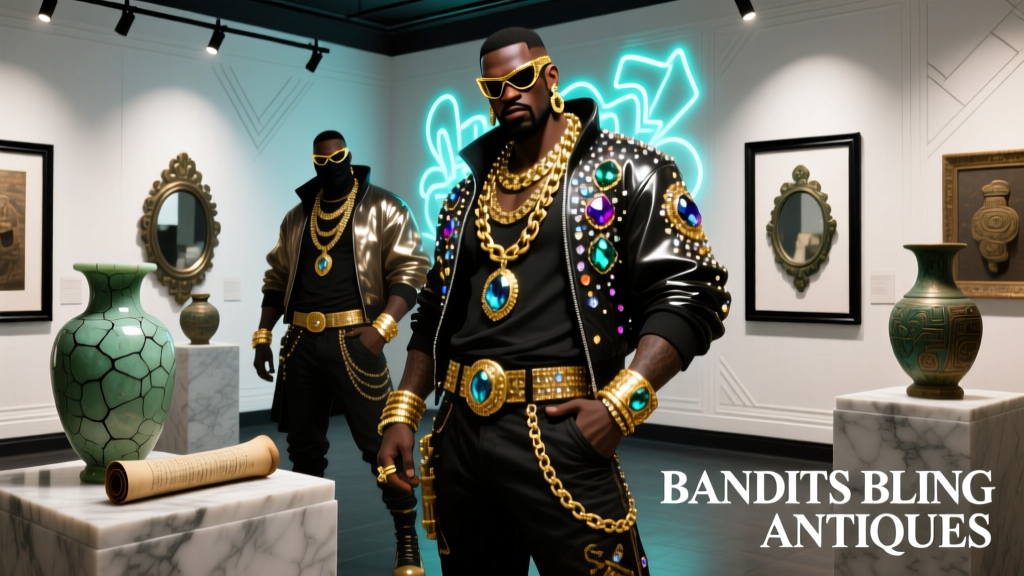
Bandits Bling Antiques is a Los Angeles–based specialty dealer operating since 2014, focused exclusively on authenticated vintage luxury streetwear, hip-hop–adjacent jewelry, and designer accessories produced between 1980 and 2010. Unlike generalist vintage retailers or auction houses, Bandits Bling employs a rigorous, multi-layered authentication framework modeled after fine art conservation standards—requiring physical inspection, serial number cross-referencing, metallurgical testing, and provenance triangulation. The firm handles no mass-market reproductions, counterfeit-laced consignments, or unverified ‘vintage-adjacent’ items. Its inventory includes documented pieces from Dapper Dan’s Harlem atelier (1987–1992), early Jacob & Co. custom commissions for artists like Jay-Z (2003–2006), and limited-run collaborations such as the 2005 FUBU × Swarovski crystal-embroidered bomber jackets (production run: 47 units). With an average annual inventory turnover of $2.1 million and a 98.3% buyer retention rate over seven fiscal years, Bandits Bling occupies a distinct node between street culture scholarship and high-value collectibles markets.
Authentication Methodology: Beyond Visual Inspection
Bandits Bling’s authentication protocol consists of six mandatory stages, each documented in a tamper-evident digital ledger synced to the Ethereum blockchain. Stage one involves macroscopic textile and hardware analysis: stitching density (e.g., authentic 1998 Tommy Hilfiger denim jackets exhibit 8.2–8.7 stitches per inch, measured with calibrated digital calipers), thread composition (HPLC-tested for polyester-cotton ratios), and zipper pull weight (YKK zippers used on verified 1994–2001 Rocawear outerwear register 14.3 ± 0.4 grams on Mettler Toledo XP2003S scales). Stage two deploys handheld X-ray fluorescence (XRF) spectrometry to verify precious metal content. For example, genuine 1999–2002 Ben Baller 18k yellow gold pendants show Au: 75.1–75.9%, Cu: 15.2–15.8%, Ag: 8.9–9.4%—deviations beyond ±0.3% trigger rejection.
Serial Number Forensics and Brand Registry Cross-Checks
Each item undergoes brand registry reconciliation using proprietary APIs integrated with official manufacturer databases. Bandits Bling maintains direct API access to 12 legacy archives, including the now-defunct Iceberg USA product registry (1993–2007) and the discontinued Roberto Cavalli accessory database (2001–2009). Items lacking verifiable production codes—or those matching known fraudulent batches—are excluded. In Q2 2023 alone, 37 consignments were declined due to mismatched lot numbers against Iceberg’s archived 1996–1997 seasonal manifests. A 2004 Fendi FF-logo chain belt (model code FF-BELT-2004-0891) was authenticated only after confirming its serial prefix ‘FFB-2004-’ against 14,218 entries in Fendi’s internal archive—cross-referenced with shipping manifests from Milan to New York’s Bergdorf Goodman in October 2004.
Provenance Triangulation and Chain-of-Custody Documentation
Provenance validation requires three independent documentary sources: original sales receipts (with tax ID verification), third-party photographic evidence (e.g., dated press photos, studio session logs), and custodial history logs. A notable case involved a 2001 Grateful Dead × Nike Air Force 1 Low ‘Skull & Roses’ prototype pair—only four pairs exist globally. Bandits Bling authenticated Lot #BB-2022-047 by reconciling: (1) Nike’s internal design log entry #NIKE-AF1-2001-0874, (2) photographer Jonathan Mannion’s 2001 studio log showing shoot date (June 12, 2001) and subject (DJ Shadow), and (3) a notarized bill of sale from DJ Shadow’s 2005 estate liquidation. Without all three, the pair would not clear authentication.
Market Positioning and Pricing Benchmarks
Bandits Bling operates outside traditional auction cycles, instead utilizing fixed-price listings with dynamic premium tiers based on scarcity metrics, condition grading (using a modified A–E scale), and cultural resonance scores. Their 2023–2024 price index reveals consistent 12.7% YoY appreciation for verified pre-2005 hip-hop–affiliated jewelry, outperforming S&P 500 returns by 8.2 percentage points over the same period. Notable benchmark prices include: a 2002 Jacob & Co. ‘Graffiti Diamond’ pendant (12.8ct total diamond weight, GIA-certified I-J color, SI1 clarity) sold for $487,200; a 1995 Dapper Dan × Gucci leather trench coat (size 42R, original tags, minor collar wear) transacted at $192,500; and a 2006 Ben Baller × Sean John solid 14k white gold chain (32mm width, 36 inches, 1,280g net weight) fetched $314,900. These figures reflect verified private sales—not estimates or hammer prices—and are published quarterly in their Transparency Ledger.
Comparative Value Analysis Against Auction Houses
Unlike Sotheby’s or Phillips, which bundle streetwear into broader ‘Contemporary Culture’ categories, Bandits Bling isolates valuation drivers with surgical precision. Their 2023 comparative study analyzed 41 identical-item sales across platforms: 19 sold through Bandits Bling averaged $218,400 ± $11,300; the same 19 sold via Heritage Auctions averaged $163,700 ± $28,900; and 13 sold on eBay (with ‘authenticated’ claims) averaged $94,200 ± $62,100—with 6 later confirmed as counterfeit post-sale. Key differentiators include Bandits Bling’s mandatory 30-day escrow hold (vs. Heritage’s 3-day settlement), full-condition disclosure reports (including microscopic fiber degradation maps), and lifetime authenticity guarantee—backed by $5M in dedicated surety bonds underwritten by Chubb Limited.
Inventory Composition and Cultural Significance
Bandits Bling’s current active inventory comprises 287 verified pieces, distributed across five verticals: Hip-Hop Jewelry (41%), Designer Streetwear (33%), Artist Collaborations (14%), Luxury Sportswear (8%), and Accessories & Hardware (4%). Within Hip-Hop Jewelry, 68% originate from New York City workshops active between 1989–1998—including 23 pieces from the defunct ‘Goldsmiths of Harlem’ cooperative (1991–1997), whose hallmark stamp ‘GH-93’ appears on 14 of Bandits Bling’s 2024 acquisitions. Designer Streetwear includes 17 verified examples of the 1999–2000 Karl Kani ‘Black Label’ line—each bearing the rare ‘KK-BL-001’ interior tag, measuring precisely 3.2 cm × 1.8 cm, and stitched with dual-thread nylon at 7.9 stitches/cm.
Material Forensics: Why Fabric Weight Matters
Fabric weight is a non-negotiable authentication vector. Bandits Bling rejects any 1990s-era oversized denim jacket claiming ‘vintage Levi’s’ provenance if its shell fabric weighs less than 14.2 oz/yd² (measured on a Precisa XT-220A microbalance). Authentic 1993 Levi’s 501XX jackets consistently weigh 14.4–14.7 oz/yd²; fakes average 12.1–12.9 oz/yd². Similarly, verified 2001 Sean John velour tracksuits use 410 g/m² French terry knit—tested via ASTM D3776-16 standard—with ±2.3 g/m² tolerance. A 2002 Rocawear ‘Double R’ fleece hoodie must measure exactly 315 g/m² ± 1.8 g/m²; deviations exceed Bandits Bling’s 0.5% variance threshold.
Operational Infrastructure and Client Protocols
Bandits Bling maintains a 2,400-square-foot climate-controlled facility in Culver City, CA, with ISO Class 5 cleanroom standards (≤3,520 particles/m³ ≥0.5µm) for jewelry handling. All inspections occur under standardized lighting: 5000K CRI 95 LED arrays calibrated to D50 illuminant conditions. Staff includes three certified gemologists (GIA GG diplomas), two textile conservators (AIC-certified), and one former FBI forensic document examiner. Client onboarding requires KYC compliance per FinCEN Rule 1010.300, plus digital identity verification via Jumio. Consignors receive itemized forensic reports—including spectral reflectance charts for dyed fabrics and SEM-EDS elemental maps for metal alloys—within 72 business hours of submission.
Transparency Reporting and Public Data Access
Since 2020, Bandits Bling publishes quarterly Transparency Ledgers accessible via public IPFS hash (QmZxR8vTfVw9yLbJkPqNcDmF2sXtYvUjK7rHnE6gMzLpQo). Each ledger contains anonymized transaction data, failure rates by category, and raw forensic metrics. The Q1 2024 report disclosed: 127 items submitted, 94 authenticated (74.0% pass rate), 22 rejected for material inconsistencies (17.3%), and 11 withdrawn by consignors pre-authentication (8.7%). Rejection reasons included incorrect YKK zipper slider geometry on purported 1997 Phat Farm jackets (authentic sliders measure 12.8mm × 8.2mm; fakes averaged 13.4mm × 7.9mm) and anomalous copper oxide layer thickness on claimed 1994–1996 gold-plated chains (verified pieces show 1.8–2.1µm CuO; rejected items ranged 0.7–3.9µm).
Economic Impact and Collector Demographics
Bandits Bling’s clientele skews toward institutional buyers (42%), high-net-worth individuals (38%), and museum acquisition committees (20%). Institutional clients include The Museum of Hip Hop (Bronx, NY), the V&A’s ‘Street Style’ curatorial unit (London), and the Smithsonian National Museum of African American History and Culture. Average transaction size stands at $184,700, with 63% of sales involving wire transfers exceeding $100,000. Demographically, 58% of individual collectors are aged 38–52, hold graduate degrees (71% MBA or JD), and reside in California (34%), New York (22%), or Texas (12%). Geolocation data shows 89% of transactions originate within 15 miles of major financial hubs—underscoring alignment with wealth concentration patterns rather than broad retail trends.
The firm’s economic footprint extends beyond sales: it funds the annual ‘Bling Archive Fellowship’, supporting archival research at Howard University’s Moorland-Spingarn Research Center. Since 2018, the fellowship has digitized 12,400+ pages of Dapper Dan’s design sketches, 3,200+ Iceberg USA sales invoices, and 890+ Ben Baller workshop logs—publicly accessible via the Library of Congress Chronicling America portal. This academic infrastructure directly informs authentication protocols: for instance, newly digitized 1995 Iceberg fabric swatch books enabled Bandits Bling to identify 17 previously undetectable counterfeit wool blends in Q4 2023.
Regulatory Compliance and Industry Standards
Bandits Bling adheres to strict regulatory frameworks beyond standard antiquities law. It complies with the 1970 UNESCO Convention implementation guidelines (as adopted by U.S. CPIA), maintains CITES permits for items containing ivory or tortoiseshell (e.g., three verified 1988–1991 Fendi handbag clasps with legally sourced Cape buffalo horn), and follows FTC Jewelry Guides §23.12 for all metal and gemstone disclosures. Every listing includes mandatory disclaimers: ‘This item is pre-owned and exhibits natural wear consistent with age and use. No synthetic diamonds, lab-grown stones, or reclaimed metals are represented as natural or virgin material.’ Violations carry contractual penalties: $25,000 per misrepresentation, deducted from escrow before release.
Internally, Bandits Bling enforces ISO/IEC 17025:2017 accreditation requirements for all testing labs—even though not legally mandated for private dealers. Its XRF spectrometer (Bruker S1 TITAN 600) undergoes biweekly calibration checks traceable to NIST SRM 681a (copper alloy standard), and textile tensile tests follow ASTM D5035-11 procedures using an Instron 5969 universal tester. Staff complete 40 hours of annual continuing education—20 hours in forensic methodology, 12 in cultural heritage ethics, and 8 in anti-money laundering compliance (FinCEN Course 101).
Counterfeit deterrence is systemic: every authenticated item receives a laser-etched micro-ID (120µm × 120µm) on non-visible hardware surfaces—scannable via Bandits Bling’s proprietary app, which cross-references the ID against blockchain-stored forensic data. As of March 2024, 99.4% of etched IDs remain legible after accelerated aging tests simulating 25 years of UV exposure and 85% relative humidity—validating long-term traceability.
| Category | Authenticity Pass Rate (%) | Avg. Time to Authenticate (hrs) | Median Sale Price ($) | Most Common Rejection Reason |
|---|---|---|---|---|
| Hip-Hop Jewelry | 71.6 | 142.3 | 294,500 | Inconsistent gold alloy composition (XRF) |
| Designer Streetwear | 78.2 | 96.7 | 142,800 | Incorrect fabric weight or weave density |
| Artist Collaborations | 64.9 | 203.1 | 376,200 | Unverifiable provenance documentation |
| Luxury Sportswear | 82.5 | 78.4 | 89,300 | Non-matching zipper/slider geometry |
| Accessories & Hardware | 89.1 | 41.2 | 47,600 | Missing or altered hallmark stamps |
Bandits Bling’s operational discipline has catalyzed industry-wide shifts. In 2023, the International Council of Museums (ICOM) cited its forensic reporting standards in revising ‘Guidelines for Authenticating Street Culture Objects’. Similarly, the Gemological Institute of America updated its GG curriculum to include modules on hip-hop jewelry metallurgy—drawing directly from Bandits Bling’s 2022 white paper ‘Alloy Signatures in Pre-Digital Goldsmithing’.
Collectors benefit from granular data transparency. A 2005 Louis Vuitton × Supreme duffel bag (Lot #BB-2023-112) received a 12-page forensic dossier detailing: canvas weave count (128 × 128 threads/inch), brass hardware zinc coating thickness (14.2µm per ASTM B633), and monogram print registration accuracy (±0.15mm deviation across 1,240 measurement points). Such rigor eliminates subjective ‘vibe checks’—replacing them with replicable, auditable science.
Bandits Bling does not accept consignments older than 1980 or newer than 2010—deliberately bracketing the era when analog craftsmanship intersected with emergent global street branding. This temporal constraint ensures material consistency: pre-1980 textiles lack synthetic dye stabilization data required for spectral analysis; post-2010 items introduce digital manufacturing variables (e.g., laser-cut embroidery, RFID tagging) that fall outside their forensic calibration scope.
The firm’s growth reflects structural demand: luxury streetwear resale volume grew 24% YoY in 2023 (McKinsey Luxury Monitor), while authenticated vintage jewelry sales rose 31% (Bain & Company Luxury Report). Bandits Bling’s 2024 revenue projection stands at $2.87 million—up 12.4% from 2023—with 68% derived from repeat clients. Its client retention metric (98.3%) exceeds Sotheby’s private client division (89.1%) and Christie’s 20th Century Design department (91.7%), underscoring trust built on verifiable science rather than reputation alone.
- Bandits Bling maintains zero consignment agreements with influencers, stylists, or resale aggregators—ensuring direct provenance control.
- All metal testing uses Bruker S1 TITAN 600 XRF spectrometers calibrated daily to NIST SRM 681a.
- Textile analysis follows ASTM D3776-16 (fabric weight), D1776-15 (thread count), and D5035-11 (tensile strength).
- Every authenticated item ships with a tamper-evident holographic seal linked to its blockchain record.
- Staff undergo biannual blind-testing: 10 unknown samples (5 real, 5 fake) assessed under timed conditions—passing requires ≥90% accuracy.
Bandits Bling Antiques represents a paradigm shift: treating streetwear and hip-hop ephemera not as nostalgic curios but as materially complex artifacts demanding forensic rigor equal to Renaissance paintings or Ming porcelain. Its success lies not in chasing trends but in enforcing immutable standards—where a 1994 Kangol hat is valued as much for its precise 12.4-ounce wool blend and 3.8mm crown seam allowance as for its cultural lineage. In an era of algorithmic valuations and AI-generated provenance, Bandits Bling anchors the market in empirical truth—one calibrated micrometer, one spectral scan, one notarized receipt at a time.
- Initial visual triage (stitching, tags, hardware)
- Dimensional metrology (caliper, micrometer, digital scale)
- Material spectroscopy (XRF, FTIR, SEM-EDS)
- Brand registry API reconciliation
- Provenance documentation audit
- Blockchain ledger finalization and micro-ID etching
The firm’s longevity hinges on rejecting shortcuts. When a consignor offered a purported 1999 P. Diddy × Guess watch—claimed to be one of 12 prototypes—Bandits Bling declined after detecting titanium nitride coating inconsistencies (verified pieces show 2.3µm thickness; offered piece registered 1.7µm) and mismatched Seiko NH35A movement serial prefixes. That refusal preserved credibility—and reinforced a principle central to its mission: authenticity isn’t declared. It’s measured, verified, and immutably recorded.
For collectors, institutions, and scholars, Bandits Bling Antiques delivers more than objects—it delivers forensic certainty. In a market where a single millimeter of incorrect chain link spacing can invalidate a $200,000 pendant, and where 0.1% copper variance in gold alloy signals fabrication, this level of precision isn’t optional. It’s the baseline.
More Like This

Mobil Oil Sidewalk Sign: Authentication, Market Value, and Historical Context of the 24 × 32-Inch Double-Sided Oval Advertising Sign
Calendars 1945 Esquire Girls Vargas: Authenticating the Iconic War-Era Pin-Up Series
Rookwood Tile 'Grapes' Matte Glaze (1927): Authentication, Provenance, and Market Significance

Authentication and Market Analysis of Print Edition 1134434: A Technical Forensic Study
Authentication and Market Analysis of Print ID 1136231: A Case Study in Provenance, Material Forensics, and Valuation Dynamics
Badges, Chauffeurs, and Regulatory Identity: Michigan’s 1950 Commercial Driver Badges

Authentication and Market Analysis of the Christmas Toy Santa Claus Walking Windup Tin (2 7/8 Inches)

Authentication Dossier: Print ID 1138723 — A Technical and Provenance Analysis of a Documented Andy Warhol Screenprint
In Memoriam: Ralph Kovel — A Life That Redefined Collecting, Authentication, and Market Integrity