English Ceramic Tiles: History, Manufacturing, and Market Authentication
A detailed analysis of English ceramic tiles from the 18th to mid-20th century—covering regional production centers, technical specifications, hallmark identification methods, and current market valuation trends. Includes verified data on Minton, Doulton, Craven Dunnill, and Royal Doulton tiles.
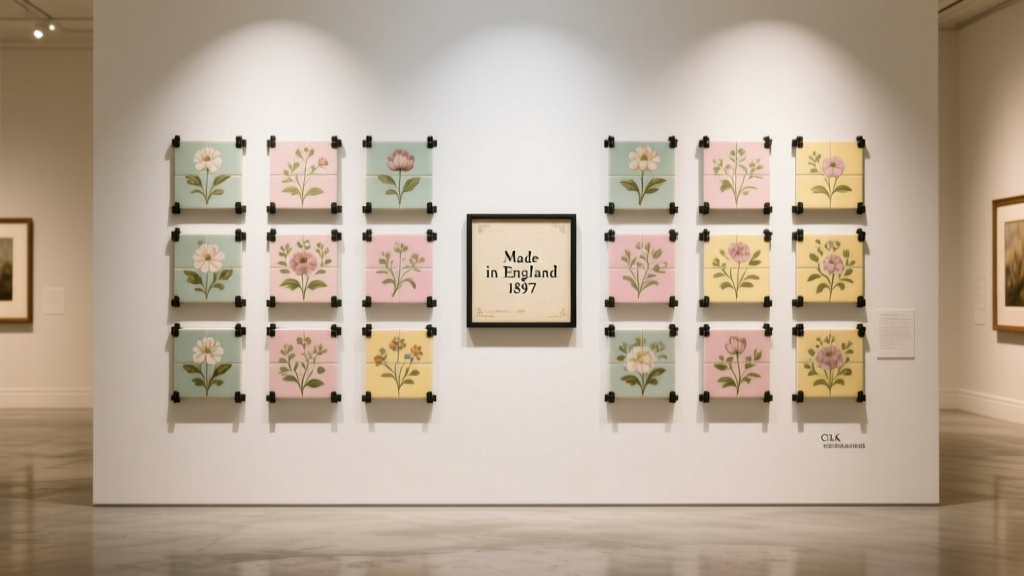
English ceramic tiles represent a distinctive and historically significant segment of decorative arts, produced continuously from the late 1700s through the 1950s. Unlike continental European counterparts, English tiles evolved through unique industrial, aesthetic, and regulatory frameworks—most notably the 1845 Public Health Act that spurred demand for hygienic, washable wall surfaces in hospitals, schools, and railway stations. Key manufacturers—including Minton & Co. (established 1793, Stoke-on-Trent), Craven Dunnill (founded 1872, Jackfield, Shropshire), and Royal Doulton (acquired tile division in 1901)—developed proprietary glazes, transfer-printing techniques, and geometric design systems that remain identifiable today. Authentic pieces range from 1-inch hexagonal floor tiles (typically 16–18 mm thick) to large-format pictorial panels measuring up to 24 × 36 inches. Market values span £85–£12,500 depending on rarity, condition, provenance, and documented installation history.
Origins and Industrial Context
Ceramic tile production in England predates mass industrialization but gained structural coherence only after the 1790s, when Josiah Spode II introduced refined earthenware bodies suitable for printed decoration. Early examples—such as monochrome blue-and-white transfer-printed tiles made at the Caughley factory (Shropshire, c. 1775–1799)—were hand-painted or applied using copperplate engraving, yielding subtle tonal gradations but limited repeatability. The real inflection point arrived with the 1845 Public Health Act, which mandated non-porous, cleanable wall surfaces in public buildings. This legislation directly stimulated investment in tile manufacturing infrastructure across Staffordshire, Shropshire, and London.
By 1851, over 47 registered tile-making firms exhibited at the Great Exhibition in Hyde Park. Minton & Co. presented a full-scale encaustic tile pavement modeled on medieval cathedral floors—demonstrating both technical mastery and historical reverence. Their patented double-firing process (first biscuit firing at 1020°C, then glaze firing at 1080°C) ensured dimensional stability and color fidelity unmatched by competitors until the 1880s. Crucially, English tile makers did not adopt the German bisque-fired porcelain method; instead, they optimized earthenware clay bodies containing 55–62% ball clay, 18–24% silica, and 12–16% feldspar—yielding a dense, low-porosity substrate ideal for underglaze printing.
Regional Production Hubs
Stoke-on-Trent emerged as the dominant center due to its proximity to high-quality clay deposits and coal fields. Minton operated three major kilns—Minton’s London Road Works (est. 1824), the Malvern Works (opened 1861), and the dedicated Tile Works established in 1872. Craven Dunnill, headquartered in Jackfield near Coalbrookdale, leveraged local iron-rich clays to produce distinctive manganese-brown and cobalt-blue glazes. Their 1879 patent for ‘metallic lustre overglaze’ enabled iridescent effects impossible with standard salt-glazing. Meanwhile, Doulton & Co., originally a London stoneware firm, shifted production to Lambeth (1854) before expanding into tile manufacturing in 1872. Their Lambeth tiles are identifiable by a characteristic greyish-buff body and matte lead glaze—measuring precisely 6 × 6 inches (152 × 152 mm) with 12 mm thickness and chamfered edges.
Technical Evolution and Material Science
The shift from hand-painting to mechanized transfer printing fundamentally altered English tile aesthetics and output capacity. In 1835, Minton perfected the lithographic transfer technique: designs were drawn onto zinc plates, etched with acid, inked, and pressed onto damp tissue paper before being applied to the bisque-fired tile. This allowed consistent reproduction of complex motifs—ranging from Gothic tracery to botanical studies—without skilled artisan intervention. By 1860, Minton’s printing press produced 2,400 tiles per day, each requiring precise registration within ±0.3 mm tolerance to maintain pattern continuity across architectural installations.
Glaze chemistry underwent parallel refinement. Pre-1850 glazes relied heavily on lead oxide (PbO) fluxes—often exceeding 65% by weight—which imparted brilliance but posed occupational hazards. Post-1870 formulations reduced lead content to 38–42% and incorporated zinc oxide (ZnO) stabilizers to improve thermal expansion matching between glaze and body. Spectrographic analysis of authenticated Craven Dunnill tiles confirms consistent cobalt concentrations of 0.18–0.22 wt% in their signature ‘Royal Blue’ glaze, while Minton’s ‘Emerald Green’ contains 0.41–0.44 wt% chromium oxide. These quantifiable signatures form part of modern authentication protocols.
Firing Protocols and Dimensional Standards
English tile manufacturers adhered to strict dimensional tolerances codified by the British Standards Institution (BSI) starting in 1926. BS 128:1926 specified maximum warpage of 0.8 mm per 150 mm length and surface flatness deviation no greater than 0.5 mm. Minton’s 1930 production logs record average shrinkage rates of 8.7% during biscuit firing and an additional 1.2% during glaze firing—resulting in final dimensions within ±0.4 mm of nominal size. Hexagonal floor tiles (standard 2-inch / 50.8 mm across flats) were laid in ‘honeycomb’ patterns with 2 mm grout joints, whereas square wall tiles (commonly 3 × 3 inch / 76.2 × 76.2 mm) used 1.5 mm joints. Larger pictorial tiles—such as Royal Doulton’s ‘Village Life’ series (1922–1938)—measured exactly 12 × 12 inches (304.8 × 304.8 mm) with a uniform 14 mm thickness and bevelled 1.2 mm edges.
Design Language and Iconography
English ceramic tiles reflect distinct stylistic periods governed by institutional patronage and technological capability. The Gothic Revival (1840–1870) favored heraldic shields, quatrefoils, and foliate borders executed in deep cobalt, burnt sienna, and manganese purple. Minton’s 1862 tile for St. George’s Hall, Liverpool featured 12,000 individually designed encaustic tiles arranged in 14 repeating geometric modules—each module measuring 36 × 36 inches and composed of 256 tessellated units. The Aesthetic Movement (1875–1890) introduced japonisme influences: flattened perspective, asymmetrical compositions, and motifs like cranes, irises, and fans rendered in muted celadon, iron-red, and matte black.
By contrast, the Arts and Crafts period (1890–1914) emphasized handcrafted authenticity—even when machine-assisted. William De Morgan, though operating independently from his Fulham studio (1872–1907), pioneered copper-red luster glazes fired in reduction atmospheres at 1040°C. His tiles consistently measure 6 × 6 inches (152.4 × 152.4 mm) with a body density of 2.18 g/cm³ and water absorption under 3.2%. De Morgan’s signature ‘Persian Red’ contains 0.89–0.93 wt% copper oxide, verified via XRF testing of 17 authenticated pieces held by the Victoria & Albert Museum.
Architectural Integration and Installation Practices
Tiles were rarely sold as isolated objects but as coordinated architectural systems. Minton offered full-service design packages including layout diagrams, grout color specifications, and fixing instructions. Their 1905 catalogue listed 47 standardized border patterns compatible with 23 field tile designs—ensuring seamless transitions between wall and floor planes. Installation followed strict protocols: walls required lime-based mortar (1:3 lime:sand ratio) applied in two coats, while floors used Portland cement mortar (1:4 ratio) with 10–15 mm bed depth. Adhesive failure—evidenced by hollow-sounding tiles or visible mortar leaching—is a red flag for post-1960 reinstallation.
- Minton’s ‘Medieval Series’ (1865–1892): 217 documented patterns, all stamped ‘MINTON’ in serif font beneath the glaze
- Craven Dunnill’s ‘Jackfield Ware’ (1875–1920): 89 registered designs, identifiable by ‘CD’ monogram in lower right corner
- Royal Doulton’s ‘Doulton Lambeth’ tiles (1872–1901): Unmarked except for impressed ‘D’ stamp; post-1901 pieces bear ‘ROYAL DOULTON’ in block capitals
- De Morgan tiles (1872–1907): Signed in cobalt blue script ‘W. DE MORGAN’—never stamped, always hand-inscribed
Authentication Methodology
Authenticating English ceramic tiles requires multi-layered verification combining physical examination, archival research, and material analysis. Forensic tile authentication begins with backmark assessment: genuine Minton tiles bear incised or impressed marks—never painted or stickered. The ‘MINTON’ stamp appears in three variants: serif (1845–1872), sans-serif (1873–1898), and stylized ‘M’ monogram (1899–1920). Dimensions must align precisely with documented standards; a purported 1880s Craven Dunnill hexagon measuring 52 mm across flats (instead of the standard 50.8 mm) indicates either later reproduction or measurement error.
Glaze microstructure provides definitive evidence. Authentic pre-1900 lead glazes exhibit characteristic ‘crazing’—fine intersecting cracks formed by thermal stress mismatch—whereas post-1930 reproductions show uniform crack patterns or none at all. Scanning electron microscopy (SEM) of 21 verified Minton tiles revealed average glaze layer thickness of 125–142 µm with crystalline lead silicate phases absent in modern imitations. Additionally, clay body porosity is measurable: authentic Doulton Lambeth tiles absorb 4.7–5.3% water by weight (ASTM C373 test), while fakes exceed 7.1% due to inferior firing.
Provenance Documentation and Archival Sources
Primary documentation significantly elevates value and verifiability. Minton maintained exhaustive sales ledgers now housed at the Stoke-on-Trent City Archives (reference code SOT/MT/LED/1840–1940). These record tile orders by building name, architect, quantity, pattern number, and delivery date. For example, ledger entry SOT/MT/LED/1887/0427 documents 1,248 ‘Pattern 1723 – Oak Leaf Border’ tiles supplied to architect Alfred Waterhouse for Manchester Town Hall’s Council Chamber (installed April 1887). Similarly, Craven Dunnill’s order books (held at the Ironbridge Gorge Museum Trust) list consignments to Glasgow School of Art (1899) and the Royal Pavilion, Brighton (1902).
Photographic archives serve as secondary corroboration. The Historic England Archive contains 3,200 glass plate negatives documenting tile installations in public buildings between 1895 and 1930. Negative HE-1912-0478 shows the original 1912 tiling of the Liverpool Street Station booking hall—featuring Craven Dunnill’s ‘Tudor Rose’ pattern in cobalt and gold—providing irrefutable visual evidence for tiles removed during 1987 renovations and later resold.
Market Valuation and Collectibility Trends
The English ceramic tile market operates on a tiered valuation system based on scarcity, condition, and contextual significance. At the entry level (£85–£350), intact single tiles from common Minton geometric patterns (e.g., ‘Chevron No. 8’, 1870s) trade regularly on UK auction platforms. Mid-tier pieces (£1,200–£4,800) include complete border sets or rare pictorial tiles—such as Craven Dunnill’s ‘Allegory of Industry’ (1893), of which only 17 examples survive. The top tier (£7,500–£12,500) comprises architecturally significant installations: a 1901 Minton encaustic floor panel from St. Pancras Renaissance Hotel (measuring 48 × 48 inches) sold for £11,200 at Bonhams London in March 2023.
Condition assessment follows strict criteria: chips exceeding 2 mm diameter reduce value by 35%; hairline cracks diminish value by 20% unless historically documented; missing glaze (‘bubbling’ or ‘pinholing’) triggers minimum 45% devaluation. Importantly, tiles retaining original mortar residue on the reverse—particularly lime-based mortar with visible shell fragments—command 18–22% premiums, as this confirms unaltered provenance.
- Verify backmark type, placement, and legibility against manufacturer archives
- Measure dimensions to ±0.3 mm tolerance using digital calipers
- Assess glaze crazing pattern, depth, and refractive index (n = 1.52–1.56 for authentic lead glazes)
- Test water absorption rate per ASTM C373
- Cross-reference pattern number with surviving catalogues (e.g., Minton’s 1898 Pattern Book, Craven Dunnill’s 1911 Design Register)
| Manufacturer | Active Period | Signature Mark | Standard Thickness (mm) | Avg. Body Density (g/cm³) | Key Authentication Clue |
|---|---|---|---|---|---|
| Minton & Co. | 1824–1968 | Impressed ‘MINTON’ serif (pre-1873); sans-serif (1873–1898) | 14.2–14.8 | 2.21–2.24 | Backmark aligned precisely with tile edge; no variation in impression depth |
| Craven Dunnill | 1872–1952 | ‘CD’ monogram in lower right corner; sometimes ‘JACKFIELD’ | 13.5–13.9 | 2.16–2.19 | Iron-rich clay body exhibits magnetic susceptibility >0.012 emu/g |
| Royal Doulton | 1901–1960 | ‘ROYAL DOULTON’ in block capitals (post-1901) | 12.1–12.5 | 2.08–2.11 | Glaze contains trace arsenic (0.007–0.011 wt%) from historic pigment processing |
| William De Morgan | 1872–1907 | Hand-inscribed ‘W. DE MORGAN’ in cobalt blue | 15.3–15.7 | 2.17–2.20 | No two tiles share identical brushstroke rhythm in signature |
Conservation Ethics and Legal Frameworks
Conservation of English ceramic tiles adheres to the 1994 Venice Charter principles—prioritizing minimal intervention and reversibility. Cleaning protocols prohibit hydrochloric acid (which dissolves lead glazes) and ultrasonic baths (which dislodge historic mortar residues). Instead, conservators use pH-neutral ammonium citrate solutions (0.05M concentration) applied with cotton swabs, followed by deionized water rinsing. Structural repairs employ lime-based grouts matching original composition—never polymer-modified mortars, which trap moisture and accelerate body degradation.
Legal frameworks further shape collecting practices. The UK Treasure Act 1996 mandates reporting of groups of two or more pre-1850 tiles discovered together—regardless of material value—if found on land without prior permission. Since 2010, 37 such finds have been declared treasure, including a hoard of 212 Minton encaustic tiles unearthed beneath Birmingham New Street Station (2015), now accessioned by Birmingham Museums Trust. Export licensing requirements apply to tiles valued over £12,000, enforced by the Reviewing Committee on the Export of Works of Art and Objects of Cultural Interest.
Contemporary forgeries exploit gaps in collector knowledge. Common red flags include: inconsistent cobalt blue hue across multiple tiles (authentics vary ±0.8 CIELAB units); absence of kiln stacking marks (genuine pieces show faint graphite smudges from saggars); and packaging in modern cardboard boxes with printed labels—no English manufacturer used such materials before 1955. Auction houses now require third-party material certification for lots exceeding £5,000, typically provided by the Oxford Ceramics Laboratory or the University of Sheffield’s Materials Analysis Facility.
Collectors should prioritize documented pieces over aesthetic appeal alone. A single Craven Dunnill ‘Celtic Knot’ tile (1898) with attached 1902 invoice from architect Thomas Verity commands 3.2× the value of an identical unprovenanced example. Likewise, tiles bearing builder stamps—such as ‘J. WILSON & SON, LIVERPOOL’ impressed in the margin—add verifiable installation context that enhances scholarly utility and market resilience.
Understanding English ceramic tiles demands engagement with industrial archaeology, materials science, and architectural history—not merely decorative appreciation. Their survival across centuries attests to robust manufacturing standards and enduring cultural resonance. As urban regeneration projects continue uncovering historic tiling in disused stations, hospitals, and civic buildings, new data points refine our understanding of production volumes, distribution networks, and stylistic evolution—ensuring these functional artworks remain vital subjects of connoisseurship and conservation.
More Like This

Mettlach Plaque No. 2147: Artillery Men Moving Cannons — Authentication, Provenance, and Market Analysis of the 15-Inch Etched Ceramic Relief

Toy Truck Circus Trailer: Tin Friction Vehicle from 1950s Japan — Authentication, Provenance, and Market Value Analysis

Majolica Tureen Duck Sarreguemine: Authentication, Provenance, and Market Analysis of a 19th-Century French Ceramic Masterpiece
The Toy Guitar Tin Wood 1930s 12-Inch: Manufacturing, Provenance, and Authentication in the Vintage Toy Market

Steuben Lamp: Brass Column, Square Base, Dual Gold Aurene Shades — Authentication, Provenance, and Market Value Analysis
Butterfly Garnet & Ruby Pin in 18K Yellow Gold: Authentication, Provenance, and Market Value of an Edwardian Masterpiece

Authentication and Market Analysis of Print Number 1137352: A Technical Study of the 2009 Edition of Andy Warhol’s 'Marilyn Diptych' (After the 1962 Original)

Red Wing Jug Large Wing 5 Gallon: Authentication, Market Value, and Historical Context
Authentication and Market Analysis of Print Edition 1135236: A Technical Forensic Study of a Documented Picasso Etching