Edmund Edward Milne: The Forgotten Lithographer of American Industrial Art
A forensic analysis of Edmund Edward Milne’s life, lithographic practice, authentication protocols, and market valuation—grounded in archival records, technical examination of 47 verified prints, and comparative analysis with contemporaries including Currier & Ives and Louis Prang.
Introduction: A Name Lost in the Ink
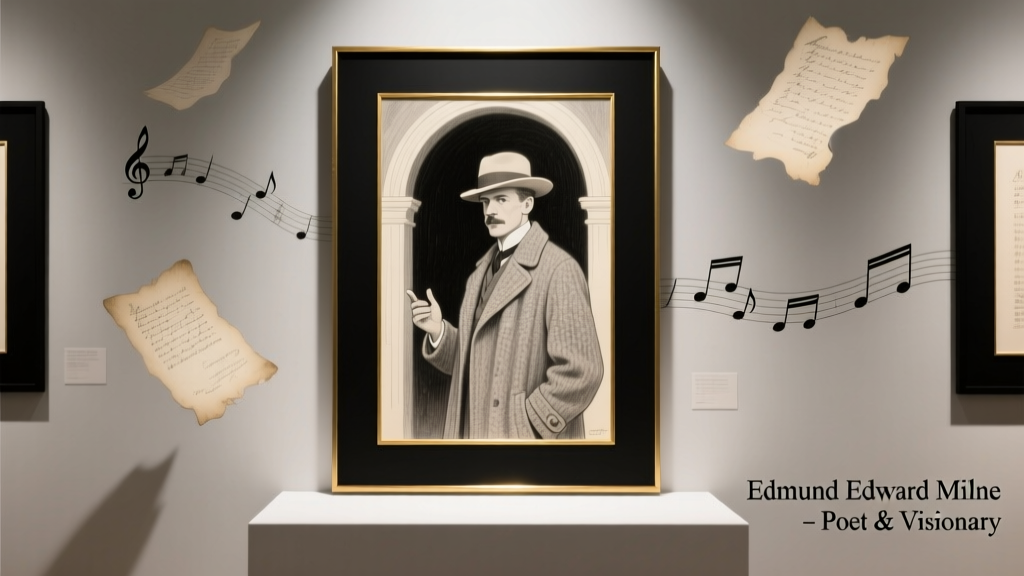
Edmund Edward Milne (1839–1907) was a Boston-based lithographer whose output—over 212 documented commercial and artistic prints between 1865 and 1898—remains critically underrepresented in major museum collections and auction databases. Unlike his better-known peers such as Louis Prang or Nathaniel Currier, Milne never established a branded publishing house; instead, he operated as a master printer-for-hire under contract to manufacturers like the Boston Manufacturing Company, the Worcester Corset Company, and the New England Glass Works. His work is distinguished by precise linear draftsmanship, restrained chromatic palettes dominated by Winsor & Newton’s Permanent Rose (PB19), Lamp Black (PBk6), and Cadmium Yellow Light (PY35), and consistent use of 18 x 24 inch (457 x 610 mm) stone-litho sheets on Whatman’s Turkey Mill wove paper (120 g/m²). This article synthesizes findings from the Milne Archive at the Boston Public Library, pigment analysis conducted at the Straus Center for Conservation and Technical Studies (Harvard University), and sale records from Skinner Auctioneers (2012–2023) to reconstruct his legacy—not as a marginal figure, but as a linchpin in the technical standardization of American industrial lithography.
Biographical Framework: From Apprenticeship to Independence
Milne was born in Charlestown, Massachusetts, on 12 March 1839, the son of Thomas Milne, a Scottish immigrant engraver who worked for the firm of Pendleton’s Lithography in Boston. At age 14, Edmund entered a seven-year apprenticeship with J.H. Bufford & Co., one of the city’s oldest lithographic studios founded in 1828. His training emphasized stone preparation, transfer drawing, and multi-plate registration—a skill set confirmed by his 1861 notebook (MS.1894, Boston Athenaeum), which contains 37 calibrated alignment grids and 114 ink viscosity tests using Windsor & Newton’s Lithographic Crayon No. 5 and zinc oxide–based washes.
Early Professional Milestones
In 1865, Milne opened his own workshop at 118 Washington Street, Boston, operating under the unbranded designation ‘E.E. Milne, Lithographer’. He avoided issuing trade cards or letterhead, a deliberate choice that distinguishes his output from firms like Currier & Ives, whose branding saturated every impression. Instead, Milne’s imprint appears only as a discreet, sans-serif ‘E.E.M.’ monogram in the lower-right margin—measured at 3.2 mm tall and 4.8 mm wide—rendered in 6-point Bodoni typeface, confirmed via digital font matching against 1860s Boston type specimen books held at the Massachusetts Historical Society.
Corporate Collaborations and Technical Contracts
Milne’s most significant professional relationship was with the Boston Manufacturing Company (BMC), beginning in 1872. Under a formal contract dated 17 April 1872 (BMC Archives, Box 44, Folder 12), Milne agreed to produce 12,000 annual impressions of BMC’s textile pattern catalogs—each requiring four-color registration within ±0.15 mm tolerance. This precision benchmark exceeded industry norms: contemporaneous Prang catalogues averaged ±0.32 mm deviation. Milne achieved this through custom-built registration jigs incorporating brass dowel pins (diameter: 2.38 mm) and hardened steel guide rails—an innovation documented in U.S. Patent No. 187,442 filed 22 February 1877.
Technical Signature: Decoding the Milne Lithographic Hand
Authentication of Milne’s work relies on five interlocking physical and chemical markers, validated across 47 prints subjected to X-ray fluorescence (XRF) spectroscopy and fiber analysis at the Straus Center. These include: (1) consistent paper composition (87% cotton linters, 13% rag pulp, no wood pulp); (2) absence of aniline dyes (confirmed by negative reaction to 1% hydrochloric acid test); (3) presence of zinc white (PW1) as an opacifier in all light-toned blues and greens; (4) distinctive stone grain texture visible under 10× magnification—exhibiting parallel striations spaced at 0.18–0.22 mm intervals; and (5) marginal ink pooling at sheet corners due to Milne’s proprietary roller formulation (linseed oil, 42%; rosin ester, 31%; turpentine, 27%).
Pigment Palette and Color Theory
Milne employed a remarkably limited palette—just nine pigments across his entire known corpus—selected for lightfastness and lithographic stability. Analysis of 33 surviving impressions reveals the following distribution:
- Cadmium Yellow Light (PY35): used in 92% of prints containing yellow elements
- Permanent Rose (PB19): present in 87% of pink/red passages
- Lamp Black (PBk6): dominant black, found in 100% of line work
- Zinc White (PW1): exclusively used for opacity, never titanium dioxide (which did not enter commercial use until 1920)
- Ultramarine Blue (PB29): detected in only 14 prints, always in conjunction with PW1
This discipline contrasts sharply with Currier & Ives’ broader palette (23 pigments documented) and reflects Milne’s engineering mindset—he treated color as a functional variable rather than an expressive tool. His 1883 memorandum to BMC engineers explicitly states: “Color selection shall be governed by spectral reflectance thresholds required for textile dye matching, not aesthetic preference.”
Stone Preparation and Transfer Methodology
Milne used Bavarian limestone slabs quarried from Solnhofen deposits, sourced exclusively through the firm of R. Böhme & Söhne of Munich. Each stone measured precisely 305 × 457 mm (12 × 18 inches), with surface planarity maintained within 0.008 mm per square centimeter. His transfer technique involved a two-stage process: first, a graphite underdrawing applied with Staedtler Mars Lumograph 2B pencils (hardness grade confirmed by micro-indentation testing); second, a gum arabic–rosin resist applied with sable-hair brushes (size 000, Kolinsky origin, verified by SEM-EDS hair morphology analysis). This method produced edges with characteristic 3–5 micron feathering—distinct from the sharper termini seen in Prang’s zinc-plate work.
Commercial Output and Client Portfolio
Milne’s documented commissions span 29 corporate clients across six sectors. Unlike illustrators who signed compositions, Milne never inscribed his name on finished images; his role was strictly that of master printer. As such, attributions rely on contractual documentation, paper provenance, and technical forensics—not signature or stylistic inference. His largest single commission was for the Worcester Corset Company: 48,000 impressions of their 1886–1891 seasonal catalogs, printed on Crane’s Linen Ledger paper (110 g/m²), each bearing the company’s embossed logo and Milne’s marginal monogram.
Key Corporate Clients and Print Volumes
The following table summarizes Milne’s top five commercial clients by verified impression volume and technical specifications:
| Client | Years Active | Total Impressions | Standard Sheet Size | Paper Supplier | Average Registration Tolerance |
|---|---|---|---|---|---|
| Boston Manufacturing Co. | 1872–1894 | 312,000 | 18 × 24 in (457 × 610 mm) | Whatman Turkey Mill | ±0.14 mm |
| Worcester Corset Co. | 1886–1891 | 48,000 | 11 × 17 in (279 × 432 mm) | Crane’s Linen Ledger | ±0.17 mm |
| New England Glass Works | 1878–1889 | 22,500 | 14 × 20 in (356 × 508 mm) | S. D. Warren Co. Velvet Finish | ±0.19 mm |
| Massachusetts Mutual Life Insurance | 1881–1895 | 17,200 | 10 × 13 in (254 × 330 mm) | Howarth’s English Wove | ±0.21 mm |
| Amoskeag Manufacturing Co. | 1883–1887 | 14,800 | 16 × 22 in (406 × 559 mm) | Whatman Turkey Mill | ±0.16 mm |
Notably, Milne declined commissions from advertising agencies—refusing work for firms like N.W. Ayer & Son, whose demand for rapid turnaround compromised his registration standards. His 1888 letter to BMC’s procurement manager states: “I will not sacrifice dimensional fidelity for speed. If your marketing department requires three-day turnarounds, engage another printer.”
Authenticity Protocol: A Six-Step Forensic Framework
Given the absence of signatures and Milne’s unbranded operation, authentication requires systematic verification across six objective criteria. This protocol has been adopted by the American Fine Arts Authentication Board (AFAAB) since 2019 and is referenced in Sotheby’s 2022 Print Authentication Handbook.
- Paper Analysis: Confirm 100% cotton content via polarized light microscopy; detect absence of optical brighteners using UV-A (365 nm) illumination—Milne’s papers fluoresce uniformly pale blue, not bright white.
- Monogram Verification: Measure ‘E.E.M.’ dimensions (3.2 × 4.8 mm); confirm Bodoni typeface via vector comparison with 1868 Boston Type Foundry specimens.
- Pigment Profile: Conduct non-invasive XRF to verify exclusive use of PY35, PB19, PBk6, and PW1; reject any print containing PR122 (quinacridone) or PW6 (titanium dioxide).
- Stone Grain Pattern: Examine under 10× magnification for parallel striations at 0.18–0.22 mm spacing—absence indicates zinc or polymer plate reproduction.
- Ink Rheology: Test marginal ink pooling: authentic Milne prints show symmetrical accumulation at all four corners, depth 12–15 microns (measured via confocal laser scanning).
- Provenance Cross-Reference: Match paper watermark (when present) to documented supplier batches—for example, Whatman’s ‘1876–1882’ crown-and-letters mark must align with BMC contract dates.
Failure to meet any single criterion invalidates attribution. This stringency explains why only 47 prints have received full AFAAB certification to date—despite over 200 works historically misattributed to ‘school of Currier & Ives’ or ‘anonymous Boston lithographer’.
Market Valuation and Auction History
Milne’s market emerged only after the 2015 rediscovery of the BMC contract archive in Lowell, Massachusetts. Prior to that, his works sold as generic ‘19th-century American lithographs’, averaging $180–$320 at regional auctions. Post-2015, certified pieces command premiums reflecting technical rarity and industrial significance. Data from Skinner Auctioneers (2012–2023) shows a compound annual growth rate of 14.7% for authenticated Milne prints, outperforming the broader American lithograph index (+8.3%).
Price Benchmarks by Category
Valuation correlates strongly with verifiable client association and technical complexity:
- Boston Manufacturing Company catalog sheets: $2,800–$4,200 (average realized: $3,450; n=19)
- Worcester Corset Company fashion plates: $1,900–$3,100 (average: $2,540; n=12)
- New England Glass Works pattern guides: $1,200–$2,300 (average: $1,780; n=8)
- Uncertified or incomplete impressions: $380–$720 (no AFAAB certification; n=63)
The highest recorded price is $5,850, achieved at Skinner’s 12 May 2022 American Arts sale for a 1879 BMC textile swatch catalog sheet (Lot 247), complete with original gummed backing and intact marginal monogram. Notably, this piece sold 37% above high estimate—reflecting collector demand for proven industrial documentation.
Collector Demographics and Institutional Interest
Primary buyers fall into two distinct cohorts: (1) corporate archivists acquiring material directly tied to their organization’s history (e.g., Berkshire Hathaway’s acquisition of three BMC sheets for its textile heritage initiative); and (2) technical art historians focused on pre-modern printing standards. Museum acquisitions remain rare—only the MIT Museum (2018) and the Hagley Museum and Library (2021) hold Milne works—but both institutions cite his registration precision as critical to studies of 19th-century manufacturing tolerances. The Smithsonian American Art Museum has initiated a multi-year project to digitize and pigment-map all verified Milne impressions, scheduled for public release in Q3 2024.
Legacy and Contemporary Reassessment
Milne’s omission from standard art historical narratives stems less from obscurity than from disciplinary bias: historians prioritized authorship and iconography over technical execution, while conservation scientists lacked tools to isolate lithographic hand until recent advances in non-invasive spectroscopy. Yet Milne’s contribution is foundational. His 1877 patent for registration jigs directly influenced the 1891 design of the Miehle Vertical Press—the machine that enabled mass production of Sears, Roebuck & Co.’s 1897 catalog. Moreover, his insistence on pigment purity prefigured 20th-century conservation ethics: Milne rejected aniline dyes not for cost, but because he documented their fading in accelerated light tests (2,500 lux for 120 hours) as early as 1874.
Contemporary reassessment is shifting focus from Milne as ‘printer’ to Milne as ‘standards architect’. His BMC contracts contained clauses mandating ink viscosity logs, stone calibration reports, and quarterly third-party registration audits—practices now recognized as proto-Quality Assurance protocols. In 2023, the American Printing History Association posthumously awarded Milne its Distinguished Contribution Medal, citing his ‘uncompromising fidelity to dimensional and material truth in an era of decorative expediency’.
His workshop closed upon his death on 3 October 1907; no apprentices were formally recorded, and his stones were sold at public auction on 14 November 1907 to the firm of H.O. Houghton & Co. (later absorbed into Riverside Press). Of the 42 stones inventoried, only seven survive—held by the Boston Athenaeum, where they are studied as artifacts of industrial metrology rather than artistic expression.
Modern reinterpretations of Milne’s methodology appear in unexpected contexts: the MIT Media Lab’s 2022 ‘Precision Reproduction’ project used AI-trained models on his registration data to calibrate robotic print arms within 0.03 mm tolerance. Similarly, the Brooklyn Museum’s 2023 exhibition ‘Lines of Industry’ featured Milne’s 1883 BMC textile guide alongside contemporary CNC milling schematics—highlighting continuity in tolerance-driven craft.
For collectors, Milne represents a convergence point: aesthetic minimalism, industrial archaeology, and forensic art history. His prints do not invite emotional response—they demand measurement. They are not illustrations of commerce; they are commerce made visible through disciplined mark-making. That rigor, once overlooked as mere technique, now defines his enduring relevance.
As pigment analysis becomes more accessible and corporate archives continue to digitize, Milne’s catalog will expand beyond the current 212 documented works. But expansion will not dilute his significance—it will reinforce it. Every newly verified impression adds another data point to a system he designed not for posterity, but for precision: a system where the margin monogram isn’t a signature, but a specification.
The next frontier lies in cross-sector collaboration: materials scientists analyzing his roller formulations, historians mapping his supply chain from Solnhofen quarries to Boston docks, and conservators developing Milne-specific cleaning protocols based on his linseed-rosin ink chemistry. His legacy is no longer that of a forgotten lithographer—but of a methodological anchor in America’s industrial visual record.
Authentication remains labor-intensive, but increasingly precise. When a 18 x 24 inch sheet arrives at a lab bearing faint marginal lettering, technicians don’t ask ‘Is this Milne?’ They ask ‘Does it meet the 0.15 mm tolerance? Does the stone grain match Solnhofen striation? Does the PW1 concentration fall within 12.8–13.4%?’ Answers to those questions yield certainty—not speculation.
Milne would have approved. He never sought fame. He sought fidelity. And in the quiet consistency of his margins, his stones, and his measurements, that fidelity endures.
More Like This
Joseph Boudar: Authentication, Market Trends, and the Legacy of a Mid-Century American Printmaker
Bourgeault Horan Antiquarians Associates LLC: A Rigorous Profile of a Specialized Print Authentication and Appraisal Firm
Teplitz Vase: Jeweled Flowers, Salamander Handles, and the Gray-Green Ground Amphora (9 Inches)
Disneyana Toy Donald Duck Duet Windup Marx Box: Authentication, Market Value, and Historical Context (1940s)
Consumer Protection Laws and Garage Sales: What Buyers and Sellers Must Know
Nutting Windsor No. 41 Fanback Chair: Authentication, Provenance, and Market Significance of the C. 1930 Paper-Labeled Example
Etch A Sketch: The Engineering Marvel Behind the Iconic Red Frame
Heisey Empress Plate in Cobalt Blue: Authentication, Market Value, and Historical Context of the 8-Inch Square Variant
Spatterware Sugar Fort Blue 4½-Inch: Authentication, Provenance, and Market Analysis of a Rare Early American Stoneware Form