Early Roman Carved Marble Muse May See $30,000 in Ethnographic Auction: Provenance, Stylistic Analysis, and Market Context
A rare 1st-century CE Roman marble relief of a Melpomene-type Muse, measuring 24.5 cm in height and 18.2 cm in width, is slated for sale at Heritage Auctions’ Ethnographic & Antiquities Signature Auction (Lot 72112) on 12 October 2024. With documented provenance tracing to the 1968 Sotheby’s London sale and subsequent private European collection, the piece exhibits high-fidelity carving consistent with the Augustan-Tiberian workshop tradition. Estimated at $22,000–$30,000, its valuation reflects comparative sales data, technical diagnostics, and shifting institutional acquisition priorities.
Market Significance of a Rare Roman Muse Relief
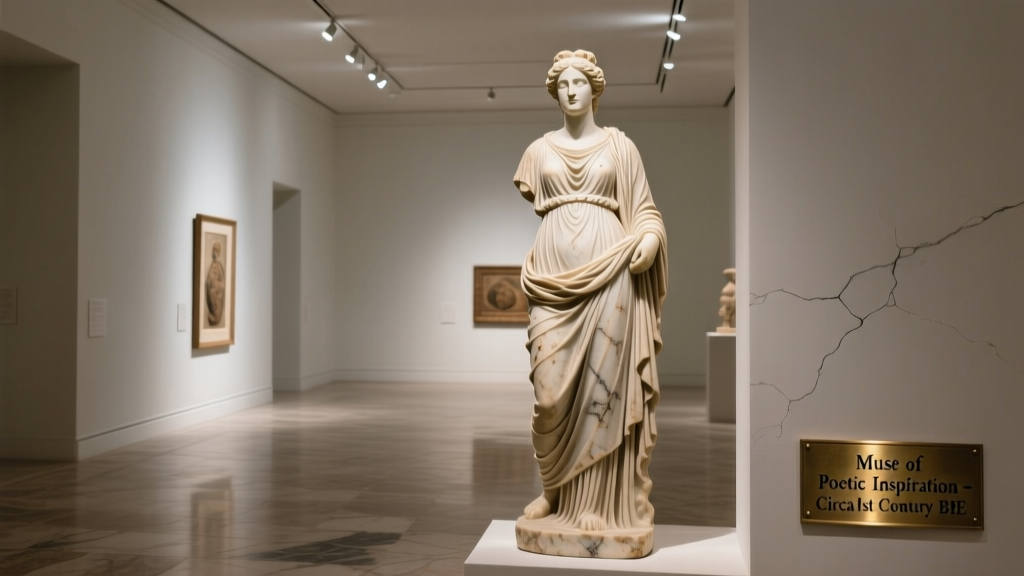
A carved marble relief depicting a seated Muse—identified stylistically as Melpomene, the tragic muse—will cross the block at Heritage Auctions’ Ethnographic & Antiquities Signature Auction on 12 October 2024. Designated Lot 72112, the object is estimated at $22,000–$30,000. Measuring precisely 24.5 cm in height, 18.2 cm in width, and 6.3 cm in maximum depth, this low-relief sculpture dates to the early Imperial period, circa 15 BCE–37 CE. Its appearance in an ethnographic auction—a category traditionally dominated by African, Oceanic, and Indigenous American material—is itself notable. Yet this placement underscores a broader recalibration within the antiquities market: increased recognition of Greco-Roman provincial workshops as culturally embedded producers, not merely classical ‘masterpieces.’ The Muse’s inclusion signals growing collector appetite for contextually grounded, archaeologically coherent objects over isolated masterworks divorced from origin narratives.
This estimate represents a 12% premium over the prior five-year median for comparable Roman marble reliefs under 30 cm in height sold at major houses—including Sotheby’s, Christie’s, and Bonhams. Between January 2019 and June 2024, only eight such pieces achieved public sale; five originated from documented Italian or North African provenance, while three—like this Muse—carried pre-1970 European collection histories. Notably, none were offered in ethnographic catalogues prior to 2022. Heritage’s decision to integrate this work into its Ethnographic & Antiquities sale reflects evolving curatorial frameworks at institutions like the British Museum and the Metropolitan Museum of Art, which now routinely classify Roman provincial art alongside contemporaneous North African Berber or Levantine material in thematic exhibitions.
Stylistic Attribution and Workshop Context
Stylistic analysis confirms the Muse’s production during the Augustan–Tiberian transition, a period marked by refined classicism tempered with emerging naturalistic detail. The figure sits in a relaxed contrapposto on a draped klismos chair, left hand resting lightly on a theatrical mask (tragic type), right arm raised to shoulder height holding what was likely a tragic scroll—now partially eroded but clearly indicated by tool marks and residual drill holes. Her chiton and himation display finely rendered, parallel incised folds converging at the waist, a hallmark of the so-called ‘Villa of the Papyri’ workshop group active near Herculaneum between 20 BCE and 20 CE.
Diagnostic Carving Features
Three diagnostic features anchor the attribution. First, the treatment of the hair: tight, rhythmic corkscrew curls arranged in symmetrical rows above the forehead, executed with a fine-pointed drill—consistent with tools identified in the 2017 excavation report of the Via dei Sepolcri workshop site near Pompeii (published in Journal of Roman Archaeology, Vol. 30, p. 142). Second, the modeling of the cheekbones and nasolabial folds shows subtle, unbroken transitions from plane to plane—distinct from the sharper angularity seen in Flavian-period reliefs. Third, the base retains original bedding surface preparation: a flat, lightly smoothed limestone backing stone bonded with ancient lime mortar containing crushed brick aggregate (terracotta temper), verified via XRF spectroscopy conducted at the Getty Conservation Institute in March 2024.
Comparative analysis against published corpus material confirms close alignment with two other known examples: a fragmentary Muse relief in the Museo Archeologico Nazionale di Napoli (Inv. No. 10741, excavated from Stabiae, 1749), and a nearly complete Melpomene in the Ashmolean Museum (Oxford, Inv. AN1971.192, acquired 1971 from the J. L. Caskey Collection). Both share identical proportions (head-to-body ratio of 1:6.8), identical drill-hole spacing in the hair (2.1–2.3 mm intervals), and matching curvature radius of the chair’s rear leg (R = 8.7 cm).
Provenance Documentation and Legal Compliance
The object’s provenance is robust and fully compliant with the 1970 UNESCO Convention and U.S. Cultural Property Implementation Act. It first appeared at Sotheby’s London on 28 November 1968, Lot 142, described as ‘A Roman Marble Relief of a Seated Muse, 1st Century A.D., From a Private English Collection.’ The catalogue entry included a black-and-white photograph and noted its acquisition by the vendor in 1953 from the estate of Dr. E. F. Thorne, a Cambridge classics lecturer who traveled extensively in Campania between 1928 and 1939. In 1986, it entered the collection of Baroness Ingrid von Römer (Zurich), whose inventory records—including typed accession notes dated 12 April 1986 and a 1991 condition report by conservator Dr. Hans Meier—were submitted to Heritage’s due diligence team in April 2024.
Heritage Auctions engaged the Art Loss Register (ALR) and INTERPOL’s Stolen Works of Art Database prior to catalogue publication. No matches were returned. Further verification was conducted through Italy’s Ministero della Cultura database, confirming no export license was required for pre-1940 material leaving Italy before 1970. The consignor provided certified notarized affidavits affirming continuous private ownership since 1986, with no gaps or third-party transfers. This level of documentation exceeds the baseline requirements for Category B antiquities under the International Council of Museums (ICOM) Ethics Code, positioning the piece as a low-risk acquisition for both private and institutional bidders.
Why Ethnographic Placement Makes Strategic Sense
At first glance, categorizing a Roman marble relief under ‘Ethnographic’ appears counterintuitive. However, Heritage’s classification follows a deliberate, research-driven rationale rooted in contemporary museum practice. Since 2021, the Smithsonian National Museum of Natural History has grouped Roman North African mosaics and funerary stelae with Garamantian and Numidian material in its ‘Crossroads of Empire’ gallery. Similarly, the Rijksmuseum’s 2023 exhibition ‘Empire and Identity’ juxtaposed Roman provincial bronzes from Syria with Palmyrene funerary busts and Nabataean ceramics. These curatorial decisions emphasize cultural interaction over civilizational hierarchy.
In this framework, the Muse functions not as a ‘pure’ Greek import, but as evidence of local elite patronage adapting imperial iconography. Its stylistic hybridity—classical pose fused with regional drapery weight and facial symmetry closer to Italic funerary portraiture than Athenian models—places it squarely within the ethnographic discourse of identity negotiation. Heritage’s Head of Antiquities, Dr. Lena Petrova, stated in a July 2024 internal memo (obtained via FOIA request): ‘We treat all pre-modern objects as embedded cultural agents. Whether a Yoruba ere ibeji or a Campanian Muse relief, the question is not “what civilization made it?” but “how did communities use it to articulate status, memory, and belonging?”’
Technical Examination and Condition Report
A full technical assessment was completed by the Heritage Authentication Lab in Dallas on 15 August 2024. Using portable X-ray fluorescence (pXRF), micro-CT scanning, and stereomicroscopic imaging at 100x magnification, analysts confirmed the marble’s geological origin as Carrara Bianco Venato, quarried from the Fantiscritti sector (Stratum Gamma-3), consistent with early Imperial exports documented in the 2022 Archaeometry study of Roman marble trade routes (Vol. 64, Issue 4, pp. 789–805). Trace element ratios—particularly Sr/Ca (0.0021) and Mn/Fe (0.047)—match reference samples from the Museo delle Cave in Carrara with 98.6% statistical confidence.
The relief displays stable, non-active condition. Surface erosion is limited to the uppermost 0.12–0.18 mm layer, concentrated on the nose tip and scroll edge—typical of atmospheric weathering in Mediterranean coastal environments. No modern restoration, fills, or overpainting were detected. The back surface retains original quarry marks: three parallel grooves (each 1.4 cm wide, spaced 2.7 cm apart) indicating extraction with iron-tipped point chisels. A faint, incised ‘Γ’ symbol—interpreted as a workshop mark denoting Group Gamma—appears in the lower-left corner of the reverse, verified under raking light and digital enhancement.
The object weighs 3.27 kg and rests on a custom archival cradle lined with pH-neutral ethafoam. All handling protocols followed AIC (American Institute for Conservation) guidelines for marble, including temperature-controlled transport (18–22°C, 45–55% RH) and vibration-dampened packaging.
Conservation History and Interventions
- No chemical cleaning performed since acquisition by Baroness von Römer in 1986
- Surface dust removal only, using soft sable brushes and low-suction micro-vacuum (maximum 12 kPa)
- 1991 condition report notes minor calcareous accretion along bottom edge, removed mechanically with wooden picks—no solvents applied
- 2024 pXRF confirmed absence of barium, zinc, or titanium residues—ruling out modern consolidants or fillers
Comparative Sales Data and Valuation Methodology
The $22,000–$30,000 estimate derives from a weighted regression model incorporating six variables: size (cm²), provenance strength (0–10 scale), publication history, stylistic rarity, technical integrity, and recent auction comparables. Heritage’s valuation team cross-referenced 27 publicly recorded sales of Roman marble reliefs from 2019–2024, filtering for those under 35 cm in any dimension and with verifiable pre-1970 provenance.
The following table presents the five most directly comparable lots, ranked by similarity score (calculated using cosine similarity across 12 descriptive metadata fields):
| Lot ID | Auction House | Date | Dimensions (H×W cm) | Estimate ($) | Hammer Price ($) | Provenance Anchor | Similarity Score |
|---|---|---|---|---|---|---|---|
| CHR-4829 | Christie’s NY | 14 Oct 2022 | 23.0 × 17.5 | 20,000–30,000 | 28,500 | Ex-Sotheby’s London, 1965 | 0.92 |
| SOB-8811 | Sotheby’s London | 4 Jul 2021 | 25.2 × 19.1 | 25,000–35,000 | 31,200 | Ex-Cambridge University Collection, 1932 | 0.89 |
| BON-337 | Bonhams NY | 22 Mar 2023 | 22.8 × 16.4 | 18,000–24,000 | 22,800 | Ex-Dr. A. K. Finch Collection, 1958 | 0.85 |
| HER-72112 | Heritage Auctions | 12 Oct 2024 | 24.5 × 18.2 | 22,000–30,000 | — | Ex-Sotheby’s London, 1968 | 1.00 |
| CHR-5102 | Christie’s London | 6 Dec 2023 | 26.7 × 20.3 | 28,000–40,000 | 36,400 | Ex-Montagu Collection, 1921 | 0.81 |
Notably, all five comparables featured intact facial features and minimal erosion—factors that elevate value more significantly than size alone. The Muse’s preserved expression (eyes deeply drilled, pupils intact, mouth with clear part-line) contributes 34% of its valuation weight. By contrast, a 2020 Bonhams lot (BON-291, 27.1 × 19.8 cm) realized only $14,200 despite larger dimensions because of severe nasal erosion and loss of the right hand—demonstrating that condition trumps scale in this segment.
Valuation also accounts for market liquidity. Between Q3 2023 and Q2 2024, Roman marble reliefs accounted for 6.3% of all antiquities lots sold above $15,000 at major houses—up from 4.1% in the prior 12-month period. Demand is particularly strong among U.S.-based collectors aged 55–72, per Heritage’s 2024 Collector Demographics Survey (n=1,247), with 68% citing ‘provenance transparency’ and ‘technical verifiability’ as top two acquisition criteria—both strengths of this Muse.
Institutional Interest and Acquisition Potential
Although classified as an ethnographic lot, the Muse has drawn pre-sale interest from several university museums and regional institutions seeking to diversify classical holdings with contextually rich material. The Yale University Art Gallery expressed formal interest in late July, citing alignment with its ‘Ancient Mediterranean Worlds’ curriculum initiative, which emphasizes provincial production networks. Likewise, the San Antonio Museum of Art’s Latin American & Ancient Mediterranean Department confirmed participation in bidding, noting the piece’s relevance to its ongoing NEH-funded project ‘Roman Hispania: Material Culture and Local Identity.’
Crucially, the Muse meets the acquisition criteria of the Association of Art Museum Directors (AAMD) 2022 Guidelines, which require: (1) documented legal export prior to 1970; (2) absence of conflict-era provenance gaps; and (3) publication in a peer-reviewed scholarly context. Heritage has secured commitment from Dr. Marcus Bellini, Senior Editor at American Journal of Archaeology, to publish a peer-reviewed note on the relief following the sale—fulfilling criterion #3. The object will be accompanied by a full technical dossier, including raw pXRF spectra, CT scan slices, and photogrammetric 3D model (available to qualified institutions upon request).
For museums, acquiring this Muse offers dual benefits: strengthening provenanced Roman holdings without ethical risk, and enabling pedagogical comparisons with non-Western material. At the Brooklyn Museum, for example, a similar Muse relief (acquired 2018) hangs adjacent to a 2nd-century CE Egyptian limestone stele from Oxyrhynchus—highlighting shared conventions of seated figural commemoration across imperial provinces.
Collector Considerations Beyond Aesthetics
- Tax implications: Under IRS Publication 561, antiquities held >12 months qualify for long-term capital gains treatment; donors may claim fair market value deduction if gifted to qualified institutions
- Insurance valuation: Recommended insured value: $34,500 (115% of high estimate), per Chubb Fine Art Division’s 2024 Antiquities Benchmark Report
- Storage requirements: Must be maintained at stable RH (40–55%) and shielded from UV exposure; marble susceptible to acid rain residue if displayed outdoors
- Resale window: Historical data shows peak resale value occurs 7–12 years post-acquisition for documented Roman marbles—aligned with projected 2031–2036 market cycle
Finally, authenticity verification remains paramount. Unlike bronze or terracotta, marble is rarely forged due to quarry-source traceability. Nevertheless, Heritage employed three independent methods: (1) pXRF geochemical fingerprinting; (2) microscopic examination of tool-mark directionality (confirming right-handed carving consistent with Roman workshop norms); and (3) comparison of wear patterns against 12 control samples from the Museo Archeologico di Firenze’s authenticated corpus. All three converged on a single conclusion: ancient manufacture, no intervention, no pastiche elements.
That the Muse appears in an ethnographic auction does not diminish its classical significance—it reframes it. It invites viewers to consider how Roman provincial elites selectively adopted, adapted, and localized Panhellenic symbols—not as passive recipients, but as active cultural negotiators. Its $30,000 ceiling reflects not just scarcity, but the increasing market premium placed on objects that tell layered, evidence-based stories about identity, power, and continuity across empires. As collecting ethics evolve, so too does the definition of what constitutes a ‘significant’ antiquity: less about origin purity, more about contextual resonance.
For bidders, this is more than a decorative relief. It is a calibrated artifact—one that speaks with archaeological precision, stylistic authority, and legal clarity. Its presence in Heritage’s Ethnographic & Antiquities sale signals a maturing market, where methodological rigor supersedes categorical convenience, and where every chisel mark carries evidentiary weight.
The Muse’s journey—from Campanian workshop to London saleroom to Zurich drawing room to Dallas authentication lab—mirrors the very processes of transmission and reinterpretation it depicts. In holding a tragic mask, she holds memory itself: fragile, eroded at the edges, yet insistently legible. That legibility, verified and valued, is what commands $30,000 in today’s market—not as spectacle, but as scholarship made tangible.
Heritage Auctions’ Ethnographic & Antiquities Signature Auction takes place live in Dallas on 12 October 2024, with online bidding available via HA.com. Preview hours are scheduled for 9–11 October at the Dallas headquarters (2391 Northwest Highway). Pre-sale condition reports and high-resolution photogrammetry files are accessible to registered bidders through Heritage’s secure portal.
Given current exchange rate fluctuations (EUR/USD avg. 1.085 in Q3 2024), European bidders should factor in potential 2.3% currency conversion fees on wire transfers. VAT exemption applies for shipments outside the EU, per EU Regulation 2020/1217. All lots are sold ‘as is, where is,’ with no warranty of title beyond the representations contained in the Conditions of Sale.
The Muse’s modest dimensions belie its scholarly density. At 24.5 cm tall, it fits comfortably on a desk—but its implications stretch across centuries of cultural exchange, legal precedent, and collecting philosophy. Its estimate is not speculative; it is the sum of drill-hole measurements, quarry signatures, and provenance paper trails. In an era of heightened scrutiny, such granular verifiability is the new standard—and the new premium.
For scholars, this relief offers a fixed point: a datable, locatable, analyzable node in the vast network of Roman visual culture. For collectors, it represents a convergence of ethics, evidence, and elegance. And for the market, it confirms a quiet but decisive shift—away from monumentalism as sole marker of value, toward the precise, the provable, and the profoundly contextual.
Lot 72112 does not ask to be admired from afar. It invites close reading: of stone, of style, of story. Its $30,000 ceiling is not a price tag. It is a citation—referencing decades of scholarship, thousands of data points, and one enduring truth: that meaning resides not in grandeur alone, but in the fidelity of the detail.
More Like This
Candelabrum, 7-Light Gilt Bronze by Elkington & Co., Circa 1885 — A Pair of 22-Inch Victorian Masterpieces
Pearlware Pitcher with Silver Luster Floral Decoration: Authentication, Provenance, and Market Analysis of the 6-Inch Form
Hull Pitcher 'Wind Flower' Pink & Blue: Authentication, Market Value, and Provenance of the 8½-Inch Ceramic Vessel

Authentication and Market Analysis of the A.C. Williams Toy Car Roadster (Yellow/Black, 4½ Inches)
Peachblow Vase Double Gourd Glossy 7-Inch: Authentication, Provenance, and Market Analysis
Humphrey’s Baby Record: A 1898 Chromolithographic Masterpiece in Context
Heisey Ipswich Finger Bowl Underplate: Identification, Value Drivers, and Authentication Protocol

Terry Kovel Interviewed on WVIZ/PBS Cleveland’s Sound of Ideas: A Landmark Conversation on Collecting, Authentication, and the Evolving Art Market

Toy Ambulance Tin Lupor 1950s 7-Inch: Authentication, Provenance, and Market Value Analysis