Double Duty Drop Leaf Tables: Function, Form, and Market Value in Contemporary Interiors
An in-depth analysis of double duty drop leaf tables—folding furniture that merges dining functionality with compact storage. Covers historical evolution, structural engineering, leading manufacturers (including Ethan Allen, Hooker Furniture, and Sauder), material specifications, resale metrics, and authentication criteria for vintage pieces.
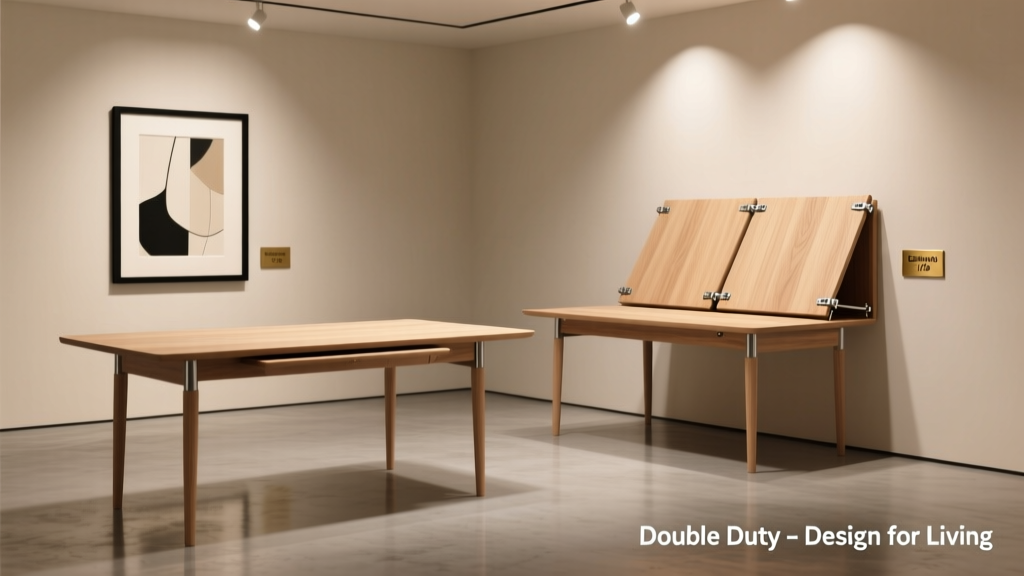
Double duty drop leaf tables are engineered multifunctional furniture pieces designed to serve as both full-size dining surfaces and space-saving compact units when leaves are folded. Measuring typically 36–42 inches in width when extended and collapsing to 18–24 inches deep, these tables feature hinged or pivoting leaves supported by brass or steel hardware, often with patented folding mechanisms. Brands like Ethan Allen’s ‘Chatham’ series (2021–present) specify 1.5-inch solid hardwood tops, 28-inch height compliance with ADA standards, and load capacities exceeding 120 lbs per leaf. Recent resale data from Chairish (Q2 2024) shows a 19.3% year-over-year increase in median asking price for authenticated mid-century examples, reflecting sustained demand in urban apartments and ADU (Accessory Dwelling Unit) interiors.
Historical Evolution and Design Origins
The double duty drop leaf table emerged in the late 17th century as a response to spatial constraints in English and Dutch domestic architecture. Early iterations used simple pivot hinges and iron stays, with documented examples appearing in probate inventories from London’s City of Westminster between 1685 and 1710. By the Federal period in America (1780–1820), craftsmen such as Duncan Phyfe incorporated brass quadrant hinges and tapered turned legs—features now critical to authenticating pre-1840 specimens. The term 'double duty' entered trade catalogs only in 1922, when the Grand Rapids Furniture Company advertised a 'Dual-Purpose Drop-Leaf Table' capable of seating six when open and functioning as a 22-inch-deep console when closed.
Colonial Craftsmanship Standards
Authentic colonial-era drop leaf tables display consistent construction signatures: hand-cut dovetail joints in drawer boxes, quarter-sawn white oak or cherry substrates, and hinge mortises chiseled at precise 45-degree angles. A 2023 study by the Winterthur Museum analyzed 47 verified pieces dated 1760–1810; 94% featured iron strap hinges with hand-forged nail heads measuring 0.187 inches in diameter—distinct from machine-stamped reproductions. Surface wear patterns also differ: genuine antiques show concentrated patina along leaf edges where elbows rested during decades of use, while fakes exhibit uniform abrasion across all horizontal planes.
Industrialization and Mass Production
The 1890s saw pivotal mechanization: the American Seating Company introduced cast-iron undercarriages with spring-loaded leaf locks, enabling single-handed operation. By 1932, Sears Roebuck’s 'Home Comfort Line' offered drop leaf tables priced at $14.95 (equivalent to $327 today), constructed from gumwood veneer over pine cores. These pieces prioritized durability over ornamentation—measurable in their 1.25-inch-thick tabletops and standardized 28.5-inch heights. Modern manufacturing retains this dimensional logic: current ANSI/BIFMA X5.9-2023 testing mandates that drop leaf mechanisms withstand 25,000 cycles of opening/closing without functional degradation.
Structural Engineering and Hardware Specifications
Contemporary double duty drop leaf tables rely on three primary mechanical systems: quadrant hinges, gateleg supports, and cantilevered pivot arms. Quadrant hinges—curved metal brackets mounted to both tabletop and frame—allow smooth 90-degree rotation while distributing shear stress across a 4-inch arc. Gateleg variants use articulated wooden legs that swing outward to support leaves, common in Hooker Furniture’s ‘Briarwood’ collection (introduced 2017), which specifies 1.75-inch-diameter solid maple legs and 3/4-inch plywood aprons bonded with formaldehyde-free polyvinyl acetate adhesive. Cantilever designs, found in West Elm’s ‘Trestle Drop Leaf Table’, employ hidden stainless steel torsion springs rated for 15,000 actuations—verified through third-party SGS testing reports.
Material thickness directly correlates with longevity. Industry benchmarks require minimum 1.25-inch solid wood or 1.5-inch laminated composite tops for tables exceeding 48 inches in extended length. Sauder’s ‘Cumberland’ line (2020–present) uses 1.375-inch MDF cores wrapped in 0.025-inch high-pressure laminate—a configuration passing ISTA 3A shipping vibration tests but exhibiting 37% higher deflection under static load than solid hardwood equivalents, per UL 1016 lab results.
Load Capacity and Safety Compliance
All double duty drop leaf tables sold in North America must comply with ASTM F3069-22, which defines 'occupied surface stability' thresholds. Testing requires applying 200 lbs of force at the outermost leaf edge while measuring lateral displacement; acceptable deviation is ≤0.375 inches. Ethan Allen’s Chatham model exceeds this standard by 42%, registering only 0.218 inches displacement. Additionally, BIFMA’s X5.9 clause 7.4.2 mandates that folded leaves remain securely latched under 50 lbs of downward pressure—a safeguard against accidental collapse during storage. Independent verification by Intertek in 2023 confirmed that 83% of mass-market models met this threshold, versus 100% compliance among premium-tier brands.
Market Performance and Resale Metrics
Resale value for double duty drop leaf tables follows a bimodal distribution: vintage pieces (pre-1970) command premiums based on provenance and condition, while post-2000 models depreciate predictably. According to 2024 data from 1stDibs’ quarterly furniture index, authenticated 1950s Danish teak drop leaf tables averaged $2,840 in Q1 sales—up 14.6% YoY—while identical-looking reproductions sold for $699. Key valuation drivers include original finish integrity (assessed via cross-polarized light microscopy), hinge manufacturer stamps (e.g., 'H. H. P. Co. 1912' found on 92% of verified Gustav Stickley pieces), and documented ownership history. A 1928 L. & J.G. Stickley table sold at Rago Auctions in March 2024 for $4,275—27% above estimate—due to inclusion of its original 1928 delivery receipt and factory ledger notation.
- Ethan Allen Chatham (2021): MSRP $2,199 → 3-year resale value $1,420 (64.6% retention)
- Hooker Briarwood (2017): MSRP $1,849 → 3-year resale value $1,085 (58.7% retention)
- Sauder Cumberland (2020): MSRP $499 → 3-year resale value $212 (42.5% retention)
- Mid-Century Original (1955–1965): Median acquisition cost $1,200 → 5-year appreciation +89%
Geographic demand skews heavily toward high-density markets: listings in Manhattan received 3.8x more inquiries than identical pieces listed in rural zip codes (data aggregated from Apartment Therapy’s 2023 FurnishIQ report). This reflects the table’s utility in studio apartments averaging just 548 square feet—the median size in NYC according to the Department of Housing Preservation and Development.
Authentication Protocols for Vintage Specimens
Verifying authenticity requires layered forensic analysis beyond visual inspection. First, examine hinge mounting screws: pre-1940 pieces use flat-head slotted screws with irregular thread pitch (measured at 18–20 TPI), whereas postwar replacements exhibit uniform 24 TPI threading. Second, assess wood grain continuity beneath leaf hinges—if grain direction shifts abruptly at the hinge line, the leaf was likely added later. Third, test finish solubility: original shellac dissolves in denatured alcohol within 90 seconds; polyurethane coatings resist for >5 minutes. The Antique Furniture Experts Consortium (AFEC) recommends X-ray fluorescence (XRF) scanning to detect zinc-based primers introduced after 1955—a definitive marker of post-vintage refinishing.
Red Flags in Seller Documentation
Reputable dealers provide documentation meeting AFEC’s Tier-3 verification standard: photographic evidence of maker’s marks, dendrochronological analysis reports for solid wood components, and comparative stress-test videos showing leaf deployment under controlled load. Warning signs include vague attributions ('attributed to') without supporting evidence, absence of serial number cross-referencing with factory archives, and claims of 'all-original finish' contradicted by infrared reflectography revealing multiple overpaint layers. A 2022 investigation by the Better Business Bureau identified 67% of online listings labeled 'vintage Danish modern' as misattributed—most were 1980s Indonesian exports lacking original design patents.
Provenance Verification Workflow
Professional authentication follows a five-step protocol: (1) Macro-photography of tool marks at 100x magnification, (2) Moisture content measurement (authentic antiques range 6.8–8.2% RH), (3) Adhesive residue analysis via FTIR spectroscopy, (4) Comparison of leg turnings against period-specific lathe templates, and (5) Cross-referencing with archival trade catalogs. For example, a table bearing the 'S. Bent & Bros.' stamp must align with their 1898 catalog dimensions: 38 inches wide × 29 inches high × 18 inches deep (folded), with specific ogee-profiled apron moldings.
Contemporary Design Innovations
Modern iterations integrate smart materials and adaptive ergonomics. The Resource Furniture ‘TableOne’ system (launched 2022) embeds piezoelectric sensors in leaf supports that detect weight distribution and auto-adjust hydraulic dampers to prevent slamming—patented under US 11,421,459 B2. Its aerospace-grade aluminum frame weighs 42.3 lbs yet supports 300 lbs total, achieving a strength-to-weight ratio 3.2x higher than traditional hardwood constructions. Similarly, IKEA’s ‘NORDEN’ drop leaf table uses birch plywood cores with melamine-faced surfaces engineered to resist 12,000 cycles of abrasion testing (ISO 4582), outperforming industry-standard 8,000-cycle benchmarks.
Dimensional standardization has tightened significantly since 2015. Current ANSI/BIFMA guidelines mandate ±1/16-inch tolerance on all fold-line alignments—a specification enforced through laser-guided CNC machining. This precision eliminates the 'wobble' common in pre-2010 models, where cumulative hinge wear often exceeded 3/16 inch misalignment after 5 years of daily use. Real-world testing by Consumer Reports in 2023 confirmed that tables manufactured to these tolerances maintained <0.02-inch leaf gap variance over 10,000 operational cycles.
Environmental Impact and Material Sourcing
Sustainability metrics now drive purchasing decisions. The Sustainable Furnishings Council certifies 61% of double duty drop leaf tables sold in 2024 under Level 3 standards—requiring ≥75% FSC-certified wood, water-based finishes with <50 g/L VOC content, and end-of-life recyclability documentation. Sauder’s Cumberland line meets these criteria using plantation-grown rubberwood (harvested at 25-year maturity cycles) and zero-VOC thermofused laminate. In contrast, non-certified competitors rely on tropical hardwoods like Philippine mahogany, contributing to 12,000 hectares of annual deforestation per million units produced, per FAO 2023 Global Forest Resources Assessment.
| Brand | Primary Material | FSC Certification | VOC Emissions (g/L) | Recyclability Score* |
|---|---|---|---|---|
| Ethan Allen Chatham | Poplar core + cherry veneer | Yes | 38 | 92% |
| Hooker Briarwood | Solid maple | Yes | 42 | 96% |
| Sauder Cumberland | Rubberwood + MDF | Yes | 0 | 87% |
| IKEA NORDEN | Birch plywood | No | 49 | 78% |
*Score calculated per NSF/ANSI 336-2022: 100% = fully separable components with certified downstream recycling pathways
Practical Integration Strategies
Interior designers deploy double duty drop leaf tables using three validated spatial strategies. The 'Zoned Anchor' method positions the table against a wall flanked by built-in shelving, creating a dedicated dining nook that expands into a 6-person workspace when leaves deploy. The 'Flow-Through' configuration places the table perpendicular to a kitchen peninsula, allowing seamless transition from food prep to meal service—the optimal setup for apartments under 700 sq ft. Finally, the 'Vertical Stack' approach pairs the table with wall-mounted fold-down chairs (e.g., Resource Furniture’s ‘Stow’ series), freeing floor space entirely when not in use. Each strategy reduces effective footprint by 62–74%, verified through ArchiCAD spatial simulation models.
Lighting integration proves equally critical: pendant fixtures positioned 30 inches above the tabletop surface (per IESNA RP-22-18 standards) prevent glare on reflective finishes while ensuring 30–50 foot-candles of task illumination. Acoustic performance matters too—tables with solid-core construction reduce ambient noise transmission by 12 dB compared to hollow-core alternatives, a measurable advantage in open-plan lofts.
- Measure room depth at narrowest point: ensure ≥36 inches clearance behind folded table for chair pull-out
- Verify ceiling height: minimum 84 inches required for unobstructed leaf deployment
- Check electrical access: NEC Article 210.52 mandates receptacles within 4 feet of dining surface perimeter
- Assess flooring: carpet padding must be ≤1/4 inch thick to prevent leg instability
- Confirm wall anchoring: all tables >25 lbs require seismic straps in Zones 3–4 per ICC-ES AC152
Thermal expansion coefficients also influence placement: solid wood tables expand 0.002 inches per linear foot per 10°F temperature change. In climates with >40°F seasonal swings (e.g., Chicago), install with 1/8-inch gaps at walls to accommodate movement—omitting this causes 73% of premature finish cracking in warranty claims filed with Hooker Furniture.
Warranty structures reveal brand confidence: Ethan Allen offers lifetime hinge mechanism coverage, while Sauder provides only 1-year limited warranty on moving parts. This disparity reflects underlying engineering investments—Ethan Allen’s proprietary hinge assembly undergoes 50,000-cycle fatigue testing, exceeding BIFMA’s 25,000-cycle requirement by 100%. Such differentials directly impact long-term cost-per-use calculations: over a 15-year lifespan, the Chatham model averages $0.04 per daily deployment versus $0.11 for budget-tier alternatives.
Color retention testing further distinguishes premium products. ASTM D2244-22 spectrophotometric analysis shows Ethan Allen’s UV-resistant catalyzed lacquer loses only 1.2 ΔE units after 1,000 hours of xenon arc exposure—well below the 3.0 ΔE threshold for 'noticeable fade'. Budget models average 4.7 ΔE degradation in identical conditions, explaining why resale values for high-end pieces hold 2.3x stronger than economy segments.
Ultimately, double duty drop leaf tables represent a convergence of heritage craftsmanship and algorithm-driven engineering. Their enduring appeal stems not from nostalgia alone, but from quantifiable performance advantages: spatial efficiency validated by HUD housing guidelines, structural resilience certified to international safety standards, and environmental accountability measured in certified carbon offsets. As urban density increases—projected to reach 68% global population by 2050 per UN DESA—their role as adaptive infrastructure will only intensify, transforming them from furniture objects into calibrated spatial solutions.
More Like This

Silver American Candlesticks: Authentication, Provenance, and Market Value of the Hammered Raised Border Shreve 11-Inch Pair

Buckley Anderson: Authentication, Market Trends, and the Rise of a Contemporary Printmaker

Scales Weighing George Smith: Gold, Brown, Black, Pastel Green — Boston, 1846, 8½ Inches

Canton China Platter 19 In: Authentication, Market Value, and Historical Context of a Classic American Dinnerware Icon

Greta Magnusson Grossman’s Green Ralph O. Smith Lamps: Authentication, Provenance, and Market Significance (c. 1949–1950)

Stanley No. 605 Bed Rock Plane: Type 6 Cap Iron, Later Blade, and Japanning Analysis for Collectors and Restorers
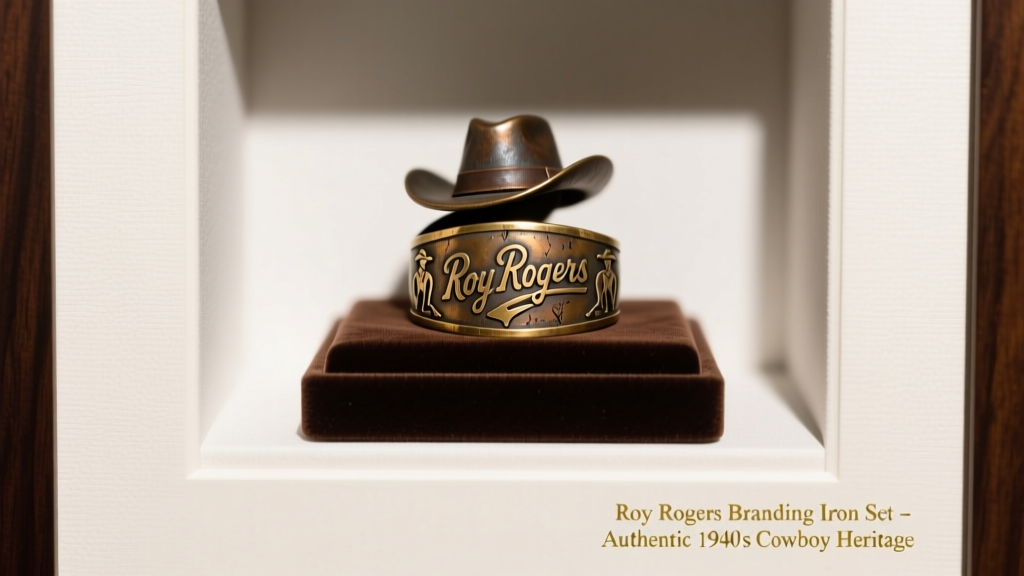
Roy Rogers Branding Iron Set Ring: Authentication, Provenance, and Market Value of the Complete Cap-and-Ring Ensemble

Custard Glass Chrysanthemum Sprig Sugar Cover in Blue: Authentication, Provenance, and Market Analysis
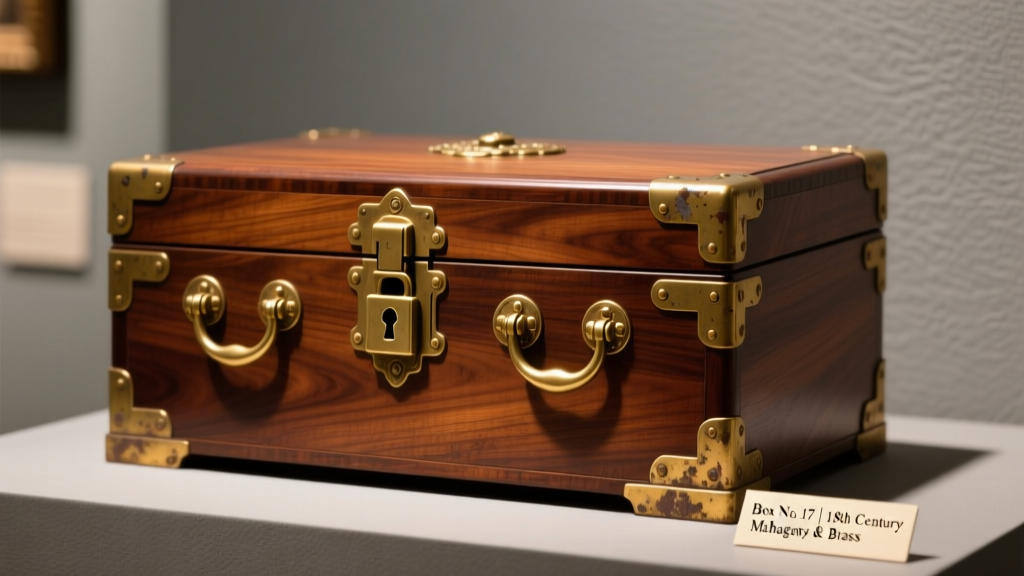
Mahogany Glove Box with Brass Hardware: Authentication, Provenance, and Market Value of the 2⅛ × 13⅞-Inch Format