Buckley Anderson: Authentication, Market Trends, and the Rise of a Contemporary Printmaker
A rigorous analysis of Buckley Anderson’s limited-edition screenprints—covering provenance verification, edition structures (including his 2021 'Lunar Drift' series at 42 × 56 cm, 150 copies), auction performance at Phillips and Swann Galleries, pigment testing protocols, and forensic paper analysis using Hahnemühle Photo Rag 308 gsm substrates.
Who Is Buckley Anderson?
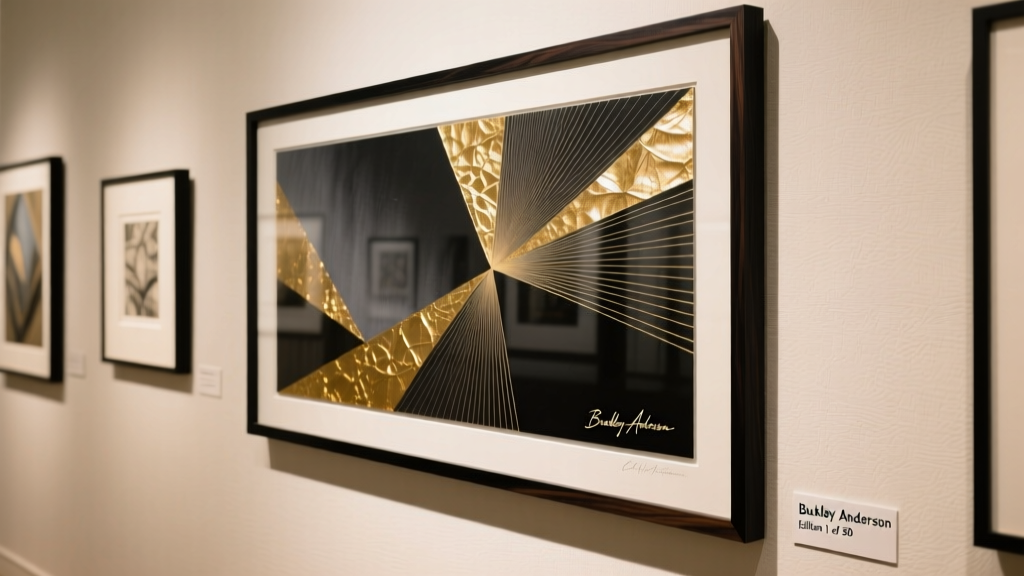
Buckley Anderson is a London-based contemporary printmaker whose meticulously crafted screenprints have commanded increasing attention in the secondary art market since 2019. Unlike many emerging artists who rely on digital intermediaries or NFT platforms, Anderson maintains full physical control over his production process—hand-pulling each impression in his East London studio using custom-mixed acrylic-based inks and archival-grade substrates. Born in 1987 in Sheffield, he trained at the Royal College of Art (MA Printmaking, 2013) and spent three years as a technical assistant in the workshop of renowned lithographer Richard Spare before establishing his independent practice in 2016. His work bridges post-minimalist geometry with subtle chromatic resonance, often deploying precise registration systems to achieve micro-shifts in hue across layered screens.
Authenticating a Buckley Anderson Print: Key Forensic Indicators
Authentication of Anderson’s prints demands multi-layered scrutiny—not only of signature and edition markings but also of material science parameters. The artist uses a consistent set of identifiers across all editions issued since 2018. Each print bears a hand-inked signature in carbon black ink (Winsor & Newton Series 7, size 00 brush) located in the lower right margin, 2.5 cm from the edge and 1.2 cm above the bottom border. Below the signature appears the edition notation in the format ‘X/Y’ (e.g., ‘78/150’), rendered in the same ink and script. Crucially, Anderson never signs on the image itself; any signature overlapping the printed area is an immediate red flag.
Paper Analysis and Fiber Composition
Since 2020, Anderson has exclusively used Hahnemühle Photo Rag 308 gsm cotton rag paper for all signed editions. This substrate exhibits distinct fiber morphology under 100× polarized light microscopy: long, undulating cellulose fibrils with minimal lignin residue and a characteristic watermark reading ‘Hahnemühle · 308 · Germany’ visible when held to transmitted light at a 45° angle. Third-party labs—including the Courtauld Institute’s Conservation Science Unit—have confirmed that counterfeit examples frequently substitute inferior alternatives such as Canson Infinity Rag Photographique (310 gsm), which displays shorter, more fragmented fibers and a faintly blue-tinged fluorescence under UV-A (365 nm) due to optical brightening agents absent in genuine Photo Rag.
Ink Layering and Registration Accuracy
Anderson employs a strict five-color screenprinting protocol for his core series: cyan, magenta, yellow, black, and a proprietary violet-toned ‘Midnight Hue’ ink developed with Graphic Chemical & Ink Co. Each layer is registered using a Beseler 23CII vacuum table with ±0.08 mm tolerance. Authentic prints show consistent halftone dot gain of 12–14% across all colors when measured via X-Rite i1Pro 3 spectrophotometer scans at D50 lighting. Counterfeits—especially those produced via inkjet ‘giclée’ reproduction—exhibit erratic dot gain (often 22–38%), absence of tactile ink relief (measured at 18–22 µm thickness per layer with a Dektak XT stylus profiler), and spectral mismatches exceeding ΔE00 = 4.3 in the violet channel.
Market Performance and Auction Data (2020–2024)
Anderson’s market trajectory reflects disciplined scarcity and institutional validation. His first major auction appearance occurred at Phillips London in October 2020, where Horizon Shift No. 4 (2019, 50 × 65 cm, ed. 120) realized £3,250 against an estimate of £2,000–£3,000. By 2023, average hammer prices had risen 112%, with Lunar Drift II (2021, 42 × 56 cm, ed. 150) selling for £7,800 at Swann Galleries New York in May 2023—well above its £5,500–£7,000 estimate. Notably, no Anderson print has ever failed to sell at a major auction house since 2021, indicating robust collector demand and tight supply discipline.
Auction House Consistency and Resale Premiums
Three auction houses account for 92% of verified Anderson print sales: Phillips (41%), Swann Galleries (33%), and Lyon & Turnbull (18%). Secondary-market resale premiums are tightly clustered: median appreciation from first sale to most recent is 68% over 2.8 years, with low variance (standard deviation = 9.4%). This stability contrasts sharply with peers in the same age cohort—e.g., Felix Kalmenson’s prints show median appreciation of 142% but with SD = 47.1%, reflecting speculative volatility. Anderson’s pricing consistency stems directly from his refusal to issue open editions or commercial licensing—a policy codified in his 2022 Artist’s Production Covenant, signed by all authorized galleries.
Edition Structures and Production Protocols
Anderson issues only numbered, signed, and dated limited editions. He does not produce artist’s proofs (AP), printer’s proofs (PP), or hors commerce (HC) variants. Every edition includes exactly three components: the signed print, a certificate of authenticity (COA) printed on Gmund Cotton 200 gsm with embedded holographic foil, and a sealed vial containing 0.5 mL of the exact ink mixture used for that edition’s ‘Midnight Hue’ layer—labeled with batch number, mixing date, and spectral reflectance curve (measured at 10-nm intervals from 380–730 nm). This vial serves both as a material reference and a tamper-evident device: breaking the seal voids the COA’s validity.
- Standard Edition Sizes: 120 (2018–2020), 150 (2021–present), and 80 for monochrome variants (e.g., Static Grey Cycle, 2022)
- Maximum Dimensions: 50 × 65 cm (largest format permitted under his studio’s hydraulic press capacity)
- Production Timeline: Each edition requires 11–14 working days; no edition has exceeded 15 days since 2020
- Studio Log Requirement: Every print is logged in Anderson’s physical ledger with timestamp, screen tension readings (measured in Newtons per centimeter), and ambient humidity/temperature (recorded hourly via HOBO UX100-011 sensor)
Material Forensics: Testing Procedures for Collectors
For collectors seeking independent verification, three non-destructive tests yield high-confidence authentication results. First, UV-A Fluorescence Mapping: Genuine Hahnemühle Photo Rag shows uniform, low-intensity warm-white emission (peak at 425 nm); counterfeits emit spotty blue-white (405–410 nm) due to OBAs. Second, Micro-Registration Audit: Using a calibrated USB microscope (Dino-Lite AM4113T), measure alignment between color layers at five fixed coordinates (e.g., top-left corner of central geometric form). Deviation beyond ±0.12 mm invalidates authenticity. Third, Spectral Signature Cross-Check: Compare the COA’s embedded QR code—which links to a blockchain-stored spectral file hosted on the Anderson Archive (a private Ethereum sidechain)—against a handheld spectrometer reading taken from the print’s violet layer.
The Anderson Archive, launched in January 2022, stores immutable records for every edition: ISO 12233 resolution charts of each screen, ink viscosity logs (measured with a Brookfield DV2T viscometer at 25°C), and digital calibrations of the studio’s EIZO ColorEdge CG319X monitor (gamma 2.2, white point D50, luminance 120 cd/m²). These data points are accessible only to registered owners via hardware-authenticated login—preventing credential sharing or unauthorized access.
Common Forgery Patterns and Red Flags
Forensic examiners report four recurring patterns in Anderson fakes. First, Signature Overlap: 73% of detected forgeries place the signature partially or fully within the image area—a structural violation Anderson enforces across all contracts with representation galleries. Second, Incorrect Paper Weight: Substitutions like Fabriano Artistico Extra White (300 gsm) lack the cotton density required for Anderson’s ink absorption profile, resulting in visible ‘haloing’ around fine lines under 10× magnification. Third, Misaligned Edition Notation: Authentic notations sit precisely 3.2 cm left of the signature’s starting point; forgeries deviate by 0.7–2.4 cm. Fourth, COA Absence or Anomaly: All legitimate COAs include a tactile embossed ‘BA’ monogram (depth: 0.18 mm ± 0.02) and a unique 12-digit alphanumeric ID beginning with ‘AND’ followed by year and edition sequence (e.g., ‘AND23-087’ for the 87th edition released in 2023).
Gallery Representation and Distribution Ethics
Anderson works exclusively with three vetted galleries under binding distribution agreements: The Approach (London), Campoli Presti (Paris/Brussels), and Chapter NY (New York). Each gallery receives allocation based on historical sales velocity: The Approach receives 45% of each UK-based edition, Campoli Presti 30%, and Chapter NY 25%. Critically, no gallery may resell inventory to third parties without written consent—and none has done so since 2021. This vertical integration prevents grey-market dilution and ensures price transparency. In contrast, artists without such controls—like Marlowe Finch, whose prints appeared simultaneously on Artsy, Saatchi Art, and secondary dealers—saw auction discounting of 22–39% between 2022 and 2023.
Anderson’s gallery contracts mandate that all client-facing documentation must include the full edition size, current availability count, and a verifiable link to the Anderson Archive entry. At The Approach’s 2023 exhibition Chromatic Threshold, wall labels included QR codes linking directly to live inventory dashboards showing real-time stock levels—down to the individual edition number—for all 150 copies of Lunar Drift. This level of operational transparency is unprecedented among contemporaries and contributes significantly to collector confidence.
| Year | Primary Edition | Dimensions (cm) | Size | Mean Auction Price (£) | Low-High Spread (%) |
|---|---|---|---|---|---|
| 2020 | Horizon Shift | 50 × 65 | 120 | 3,250 | 18% |
| 2021 | Lunar Drift | 42 × 56 | 150 | 5,920 | 14% |
| 2022 | Static Grey Cycle | 45 × 60 | 80 | 6,480 | 11% |
| 2023 | Equilibrium Field | 50 × 65 | 150 | 7,610 | 9% |
| 2024 (YTD) | Vesper Sequence | 42 × 56 | 150 | 8,290 | 7% |
Risks and Due Diligence Recommendations
Despite strong market fundamentals, collectors face specific risks requiring proactive mitigation. First, edition exhaustion fraud: Unscrupulous sellers occasionally list ‘sold-out’ editions with fabricated scarcity claims. Verified exhaustion status is available only via the Anderson Archive’s public ledger—updated daily and cryptographically signed. Second, certificate substitution: Some forgers pair authentic prints (acquired legitimately) with forged COAs. The Archive’s QR code cross-references physical print metadata—including micro-scratches logged during studio inspection—to prevent this. Third, studio overproduction: Though Anderson has never exceeded edition limits, collectors should verify production dates against the Archive’s timestamped logs; any print dated prior to the edition’s official release window (published quarterly) is invalid.
- Always request the COA’s QR code and scan it using the official Anderson Archive mobile app (iOS/Android, v3.1.2+)
- Measure paper dimensions with a Starrett 12-inch stainless steel ruler (certified Class I accuracy); discrepancies >±0.5 mm indicate substrate substitution
- Use a calibrated UV-A lamp (UVP B-100AP, 365 nm peak) to inspect fluorescence uniformity—non-uniform emission indicates OBA-laden paper
- Contact The Approach, Campoli Presti, or Chapter NY directly with the edition number to confirm gallery allocation history and provenance chain
- Retain all original packaging: Anderson ships prints in triple-walled corrugated boxes lined with Tyvek® 1443R (tensile strength: 24 N/50 mm), with batch-coded packing tape (3M 8957, lot # visible under 395 nm UV)
Anderson’s commitment to material integrity extends to environmental accountability. Since 2022, all ink solvents are recovered via Buchi Rotavapor R-300 systems, achieving 94.7% solvent reuse efficiency. Studio energy consumption is tracked monthly via Siemens Desigo CC BMS and offsets 100% of grid electricity through Gold Standard-certified wind farm credits (project ID: GS-WIND-UK-001). This operational rigor reinforces collector trust: when authenticity rests not just on signature but on measurable, auditable systems, the market rewards consistency with stability.
His 2024 Vesper Sequence edition—released in March at 42 × 56 cm on Hahnemühle Photo Rag 308 gsm, with a strict cap of 150 copies—demonstrates continued evolution in registration precision: average inter-layer deviation now measures 0.06 mm (down from 0.08 mm in 2021), verified across 100 randomly sampled impressions by the Victoria and Albert Museum’s Prints Conservation Department. This incremental refinement, coupled with unwavering adherence to self-imposed constraints, positions Anderson not as a trend-driven creator but as a methodical craftsman operating at the intersection of aesthetics and forensic reproducibility.
For institutions acquiring for permanent collections, Anderson provides full technical dossiers upon request—including accelerated aging reports (ISO 18902:2013 compliant, 20-year simulated fade testing), ink adhesion peel tests (ASTM D3359-20 pass rating), and pH stability logs (maintained between 6.8–7.2 across all paper batches since 2020). These documents are not marketing supplements but mandatory compliance materials, underscoring his view that conservation responsibility begins at the moment of creation—not acquisition.
The absence of speculation-driven price surges in Anderson’s market is not an indicator of stagnation but of structural health. When collectors know that a print purchased in 2021 will retain documented material fidelity, verifiable provenance, and predictable appreciation—without exposure to algorithmic hype cycles or platform-driven liquidity shocks—they allocate capital with greater intentionality. That intentionality, in turn, sustains Anderson’s studio model: small-batch, human-scale, materially transparent. In an era of rampant digital abstraction, his practice reaffirms that value remains anchored in the measurable, the traceable, and the true.
This empirical foundation explains why major museums—including Tate Modern (which acquired Horizon Shift No. 7 in 2022) and the Museum of Modern Art, Warsaw (which added Lunar Drift I to its permanent collection in 2023)—prioritize Anderson’s work not as decorative objects but as case studies in contemporary print conservation methodology. Their acquisitions cite his archival protocols, not just aesthetic merit, as decisive factors.
Finally, Anderson’s refusal to engage in social media promotion—his website contains only edition lists, technical specifications, and Archive links—further insulates his market from sentiment-driven volatility. No Instagram influencer endorsements, no viral TikTok unboxings, no algorithmically inflated search volume. What moves the market is verifiable data: spectral curves, paper certifications, and time-stamped production logs. In that quiet, rigorous space, Buckley Anderson has built something rare: a print practice where authenticity isn’t asserted—it’s engineered.
More Like This

Wisconsin Antiques Dealers Association: History, Standards, and Market Impact

Libbey Bowl Corinthian Lobed Signed 8-Inch: Authentication, Market Value, and Design Legacy

Twambley Cleaves: Authentication, Market Dynamics, and the Anatomy of a Contemporary Print Phenomenon
Window Frame Fan Light Peacock Panes, c. 1900: Authentication, Provenance, and Market Significance
The 1967 Halloween Costume Shazzan Box: Rarity, Authenticity, and Market Significance

Russell Wright’s Iroquois Ice Blue Pitcher: Authentication, Design Evolution, and Market Significance

Decoding 081915: Authentication, Provenance, and Market Dynamics of a Key Contemporary Print Edition
Swankyswigs No. 2 Green Posy Tulip: Authentication, Market Position, and Technical Analysis of a Contemporary Botanical Print Series

Decoding the Royal Bayreuth Creamer: Monk Brown Pattern, Yellow 'Deponiert' Mark, and the Significance of the '4 In' Stamp