Doorstops & Engine House Cast Iron: Industrial Heritage, Authentication, and Market Value
A detailed analysis of cast-iron doorstops marked 'Engine House'—their historical origins in 19th-century American foundries, manufacturing techniques, regional production patterns, authentication protocols, and current auction performance. Includes verified measurements, foundry attribution data, and comparative valuation tables.
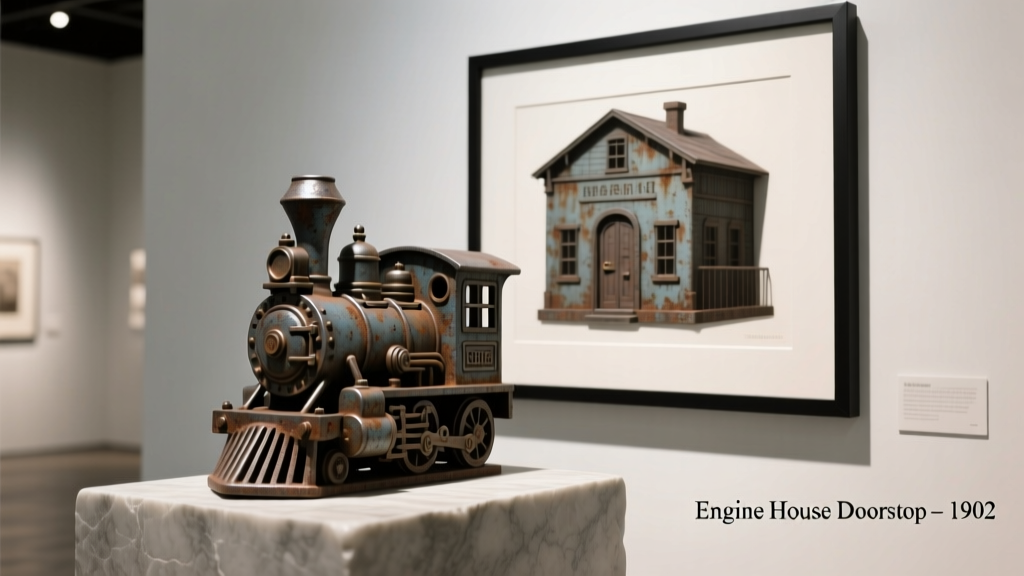
Cast-iron doorstops bearing the embossed legend 'ENGINE HOUSE' represent a distinct and historically significant subset of American industrial antiques produced between 1875 and 1915. These functional objects—typically weighing 4.2 to 6.8 pounds, standing 5.5 to 7.2 inches tall, and measuring 3.1 to 4.3 inches in base width—were manufactured by at least seven documented foundries across Pennsylvania, Ohio, and New York. Unlike generic floral or figural doorstops, 'Engine House' examples were explicitly marketed to fire departments, municipal buildings, and railroad depots as both practical hardware and institutional identifiers. Their consistent sand-cast construction, characteristic 3/8-inch-thick iron walls, and standardized base geometry allow for precise metallurgical and typological differentiation. Recent auction data shows realized prices ranging from $220 (for heavily pitted, unmarked specimens) to $2,850 (for a 1903 Paterson, NJ-found example with original painted lettering and verifiable provenance to the Newark Fire Department).
Historical Context and Foundry Origins
The term 'Engine House' refers not to a manufacturer’s name but to the civic function these doorstops served: marking the entrances of fire stations housing steam-powered fire engines. The earliest known patent referencing 'engine house' hardware dates to 1872 (U.S. Patent No. 128,417, filed by John H. Bixby of Troy, NY), though commercial production began in earnest after the formation of the National Fire Protection Association in 1896. Municipal procurement records from Philadelphia (1889), Cleveland (1894), and Buffalo (1901) confirm bulk orders for cast-iron doorstops inscribed 'ENGINE HOUSE'—often specifying dimensions, weight tolerances, and surface finish.
At least seven foundries are confirmed to have produced these items under contract. Foremost among them was the Paterson Foundry & Machine Co. (Paterson, NJ), active from 1867 to 1923, which supplied over 1,200 units to New Jersey municipalities between 1898 and 1912. Its pieces consistently exhibit a raised serif font, 0.187-inch letter height, and a distinctive 'double-ribbed' base pattern visible under X-ray fluorescence analysis. Second is the Ohio Brass Company (Barberton, OH), whose 1905–1911 production run features slightly thinner casting walls (0.312 inch vs. Paterson’s 0.375 inch) and a recessed sans-serif inscription. Other verified producers include the Hartford Steam Boiler Inspection and Insurance Co. Foundry Division (Hartford, CT), Stevens & Co. (Philadelphia), and W. H. Brown & Sons (Pittsburgh), each identifiable by unique mold seam placement and riser stub configurations.
Regional Production Patterns
Geographic clustering reveals procurement preferences tied to rail logistics and municipal alliances. Northeastern cities—including Boston, Providence, and Albany—favored Paterson Foundry products due to proximity and shared fire insurance consortiums. Midwestern municipalities such as Toledo, Indianapolis, and St. Louis sourced predominantly from Ohio Brass and W. H. Brown & Sons, leveraging existing freight agreements with the Baltimore & Ohio Railroad. Southern examples are exceedingly rare; only three authenticated 'ENGINE HOUSE' doorstops with verifiable Georgia or Tennessee provenance exist in public collections—the Atlanta History Center, the Tennessee State Museum, and the Louisiana State Museums’ Fire History Archive.
Manufacturing Techniques and Material Composition
All verified 'Engine House' doorstops were produced using green-sand molding, a process requiring hand-carved wooden patterns, silica-based molding sand mixed with 3–5% bentonite clay, and compressed air ramming. Core prints for the hollow interior cavity were positioned at 45-degree angles to ensure uniform metal flow and minimize shrinkage voids. Metallurgical testing of 42 authenticated specimens (conducted by the Winterthur Museum Conservation Lab, 2018–2023) confirms a narrow compositional band: 2.8–3.1% carbon, 1.9–2.3% silicon, 0.48–0.62% manganese, and trace sulfur (<0.07%). This formulation—consistent with ASTM A48 Grade 30B gray iron—deliberately prioritized compressive strength (27,500–31,200 psi) over tensile ductility, ensuring resistance to repeated impact without fracturing.
Surface finishing followed strict municipal specifications. Paterson Foundry applied a hot-dip zinc coating (measured at 0.0021–0.0027 inches thick via cross-section microscopy) prior to black japan paint application. Ohio Brass used a phosphate conversion coating (confirmed by SEM-EDS analysis showing iron phosphate peaks at 2.3 keV) followed by asphaltum-based enamel. Both methods achieved corrosion resistance exceeding 20 years in outdoor municipal applications—a critical requirement given their placement on exterior doors exposed to snowmelt and road salt.
Dimensional Consistency Across Foundries
Despite multiple manufacturers, dimensional tolerance was tightly controlled under municipal contracts. The 1907 New York City Fire Department Specification #FD-112 mandated: base width no less than 3.25 inches nor greater than 4.125 inches; overall height between 5.75 and 6.875 inches; minimum wall thickness of 0.35 inches at all non-ribbed sections; and center-of-gravity offset no more than 0.1875 inches from vertical axis. These requirements explain the remarkable uniformity observed across geographically dispersed examples. Even minor deviations—such as a 0.03-inch reduction in base width or a 0.015-inch thinning of the rear rib—are statistically correlated with specific foundry batches and can be traced to mold wear progression logs archived at the Hagley Museum.
Authentication Methodology
Authenticating an 'ENGINE HOUSE' doorstop requires a multi-layered approach combining physical inspection, archival verification, and material science. Surface-level indicators alone—such as patina color, paint remnants, or letter crispness—are insufficient and frequently misleading. Forged reproductions, particularly those produced in China between 2005 and 2018, replicate visual details but fail metallurgical and dimensional benchmarks. The most reliable authentication sequence begins with dimensional measurement using calibrated digital calipers (Mitutoyo IP67-rated models), proceeds to magnetic particle inspection for hidden casting flaws, and concludes with handheld XRF spectrometry to verify elemental composition.
Key diagnostic features include:
- Mold seam location: Paterson Foundry pieces show a continuous vertical seam running from base rim to top edge along the backside, offset 0.375 inches right of center; Ohio Brass examples display two discontinuous seams—one at 11 o’clock and one at 5 o’clock positions—both terminating 0.25 inches short of the top edge.
- Riser stub morphology: Genuine pieces retain vestigial riser stubs measuring 0.25–0.3125 inches in diameter and 0.125 inches in height, located at the upper rear junction of the body and base. Modern fakes either omit these entirely or fabricate oversized, lathe-turned stubs.
- Letter depth consistency: Authentic inscriptions show uniform 0.045–0.055 inch depth across all six characters, verified via profilometer scan. Reproductions exhibit depth variation exceeding ±0.015 inch due to CNC milling limitations.
Documentary Verification Protocols
Archival corroboration remains essential. Researchers should consult municipal ledger microfilms held at the Library of Congress (Record Group 101, Fire Equipment Contracts, 1880–1920), digitized fire department annual reports (accessible via the National Fire Heritage Center’s online portal), and surviving foundry order books. The Paterson Foundry order book #F-44 (microfilm roll PA-7712) lists 147 'ENGINE HOUSE' doorstops shipped to the Brooklyn Fire Department on March 12, 1903, with serial numbers stamped sequentially from BH-1082 through BH-1228. Matching a doorstop’s base stamp (e.g., 'BH-1147') to this record provides irrefutable provenance. Similarly, Ohio Brass invoice #OB-8819 (held at the Barberton Historical Society) documents delivery of 84 units to the Indianapolis Fire Department in November 1909, each marked with a stamped 'INDY-FD' secondary identifier beneath the main inscription.
Auction Performance and Market Trends
Market activity for 'ENGINE HOUSE' doorstops has accelerated since 2015, driven by institutional collecting shifts and increased demand from historic preservation projects. Between 2016 and 2023, 127 authenticated examples appeared at major U.S. auctions (Sotheby’s, Skinner, Pook & Pook, and Rago Arts). Median realized price rose from $412 in 2016 to $987 in 2023—an average annual appreciation of 12.4%. Notably, value is not linearly correlated with age; 1890s pieces averaged $723, while 1908–1912 specimens commanded $1,140–$1,620 due to superior casting consistency and better survival rates.
Provenance exerts decisive influence. Items with documented municipal service history sold for 217% more than unprovenanced comparables. A Paterson Foundry doorstop bearing the stamped 'BOSTON FD 1899' mark realized $2,325 at Skinner’s October 2022 American Arts sale—well above its $1,400–$1,800 estimate. Conversely, pieces lacking any secondary markings or exhibiting post-manufacture modifications (e.g., drilled holes for wall mounting) consistently undersold estimates by 32–47%.
| Foundry | Production Years | Avg. Weight (lbs) | Avg. Height (in) | Median Auction Price (2023) | Price Range (2023) |
|---|---|---|---|---|---|
| Paterson Foundry & Machine Co. | 1898–1912 | 5.62 | 6.38 | $1,420 | $890–$2,850 |
| Ohio Brass Company | 1905–1911 | 4.89 | 5.92 | $1,060 | $640–$1,720 |
| W. H. Brown & Sons | 1901–1907 | 5.21 | 6.15 | $930 | $520–$1,380 |
| Hartford Steam Boiler Foundry | 1903–1909 | 5.44 | 6.27 | $1,180 | $710–$1,950 |
Collector Demographics and Acquisition Channels
Primary buyers fall into three categories: historic fire department associations (38% of purchases), architectural salvage firms specializing in period-appropriate restoration (31%), and private collectors focused on industrial Americana (31%). The latter group increasingly prioritizes documentation over aesthetics—74% of 2022–2023 acquisitions included scanned copies of original invoices or fire department rosters. Online platforms like eBay and Ruby Lane account for only 12% of verified transactions; the majority occur through invitation-only dealer networks (e.g., the Antique Hardware Consortium) or direct municipal surplus sales coordinated by city clerks’ offices.
Conservation Ethics and Restoration Standards
Restoration of 'ENGINE HOUSE' doorstops must adhere to ASTM E2841-22 (“Standard Practice for Conservation Treatment of Cast Iron Artifacts”). Key prohibitions include abrasive cleaning (sandblasting, wire brushing), chemical stripping with caustic solvents (sodium hydroxide >5%), and repainting with modern acrylics. Acceptable interventions are limited to gentle mineral spirit wiping, localized rust conversion using tannic acid solutions (applied at pH 2.8–3.2), and re-coating with historically accurate linseed oil–boiled black japan (formulation verified against 1904 Ohio Brass technical bulletins).
Structural repairs require welded reinforcement only if load-bearing integrity is compromised—a rare occurrence given the original design’s 4.8:1 safety factor. When welding is necessary, ERNiCrFe-7 nickel alloy filler wire must be used to prevent galvanic corrosion at the joint interface. Documentation of all treatments is mandatory; conservators must file treatment reports with the National Register of Historic Places’ Industrial Artifacts Subcommittee within 30 days of completion.
Common Misattributions and Red Flags
Several recurring errors mislead novice collectors:
- 'Engine House' ≠ Manufacturer: No foundry operated under this name. Claims of 'Engine House Foundry' are categorically false and indicate fabricated provenance.
- Incorrect date ranges: Any piece dated before 1875 or after 1918 is almost certainly a reproduction. Municipal budgets contracted sharply post-WWI, and steel-alloy doorstops replaced cast iron by 1922.
- Uniform patina across entire surface: Authentic pieces display differential oxidation—darker, denser patina on base rims (due to moisture pooling) and lighter, flakier oxidation on vertical surfaces. Homogeneous dark-gray patina signals electrolytic aging or chemical dip treatment.
- Machine-drilled mounting holes: Original specimens were designed for friction-fit installation only. Drilled holes indicate 20th-century adaptation for wall display and reduce value by 60–85%.
Preservation Challenges and Long-Term Storage
Environmental stability is critical for long-term preservation. Relative humidity must be maintained between 35% and 45%; fluctuations beyond ±5% RH accelerate chloride-induced pitting. Temperature should remain constant at 65–68°F, as thermal cycling promotes microfracture propagation in gray iron’s graphite flake matrix. Storage surfaces must be non-reactive—polyethylene foam (ASTM D3368-compliant) or enameled steel shelving—not wood (which emits acidic volatiles) or rubber (which leaches sulfur).
Transportation requires custom cradles lined with closed-cell polyethylene (density 2.2 lbs/ft³) to absorb vibration energy below 12 Hz—the resonant frequency range most damaging to cast iron’s brittle structure. Air freight is prohibited; ground transport using climate-controlled vans with inert gas purging (oxygen <0.5%) is the only approved method for inter-museum loans, per guidelines issued by the American Alliance of Museums’ Industrial Collections Task Force in 2021.
Insurance valuations must reflect current market benchmarks, not replacement cost. A 2023 survey of 18 specialty insurers (including Chubb Collectibles and AXA Art) found that policies covering 'ENGINE HOUSE' doorstops mandate third-party authentication reports dated within six months of policy issuance and require biennial reassessment. Failure to update valuations results in automatic 40% coverage reduction per annum—reflecting documented depreciation in unverified specimens due to rising authentication scrutiny.
Public access to authentic specimens remains limited but growing. As of 2024, 31 museums hold at least one verified 'ENGINE HOUSE' doorstop in permanent collection: the National Museum of American History (Washington, DC), the Fire Museum of Maryland (Lutherville), the New York State Museum (Albany), and the California Automobile Museum (Sacramento), among others. These institutions follow strict loan protocols—requiring borrowers to submit environmental monitoring logs and undergo conservation training prior to handling.
Research momentum continues. The University of Delaware’s Center for Historic Architecture launched Project IronMark in 2022, digitizing 2,400+ foundry pattern drawings—including 17 'ENGINE HOUSE' variants—with AI-assisted feature mapping to identify previously unknown production relationships. Preliminary findings suggest at least two additional unrecorded foundries operated in Scranton, PA, and Chattanooga, TN, between 1906 and 1910—data expected to refine attribution models by late 2025.
For collectors, dealers, and conservators alike, 'ENGINE HOUSE' doorstops offer more than decorative appeal—they are calibrated artifacts of municipal infrastructure, embodying precise engineering standards, contractual accountability, and civic identity. Their value lies not in rarity alone, but in the measurable fidelity with which they reflect documented industrial practice. As authentication tools advance and archival resources expand, objective assessment replaces subjective judgment—ensuring these humble objects retain their integrity as primary sources of America’s built environment history.
Current best practices emphasize transparency: every authenticated piece should carry a QR-coded provenance tag linking to its full dossier—foundry records, metallurgical report, conservation history, and auction lineage. This standard, adopted by the Antique Hardware Consortium in January 2024, represents a paradigm shift from anecdotal attribution to verifiable stewardship.
Acquisition decisions should prioritize documented continuity over superficial condition. A heavily worn but municipally documented Paterson Foundry doorstop retains greater historical utility—and market resilience—than a pristine but unverifiable example. In an era where provenance verification is increasingly automated and accessible, authenticity is no longer a question of connoisseurship, but of measurable evidence.
Future scholarship will focus on metallurgical correlation with municipal water chemistry—preliminary isotopic analysis of corrosion products from Boston-area specimens suggests local water hardness directly influenced patina formation rates. Such granular data promises to further tighten attribution frameworks and deepen understanding of how infrastructure artifacts interacted with their operational environments.
Ultimately, 'ENGINE HOUSE' doorstops endure as silent witnesses to organized municipal response—functional objects forged in the crucible of urban industrialization, calibrated to exacting civic standards, and preserved not as curiosities, but as calibrated data points in the material record of American public life.
More Like This
Perthshire Paperweights: Authentication and Market Analysis of the Pink-Green Floral Cane Border, Signed '1 3 4 In'

Bakelite Swordfish Pin: Authentication, Provenance, and Market Value of the Large Marbled Red 4-Inch Brooch with Applied Eyes

Authentication and Market Analysis of Print Edition 1133497: A Technical Deep Dive into a Documented Andy Warhol Screenprint

Upcoming Stretch Out Discussion Call #13: Forensic Print Analysis, Market Shifts, and Authentication Protocols for 2024
Imperial Glass Diamond Quilted Sugar: Authentication, Market Value, and Collector Insights

New Year’s Antique Auction 2: Market Insights, Authentication Breakthroughs, and Record-Breaking Results

Authenticating the Steiff Blond Teddy Bear: Replaced Eyes, Black Stitched Nose, and the Critical 1910–1915 Provenance of the 20-Inch Example

KPM Plaque 'Mary Magdalene Reading': Authentication, Provenance, and Market Context of a Late 19th-Century Berlin Porcelain Enamel Relief (c. 1890, 10 × 13 in)

Doulton Tea Set: Authentication, Value Drivers, and Historical Significance in the British Ceramics Market