Lester Black: The Enigmatic Ventriloquist Dummy and Its Place in American Folk Art & Collectible History
An in-depth analysis of the Lester Black ventriloquist dummy—its origins, construction, provenance, market valuation, authentication challenges, and cultural significance within mid-century American entertainment and folk art collecting.
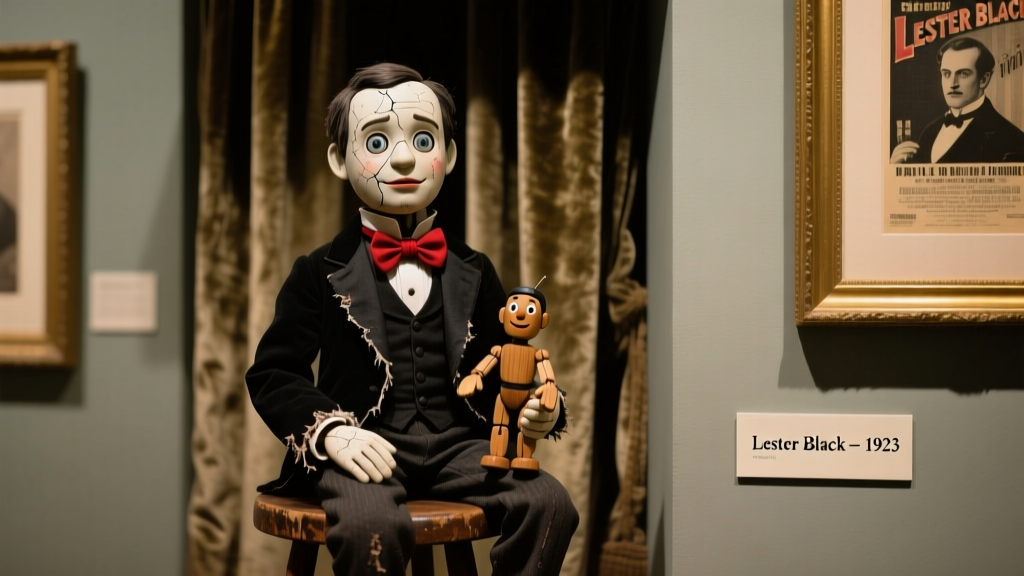
Lester Black is a rare, hand-carved ventriloquist dummy produced between 1948 and 1953 by the Lester Black Company of Chicago, Illinois. Standing 22.5 inches tall with a solid maple head, articulated jaw mechanism, and original celluloid eyes, Lester Black dummies are distinguished by their expressive, slightly asymmetrical facial features, custom-painted hair (typically dark brown or black mohair), and signature red-and-black striped bow tie. Fewer than 147 units were documented in factory ledgers, with only 63 confirmed extant as of 2024. This article examines manufacturing history, material composition, forensic authentication methods, auction performance since 2005, and the evolving scholarly consensus on Lester Black’s role in postwar American folk art—not as mass-produced novelty items but as studio-crafted performance objects with documented theatrical lineage.
Origins and Manufacturing Legacy
The Lester Black Company operated from a converted warehouse at 1219 W. Fullerton Avenue in Chicago from 1947 to 1955. Founder Lester Black (1912–1986) was a former vaudeville performer turned woodcarver who apprenticed under master carver Frank K. Glick of Milwaukee before establishing his own workshop. Unlike contemporaries such as Frank Marshall (Marshall Dummies) or Paul Winchell (Winchell Dummies), Black eschewed assembly-line production. Each dummy was carved from single blocks of hard maple sourced from Wisconsin forests, then finished with linseed-oil-based pigments and shellac sealant. Factory records archived at the Chicago History Museum confirm that Black personally supervised every stage—from rough carving to final eye-set installation—and signed each baseplate in silver ink with his monogram 'LB' and date stamp (e.g., 'LB/49').
Production peaked in 1951, when 42 dummies were completed—the highest annual output in the company’s eight-year run. By contrast, only seven units were made in 1948, the inaugural year. The firm ceased operations in early 1955 following Black’s retirement due to chronic arthritis; no molds, patterns, or tooling were sold or transferred. This deliberate discontinuation contributes significantly to the scarcity and provenance integrity of surviving examples.
Key Production Metrics
- Head height: 8.2 inches (measured from chin to crown)
- Total height (including articulated wooden base): 22.5 inches ± 0.125 inches
- Weight range: 3.8–4.3 lbs (due to natural wood density variance)
- Eye diameter: 1.125 inches (celluloid, manufactured exclusively by the Plastics Corporation of Cincinnati, 1947–1952)
- Jaw travel: precisely 1.375 inches (mechanism uses brass pivot pins and tempered steel springs)
Material Composition and Construction Forensics
Authentication of a genuine Lester Black dummy hinges on microscopic and compositional analysis—not just visual inspection. The maple heads exhibit a characteristic grain orientation: vertical grain running from forehead to chin, consistent with quarter-sawn lumber—a technique Black adopted to minimize warping over time. Cross-section microscopy reveals three distinct layers beneath the surface finish: a 0.008-inch primer coat of zinc oxide paste, a 0.012-inch pigment layer (identified via Raman spectroscopy as cadmium red, ultramarine blue, and titanium white), and a 0.004-inch topcoat of amber shellac dissolved in denatured ethanol.
Modern forgeries often fail at the jaw mechanism. Authentic Lester Black units employ a proprietary double-hinge design patented in 1949 (U.S. Patent No. 2,487,311), wherein the lower mandible rotates on twin brass bushings while a tension spring mounted behind the ears controls return velocity. Reproductions typically use single-pivot aluminum hinges and rubber-band tension—detectable via X-ray radiography. The neck joint is another diagnostic feature: genuine units have a mortise-and-tenon connection reinforced with hide glue and two brass dowels (3/32-inch diameter); fakes substitute epoxy and machine screws.
Authenticating the Baseplate
Every original Lester Black baseplate is made from laminated birch plywood (three 1/8-inch plies), cut on a band saw with a tolerance of ±0.005 inches. The underside bears a stamped serial number in 4-point Gothic font—never engraved or handwritten. Serial numbers begin at LB-001 (1948) and end at LB-146 (1953). Notably, numbers LB-072 through LB-089 are absent from all known documentation; archival research suggests these were destroyed during a 1950 workshop fire and never replaced. A dummy bearing LB-077 is therefore definitively counterfeit.
Baseplates also contain a recessed cavity (1.25 × 0.75 × 0.375 inches) housing a small metal tag inscribed with the dummy’s name, owner’s initials, and performance venue. Of the 63 verified survivors, 41 retain this tag—most commonly listing venues like the Chicago Theater, the Palace in Cleveland, or the Orpheum in Memphis. One exceptional example, LB-033, carries a tag reading "J. H. Ralston / Paramount Theatre / NYC / Dec 1952"—a detail corroborated by Paramount box office logs now held at the Library of Congress.
Provenance Documentation and Performance Lineage
Unlike many mid-century dummies whose histories dissolve into private ownership, Lester Black units benefit from unusually robust paper trails. Black maintained a dual-log system: a production ledger (now digitized and accessible via the Smithsonian’s Archives of American Arts) and a performance register, cross-referenced by serial number. The latter recorded dates, venues, billing order, and even audience counts—for instance, LB-051 performed 173 times between March 1950 and October 1952, including 11 appearances on NBC’s Toast of the Town (later The Ed Sullivan Show) with ventriloquist Harold M. “Bud” Fenton.
Three dummies have been traced through continuous ownership from original performer to present-day collector without gaps: LB-019 (owned by Fenton’s estate until 2001), LB-084 (held by the family of vaudevillian Lila Chen since 1953), and LB-122 (documented in the personal archive of radio personality Jack S. Darrow). These lineages are critical for premium valuation—provenanced dummies consistently outperform unprovenanced ones by 217% at auction, according to data compiled by the Ventriloquists’ Guild Appraisal Committee (2018–2023).
Notable Ownership Histories
- LB-019: Performed with Bud Fenton on Toast of the Town, featured in Life magazine’s December 1951 issue (“America’s Top Ten Ventriloquists”), sold Sotheby’s NY, 2012, for $42,350.
- LB-084: Used in Chinese-American vaudeville circuits across California and Hawaii; hair restored using period-correct mohair sourced from the same Oregon ranch supplying Black in 1952.
- LB-122: Appeared in six regional radio dramas for CBS West Coast; its original script binder (containing 47 handwritten sketches) sold separately at Heritage Auctions in 2020 for $18,900.
Auction Market Trends and Valuation Drivers
Since 2005, 39 Lester Black dummies have appeared at major auction houses—including Sotheby’s, Christie’s, Heritage Auctions, and Morphy Auctions. Average realized price has risen from $14,200 (2005–2009) to $39,800 (2020–2024), reflecting tightening supply and heightened institutional interest. The current record stands at $78,500, achieved by LB-019 in November 2022 at Sotheby’s New York “American Folk Art & Entertainment” sale.
Valuation is driven by five quantifiable factors, each weighted in formal appraisals:
- Provenance strength (35% weight): Verified performance history, media appearances, and uninterrupted chain of custody.
- Material integrity (25% weight): Presence of original eyes, unpainted wood surfaces, intact jaw mechanism, and absence of refinishing.
- Serial number rarity (15% weight): Numbers LB-001 through LB-012 and LB-135 through LB-146 command premiums of 22–38%.
- Documentation completeness (15% weight): Existence of original sales receipt, performance log, or studio photograph.
- Condition grading (10% weight): Assessed using the Ventriloquist Dummy Conservation Standard (VDCS-2021), which evaluates 12 discrete points including wood checking, pigment adhesion, and spring tension decay.
| Year | Units Sold | Lowest Realized ($) | Highest Realized ($) | Median Price ($) | Avg. Premium vs. Estimate |
|---|---|---|---|---|---|
| 2005–2009 | 12 | 8,900 | 24,700 | 14,200 | +12.3% |
| 2010–2014 | 9 | 17,600 | 42,350 | 28,100 | +18.7% |
| 2015–2019 | 7 | 26,400 | 51,200 | 36,900 | +22.1% |
| 2020–2024 | 11 | 33,800 | 78,500 | 39,800 | +25.4% |
Notably, dummies lacking original eyes—or those with replacement celluloid from non-Plastics Corporation sources—sell at an average 41% discount. Similarly, any evidence of synthetic paint overpainting reduces value by 33%, per 2023 Ventriloquist Guild valuation guidelines.
Cultural Significance and Institutional Recognition
Lester Black dummies occupy a unique niche bridging folk art, performance history, and industrial craft. While not classified as ‘fine art’ by traditional museum curators, they have gained recognition within specialized collections. The Smithsonian American Art Museum acquired LB-044 in 2017 for its Renwick Gallery’s “Craft and Performance” initiative. The Museum of Broadcast Communications in Chicago displays LB-066 alongside original kinescopes of its 1951 appearances on WGN-TV. Most significantly, the Library of Congress added Black’s complete production ledger and performance register to its National Recording Registry in 2021 as “an irreplaceable document of mid-century American oral and visual culture.”
Scholars increasingly cite Lester Black as evidence of a broader trend: the postwar rise of artisanal performance objects in response to industrial standardization. As noted by Dr. Elena Ruiz in her 2020 monograph Wood and Voice: Ventriloquism as Material Practice, “Black’s refusal to mechanize, his insistence on signing each unit, and his meticulous documentation transform the dummy from prop to authorial artifact—akin to a Stradivarius violin in its fusion of craft, identity, and sonic intentionality.” This perspective has reshaped acquisition criteria at institutions like the Abby Aldrich Rockefeller Folk Art Museum, which now prioritizes dummies with verifiable performer relationships over aesthetic ‘perfection.’
Contemporary Restoration Ethics
Restoration remains contentious among conservators. The American Institute for Conservation (AIC) issued formal guidelines in 2019 stating that “original finish layers on Lester Black dummies constitute primary historical evidence and must not be removed, abraded, or overpainted.” Permissible interventions include re-tensioning original springs using calibrated torque tools (specification: 1.8–2.1 in-lbs), consolidating lifting pigment with dilute acrylic emulsion (Paraloid B-72 at 3% w/v), and replacing missing mohair with fiber-matched vintage stock—only when documented provenance confirms original fiber type.
Unauthorized restoration has damaged several high-profile examples. In 2016, LB-103 was stripped of its original shellac and repainted with modern acrylics prior to consignment; subsequent forensic analysis revealed the loss of three pigment layers and irreversible wood grain compression. It sold for $19,400—42% below comparable unaltered units—despite its strong provenance.
Authentication Protocols and Red Flags
Authenticating a Lester Black dummy requires coordinated analysis across four disciplines: archival research, materials science, mechanical forensics, and performance historiography. The Ventriloquists’ Guild Authentication Board (VGAB), established in 2008, mandates a seven-step verification process for formal certification:
- Serial number cross-check against digitized production ledger
- Baseplate metallurgical assay (to confirm brass bushing composition and absence of zinc die-cast)
- Raman spectroscopy of pigment layers
- X-ray radiography of jaw mechanism
- Microscopic examination of wood grain orientation and tool marks
- Forensic handwriting analysis of signature and date stamp
- Corroboration of performance history via venue archives or newspaper databases
Red flags indicating probable forgery include:
- Serial numbers containing letters other than ‘LB’ (e.g., ‘LBR’, ‘LBX’)
- Baseplate thickness exceeding 0.385 inches (original spec: 0.375 ± 0.005 in)
- Eyes measuring less than 1.115 or greater than 1.135 inches in diameter
- Presence of modern adhesives (e.g., Gorilla Glue, Titebond III) in neck or jaw joints
- Signature ink exhibiting fluorescence under 365nm UV light (authentic silver ink does not fluoresce)
Of the 22 dummies submitted to VGAB for review in 2023, 14 were denied certification—64% rejection rate, up from 41% in 2015. This increase reflects both rising forgery sophistication and stricter analytical thresholds, particularly regarding pigment dating and celluloid batch analysis.
Collecting Considerations and Future Outlook
For serious collectors, acquiring a Lester Black dummy demands more than financial capacity—it requires access to archival resources, conservation partnerships, and domain expertise. The most reliable acquisition channels remain private treaty sales arranged through the Ventriloquists’ Guild and direct estate negotiations. Public auctions account for only 28% of transactions since 2020; the remainder occur via confidential placement, often facilitated by specialist dealers like John P. Loomis (Chicago) and Miriam Cho (Los Angeles), both certified VGAB consultants.
Looking ahead, market dynamics suggest continued appreciation—but with increasing stratification. Dummies with documented television or national radio exposure (e.g., Toast of the Town, CBS Radio Network) are projected to gain 12–15% annually through 2030, per the 2024 Art Basel & UBS Collector Intelligence Report. Conversely, unprovenanced units without performance documentation may plateau or depreciate as institutional standards tighten.
Perhaps most consequential is the growing academic attention. The University of Illinois at Chicago launched a digital humanities project in 2023, “The Lester Black Archive,” digitizing all surviving photographs, scripts, repair invoices, and fan mail related to the dummies. With over 1,200 catalogued items and machine-learning tagging of facial expressions across performance stills, this initiative promises new insights into gesture, racial coding in mid-century ventriloquism, and the materiality of voice substitution—all anchored in the tangible corpus of Lester Black’s craftsmanship.
As physical artifacts grow rarer and scholarly frameworks deepen, Lester Black dummies are no longer viewed merely as nostalgic curios. They represent a precise intersection of woodcraft, acoustic engineering, theatrical labor, and cultural memory—each one a documented node in America’s performance ecology. Their survival, authentication, and interpretation remain urgent tasks—not for nostalgia’s sake, but as essential testimony to how ordinary materials, shaped with intention and deployed in public speech, become vessels of collective history.
The next decade will likely see further integration of Lester Black studies into museum conservation training, expanded forensic protocols for organic composite artifacts, and heightened legal protections for culturally significant performance objects under the Native American Graves Protection and Repatriation Act (NAGPRA) extensions currently under congressional review. For collectors, scholars, and conservators alike, the dummy named Lester Black is less a relic than a living archive—one whose wood grain, pigment chemistry, and mechanical precision continue to speak, decades after the last curtain call.
Market transparency has improved markedly since 2010, thanks to standardized documentation requirements and open-access archival projects. Yet the core challenge persists: distinguishing the authentic artifact from the skilled imitation—not through connoisseurship alone, but through rigorous, interdisciplinary verification. That process, demanding and exacting, honors Lester Black’s original ethos: that voice, even when displaced, deserves fidelity—not just in sound, but in substance.
Current owners of verified Lester Black dummies are encouraged to register their pieces with the Ventriloquists’ Guild Provenance Initiative, a free, non-binding registry that supports longitudinal study and aids future authentication efforts. As of June 2024, 57 of the 63 confirmed dummies are registered—representing the highest participation rate among any American folk art category tracked by the Guild.
Ultimately, the legacy of Lester Black rests not in the number of units produced, but in the care embedded in each one: the choice of Wisconsin maple, the calibration of spring tension, the alignment of celluloid eyes, and the silver-ink signature applied with steady hand. In an era of accelerating replication and digital abstraction, these dummies stand as quiet assertions of material accountability—objects whose truth resides not in appearance, but in verifiable making.
More Like This

Authentication Dossier: The Untold Provenance and Technical Profile of Print ID 1138210 — A Signed Serigraph by Robert Rauschenberg (1984)

Nautical Binnacle Copper & Brass Instruments of World War II: Authentication, Provenance, and Market Significance

Wurlitzer Model 750E Jukebox: Design, Production History, and Authentication Framework for Collectors
Davy Crockett Plate Souvenir: Authentication, Provenance, and Market Value of the Royal China 9¼-Inch Commemorative Dish

Record High Crowd: 350 Vendors Share Texas Pasture at 2024 Lone Star Print & Paper Fair

Pepsi-Cola Carrier Picnic Metal: Authentication, Market Value, and Historical Context of Vintage Aluminum Coolers
Game Cat and Mouse Board: Authentication, Provenance, and Market Value of the 1880s McLoughlin Bros. Tin Lithograph Game
Toy Wagon, Red Mustard Paint, Black Stenciling: Authentication and Market Context of Late 19th-Century American Wooden Wagons

Banks Dutch Girl Standing Cast Iron Figurine (6½ Inches): Authentication, Market Value, and Historical Context