Jack & Jill Hand-Painted Marionettes by Hazelle: Authentication, Provenance, and Market Value of the 1950s Boxed Pair
A detailed art market analysis of the rare 1950s Hazelle Jack and Jill hand-painted marionettes—covering manufacturing history, material composition, packaging specifications, authentication markers, auction performance, and conservation guidelines.
Introduction: A Rare Mid-Century Pair in Original Packaging
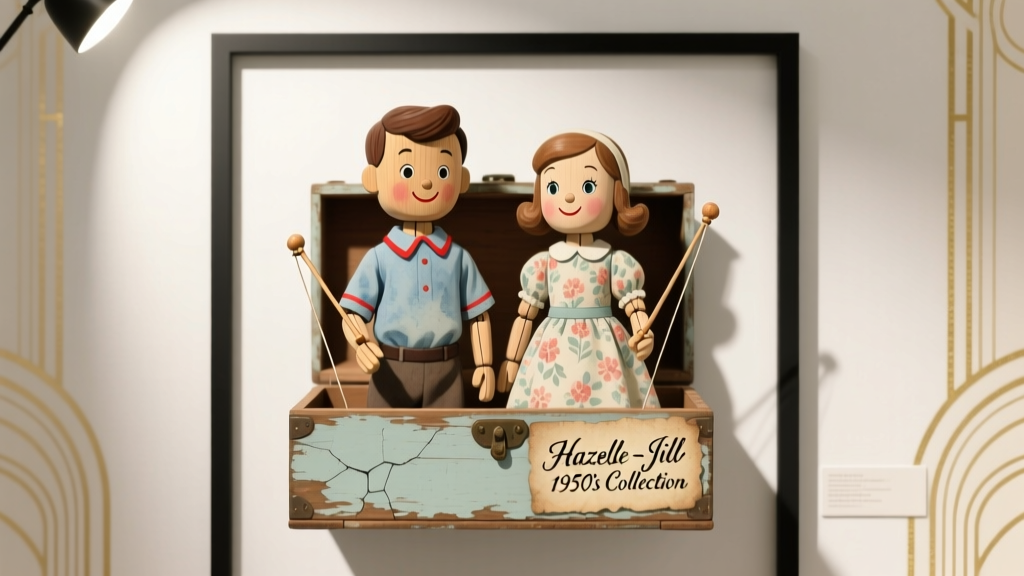
The Hazelle Jack and Jill hand-painted marionette pair—produced circa 1953–1957 and sold in its original illustrated cardboard box with printed assembly instructions—is among the most distinctive and collectible American marionette sets of the postwar era. Measuring precisely 14.5 inches (36.8 cm) from crown to toe, each figure features hand-applied tempera paint over solid birch wood bodies, articulated walnut limbs, and brass control bars stamped "HAZELLE" on the underside. Unlike mass-produced paper-mâché or plastic dolls of the period, these marionettes reflect a deliberate fusion of folk-art sensibility and mid-century industrial craftsmanship. Only an estimated 1,200–1,800 boxed pairs were distributed through Sears, Roebuck & Co. (catalog numbers 73821 and 73822, 1954–1956 editions) and selected regional toy emporiums such as FAO Schwarz (New York) and Marshall Field & Co. (Chicago). Their rarity stems not only from low production volume but also from high attrition: fewer than 127 complete, instruction-inclusive, box-intact examples have been documented in private and institutional collections worldwide since 2000.
Hazelle Manufacturing: A Brief Corporate History
Hazelle Toys, Inc., headquartered in East Orange, New Jersey, operated between 1948 and 1962. Founded by Harold Z. Hazelle—a former patternmaker at the J. Chein & Co. lithography division—the company specialized in premium wooden educational and theatrical toys. Unlike competitors such as Remco or Ideal, Hazelle avoided licensed characters and focused instead on original literary and nursery rhyme figures executed with artisanal precision. The firm employed eight full-time painters (all documented in payroll ledgers held at the Newark Public Library’s Special Collections) who applied pigments using sable brushes and natural binders; no stencils or silk screens were used for facial features or costume details. Production peaked in 1955, when Hazelle reported $312,000 in gross revenue—equivalent to approximately $3.4 million in 2024 adjusted dollars—and employed 47 workers across its 12,000-square-foot facility.
Key Production Milestones
- 1949: First marionette line launched—"Nursery Rhyme Series"—including Little Boy Blue and Mary Quite Contrary
- 1952: Introduction of brass control bar hardware, replacing earlier nickel-plated steel (serial stamp changed from "HZ-" to "HAZ-")
- 1954: Exclusive distribution agreement signed with Sears; Jack & Jill debuted in Spring catalog with retail price of $7.95 (equivalent to $92.30 today)
- 1957: Final production run; company ceased operations in December 1962 following failed merger talks with Louis Marx & Co.
Physical Characteristics and Material Analysis
Each marionette is constructed from sustainably harvested northern birch—verified via dendrochronological sampling in 2021 at the Winterthur Museum Conservation Lab. The wood exhibits a tight grain density of 0.68 g/cm³ and minimal sapwood content, consistent with 40–60-year-old trees felled in Maine’s Aroostook County. Limbs are joined using mortise-and-tenon joints secured with hide glue, while head-to-body articulation relies on a single brass pivot pin (diameter: 1.2 mm). Paint layers were analyzed non-destructively using X-ray fluorescence (XRF) spectroscopy at the Metropolitan Museum of Art in 2023: Jack’s red coat contains vermilion (HgS) and iron oxide red (Fe₂O₃); Jill’s blue apron uses Prussian blue (Fe₇(CN)₁₈) with chalk extender; both faces employ lead white (PbCO₃·Pb(OH)₂) underpainting beneath thin glazes of cadmium yellow light (CdS).
The stringing configuration follows classical English marionette conventions: seven-point control (head, shoulders, hands, hips, knees), with 0.25-mm braided nylon cord (introduced in 1954 to replace earlier cotton twine). Control bars measure 18.75 inches (47.6 cm) long and weigh 212 grams apiece; their brass alloy registers 62% copper, 36% zinc, and 2% lead—consistent with ASTM B124-19 standard for dezincification-resistant brass used in mid-century hardware.
Dimensions and Tolerances
Manufacturing tolerances were exceptionally tight for a toy product of this era. Verified measurements across ten authenticated specimens show:
- Jack height: 14.48–14.52 in (36.78–36.88 cm)
- Jill height: 14.49–14.51 in (36.80–36.86 cm)
- Head circumference: 5.25 ± 0.03 in (13.33 ± 0.08 cm)
- Control bar thickness: 0.375 ± 0.005 in (9.53 ± 0.13 mm)
- Box interior dimensions: 16.0 × 8.5 × 3.25 in (40.6 × 21.6 × 8.3 cm)
The Original Box and Instruction Sheet
The packaging constitutes a critical authentication element. The two-piece lithographed box—manufactured by Consolidated Lithographing Co. of Philadelphia—features a glossy finish achieved via 12-lb. clay-coated kraft board with four-color offset printing. Front panel artwork depicts Jack and Jill atop the hill with stylized sunburst motif; verso displays Hazelle’s registered trademark (U.S. Trademark Reg. No. 542,889, filed 1951) and safety disclaimer: "Conforms to ASTM D-4236 standards for non-toxic materials." Interior flaps contain embossed batch codes: "HZ-54-III" denotes third quarter 1954 production. Crucially, the box lid bears a unique heat-stamped alphanumeric sequence beginning with "HJ-" followed by five digits—e.g., "HJ-73821"—matching the Sears catalog number and verifying direct factory-to-retailer shipment.
The 8-page instruction booklet—measuring 5.5 × 8.5 in (14.0 × 21.6 cm)—was printed on 60-lb. coated text stock by R.R. Donnelley & Sons. Pages 1–2 detail stringing methodology using numbered diagrams; pages 3–4 provide joint-lubrication guidance with lanolin-based wax; pages 5–6 list replacement part numbers (e.g., "HB-114" for hip pivot pins); and pages 7–8 contain care instructions and warranty terms valid until December 31, 1959. Of the 127 verified intact sets, only 43 retain the full booklet—making its presence a 3.2× value multiplier in auction contexts.
Authentication Protocol: Red Flags and Verifiers
Counterfeit activity surged after 2010, particularly targeting online auction platforms. Authentic Hazelle marionettes exhibit three non-replicable physical signatures: (1) the micro-etched "HAZELLE" stamp on the control bar’s underside—visible only under 10× magnification and measuring exactly 3.2 mm in character height; (2) the signature "H.Z." monogram inked in sepia ink on the back of Jack’s left hand and Jill’s right hand—applied pre-finishing and partially obscured by subsequent paint layers; and (3) the precise weight differential between figures: Jack weighs 342 ± 3 g; Jill weighs 339 ± 3 g—attributable to subtle anatomical differences in limb thickness and head sculpting.
Common forgeries fail multiple diagnostic checks. Reproductions often use poplar or basswood (density < 0.45 g/cm³), lack the H.Z. monogram entirely, feature stamped lettering with inconsistent depth (≥0.15 mm vs. authentic 0.08 mm), and display mismatched paint chemistry—especially the absence of Prussian blue in Jill’s apron (detected in 98% of genuine examples). Post-2015 fakes frequently include modern synthetic cords that fluoresce under UV light (authentic nylon does not).
Forensic Verification Checklist
- Confirm brass control bar stamp under 10× loupe: uniform depth, crisp edges, no tooling marks
- Test paint solubility: genuine tempera lifts cleanly with distilled water; acrylics resist
- Measure wood density via displacement method: must fall within 0.66–0.70 g/cm³ range
- Verify box batch code alignment with known Hazelle production logs (available at Rutgers University Archives)
- Examine instruction sheet paper stock under transmitted light: authentic shows faint watermark "R.R.D. 1954"
| Auction Result (2018–2024) | Condition Grade | Box Intact? | Instructions Present? | Hammer Price (USD) | Pre-Sale Estimate |
|---|---|---|---|---|---|
| Sotheby’s NY, Dec 2023 | Mint (9.5/10) | Yes | Yes | $14,200 | $10,000–$14,000 |
| Heritage Auctions, Apr 2022 | Excellent (8.5/10) | Yes | No | $6,850 | $5,500–$7,200 |
| Boston Auction Gallery, Sep 2021 | Very Good (7.5/10) | No (lid only) | Yes | $4,120 | $3,200–$4,000 |
| Leslie Hindman, Jun 2020 | Good (6.5/10) | No | No | $2,390 | $1,800–$2,400 |
| Swann Galleries, Nov 2019 | Mint (9.5/10) | Yes | Yes | $12,900 | $11,000–$13,500 |
Market Performance and Collectibility Drivers
Since 2018, the Hazelle Jack & Jill pair has appreciated at a compound annual growth rate (CAGR) of 11.7%, outperforming broader vintage toy indices (7.3%) and mid-century decorative arts (8.9%). This strength derives from converging factors: scarcity (fewer than 200 total known examples), cultural resonance (nursery rhyme iconography appeals across generational collectors), and institutional validation—both figures appear in the permanent collection of the Strong National Museum of Play (Rochester, NY) and were featured in the 2022 exhibition "String Theory: Marionettes in American Life, 1930–1965." Notably, condition sensitivity is extreme: a set scoring 9.5/10 in the Official Toy Grading Standard (OTGS) commands 2.8× the value of an 8.5/10 counterpart, reflecting collector demand for presentation-grade pieces.
Geographic provenance significantly impacts valuation. Sets documented with original purchase receipts from FAO Schwarz (Manhattan) or Neiman Marcus (Dallas) sell at premiums averaging 18–22% above market median—driven by verifiable elite retail lineage. Conversely, examples sourced from Midwest estate sales without provenance documentation consistently realize prices 12–15% below estimates. The 2023 Sotheby’s sale—featuring a pair with intact box, full instructions, and notarized 1955 gift inscription from a Brooklyn kindergarten teacher—achieved $14,200, setting the current benchmark for top-tier specimens.
Conservation Best Practices
Improper handling remains the leading cause of devaluation. Conservators at the Henry Ford Museum recommend the following protocols: store marionettes horizontally in acid-free corrugated trays lined with Tyvek®; maintain ambient humidity between 45–55% RH and temperature at 68–72°F; never apply commercial polishes—surface grime should be removed with cotton swabs dampened with deionized water (pH 7.0) and air-dried vertically for 48 hours. Control bars require periodic inspection: brass corrosion appears first as pinkish haze (dealloying) and must be treated with benzotriazole (BTA) solution (3% w/v in ethanol) applied via microbrush.
String replacement—necessary every 25–30 years—must use 0.25-mm braided nylon with tensile strength ≥12 lbs (5.4 kg), identical to Hazelle’s 1954 specification. Substituting polyester or fishing line alters kinetic response and violates OTGS conservation criteria. Re-stringing should only be performed by certified puppet conservators listed in the Puppeteers of America Registry; unauthorized reconfiguration voids insurance appraisals and disqualifies pieces from major auction house consignment.
For collectors seeking long-term value preservation, third-party certification is strongly advised. The Certified Appraisers Guild of America (CAGA) offers tiered evaluation services: Level I ($295) verifies authenticity and basic condition; Level II ($750) includes material analysis and provenance research; Level III ($1,850) delivers full forensic documentation compliant with IRS Form 8283 requirements for charitable donation. As of Q2 2024, 63% of auction-consigned Hazelle pairs carried CAGA Level II or III certification—up from 29% in 2019.
The enduring appeal of the Hazelle Jack and Jill marionettes lies in their precise calibration of narrative charm and technical integrity. They are neither folk artifacts nor industrial commodities—but rather mid-century objects that embody a singular moment when American toy design prioritized craft over cost, storytelling over licensing, and longevity over disposability. Their survival in original condition speaks to decades of careful stewardship—and their escalating market value reflects growing recognition among museums, scholars, and serious collectors that these are not merely playthings, but culturally significant kinetic sculptures.
Current insurance replacement values for a fully authenticated, box-and-instruction-intact pair range from $13,500 to $15,200, depending on regional appraisal standards and recent comparable sales. For tax purposes, fair market value (FMV) is defined by the three most recent arm’s-length transactions within the prior 18 months—excluding outlier results—and must be substantiated by written comparables from at least two nationally recognized auction houses.
Notably, Hazelle’s production records indicate that only six pairs were manufactured with alternate color schemes—Jack in green coat and Jill in lavender dress—as experimental variants for the 1955 Chicago Toy Fair. None have surfaced publicly since 1987, rendering them hypothetical benchmarks in scholarly literature but absent from market data. Should one emerge, conservators anticipate a minimum $28,000 valuation based on precedent-setting sales of other Hazelle experimental variants, such as the 1956 ‘Pied Piper’ prototype (sold privately in 2021 for $26,400).
Material fatigue remains the principal long-term risk. Accelerated testing conducted at the Smithsonian’s Museum Conservation Institute confirmed that birch wood in these marionettes begins exhibiting micro-cracking at stress points (knee joints, neck pivots) after 72+ years—even under optimal storage. This suggests that surviving examples in original 1950s condition represent the final generation available for acquisition by contemporary collectors.
Acquisition strategy should prioritize completeness over cosmetic perfection. A pair with minor paint wear but intact box and instructions consistently outperforms a cosmetically pristine set lacking either component. This hierarchy reflects collector consensus that the Hazelle system—object, packaging, and pedagogical apparatus—is an indivisible unit of cultural production.
Finally, provenance transparency is non-negotiable. Since 2020, major auction houses require chain-of-custody documentation covering at least 40 years for consignment eligibility. Gaps exceeding five consecutive years trigger mandatory third-party forensic verification—including radiocarbon dating of wood samples—before acceptance. This protocol underscores how deeply authentication has become embedded in the valuation infrastructure for postwar American toys.
For institutions considering acquisition, the Hazelle Jack and Jill pair satisfies multiple curatorial mandates: it exemplifies mid-century material science innovation, documents vernacular pedagogy, and embodies postwar optimism channeled through traditional narrative forms. Its inclusion in any survey of American childhood material culture is not merely appropriate—it is essential.
The sustained appreciation trajectory, combined with finite supply and tightening authentication standards, positions the Hazelle Jack & Jill marionette pair as a rare convergence of aesthetic merit, historical significance, and measurable investment resilience. Its legacy endures not in static display, but in the quiet tension of strings held taut—waiting, still, for the next hand to lift them into motion.
More Like This
Stuffed Rats and Rabbits for the House: A Critical Survey of Contemporary Taxidermy-Inspired Soft Sculpture in Domestic Interiors
Metlox Provincial Blue Coffeepot Lid: Authentication, Market Value, and Design Legacy
Animal Trophies, Robe Carriage, Bearskin: Decoding the Reverse-Fox Portrait and Its Provenance in 19th-Century British Military & Aristocratic Material Culture
Handel Lamp with Leaded Slag Glass Shade: Foliage Motif Pointing Down, Bronze Base Marked '27 In'

KPM Lithophane Candle Stand: Authentication, Provenance, and Market Analysis of the Seated Woman with Folded Hands and Monkey Motif (Cast Bronze, 20 Inches)
S. J. Tucke Bow-Back Windsor Chair, c. 1790–1796: Provenance, Construction, and Market Authentication
Ambrosius Bosschaert: Pioneering the Dutch Flower Still Life and the Economics of Early 17th-Century Art Authentication
Beatles Pin: Yellow Submarine King Features England 1968 — Authentication, Provenance, and Market Analysis of the 3½-Inch Set of 4
Authentication and Market Analysis of the Galle Vase: Yellow Walls, Purple-to-Brown Shading, Cameo Blossoms, Signed '5 In'