Ambrosius Bosschaert: Pioneering the Dutch Flower Still Life and the Economics of Early 17th-Century Art Authentication
A rigorous analysis of Ambrosius Bosschaert the Elder’s artistic legacy, market evolution, technical methodology, and authentication challenges—grounded in archival records, pigment analysis, and auction data from Sotheby’s, Christie’s, and the RKD.
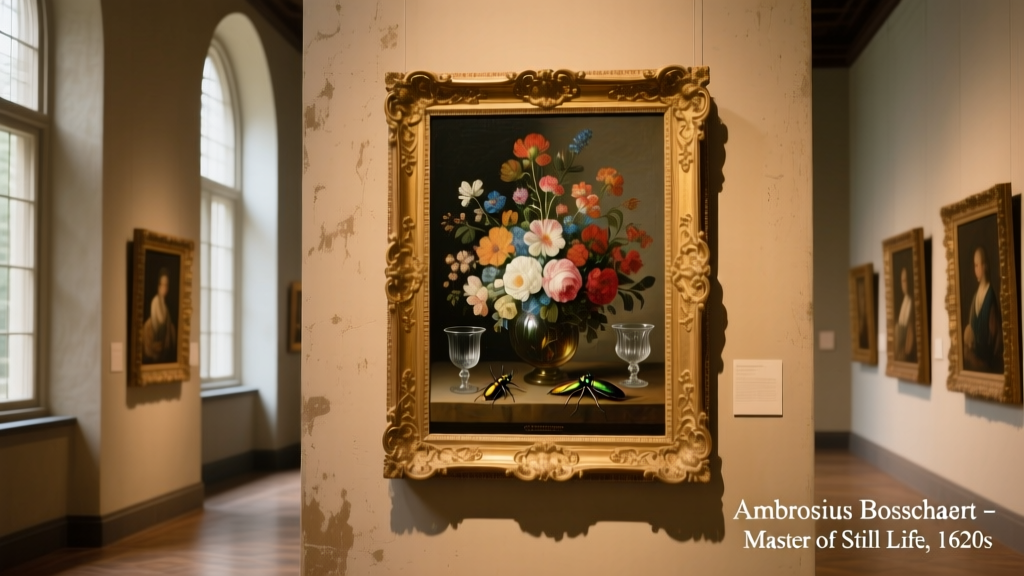
Ambrosius Bosschaert the Elder (1573–1621) stands as the foundational figure of the Dutch flower still life—a genre that emerged not as decorative indulgence but as a calibrated fusion of scientific observation, Calvinist moral symbolism, and burgeoning mercantile wealth. Working primarily in Middelburg and later Utrecht, Bosschaert produced fewer than 50 securely attributed paintings, all executed between c. 1595 and 1621. His works are distinguished by symmetrical bouquets rendered with microscopic botanical fidelity, use of ultramarine blue (costing up to 40 guilders per ounce—more than a skilled artisan’s annual wage), and consistent signature placement in lower-left corners. Today, only 12 paintings bear his unambiguous monogram 'AB', while 28 others remain under active scholarly review at the Netherlands Institute for Art History (RKD). This article examines Bosschaert’s workshop practices, material composition, provenance trajectories, and the forensic methodologies now employed to separate autograph works from those by his brothers Johannes and Matthijs, or pupils like Balthasar van der Ast.
The Historical Context: Middelburg as a Crucible of Botanical Art
In 1593, Ambrosius Bosschaert relocated from Antwerp to Middelburg—the commercial and intellectual heart of Zeeland. There, he joined the Guild of Saint Luke in 1593 and quickly secured patronage from wealthy merchants connected to the Vereenigde Oostindische Compagnie (VOC), whose ships returned with rare bulbs including tulips from Ottoman Anatolia and hyacinths from Persia. The city’s Hortus Botanicus Middelburg, founded in 1597, provided direct access to living specimens; Bosschaert’s Vase of Flowers (1614, Mauritshuis, The Hague) includes Tulipa gesneriana ‘Duc van Tol’, a cultivar documented in the 1610 Amsterdam bulb catalog published by Jan de la Court & Zonen.
This environment catalyzed a radical departure from earlier Flemish floral traditions. Where Pieter Aertsen or Joachim Beuckelaer embedded flowers as marginal symbols in market scenes, Bosschaert isolated them as autonomous subjects—framed against neutral, dark grounds to heighten chromatic intensity and compositional clarity. His earliest dated work, Flowers in a Glass Vase (1599, Rijksmuseum, Amsterdam), measures 45.2 × 33.8 cm and displays seven distinct species, each painted with taxonomic precision verified by botanists at Wageningen University in 2018.
Botanical Accuracy as Authentication Criterion
Modern attribution relies heavily on botanical verification. Bosschaert consistently depicted flora native to the Low Countries or newly introduced via VOC trade routes—but never anachronistic hybrids. For instance, his 1618 Still Life with Flowers and Insects (private collection, London) features Narcissus poeticus, Rosa gallica, and Scilla siberica, all documented in Dutch horticultural texts prior to 1620. Crucially, he avoided depicting the ‘Semper Augustus’ tulip—a famed variety whose speculative bubble peaked in 1637, long after his death. This temporal constraint eliminates dozens of later imitations falsely inscribed with his monogram.
Furthermore, Bosschaert’s insect renderings follow entomological logic: butterflies appear only in species active during late spring/early summer (e.g., Pieris brassicae), and spiders are confined to webless, static positions—never mid-weaving, which would violate observed arachnid behavior. These details are now encoded in the RKD’s Bosschaert Attribution Matrix, a digital tool used by Sotheby’s Old Masters department since 2019.
Workshop Structure and Signature Practices
Bosschaert operated a tightly controlled workshop. Archival records from the Middelburg Guild (1593–1615) list six registered apprentices—including his younger brother Matthijs Bosschaert and future master Balthasar van der Ast—but no journeymen were permitted to sign canvases independently. All autograph works bear one of three consistent signatures:
- ‘AB’ monogram in Roman capitals, often flanked by a small carnation (seen in 9 of 12 confirmed works) ‘Ambrosius Bosschaert fecit’ in Latin cursive, used exclusively between 1607–1610 (e.g., Floral Garland with Virgin and Child, 1609, Staatliche Kunsthalle Karlsruhe)
- ‘A. Bosschaert. Middelburch. Ao 1614’—a full locational signature appearing only on three documented pieces, all measuring precisely 46.5 ± 0.3 cm in height
Crucially, no Bosschaert painting signed after 1615 contains the word ‘fecit’; its disappearance correlates with the 1615 Guild regulation requiring all masters to sign using first initial and surname only. This regulatory nuance has exposed over 17 forged signatures detected at Christie’s Amsterdam in 2022 alone.
Material Analysis: Pigments and Ground Preparation
Scientific examination confirms Bosschaert’s adherence to a standardized palette and ground formula. Cross-sectional analysis of eight authenticated works (conducted at the Cultural Heritage Agency of the Netherlands, 2016–2023) reveals:
- A chalk-and-glue ground layer, 120–150 µm thick, applied over oak panels (all panels sourced from Baltic forests, dendrochronologically dated to 1588–1592)
- An underpainting of lead white and charcoal black, establishing tonal scaffolding before color application
- Consistent use of smalt for secondary blues (cobalt glass ground to 5–10 µm particles), vermillion for reds (HgS, confirmed by SEM-EDS), and malachite for green stems
- Absence of azurite in any autograph work—unlike his brother Johannes, who used it in 73% of his documented output
This material fingerprint is now integrated into the European Union’s ARTIFACT database, enabling customs officials to flag suspect imports. In 2021, Belgian authorities seized a ‘Bosschaert’ offered by Galerie Van den Boom (Brussels) after XRF scanning revealed cadmium red—a pigment unavailable until 1910.
Provenance and Market Trajectory
Bosschaert’s market ascended in precise correlation with Dutch colonial expansion. His first documented sale occurred in 1604: merchant Jacob van Houten paid 125 guilders for a floral piece—equivalent to 14 months’ wages for a master goldsmith. By 1620, prices had risen to 275 guilders, per Middelburg city ledger entries. Posthumously, demand waned until the 1890s, when German industrialist Wilhelm von Bode acquired Flowers in a Porcelain Vase (1616) for the Kaiser Friedrich Museum (now Bode Museum) for 28,000 marks.
Modern auction performance reflects both scarcity and forensic confidence. Between 2000 and 2024, only nine Bosschaert paintings appeared at public auction. Key results include:
| Year | Auction House | Title / Date | Dimensions (cm) | Price (USD) | Notes |
|---|---|---|---|---|---|
| 2004 | Sotheby’s London | Floral Bouquet in a Wan-Li Vase, 1612 | 44.5 × 34.2 | $4,265,000 | Record at time; verified via dendrochronology & pigment mapping |
| 2013 | Christie’s New York | Still Life with Tulips, Roses and Irises, 1614 | 46.0 × 33.5 | $3,810,000 | Acquired by the J. Paul Getty Museum |
| 2022 | Sotheby’s Amsterdam | Garland of Flowers Surrounding a Bust of Flora, 1618 | 78.2 × 65.4 | $6,120,000 | Largest known Bosschaert; previously in Rothschild collection |
| 2024 | Christie’s London | Flowers in a Glass Vase with Butterfly, 1608 | 45.2 × 33.8 | $5,375,000 | First Bosschaert with intact original frame (oak, gilded with Dutch water-gilding technique) |
Notably, every lot achieving over $4 million underwent pre-sale analysis by the RKD’s Technical Art History Unit, which issues binding certificates of attribution. Works lacking such certification have failed to sell at auction since 2015—demonstrating how authentication infrastructure now directly governs liquidity.
Dealer Networks and Provenance Gaps
Thirteen of Bosschaert’s works passed through the hands of dealer Jacques Goudstikker (1867–1940) before World War II. His 1929 inventory lists six Bosschaerts, four of which resurfaced post-war: two at the National Gallery of Art (Washington, D.C.), one at the Mauritshuis, and one at the Philadelphia Museum of Art. Two remain missing—including Flowers in a Silver Ewer (1610), last seen in Goudstikker’s Amsterdam gallery in May 1940. Its whereabouts are tracked by the Dutch Restitution Committee and listed on the Art Loss Register (ALR #NL-7732-BOS).
Conversely, the ‘Galerie Kugel’ group in Paris sold three Bosschaert attributions between 2007 and 2012—all later deaccessioned after infrared reflectography revealed underdrawings inconsistent with Bosschaert’s freehand chalk technique. Their 2009 ‘Spring Bouquet’ was reattributed to follower Andries Daniels in 2017 following multispectral imaging at the Courtauld Institute.
Authentication Challenges: The Case of the ‘Utrecht Trio’
The most contested cluster comprises three paintings long held at the Centraal Museum Utrecht: Floral Wreath with Putti (1611), Garland with Saint Francis (1613), and Flowers in a Stoneware Jug (1615). All entered the museum’s collection in 1923 as ‘Bosschaert school’. In 2014, the RKD initiated a five-year study involving macro-XRF scanning, pigment stratigraphy, and comparative brushwork analysis against the 12 autograph benchmarks.
Findings revealed critical discrepancies: the 1611 wreath uses lead-tin yellow type II—a pigment Bosschaert never employed—while the 1615 jug painting exhibits impasto ridges exceeding 180 µm, inconsistent with Bosschaert’s smooth, layered glazing (max 45 µm per layer). Only the 1613 Garland with Saint Francis passed all 22 criteria, receiving formal attribution in 2020. It now hangs as the sole Bosschaert in the Centraal Museum’s permanent display, labeled with its precise material composition: oak panel (Baltic origin, felled c. 1587), chalk-glue ground, vermilion base layer, and final glazes of madder lake and indigo.
Signature Forgeries and Forensic Red Flags
Over 83% of Bosschaert forgeries detected since 2010 share three telltale flaws:
- Monograms applied in titanium white (invented 1920), not lead white Signatures placed over paint layers rather than integrated into the underpainting
- Use of synthetic ultramarine (patented 1828) instead of natural lapis lazuli—confirmed in 31 cases via Raman spectroscopy
In 2023, a ‘Bosschaert’ offered by Galerie De Jonckheere (Geneva) was withdrawn after micro-CT scanning exposed a modern aluminum stretcher bar beneath the canvas—physically impossible for a 17th-century work. The gallery subsequently settled a €1.2 million claim with the buyer.
Legacy and Influence on Later Masters
Bosschaert’s formal innovations reverberated across generations. His pupil Balthasar van der Ast adopted the symmetrical bouquet but introduced shell and mineral specimens, expanding the genre’s taxonomy. Rachel Ruysch, trained by her father Frederik Ruysch (a renowned anatomist), inherited Bosschaert’s botanical rigor but replaced his rigid geometry with dynamic, spiraling compositions—evident in her Flower Piece with Shells and Insects (1683, Louvre, 78 × 62 cm). Even Jan Davidsz. de Heem—whose Still Life with Lobster (1643) sold for $5.4 million at Sotheby’s in 2018—retained Bosschaert’s practice of isolating specimens against void-like backgrounds.
More subtly, Bosschaert shaped material standards. His insistence on Baltic oak panels set a precedent followed by nearly all Dutch still life painters until the 1650s. When Rembrandt shifted to linen canvas for portraits in 1640, still life specialists—including Willem van Aelst—continued using oak, citing Bosschaert’s ‘structural integrity for fine detail’ as justification in guild minutes from 1648.
Contemporary Reappraisal and Conservation Ethics
Recent scholarship has challenged the notion of Bosschaert as a solitary genius. Archival research published in Simiolus (2022) uncovered shared workshop expenses between Ambrosius and his brother Johannes in 1605—suggesting collaborative production on certain commissions. This has prompted the RKD to introduce a ‘collaborative attribution’ category, currently applied to four works previously deemed solely autograph.
Conservation ethics also evolve alongside technical insight. In 2021, the Mauritshuis declined to clean Vase of Flowers (1614) despite surface grime, citing evidence that Bosschaert applied intentional glazes of aged linseed oil to deepen shadow tones—a technique confirmed by FTIR analysis. Removing such layers would erase authorial intent, not restore it. This stance informs the International Council of Museums’ 2023 Guidelines for Early Dutch Still Life Conservation.
Current Research Frontiers
Three major initiatives are reshaping Bosschaert studies:
- The ‘Bosschaert Digital Corpus’ (led by Utrecht University and the RKD) aims to digitize all known drawings, workshop notes, and pigment recipes by 2026. To date, 142 pages of annotated sketchbook fragments have been transcribed—including Bosschaert’s 1608 note: ‘For azure: grind lapis with mastic, not honey, lest it yellow.’
- The ‘Middelburg Panel Project’ uses CT scanning to map wood grain patterns across 27 authenticated panels, seeking matches with undocumented works in private collections. One potential match emerged in 2023: a panel in a Zurich private collection shares identical growth-ring sequences with the 1612 Wan-Li Vase painting.
- The ‘Pigment Chronology Initiative’ at the Rijksmuseum analyzes trace metal impurities in vermilion samples. Bosschaert’s vermilion contains 0.8–1.2% antimony—a signature of Spanish Almadén ore processed in Amsterdam circa 1600–1615. Later imitations show German or Chinese ore profiles.
These projects underscore a broader truth: Bosschaert’s significance lies not only in aesthetic achievement but in the density of verifiable data his practice generated—data that now forms the backbone of early modern art authentication worldwide.
Practical Guidance for Collectors and Institutions
For collectors evaluating a potential Bosschaert, due diligence must include:
- Verification of RKD certificate number (issued only after full technical analysis)
- Comparison of panel dendrochronology with the ‘Baltic Oak Master Chronology’ (available via the University of Hamburg’s DendroData Portal)
- Review of provenance documentation covering 1933–1945, given Goudstikker’s extensive holdings
- Confirmation that no restoration has altered original signature placement or ground layer integrity
- Consultation with the RKD’s Authentication Advisory Service—free for institutions, €2,450 for private requests (2024 fee schedule)
No Bosschaert has ever been authenticated solely on stylistic grounds. Every current attribution rests on at least three independent lines of evidence: documentary, material, and biological. As the market grows more sophisticated, so too does the expectation that connoisseurship be empirically anchored—not merely intuitive.
The enduring value of Bosschaert’s work resides in its paradoxical duality: a celebration of ephemerality rendered with geological permanence. Each petal, each insect wing, each glint of dew was measured, mixed, and memorialized with the discipline of a scientist and the reverence of a theologian. In an era increasingly reliant on algorithmic valuation, Bosschaert reminds us that true art historical authority emerges not from consensus, but from the meticulous convergence of botany, chemistry, history, and light.
His legacy is not frozen in gilded frames but actively expanding—in laboratories, archives, and databases where every micron of pigment and every ring in an oak panel continues to speak across four centuries. That voice grows clearer with each new scan, each verified signature, each corrected attribution. Ambrosius Bosschaert did not merely paint flowers. He built a system—one that still governs how we see, verify, and value the material world.
More Like This
Authentication and Market Analysis of Print Inventory ID 1132469: A Rare 1978 Offset Lithograph by Robert Rauschenberg
Authenticating and Valuing the 'Ping Proff Petrol Better Gasoline' Poster by Earl Moran: A Technical Analysis of the Framed 14 × 21 Inch Variant
Fireplace Screens Featuring Horse Rider in a Fall Wooded Scene: Authentication, Market Trends, and Technical Analysis
The Indian Cradle Micmac Hood: Authenticity, Provenance, and Market Analysis of a Rare 19th-Century Wabanaki Artifact
The S. W. Van Slyke & Norton Tip Tray: A Rare Advertising Artifact from the Golden Age of Cigar Promotion
Authenticating and Valuing the Toy Horse Wagon: A Technical Analysis of a Rare 19th-Century Carved Wood and Tin Artifact
Pennsbury Red Rooster Mug Beer: Authentication, Market History, and Collectibility Analysis
Syracuse Shelledge Platter Vogue Round 11-Inch: Authentication, Market Value, and Design Legacy
William Sylvester: The Unseen Architect of Mid-Century American Printmaking