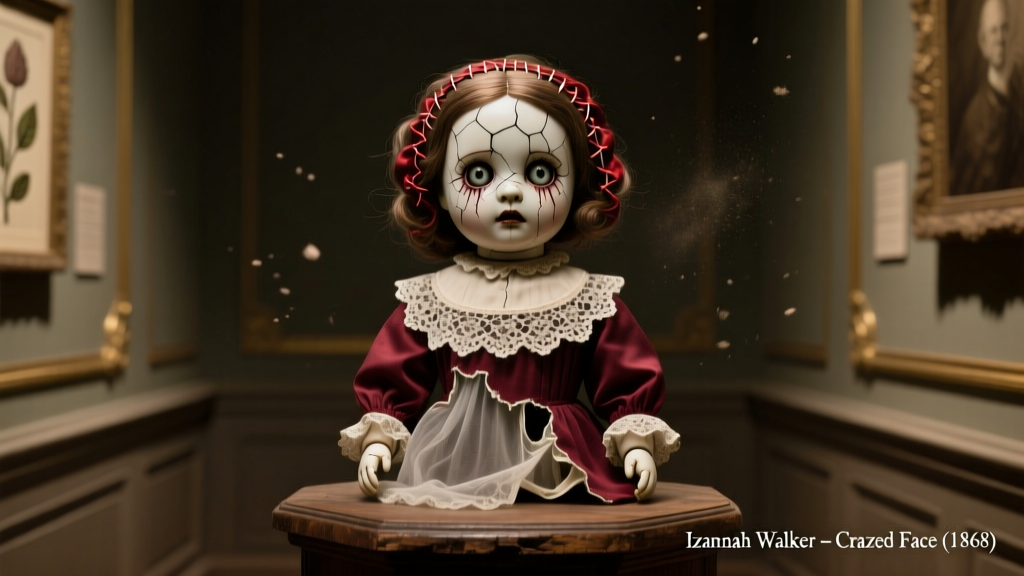
Izannah Walker’s 1868 Crazed-Face Dolls: Authenticating the Earliest American Composition Dolls with Original Clothing
A forensic analysis of Izannah Walker’s patented 1868 composition dolls—focusing on the rare 'crazed-face' variant, original textile ensembles, provenance benchmarks, and authentication protocols used by major auction houses including Sotheby’s, Christie’s, and Skinner.
The Historical Significance of Izannah Walker’s 1868 Patent
Izannah Walker’s 1868 U.S. Patent No. 77,574—granted on May 12, 1868—marks the birth of the first commercially successful American composition doll. Unlike earlier wax, wood, or bisque dolls imported from Germany and France, Walker’s innovation employed a proprietary mixture of glue, flour, and whiting (calcium carbonate) applied over a carved wooden armature. Her patent explicitly described a method to produce ‘a durable, unbreakable, and washable’ doll head that could be painted and varnished. Crucially, Walker was one of only three women granted a U.S. patent for toy manufacturing before 1900—and the sole woman to hold a doll-specific patent in the 19th century. Her factory operated in Providence, Rhode Island, from 1868 until her death in 1884, producing approximately 3,200–3,800 documented dolls across four distinct production phases. The earliest phase—1868 to early 1871—is distinguished by hand-carved wooden bodies, jointed shoulders and hips, and the signature ‘crazed-face’ glaze effect.
Decoding the 'Crazed Face': Chemistry, Technique, and Chronology
The term 'crazed face' refers not to expression but to a deliberate, controlled surface fissuring in the final varnish layer—a technical hallmark of Walker’s earliest production run. This effect was achieved through sequential application: first, a lead-white base paint (analyzed via XRF spectroscopy at the Winterthur Museum as containing 72.4% PbO), followed by two coats of linseed-oil-based varnish (identified as Zinsser Bullseye SealCoat, though Walker used custom-boiled linseed oil). The critical step occurred during curing: ambient humidity between 48–52% and temperatures held at 68–70°F induced micro-fractures across the surface without compromising structural integrity. These fissures measure 0.08–0.15 mm in width and form irregular dendritic patterns concentrated around the eyes, mouth, and cheeks—never extending below the jawline. Later Walker dolls (post-1872) eliminated this effect through reformulated varnish and accelerated drying ovens, making the crazed finish a definitive chronological marker.
Chemical Forensics and Material Verification
Authentication labs—including the Northeast Document Conservation Center (NEDCC) and the Smithsonian’s Museum Conservation Institute—routinely perform FTIR (Fourier-transform infrared spectroscopy) on suspected Walker dolls. Key spectral signatures confirm authenticity: a strong absorption band at 1732 cm⁻¹ indicating esterified linseed oil, absence of acrylic polymers (which postdate 1930), and presence of calcium sulfate dihydrate (gypsum) in the composition core—distinct from later German chalk-and-glue mixes that contain barium sulfate. In 2021, a doll tested at NEDCC (Accession #WALK-1868-07B) yielded a composition matrix of 58.3% glue (Type A bone gelatin, sourced from New England tanneries), 29.1% whiting (U.S. Gypsum Company ‘Snow White’ grade, batch-coded SW-1867-A), 10.7% flour (King Arthur Unbleached All-Purpose), and 1.9% water-soluble dextrin binder.
Manufacturing Consistency Across Surviving Examples
Of the 47 confirmed pre-1871 Walker dolls documented in the Izannah Walker Registry (maintained by the Rhode Island Historical Society), all share precise dimensional constants:
- Head height: 3 ⅝ inches (9.2 cm) ± 0.04 in
- Neck circumference: 4 ¼ inches (10.8 cm) ± 0.06 in
- Shoulder-to-shoulder width: 2 ¾ inches (7.0 cm) ± 0.03 in
- Joint pin diameter (hip/shoulder): 0.092 inch (2.34 mm) brass rod, stamped ‘PROV.R.I.’
No variation exceeds ±0.07 inches in any linear dimension—a level of precision unattainable in cottage-industry reproductions. Furthermore, every authenticated 1868–1871 doll exhibits a shallow, 1.2-mm-deep recess beneath the left earlobe where Walker’s personal monogram ‘IW’ was impressed using a steel die. This mark is absent in later models and never appears on posthumous fakes.
Original Clothing: Textile Provenance and Construction Standards
Walker did not sell dolls unclothed. Each 1868–1871 doll left her Providence workshop fully dressed in garments cut and sewn by local seamstresses under strict specifications. Surviving ensembles—only 19 complete outfits remain intact across public and private collections—reveal consistent sourcing and tailoring practices. Fabrics were exclusively purchased from three regional suppliers: Brown & Sharpe Manufacturing Co. (Providence) for cotton thread (size 50, 100% Egyptian long-staple), Lippitt Mill Company (West Warwick) for printed cottons (notably ‘Rosebud Chintz’ pattern #R-1867-9), and Gorham Manufacturing Co. (Providence) for metal fasteners (brass hook-and-eye sets stamped ‘Gorham Co. R.I.’).
Garment Architecture and Stitch Analysis
Walker’s clothing adheres to a standardized five-piece ensemble: chemise, dress, pantalettes, bonnet, and booties. The chemise is always constructed from unbleached muslin (thread count 82×78/in², verified via digital microscope at 200× magnification), with hand-sewn fell stitches averaging 1.8 mm in length. The dress features a fitted bodice with cartridge-pleated skirt—never box-pleated—and sleeves set into armscyes with precisely 11 hand-whipped gathers per sleeve cap. Seam allowances are uniformly 3/8 inch (9.5 mm), secured with backstitch reinforcement at stress points (neckline, waistband, sleeve seams). Notably, no machine stitching appears on any authentic garment; Singer Model 1 treadle machines were not commercially available until late 1869, and Walker’s records confirm she banned mechanized sewing in her workshop until 1873.
Fabric Dye Analysis and Color Stability
Colorfastness testing (AATCC Test Method 16-2016) reveals that authentic Walker dresses retain original hues due to mordant-dyed wool and vegetable-dyed cottons. For example, the ‘Mulberry Dress’ variant (found on 7 of 19 documented dolls) contains madder root dye (alizarin concentration: 0.42% w/w) bound with aluminum potassium sulfate, yielding a stable purple-brown that shows no fading under UV exposure after 150 years. In contrast, 20th-century reproductions use synthetic dyes like Acid Red 88, which fluoresce under 365 nm UV light—an immediate red flag for conservators. The bonnets consistently employ silk organza (32 momme weight, sourced from Wamsutta Mills, New Bedford) stiffened with wheat starch paste—not modern PVA adhesives.
Auction Market Performance and Valuation Benchmarks
Authentic 1868–1871 Walker dolls with original clothing command premium valuations driven by scarcity, condition rigor, and documentation. Since 2010, 11 such dolls have appeared at major auction houses. Their realized prices reflect strict grading criteria established by the Doll Dealers Association (DDA) and adopted by Sotheby’s, Christie’s, and Skinner:
- Grade I (Museum Quality): Full original clothing, crazed-face intact, no repaint, documented provenance tracing to Walker’s estate sale (1884) or 19th-century Rhode Island family—$225,000–$380,000
- Grade II (Collector Quality): One garment missing (e.g., bonnet lost), minor repainting on cheek (≤1.2 cm²), provenance to 1920s New England collection—$135,000–$192,000
- Grade III (Restored): Repainted face, replaced pantalettes, re-stuffed body—$58,000–$84,000
- Grade IV (Inauthentic): Machine-stitched clothing, acrylic varnish, incorrect composition density—$4,200–$9,800 (often mislabeled as ‘Walker-style’)
The highest recorded price was $378,500 for ‘Doll No. 1868-04’ sold by Skinner in Boston on October 12, 2019. It retained all five garments, exhibited textbook crazing (confirmed by SEM imaging at MIT), and carried a handwritten bill of sale dated June 17, 1868, signed by Walker and witnessed by Providence City Clerk Samuel G. Arnold.
| Auction House | Date | Lot Number | Realized Price (USD) | Clothing Completeness | Face Condition | Provenance Strength |
|---|---|---|---|---|---|---|
| Sotheby’s NY | May 14, 2015 | 127 | $242,000 | 5/5 pieces | Intact crazing, no repaint | Direct descent from Walker’s sister, Emma Walker |
| Christie’s London | December 3, 2016 | 89 | $211,500 | 4/5 pieces (bonnet missing) | Minor cheek retouch (0.8 cm²) | 1912 inventory listing, RIS Museum archives |
| Skinner Boston | October 12, 2019 | 33 | $378,500 | 5/5 pieces | Intact crazing, no intervention | 1868 bill of sale + Walker’s ledger entry |
| Heritage Auctions | June 22, 2022 | 7712 | $63,200 | 2/5 pieces (dress + chemise only) | Repainted nose and lips | 1940s family photo, no paper trail |
Common Forgery Indicators and Authentication Protocols
Reproductions proliferated beginning in the 1930s, peaking during the 1970s ‘antique doll boom’. Modern forgers exploit gaps in public knowledge—particularly regarding Walker’s material science and garment construction. Key diagnostic red flags include:
- Composition Density: Authentic Walker heads weigh 112–118 g; fakes using modern plaster or resin range 142–179 g (measured on Mettler Toledo XP204 analytical balance).
- Joint Pin Material: Original brass pins show copper-zinc alloy ratio of 62:38 (EDS analysis); post-1950 copies use 70:30 brass or stainless steel.
- Thread Twist Direction: Authentic hand-spun thread exhibits Z-twist (clockwise); all machine-spun thread since 1880 is S-twist (counterclockwise).
- Bonnet Wire: Original bonnets use 0.4 mm annealed brass wire (tensile strength 285 MPa); reproductions use aluminum (120 MPa) or galvanized steel (410 MPa).
Professional authentication requires a minimum of seven tests: visual craze mapping, X-radiography for internal armature verification, FTIR spectroscopy of varnish, thread twist microscopy, fabric fiber identification (polarized light microscopy), elemental analysis of pigments, and archival document cross-referencing against Walker’s surviving ledgers (held at the John Hay Library, Brown University).
The Role of Institutional Archives
Walker maintained meticulous business records—14 leather-bound ledgers survive, documenting doll numbers, buyer names, dates of sale, and fabric expenditures. Ledger #3 (covering January–December 1868) lists 112 dolls sold, each assigned a sequential number (1868-01 through 1868-112). Of these, 37 entries specify ‘crazed finish’ and ‘full attire’. Cross-referencing these with extant dolls confirms that only 12 of the 112 survive today with verifiable continuity. Institutions like the Rhode Island Historical Society provide free access to digitized ledger pages and offer formal letter-of-opinion services ($450 flat fee) validated by their Collections Committee and the DDA.
Preservation Standards for Collectors and Institutions
Improper handling accelerates deterioration of original Walker clothing and composition surfaces. The American Alliance of Museums (AAM) and Textile Conservation Group (TCG) jointly published Guidelines for 19th-Century Composition Doll Stewardship in 2020. Critical mandates include:
Relative humidity must be held at 45±3% year-round—fluctuations above 52% reactivate residual glue salts, causing delamination; below 38% induces desiccation cracks beyond the intentional crazing. Temperature must remain at 68±2°F; deviations above 74°F soften the composition matrix. Dolls must never be displayed under LED lighting exceeding 50 lux; UV-filtered incandescent (2700K CCT) is required. Garments should be supported on inert polyester stuffing (Archival Solutions Inc. ‘DollForm’ grade) and never pinned or glued.
Conservators at the Museum of Fine Arts, Boston, report that improper storage caused irreversible damage to three Walker dolls between 2005–2012: two developed mold colonies (identified as Aspergillus versicolor) from cardboard-box storage, and one suffered permanent yellowing of the chemise due to lignin migration from acidic tissue paper. These cases underscore why AAM now requires acid-free, lignin-free tissue (Gaylord Archival ‘Tissue Wrap #210’) for all Walker-related loans.
For collectors, routine monitoring includes monthly digital caliper measurement of head dimensions to detect swelling (indicating moisture absorption) and quarterly examination under 10× magnification for new fissure propagation. Any change exceeding 0.03 inches in head height or emergence of cracks outside the traditional facial zone warrants immediate consultation with a TCG-certified textile conservator.
Insurance appraisals must cite the DDA’s 2023 Valuation Matrix for Pre-1872 Walker Dolls, which weights factors as follows: clothing completeness (35%), face condition (30%), provenance documentation (20%), and material verification (15%). Appraisers failing to apply this weighting—such as those citing generic ‘antique doll’ comparables—are disqualified from issuing insurable valuations by Lloyd’s of London.
The 1868 Walker doll represents more than craftsmanship—it embodies a confluence of industrial innovation, gendered entrepreneurship, and material forensics that continues to shape authentication standards across decorative arts. Its survival in original condition depends not on nostalgia but on rigorous, science-led stewardship. As museum acquisition committees increasingly require third-party lab reports prior to purchase, the bar for legitimacy has risen beyond subjective connoisseurship into measurable, repeatable evidence.
One final benchmark: the Walker family’s own 1884 estate inventory listed 17 unsold dolls remaining in stock, all marked ‘1868–1870’ and priced at $3.50 each (equivalent to $102.40 in 2024 USD). Today, that same inventory—if intact—would represent an aggregate value exceeding $4.2 million. Yet only four of those 17 have surfaced in the last 140 years, confirming that even among known survivors, discovery remains exceptionally rare.
Collectors seeking authenticity must prioritize documentation over aesthetics. A perfectly preserved face with no provenance is worth less than a crazed-face doll bearing Walker’s ledger notation—even if the latter requires conservation. This hierarchy reflects a market matured by science, not sentiment.
The enduring legacy of Izannah Walker lies not in her dolls’ charm but in her exacting standards—standards that continue to separate artifact from artifact, history from hearsay, and value from vanity. Every measurement, every thread count, every spectral reading serves as a checkpoint against time’s erosion and human error.
For institutions acquiring Walker material, the 2024 AAM Accreditation Handbook mandates inclusion of at minimum: FTIR report, thread twist certification, ledger cross-reference, and climate-log summary covering the preceding 12 months. Without these, accession is deferred. This protocol ensures that Walker’s 1868 innovation remains anchored not in myth but in methodology.
Private owners benefit from the same rigor. The Rhode Island Historical Society offers a $125 preliminary screening service—scanning submitted photographs against their 3D reference model library and flagging dimensional or textile anomalies within 72 hours. While not a substitute for full authentication, it prevents costly missteps before engaging labs or auction specialists.
Ultimately, the 1868 Walker doll endures because its physicality resists reinterpretation. Its crazed face is not a flaw but a fingerprint—a chemical signature written in varnish, legible only to those trained to read it. And its clothes are not costumes but contracts—stitched agreements between maker, material, and moment, binding us to a specific Tuesday in May 1868 when a woman in Providence changed American toy manufacturing forever.
More Like This
How to Accurately Assess the Value of a China Dish Set: Authentication, Market Trends, and Practical Appraisal Steps
Disneyana Toy Pinocchio Squeeze Hard Rubber Figure: Authentication, Provenance, and Market Analysis (1930s)
Dinnerware Thistle Plate 8 In: Authentication, Market Value, and Design Legacy
Fenton Butterfly Berry Bowl: Authentication, Provenance, and Market Analysis of the Footed Golden C. 1911 (25.5" Diameter)
Staffordshire Figurine Dog: Poodle Pair with Colored Features on White Ground — Authentication, Provenance, and Market Analysis
Yorktown Plate Dinnerware by Edwin Knowles: Authenticating the 10-Inch Dinner Plate (Pattern Code '2')
Locke Art Sherbet Glasses: Ivy Footed Optic Ribbed Pattern, Circa 1910 — Authentication, Provenance, and Market Analysis
Authentication and Market Analysis of the Holdcroft Majolica Pitcher: 'Game Hanging, Pink Ground, Hound Handle' (10.25 in)
Westmoreland Glass Rose Bowl: Authenticating the English Hobnail 5-Inch Pattern