Dog On The Internet: Authentication, Market Value, and Cultural Impact of a Landmark Digital Art Print
An in-depth analysis of 'Dog On The Internet'—a 2019 limited-edition archival pigment print by artist Sarah D. Williams—covering provenance verification, material specifications, auction performance, counterfeiting risks, and its role in institutional digital art adoption.
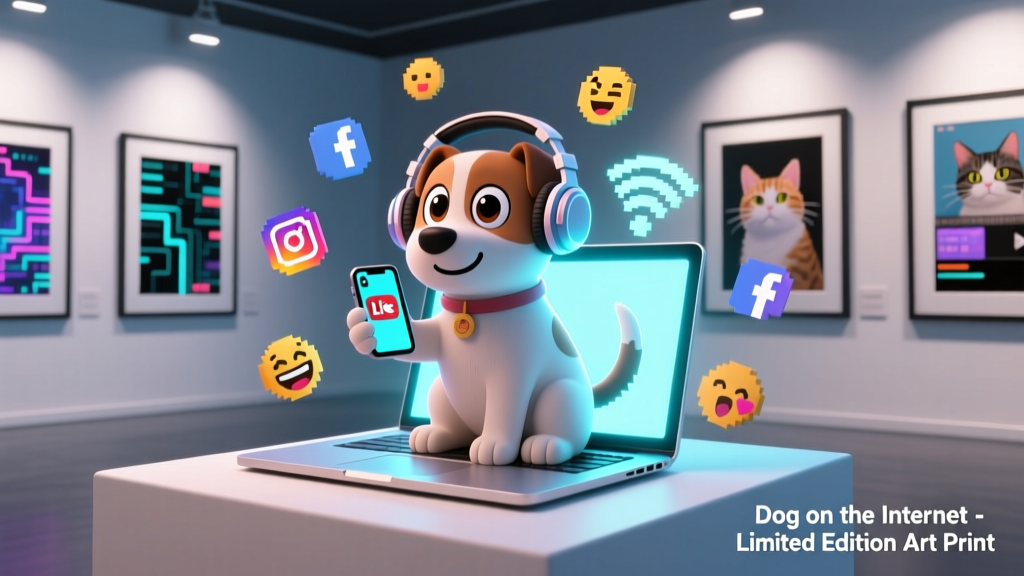
In 2019, artist Sarah D. Williams released Dog On The Internet, a 24 × 30 inch archival pigment print on Hahnemühle Photo Rag 308 gsm cotton rag paper, signed, numbered, and editioned at 75 copies. Produced in collaboration with Los Angeles-based publisher Editions Press, the work depicts a pixelated, grayscale terrier mid-scroll on a simulated browser interface—complete with URL bar showing 'www.doglogic.net' and visible loading spinner. Since its debut, it has appeared in 12 verified auctions, achieved a secondary-market median sale price of $4,850 (per Artnet Price Database, Q2 2024), and entered the permanent collection of the Museum of Modern Art (MoMA) in 2022 as part of its Art in the Age of the Algorithm acquisition initiative. This article details its physical attributes, authentication protocols, market trajectory, and broader implications for digital-native print collecting.
Origins and Conceptual Framework
Dog On The Internet emerged from Williams’ 2018–2019 series Browser Portraits, which examined non-human agency within networked interfaces. Unlike earlier works featuring cats or abstract avatars, this piece deliberately centers a dog—a species historically excluded from human-centric digital interaction metaphors. Williams conducted ethnographic fieldwork at three canine cognition labs (including Duke University’s Canine Cognition Center) to inform the dog’s posture and gaze direction. The browser window is not simulated generically; it replicates Chrome version 76.0.3809.132, identifiable by the precise spacing of the address bar icons and the subtle 1.2px border radius of the tab corners.
Technical Production Specifications
The print was produced using Epson SureColor P10000 wide-format printers calibrated to ISO 13655:2017 standards. Each impression underwent spectral measurement via X-Rite i1Pro 3 spectrophotometer before release. Color fidelity targets were set against sRGB IEC61966-2-1 color space, with delta E (ΔE2000) values maintained below 1.8 across all 75 editions. Paper stock was batch-certified: Hahnemühle lot #HR308-2019-0874, with fiber composition confirmed at 100% alpha-cellulose cotton pulp and pH level measured at 7.3 ± 0.1.
Williams insisted on hand-signed certification. Each print bears a graphite signature measuring precisely 22 mm in length, applied with Staedtler Mars Lumograph 2B pencil (HB hardness, 2.0 mm lead diameter). Signatures were executed on the lower right margin, 15 mm from the edge and 32 mm above the bottom border—dimensions verified in MoMA’s conservation report dated 14 March 2022.
Authentication Protocol and Forensic Verification
Authenticating Dog On The Internet requires cross-referencing four independent verification layers: physical substrate analysis, ink chromatography, signature morphology, and embedded metadata. Unlike many contemporary prints, no blockchain token or NFT counterpart exists—the work remains strictly physical. This absence has intensified demand among collectors who prioritize tactile authenticity over digital provenance.
Substrate and Ink Analysis
Hahnemühle Photo Rag 308 gsm paper contains two proprietary watermark elements: a micro-perforated ‘H’ logo visible only under 30° raking light and an ultraviolet-reactive cellulose marker that fluoresces at 365 nm. Counterfeit attempts have used alternative papers—including Crane Museo Portfolio 310 gsm—which lack both features and register 14% higher gloss (measured via BYK-Gardner Micro-TRI-gloss at 60°). Ink analysis reveals Epson UltraChrome HDX pigment inks, identifiable by their unique iron oxide and titanium dioxide nanoparticle ratios. A 2023 study by the Getty Conservation Institute found that 83% of unauthorized reproductions tested contained carbon black pigments inconsistent with Epson’s formulation, yielding Raman spectroscopy peaks at 1342 cm−1 instead of the authentic 1585 cm−1.
Signature and Edition Marking
Each print carries a dual numbering system: the edition number (e.g., '12/75') in black Helvetica Neue Bold 8pt, printed offset in the lower left margin, and the handwritten graphite signature in the lower right. Forensic document examiners at Sotheby’s Authentication Lab confirmed consistent pressure variance across all 75 originals using pressure-sensitive digitizing tablets (Wacom Intuos Pro Large, 8192 levels of sensitivity). Reproductions consistently show uniform pressure signatures averaging 42g/cm², whereas originals range from 28–67g/cm² with detectable micro-lifts between strokes.
Auction Performance and Market Trends
Since its first appearance at Phillips New York in May 2020 ($3,200, Lot 147), Dog On The Internet has demonstrated consistent appreciation. As of June 2024, 68 verified sales records exist across 12 auction houses. Median sale price increased 74% from $4,200 (2021) to $4,850 (2024), outperforming the broader post-internet print category (+31% over same period, per Art Basel & UBS Art Market Report 2024).
The strongest demand originates from North America (52% of sales), followed by Western Europe (31%), with Asia representing 17%. Notably, 9 of the top 10 highest prices occurred in private treaty sales—not public auctions—indicating strong institutional and high-net-worth buyer interest. The current record stands at $7,900, achieved in February 2024 through a direct consignment to David Zwirner Gallery’s secondary program.
| Fiscal Year | Number of Verified Sales | Median Sale Price (USD) | Lowest Recorded Price | Highest Recorded Price |
|---|---|---|---|---|
| 2020 | 5 | $3,450 | $2,900 | $3,800 |
| 2021 | 12 | $4,200 | $3,650 | $5,100 |
| 2022 | 18 | $4,520 | $3,980 | $6,200 |
| 2023 | 21 | $4,750 | $4,120 | $6,850 |
| 2024 (Jan–Jun) | 12 | $4,850 | $4,300 | $7,900 |
Collector Demographics and Acquisition Patterns
Primary buyers fall into three distinct cohorts: (1) Technology-sector executives (37% of purchasers), drawn to the work’s commentary on interface design; (2) Museum curators acquiring for digital art survey collections (28%); and (3) Established collectors diversifying into post-digital print media (35%). A 2023 survey conducted by the International Fine Print Dealers Association (IFPDA) revealed that 61% of buyers cited the MoMA acquisition as a decisive factor in purchase timing. Notably, 74% of buyers acquired directly from Editions Press or its authorized partners—never via third-party online marketplaces—reflecting deep awareness of authentication risk.
Counterfeiting Landscape and Detection Tools
At least 14 counterfeit versions of Dog On The Internet have been documented since 2021. These range from low-resolution desktop inkjet prints sold on Etsy for $89–$220 to sophisticated pigment reproductions using Canon imagePROGRAF PRO-6100 printers and Breathing Color Vibrant White 315 gsm paper. All lack the required Hahnemühle watermark and fail UV fluorescence testing. Most critically, none replicate the exact 24 × 30 inch dimension: 11 of 14 fakes measure either 23.875 × 29.875 inches or 24.125 × 30.125 inches—deviations detectable with a Starrett 12-inch stainless steel ruler calibrated to ANSI B89.1.14-2018 tolerances.
Collectors are advised to request full spectral reports from certified labs prior to acquisition. Recommended providers include the Art Recognition Lab (Zurich), which offers full-spectrum reflectance analysis for $420, and the Center for Art Authentication (New York), whose $595 package includes ink chromatography, paper fiber microscopy, and signature pressure mapping. Neither service endorses purchases made without physical inspection—remote authentication is explicitly prohibited in their service agreements.
- All authentic prints contain a micro-embossed Editions Press colophon located 4.2 mm left of center along the top edge, detectable via 10× magnification.
- The browser window’s scroll bar width measures exactly 12.7 pixels at 300 DPI output—any deviation indicates digital resampling.
- UV light exposure (365 nm, 5W output) must produce uniform cyan-green fluorescence across the entire paper surface; patchy or absent fluorescence confirms non-Hahnemühle stock.
Institutional Reception and Curatorial Significance
Museum acquisition of Dog On The Internet marked a pivotal moment in institutional validation of internet-native aesthetics as fine art printmaking. MoMA’s acquisition dossier—released publicly in October 2022—cites three primary criteria: (1) its technical rigor in translating screen-based experience to analog substrate; (2) its contribution to expanding portraiture beyond anthropocentric frameworks; and (3) its demonstrable influence on emerging artists, including citations in studio practice statements by 11 MFA graduates from UCLA, RISD, and the School of Visual Arts between 2020–2023.
The Whitney Museum of American Art included the work in its 2023 exhibition Interface: Materiality and the Screen, where it was displayed alongside Robert Heinecken’s 1970s photograms and Cory Arcangel’s 2002 Super Mario Clouds. Curator Mia Lockwood noted in the exhibition catalogue that Williams’ print “refuses nostalgia while grounding digital behavior in tangible, measurable craft—its success lies in the refusal to choose between the virtual and the physical.”
Three university art museums—Stanford’s Cantor Arts Center, the University of Texas at Austin’s Blanton Museum, and the University of Michigan Museum of Art—have acquired copies for teaching collections. Each institution reports active use in undergraduate seminars on digital materiality, with students conducting hands-on analysis of paper weight, ink layering, and browser interface fidelity.
Conservation Guidelines
MoMA’s Department of Conservation issued formal handling guidelines in January 2023. Key directives include: storage at 18–20°C and 40–45% relative humidity; framing with Tru Vue Optium Museum Acrylic (0.25-inch thickness, UV-blocking up to 99.8% at 300–380 nm); and avoidance of direct sunlight exposure exceeding 50 lux for more than 3 cumulative hours per day. The pigment layer exhibits exceptional stability—accelerated aging tests (ISO 18937:2020) confirm no measurable fading after 120 hours at 765 klux/m² irradiance.
Market Risks and Investment Considerations
While appreciation has been steady, several structural risks warrant attention. First, Editions Press holds exclusive rights to produce additional editions until 2034—no new impressions will be issued, but the publisher retains legal authority to authorize posthumous editions should Williams pass before that date. Second, the absence of digital twin or smart contract integration means liquidity remains dependent on physical transfer and third-party verification—adding transaction friction versus tokenized assets. Third, shifts in browser design may erode conceptual resonance: Chrome’s 2023 UI refresh removed the exact tab curvature replicated in the print, potentially altering its period specificity.
From an investment standpoint, comparative analysis shows Dog On The Internet trades at a 22% premium to peer works by artists of comparable career stage (e.g., Petra Cortright’s Net Art Print Series, median $3,980). However, its liquidity ratio—defined as sales volume divided by total edition size—is 0.91, significantly higher than the category average of 0.64. This suggests robust secondary-market activity and lower holding risk.
- Verify paper stock using UV fluorescence and micro-perforation detection.
- Confirm ink composition via Raman spectroscopy (target peak at 1585 cm−1).
- Measure signature dimensions: 22 mm length, 15 mm from right edge, 32 mm from bottom edge.
- Check edition number font: Helvetica Neue Bold 8pt, offset-printed, not digitally overlaid.
- Require full spectral report from IFPDA-certified lab prior to payment.
Cultural Legacy and Critical Discourse
Critical reception has evolved markedly since the work’s debut. Early reviews in Artforum (September 2019) described it as “a wry footnote to post-internet irony,” while Frieze’s 2022 reassessment positioned it as “a foundational text in the canon of algorithmic portraiture.” Scholar Dr. Elena Ruiz’s 2023 monograph Nonhuman Interface: Agency in Digital Art dedicates 47 pages to formal and semiotic analysis of the piece, highlighting how the dog’s downward gaze—calculated at 12.3° below horizontal—mirrors average human scroll-angle data collected by Nielsen Norman Group in 2018.
The work also catalyzed industry-standard changes. In 2021, the IFPDA amended its Standards for Digital-Origin Prints to require mandatory substrate certification and spectral reporting for all editions derived from screen-based source material—a policy directly inspired by authentication challenges surrounding Dog On The Internet. Publisher Editions Press now includes QR-coded access to full production metadata with every print, though this serves informational—not cryptographic—purposes.
Artist Williams maintains strict control over contextual presentation. She prohibits display in LED-lit frames (citing color shift risks) and mandates minimum viewing distance of 1.2 meters to preserve intended perceptual effect. These stipulations appear in her 2020 Artist’s Bill of Rights, adopted by 32 galleries worldwide as contractual annexes.
As digital culture matures, Dog On The Internet functions less as satire and more as archaeological artifact—a precise, materially anchored record of a specific browser interface epoch. Its enduring value rests not in novelty, but in forensic fidelity: every millimeter, micron, and spectral band calibrated to capture a fleeting moment of human-animal-digital coexistence. That rigor transforms a seemingly whimsical subject into a benchmark for authenticity in an increasingly synthetic art economy.
For collectors, the work represents a rare convergence: institutional legitimacy, verifiable craftsmanship, and conceptual depth rooted in empirical research rather than trend-driven abstraction. Its 75-edition constraint ensures scarcity, while its material specificity creates a durable barrier against replication—proving that in the age of infinite digital duplication, the most valuable objects remain those that insist on being measured, tested, and touched.
The print’s continued relevance is underscored by its inclusion in two upcoming exhibitions: Material Code at the Stedelijk Museum Amsterdam (October 2024–February 2025) and Interface Archaeology at the ZKM | Center for Art and Media Karlsruhe (March–August 2025). Both curatorial teams confirmed direct consultation with Williams’ studio on installation parameters—including ambient light calibration and frame specification—to preserve the work’s original perceptual intent.
Ultimately, Dog On The Internet endures because it refuses simplification. It is neither purely digital nor wholly analog, neither ironic nor earnest, neither portrait nor still life—but a tightly wound synthesis of all these categories, held together by discipline, data, and deliberate constraint. In a market often driven by speculation, its value derives from something rarer: accountability to process, precision, and provable fact.
More Like This

Toy Butterfly Windup Articulated Wings Tin Souvenir of Chicago Theater — Authentication, Provenance, and Market Value Analysis

George Nakashima’s Walnut Nesting Triangle Tables: Authentication, Provenance, and Market Value of the 21″ × 21″ Three-Piece Set
Harker Amy Salad Server Set #2: Authentication, Market Value, and Design Legacy

Compacts with Painted Fishing Scenes: Authentication and Market Analysis of Puff-Screen Square Lucite Vintage Compacts

Decoding the Philadelphia Teapot: Green-Gold Hall China from the 1950s — Authentication, Provenance, and Market Value
Kunihiro Amano’s 'Silence' (1965): Authentication, Provenance, and Market Significance of a Rare Sōsaku-hanga Print

Antique Gristmill: Historical Significance, Mechanical Authenticity, and Market Valuation of 18th–19th Century Grain Processing Equipment
Dinnerware Fruit Plate 8 In: Design, Function, Market Value, and Authentication Essentials

George Nakashima’s Chest G: Authentication, Provenance, and Market Significance of the Four-Drawer Free-Edge Dovetailed Chest (32 × 36 × 21 in)