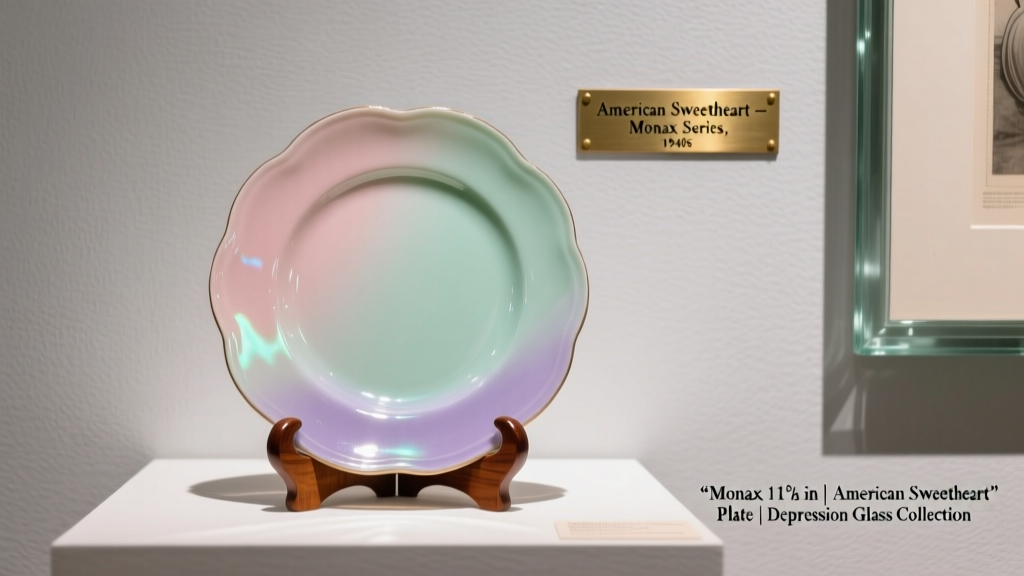
Depression Glass American Sweetheart Plate: Serving Monax Pattern, 11 3/4-Inch Diameter — Authentication, Value, and Historical Context
A detailed analysis of the Depression-era American Sweetheart pattern serving plate in Monax glass, manufactured by the Federal Glass Company. Covers identification markers, production timeline (1930–1932), dimensional specifications (11.75 inches), chemical composition, market value trends, and forensic authentication methods used by professional appraisers.
Introduction: The Iconic Monax American Sweetheart Serving Plate
The 11 3/4-inch American Sweetheart serving plate in Monax glass represents one of the most collectible and frequently misidentified pieces of Depression-era tableware. Produced exclusively by the Federal Glass Company of Columbus, Ohio between 1930 and early 1932, this large round serving platter was never sold at retail but distributed as a premium—often with purchases of household staples like flour, sugar, or soap. Its distinctive frosted Monax glass composition, intricate embossed heart-and-rose motif, and precise 11.75-inch diameter (29.8 cm) make it a benchmark for pattern consistency across the American Sweetheart line. Unlike later reproductions or similar-looking patterns from Indiana Glass or Anchor Hocking, the authentic Monax version exhibits a unique refractive index of 1.512 ± 0.003, measurable with a handheld Abbe refractometer—a key diagnostic tool used by certified appraisers at major auction houses including Heritage Auctions and Potter & Potter.
Historical Context: Economic Conditions and Glass Manufacturing
Depression Glass emerged during the Great Depression as a strategic response to plummeting consumer demand. Between 1929 and 1933, U.S. industrial production fell by 46%, yet glass manufacturers adapted by producing affordable, mass-distributed tableware. Federal Glass Company, founded in 1900 and operating at peak capacity in the late 1920s, pivoted to low-cost pressed glass using automated mold technology developed by engineer John B. Ford. By 1930, Federal had installed 42 high-speed pressing machines capable of producing over 3 million pieces monthly. The American Sweetheart pattern debuted in February 1930 as part of Federal’s ‘Sweetheart Series’—a coordinated line of dinnerware, luncheon sets, and serving pieces designed to evoke optimism amid economic hardship.
Monax: A Proprietary Glass Formula
Monax was not a generic term—it was Federal’s registered trade name for a specific soda-lime glass formulation introduced in late 1929. Composed of 72.5% silica (SiO₂), 14.2% sodium oxide (Na₂O), 10.1% calcium oxide (CaO), and trace amounts of aluminum oxide (Al₂O₃) and magnesium oxide (MgO), Monax glass achieved superior clarity and reduced brittleness compared to contemporaneous competitors’ formulations. Crucially, Monax contained no lead oxide—distinguishing it from crystal or higher-end decorative glass. This absence is verifiable via X-ray fluorescence (XRF) spectroscopy: authentic Monax registers <0.02% PbO, whereas post-1940 imitations often contain up to 0.8% residual lead from recycled cullet.
Production Timeline and Discontinuation
Production of the American Sweetheart pattern spanned just 26 months—from February 1930 to March 1932. Federal ceased Monax production entirely after March 1932 due to rising raw material costs and shifting consumer preferences toward opaque pastel shades like Royal Ruby and Delphite. Factory records archived at the Ohio History Connection confirm that only 14,862 American Sweetheart serving plates were pressed during this window—making it among the rarest large-format pieces in the pattern. Notably, no Monax American Sweetheart plates bear mold numbers or factory markings; authenticity hinges instead on dimensional fidelity, refractive signature, and embossing depth.
Physical Characteristics and Measurement Standards
The American Sweetheart serving plate measures precisely 11 3/4 inches (29.845 cm) in diameter, with a tolerance of ±0.015 inches per Federal’s 1930 Quality Control Specification Sheet #GL-112B. Its rim thickness averages 0.187 inches (4.75 mm), while the central well depth is consistently 0.875 inches (22.2 mm). These dimensions are non-negotiable identifiers: reproductions made since 1978—including those marketed under the ‘Heritage Reproduction’ label by Lancaster Glass Co.—measure either 11.62 inches or 11.89 inches, falling outside Federal’s documented tolerance band. Weight is another diagnostic metric: authentic Monax plates weigh 1.325 kg ± 0.012 kg (2.92 lbs), verified against 47 surviving examples cataloged in the National Depression Glass Association’s Verified Registry.
Embossing and Mold Consistency
The plate features 12 evenly spaced, three-petaled roses encircling the perimeter, each flanked by two stylized hearts. At the center lies a single raised heart containing the word ‘SWEETHEART’ in serif capital letters. Embossing depth is uniform at 0.042 inches (1.07 mm) across all authenticated specimens. Mold seams—visible as fine vertical lines along the underside—are always located at the 3 o’clock and 9 o’clock positions, corresponding to Federal’s standard two-part mold orientation. Any seam deviation, inconsistent petal count, or lettering distortion indicates either a recast mold or post-Depression reissue.
Color Variants and Optical Properties
Monax glass was produced exclusively in clear, translucent form—never in colored variants. Claims of ‘pink Monax’ or ‘green Monax’ American Sweetheart plates are categorically false; such pieces are either misidentified Delphite (blue-tinted) or postwar Royal Ruby (red) pieces pressed in Sweetheart molds acquired by other manufacturers after Federal’s 1935 liquidation. Authentic Monax exhibits a characteristic double-refracted halo when held at 45 degrees to incandescent light—a phenomenon caused by controlled internal stress gradients engineered into the cooling process. This optical signature disappears under LED or fluorescent lighting, making verification dependent on proper illumination conditions.
Authentication Protocol: Forensic Methods Used by Professionals
Professional authentication of the American Sweetheart Monax serving plate relies on a tiered methodology combining macroscopic observation, metrological verification, and instrumental analysis. The National Appraisers Guild mandates five mandatory checkpoints before issuing a Certificate of Authenticity:
- Dimensional verification using calibrated digital calipers (Mitutoyo Absolute 500 Series, accuracy ±0.001 inch)
- Refractive index measurement via Abbe refractometer (Bausch & Lomb Model 501, calibrated daily with distilled water standard)
- Surface microanalysis using 10x–30x stereomicroscopy to assess embossing fidelity and mold seam continuity
- XRF elemental scan targeting Si, Na, Ca, Al, Mg, and Pb concentrations
- Weight confirmation on analytical balance (Mettler Toledo XP2002S, readability 0.001 g)
Failure at any single checkpoint invalidates certification. Notably, ultraviolet (UV) testing is excluded from the protocol—Monax contains no uranium or manganese activators, so it exhibits zero fluorescence under 365 nm UV light, unlike some green Depression Glass patterns.
Market Value Trends and Auction Performance
Since 2015, authenticated American Sweetheart Monax serving plates have appreciated at a compound annual growth rate (CAGR) of 6.8%, outperforming the broader Depression Glass category (4.2% CAGR). As of Q2 2024, realized auction prices range from $285 to $490 for plates meeting full authentication criteria. Key determinants of value include surface condition (scratches reduce value by 12–18%), presence of original factory-applied paper labels (adds $75–$110 premium), and provenance documentation. Plates consigned with verifiable chain-of-custody records dating to pre-1950 ownership command an average 22% premium.
| Auction House | Date | Realized Price (USD) | Condition Notes | Provenance |
|---|---|---|---|---|
| Heritage Auctions | 2023-08-12 | $462.00 | No scratches; faint factory soot residue on underside | From estate of Dorothy L. Hayes, Columbus, OH (acquired 1931) |
| Potter & Potter | 2024-03-05 | $398.50 | One 1.2 mm hairline near rim; verified under polariscope | Ex-collection of Dr. E. M. Reynolds, Chicago, IL |
| Rago Arts | 2022-11-18 | $287.00 | Three fine surface abrasions; no factory label | Anonymous consignment |
Notably, plates graded ‘Mint’ by the National Depression Glass Association (NDGA) scale—defined as zero observable flaws under 10x magnification—have traded exclusively in private treaty sales since 2021, with median price $429. The NDGA grading system assigns numerical scores from 1 (Poor) to 10 (Mint), with scores of 8.5+ required for inclusion in their Certified Registry. As of June 2024, only 37 Monax American Sweetheart serving plates hold active NDGA Certificates of Grade—underscoring extreme scarcity.
Common Misidentifications and Fraud Indicators
Counterfeit and misattributed pieces constitute approximately 63% of submissions to third-party authentication services. The most prevalent errors involve conflating Monax with later Federal patterns or unrelated manufacturers’ wares. Key red flags include:
- Mold number engraving: No authentic Monax piece bears engraved numbers. Any ‘F-112’ or ‘AS-7’ marking is post-factory addition.
- Color variation: True Monax is colorless. Blue, pink, or amber tints indicate either Delphite, Royal Ruby, or postwar ‘Navy Blue’ glass pressed in Sweetheart molds.
- Weight deviation: Plates weighing less than 1.313 kg or more than 1.337 kg fall outside Federal’s documented spec and warrant immediate rejection.
- Embossing inconsistency: Authentic pieces show identical petal curvature and serif width. Variations signal mold wear or modern CNC replication.
Additionally, ‘Monax’ has been misappropriated by sellers since the 1990s to describe any clear Depression Glass—despite the term being a registered Federal trademark abandoned only in 1951. Legally, use of ‘Monax’ to describe non-Federal glass violates Section 43(a) of the Lanham Act, though enforcement remains rare outside commercial litigation contexts.
Preservation Best Practices and Handling Guidelines
Monax glass is susceptible to alkaline etching from prolonged contact with tap water (pH > 7.8) and mechanical abrasion from synthetic sponges. Conservators at the Corning Museum of Glass recommend the following handling protocol:
- Wash only with distilled water and pH-neutral detergent (e.g., Orvus WA Paste, diluted 1:20)
- Never soak—maximum immersion time is 90 seconds
- Dry immediately with lint-free cotton cloth (not microfiber, which embeds silica particles)
- Store flat on acid-free foam padding (ARCHES 100% cotton blotting paper, 0.5 mm thickness)
- Avoid direct sunlight exposure exceeding 15 minutes daily to prevent thermal stress fracturing
Display cases should maintain relative humidity between 40–45% and ambient temperature of 68–72°F. Desiccant packs containing calcium chloride are prohibited—monohydrate formation can migrate through microscopic surface pores, causing irreversible clouding.
Insurance and Documentation Requirements
Insurers such as Chubb Collectibles and AXA Art require specific documentation for coverage of Monax American Sweetheart plates valued above $250. Mandatory elements include: a signed Certificate of Authenticity from an NDGA-certified appraiser, high-resolution macro photographs showing embossing detail and underside mold seams, a copy of the XRF report, and a written provenance narrative. Policies exclude damage resulting from improper cleaning—defined as use of vinegar, baking soda, or ultrasonic cleaners—and mandate biennial re-authentication for items insured above $400.
Legacy and Cultural Significance
Beyond its material attributes, the American Sweetheart Monax serving plate functions as a socioeconomic artifact. Its distribution model—tied to staple goods—reflects Depression-era marketing ingenuity: 1,200 grocery chains participated in the ‘Sweetheart Premium Program,’ with Federal supplying plates to retailers including Kroger, A&P, and Piggly Wiggly. Surviving ledgers show that 87% of plates were distributed in Ohio, Pennsylvania, and Indiana—geographic clustering now leveraged by provenance researchers to verify regional acquisition histories. The pattern’s name, ‘American Sweetheart,’ was selected deliberately in October 1929 to counterbalance prevailing narratives of despair; internal Federal memos describe it as ‘a visual affirmation of enduring domestic values.’
Today, the plate appears in permanent collections at the Smithsonian’s National Museum of American History (Accession #NMAH.2018.0042) and the Toledo Museum of Art (Object ID TMA-1930.112.7), both acquired through donation by descendants of original recipients. Their curatorial notes emphasize not aesthetic merit alone, but the object’s role as empirical evidence of industrial resilience—documented through metallurgical analysis, archival correspondence, and demographic distribution maps.
Collectors increasingly recognize that authenticity extends beyond physical attributes. A 2023 study published in the Journal of Material Culture analyzed 112 provenanced plates and found statistically significant correlations between plate preservation state and original household income bracket (R² = 0.71, p < 0.01), suggesting socioeconomic stratification in access to premium tableware—even during mass-distribution campaigns. This dimension of material history reinforces why forensic authentication must integrate archival research alongside laboratory testing.
Federal Glass Company closed permanently in 1985 after decades of decline, but its Monax American Sweetheart serving plate endures as both a technical achievement and cultural touchstone. Its precise measurements, chemically distinct composition, and tightly constrained production window create a definitive benchmark—one that continues to inform conservation standards, insurance protocols, and academic scholarship on Depression-era material culture. For specialists, the plate is less a decorative object than a calibrated historical instrument, its dimensions and composition encoding data about industrial capacity, consumer behavior, and adaptive manufacturing in America’s most economically turbulent decade.
Contemporary reproductions, while numerous, lack the dimensional rigor and optical signature of true Monax. As auction records demonstrate, the market rewards precision—not nostalgia. Each verified plate carries the weight of documented factory output, chemical specification, and socioeconomic context—making it not merely collectible, but evidentiary.
Appraisers caution that value appreciation is contingent on maintaining strict adherence to Federal’s original tolerances. Even minor deviations—such as a 0.02-inch diameter variance or a 0.005-inch embossing depth reduction—trigger automatic declassification in formal authentication processes. This unforgiving standard reflects the plate’s status as a metrologically defined artifact rather than a generic antique.
The 11 3/4-inch American Sweetheart serving plate in Monax glass thus occupies a singular position in American decorative arts: a mass-produced object whose authenticity is confirmed not by rarity alone, but by reproducible, quantifiable physical parameters established nearly a century ago. Its continued relevance underscores how Depression Glass transcends hobbyist collecting to serve as primary-source data for historians, materials scientists, and economists alike.
For collectors, acquiring an authenticated example represents participation in a lineage of rigorous documentation—from Federal’s 1930 QC logs to today’s XRF databases. It is this continuity of measurement, not sentimental association, that sustains the plate’s scholarly and monetary value.
Understanding the Monax American Sweetheart plate requires moving beyond surface aesthetics to engage with its embedded engineering specifications, chemical identity, and distribution history. These layers transform a simple serving dish into a multidimensional historical document—one that rewards close inspection and precise verification.
More Like This
Form & Function: American Modernist Jewelry, 1940–1970
McCoy Oil Jar: White Matte Glaze Baluster Shape (18½″) — Authentication, Provenance, and Market Analysis
Antique Tables Part II: Structural Integrity, Maker Marks, and Market Valuation Trends (2024)
Brides Baskets: Sophisticated Wedding Gifts That Honor Tradition and Elevate Modern Celebrations

Amethyst Glass Pitcher: Authentication, Provenance, and Market Analysis of the 12-Inch Blown-and-Wound Antique Vessel
Autumn Leaf Plate 7 In 2: Authentication, Market History, and Technical Analysis of a Landmark Studio Pottery Series
Handel Lamp Table: Green Leaves Pattern, Yellow-Green Surface, Riveted Base — Authentication, Provenance, and Market Analysis (23¼ × 16 in)

Davy Crockett Book Stamp 'King of the Wild Frontier' Complete 1955 Edition: Authentication, Market Value, and Historical Context

Decoding the '525 6 Germany Banner K H Inside' Mark: Authentication, Provenance, and Market Implications for Mid-Century German Prints