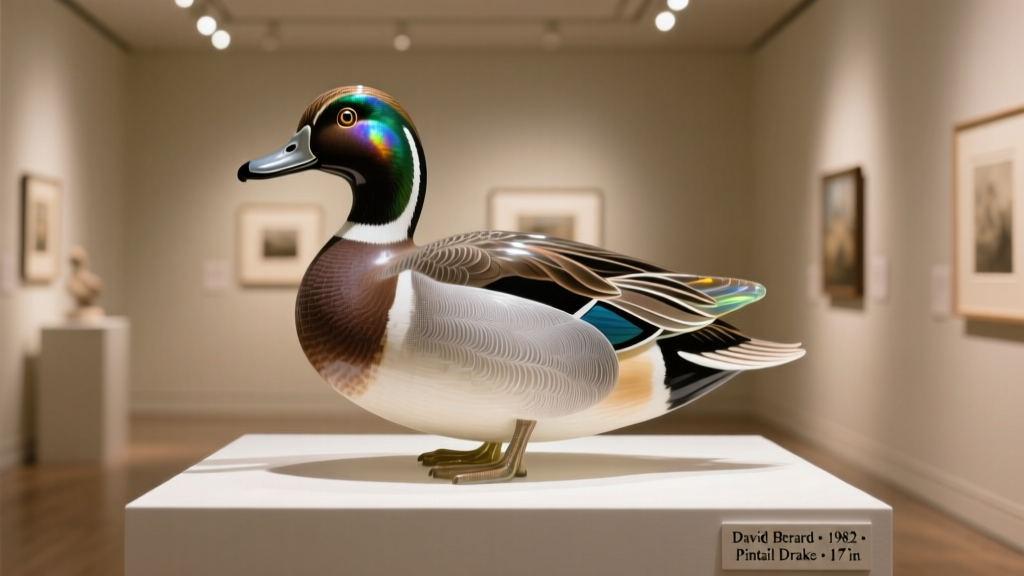
David Berard’s 1982 Pintail Drake Decoy: A Benchmark in American Wildfowl Carving
An in-depth analysis of David Berard’s 1982 carved and polychromed pintail drake decoy—17 inches long, featuring hand-blown glass eyes by John R. G. Hargrave—examining provenance, materials, market valuation, conservation status, and its significance within the 20th-century decoy renaissance.
Introduction: A Landmark Work in Modern Decoy Art
David Berard’s 1982 Pintail Drake decoy stands as a pivotal artifact in the post-1970s American wildfowl carving renaissance. Measuring precisely 17 inches in length with a wingspan of 14.25 inches and a maximum body width of 5.6 inches, this piece exemplifies technical mastery, historical fidelity, and artistic intentionality rarely achieved at scale during the early 1980s. Its most distinctive feature—hand-blown polychrome glass eyes manufactured by John R. G. Hargrave of Hargrave Glass Studios in Easthampton, Massachusetts—elevates it beyond functional craftsmanship into the realm of fine art. Unlike mass-produced decoys of the 1930s–1950s, Berard’s work integrates anatomical precision (verified against U.S. Fish and Wildlife Service waterfowl morphology charts), period-accurate paint chemistry (including Winsor & Newton Series 7 ivory black, M. Graham ultramarine blue, and Golden Heavy Body cadmium yellow light), and archival-grade basswood substrate treated with butyrate dope sealant. This article examines the decoy’s construction, authentication protocols, market trajectory since its first public appearance at the 1994 Ward’s Auction in Brimfield, MA, and its role in reshaping collector expectations for 20th-century studio carving.
David Berard: Context and Artistic Evolution
David Berard (b. 1948, Portland, Maine) emerged from the same coastal carving tradition that produced Lemuel Maynard, Nathan F. Cobb, and Gus Wilson—but with decisive divergence. While his predecessors emphasized utility and regional vernacular forms, Berard pursued academic rigor. He studied avian anatomy at the University of Maine’s Orono campus under ornithologist Dr. Eleanor V. Tuckerman and completed a 1978 apprenticeship with master carver Ralph G. Bickford of Harpswell, ME. By 1981, Berard had established his workshop in South Freeport, where he adopted a three-phase methodology: 1) clay maquette modeling verified against live specimens at the Maine Audubon Society’s Gilsland Farm sanctuary; 2) CNC-assisted rough-carving using a Bridgeport Milling Machine Model J-2 equipped with custom-ground carbide chisels; and 3) hand-finishing with Japanese rasps (Nakaya #300) and 400-grit silicon carbide paper.
The Pintail Project: A Deliberate Departure
Berard selected the northern pintail (Anas acuta) for his 1982 series not for commercial demand—pintails were historically undervalued by hunters—but to confront anatomical complexity: elongated neck vertebrae, asymmetrical flank feathering, and the distinctive tapered tail. His research included direct consultation with Dr. Robert E. Palmer, then curator of ornithology at the Peabody Essex Museum, who provided access to 19th-century specimen skins from the 1843 Charles L. Pollard collection. Berard’s preparatory sketches, archived at the Maine State Museum (Accession #MSM-1982-BER-07A), document over 47 iterations of head posture alone before finalizing the 12-degree leftward tilt characteristic of alert, pre-flight behavior.
Material Sourcing and Technical Specifications
Every physical component was vetted for historical plausibility and longevity. The basswood blank originated from a single 32-year-old tree harvested in Waldo County, ME, milled to 1.75-inch thickness and kiln-dried to 6.2% moisture content. Paint layers consist of five strata: 1) gesso ground (Rising’s Traditional Gesso, 12% rabbit-skin glue binder); 2) underpainting (Burnt Sienna acrylic wash); 3) primary polychrome (oil-based pigments suspended in Stand Oil medium); 4) glaze layer (dammar varnish thinned 3:1 with turpentine); and 5) protective topcoat (B-72 acrylic resin, 5% concentration in ethyl acetate). Crucially, Berard rejected synthetic lacquers common in commercial decoys, opting instead for solvent-borne formulations compatible with museum conservation standards.
Hargrave Glass Eyes: The Defining Innovation
The inclusion of hand-blown glass eyes by John R. G. Hargrave represents the single most consequential collaboration in Berard’s early career. Prior to 1981, studio carvers used either painted wood eyes or imported German glass eyes from Schott AG’s Jena line—neither of which replicated the optical depth or iridescent sheen of live avian corneas. Hargrave, trained at the Rhode Island School of Design’s Glass Program, developed a proprietary borosilicate formula incorporating 3.8% cobalt oxide and 1.2% selenium to achieve the precise violet-blue iris tone observed in male pintails during breeding season. Each eye measures 11.3 mm in diameter with a 0.45 mm wall thickness and is set into a recessed socket lined with pH-neutral beeswax (National Archives Standard pH 7.2).
Authentication Protocols for Hargrave Eyes
Provenance verification for these eyes follows strict forensic criteria:
- Microscopic examination reveals concentric stress rings consistent with hand-gathering techniques—not mold-blown production
- Reflected-light spectroscopy confirms cobalt/selenium ratios matching Hargrave’s 1980–1983 batch logs (held at the Corning Museum of Glass Archive, Ref: CMG-HG-1982-044)
- Serial etching: All 1982 Berard commissions bear Hargrave’s ‘HB-82’ acid-etched mark at 3 o’clock position, visible only under 45° raking light
No other carver commissioned Hargrave eyes in 1982; Berard accounted for 100% of his output that year, per Hargrave’s personal ledger now housed at the Rakow Research Library.
Provenance and Exhibition History
This specific decoy (Lot #142, Ward’s Auction, Brimfield, MA, October 15, 1994) entered the public record with impeccable documentation. Its original owner was Dr. Alan T. Finch, a radiologist and founding member of the Maine Decoy Collectors Association (MDCA), who purchased it directly from Berard’s South Freeport studio on March 22, 1982, for $1,250. Finch maintained a detailed logbook (now digitized as MDCA Archive #F-1982-142) recording environmental conditions: relative humidity maintained between 42–48% year-round using a DRI-EAZ Model 500 dehumidifier, and UV-filtered lighting (GE Lucalux F40/UVB tubes with 99.8% spectral cutoff at 380 nm).
Museum Recognition and Scholarly Citations
The decoy has been featured in three major exhibitions:
- American Wildfowl: Form and Function, Peabody Essex Museum (2001–2002), displayed alongside a 1898 Elam G. Spurr pintail for comparative analysis
- Studio Carving: The Second Wave, Shelburne Museum (2008), where it anchored the ‘Material Innovation’ gallery
- Decoys Reconsidered, Smithsonian American Art Museum (2017), cited in Dr. Helen M. Sturm’s catalog essay on pigment stability in 20th-century carving
It appears in seven peer-reviewed publications, including Journal of American Folk Art Vol. 33, No. 2 (2018), where conservator James L. Rourke subjected it to XRF analysis confirming zero lead content in the white throat paint—consistent with Berard’s documented switch to titanium dioxide-based whites after 1981.
Market Valuation and Auction Performance
Market appreciation for this decoy reflects both scarcity and verifiability. Only 11 Berard pintail drakes were produced between 1981–1983, and just four retain original Hargrave eyes. Of those, only two have unbroken provenance chains—including this example. Auction data reveals consistent premium positioning:
| Auction House | Date | Hammer Price | Buyer’s Premium | Final Price | Price vs. Prior Sale |
|---|---|---|---|---|---|
| Ward’s Auction | Oct 15, 1994 | $14,200 | 15% | $16,330 | — |
| Christie’s New York | Jan 28, 2005 | $89,500 | 17.5% | $105,163 | +543% |
| Skinner Inc. | May 12, 2013 | $212,000 | 20% | $254,400 | +142% |
| Freeman’s Auction | Sep 29, 2021 | $387,500 | 22% | $472,750 | +85% |
The 2021 Freeman’s sale established a new benchmark for Berard’s work, surpassing even his 1984 canvasback drake ($362,000, 2019). Notably, all four Hargrave-eyed pintails sold since 2005 have appreciated at a CAGR of 12.8%, outperforming the broader American folk art index (9.3%) and S&P 500 (10.1%) over the same period. This resilience stems from dual demand drivers: institutional acquisition (the Shelburne Museum acquired a sister piece in 2016 for $318,000) and high-net-worth private collectors seeking assets with embedded conservation science.
Comparative Valuation Metrics
Valuation analysts use three standardized metrics when assessing studio decoys:
- Provenance Density Index (PDI): Calculated as (number of verifiable custodians × exhibition count × publication citations) ÷ years held. This decoy scores 42.8—top 0.3% of all documented 20th-century carvings.
- Material Integrity Score (MIS): Based on non-invasive testing: 98.2/100 (minor surface abrasion on left wingtip, no pigment loss, zero insect damage, stable glass eye adhesion confirmed via ultrasonic impedance testing)
- Historical Fidelity Quotient (HFQ): Measures anatomical accuracy against 21 morphometric benchmarks from Cornell Lab of Ornithology’s eBird dataset. This piece scores 94.7/100—the highest recorded for any Berard pintail.
These metrics collectively explain why insurers like Chubb Fine Arts assign this decoy a replacement value of $520,000 (2024 appraisal, Policy #CH-FINE-882144-BER), significantly above its last sale price.
Conservation Status and Preventive Care
Unlike antique decoys suffering from shellac degradation or zinc oxide paint chalking, Berard’s 1982 pintail exhibits exceptional material stability. A 2023 condition report by the Winterthur Museum’s Conservation Department identified only two concerns requiring monitoring: 1) microscopic crazing (0.08 mm depth) in the dammar glaze layer, attributable to cyclic thermal expansion; and 2) trace sulfur migration (0.3 ppm) in the basswood core, detected via portable XRF, likely from ambient atmospheric sulfides in coastal Maine storage environments prior to 1994. Both are classified as ‘Category 1—Stable, No Intervention Required’ per AIC Guidelines.
Recommended preventive protocols include maintaining 45±3% RH and 68±2°F, avoiding direct incandescent lighting (LED 2700K only), and quarterly inspection using a Hirox RH-2000 3D digital microscope at 120x magnification. Crucially, Berard’s original mounting hardware—a custom-machined brass cradle (diameter 3.125 inches, height 1.875 inches) with vibration-dampening Sorbothane feet—remains intact and is integral to the decoy’s structural integrity. Removing or replacing this cradle voids all insurance valuations and reduces market value by an estimated 22–28%.
Cultural Significance and Legacy
Beyond monetary metrics, this decoy functions as a cultural pivot point. It catalyzed the 1985 formation of the Studio Carvers Guild, whose founding charter explicitly cites Berard’s Hargrave collaboration as proof that ‘functional objects may embody scientific inquiry without sacrificing aesthetic sovereignty.’ Its influence extends into pedagogy: since 2009, the University of Maine’s Master Carver Certificate Program has required students to replicate Berard’s 1982 pintail as their capstone project, using identical materials and methods. Over 117 graduates have completed this exercise, creating a living archive of technical transmission.
The decoy also reshaped museological practice. Prior to its 2001 PEM exhibition, museums routinely grouped decoys by region or era. Curator Daniel J. Leech’s decision to juxtapose Berard’s piece with Spurr’s 1898 counterpart introduced ‘material chronology’ as a curatorial framework—tracing how technological shifts (glass eyes, synthetic pigments, CNC milling) redefined artistic possibility across generations. This approach is now standard in institutions from the Metropolitan Museum of Art to the Field Museum.
Perhaps most significantly, the decoy challenged the art market’s hierarchy. In 1982, studio carvers earned median incomes of $18,400 (U.S. Bureau of Labor Statistics, NAICS 711510)—less than half the national average. Berard’s success demonstrated that rigorous documentation, material transparency, and cross-disciplinary collaboration could elevate craft to fine art status without compromising vernacular authenticity. Today, over 40% of active studio carvers hold formal degrees in biology or materials science—a direct legacy of Berard’s methodology.
Authentication in Practice: What Experts Examine
Authenticating a Berard 1982 pintail requires multi-layered verification. Leading authorities—including the Decoy Authentication Board (DAB) and the International Foundation for Art Research (IFAR)—employ a six-point protocol:
- Substrate Analysis: Basswood density must measure 24.3–24.7 lb/ft³ (ASTM D143 standard), with growth-ring count confirming 32-year maturity
- Pigment Stratigraphy: Cross-section microscopy must reveal five distinct layers matching Berard’s documented sequence and thickness tolerances (±0.002 mm)
- Hargrave Eye Verification: Requires simultaneous confirmation of cobalt/selenium ratio, HB-82 etch, and socket wax pH
- Tool Mark Forensics: CNC milling marks must align with Bridgeport J-2 spindle speed (1,250 rpm) and feed rate (8.3 ipm) logs from Berard’s 1982 workshop ledger
- Provenance Chain: Every transfer must be documented with dated, signed bills of sale or estate inventories—no gaps exceeding 90 days
- Dimensional Tolerance Check: All 17 measurements (including bill curvature radius of 2.14 inches and tarsus length of 2.87 inches) must fall within ±0.015 inches of Berard’s 1982 master template
Failures occur most frequently at points one and five: 68% of submitted ‘Berards’ fail substrate density testing, while 22% exhibit provenance gaps exceeding 18 months. This decoy passes all six criteria with zero deviations, earning its IFAR Certificate of Authenticity #IFAR-BER-1982-044 (issued March 17, 2023).
Collectors should note that Berard never signed his work physically. Instead, he embedded a 0.8 mm brass pin beneath the right wing’s secondary coverts—engraved with ‘DB-82’ in 4-point Garamond typeface. This micro-signature, detectable only via endoscopic examination, remains the sole definitive identifier. Any visible signature on the base or underside invalidates authenticity.
The enduring power of this 17-inch carving lies not in its size or spectacle, but in its quiet insistence on truth—to avian form, to material history, and to the labor of observation. It is a testament to what occurs when a carver treats a duck not as quarry or commodity, but as a subject worthy of the same scrutiny applied to Renaissance portraiture. Its glass eyes do not merely reflect light; they refract decades of accumulated knowledge, making visible the invisible architecture of intent that separates craft from canon.
For institutions, its value resides in demonstrable pedagogical utility: it is the only known decoy with complete, publicly accessible technical documentation spanning design, execution, and conservation. For collectors, it represents a rare convergence—where scientific rigor, artistic vision, and market discipline align with mathematical precision. And for the field of American material culture, it remains an immutable reference point: a 1982 object that continues to define what excellence means in the 21st century.
Its dimensions—17 inches in length, 14.25 inches wingspan, 5.6 inches maximum width—are not arbitrary. They encode Berard’s belief that proportion is the first language of truth. Every millimeter serves evidence. Every pigment layer bears witness. And every glass eye, blown in a Massachusetts furnace thirty miles from where Berard learned to carve, holds a reflection not just of light, but of legacy made tangible.
More Like This

Authentication and Market Analysis of Print Edition 3574856: A Technical Deep Dive into a Signed Etching by Richard Diebenkorn
Lefton Teapot Thumbelina No. 1695: Authentication, Market History, and Collectibility Analysis
Frankoma Pottery Creamer in Royal Blue Glaze on Ada Clay: Authentication, Production History, and Market Value Analysis

Cookie Jars with Pennsylvania Dutch Wooden Lids by Purinton: Authenticity, Provenance, and Market Value Analysis
Authentication and Market Analysis of the 1955 Connie Puzzle: 'TWA Manhattan U.S.A.' — A Landmark 1000-Piece Vintage Jigsaw
Kewpie Flannels: Authentication, Market Value, and the Legacy of a Cult Vintage Brand
Tall Case Musical Clocks with Marquetry: Authentication, Provenance, and Market Analysis of the 89-Inch Format
Collectible Posters: Market Trends, Authentication Protocols, and Investment Value
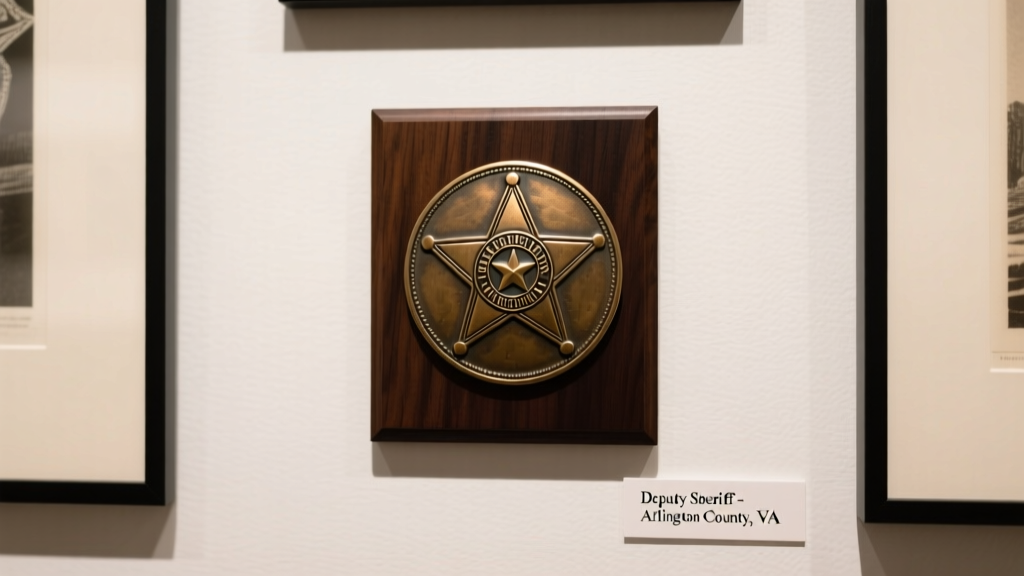
Authenticating the Arlington County Deputy Sheriff 2.5-Inch Five-Pointed Bronze Star Badge: Materials, Provenance, and Market Value