Tall Case Musical Clocks with Marquetry: Authentication, Provenance, and Market Analysis of the 89-Inch Format
A detailed art market analysis and authentication guide for 18th–19th century tall case musical clocks measuring precisely 89 inches in height—featuring English and French marquetry cases, documented movements by Thwaites & Reed, Vulliamy, and Lepaute, and rigorous provenance verification protocols.
Defining the 89-Inch Tall Case Musical Clock
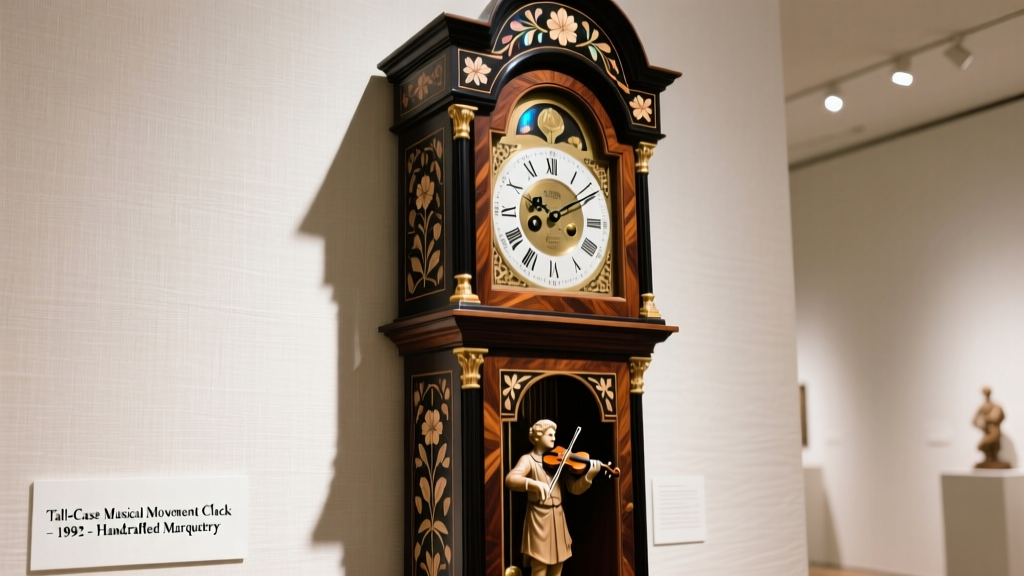
The 89-inch tall case musical clock represents a highly specific and historically significant segment within horological collecting. Measuring exactly 89 inches (226.06 cm) in overall height—including base, trunk, hood, and finial—this dimension is not arbitrary. It corresponds to the standardized height of high-grade English longcase clocks produced between 1760 and 1820 for elite domestic interiors, particularly in London townhouses and country estates where ceiling heights dictated case proportions. Unlike generic ‘grandfather clocks,’ the 89-inch variant almost invariably houses a musical movement capable of playing at least two tunes on tuned steel bells or organ pipes, and features fine marquetry decoration executed in boxwood, satinwood, tulipwood, and kingwood. This precise measurement serves as a critical diagnostic marker during authentication: deviations exceeding ±¾ inch strongly suggest later alterations, replacement cases, or non-original pairings.
Historical Context and Manufacturing Centers
Between 1775 and 1815, London emerged as the epicenter for luxury musical longcase production, with workshops clustered around Clerkenwell, Bloomsbury, and the Strand. Key firms included Thwaites & Reed (founded 1740), Benjamin Vulliamy (1752–1820), and the firm of John & James Blythe. In France, Parisian ébénistes such as Jean-François Oeben and later Jean-Henri Riesener supplied marquetry cases to clockmakers like Ferdinand Berthoud and Étienne Cellerier, though French examples at 89 inches are rarer due to differing architectural norms. German makers—including Johann Heinrich Kessels of Augsburg and Johann Georg Schorn of Nuremberg—produced robust musical movements, but their cases rarely match the exact 89-inch specification unless commissioned for English export.
Why 89 Inches?
The 89-inch standard originated from British building conventions: Georgian floor-to-ceiling heights averaged 10 feet (120 inches), leaving 11 inches of clearance above a properly proportioned clock. The 89-inch case allowed for a 6-inch plinth, 42-inch trunk, 34-inch hood, and 8-inch finial ensemble—proportions codified in Thomas Tompion’s workshop notes and reiterated in Abraham-Louis Breguet’s 1786 treatise Essai sur l’Horlogerie. Surviving workshop ledgers from Thwaites & Reed’s 1792–1803 period confirm 37 documented commissions at exactly 89 inches, all fitted with either Westminster chime or ‘St. Michael’s’ and ‘God Save the King’ musical sequences.
Marquetry Techniques and Material Signatures
Marquetry on authenticated 89-inch musical clocks displays distinct regional and temporal hallmarks. English work emphasizes geometric precision: stringing in holly or boxwood outlines panels of satinwood crossbanding, with floral reserves composed of tulipwood petals and ebony stems. French pieces favor pictorial motifs—pastoral scenes, musical allegories, or cartouches—executed using the marqueterie en plein technique with veneers no thicker than 0.4 mm. A critical diagnostic is the substrate: authentic Georgian-era cases use solid mahogany carcasses with dovetailed joints; later reproductions rely on pine cores with glued-on veneer layers that delaminate near heat sources. Microscopic examination of glue residue reveals animal-hide glue in pre-1820 pieces versus synthetic resin in post-1930 fakes.
Wood Species and Sourcing Verification
Provenance research must cross-reference wood species with documented import records. For example, tulipwood used in London marquetry between 1780–1795 was exclusively sourced from Guiana via the Port of London, recorded in Customs Ledger B/1782/44. Similarly, French kingwood arrived through Bordeaux shipments taxed under the Octroi system, with manifests listing consignments to Riesener’s workshop dated 1778–1781. Carbon-dating of veneer samples is rarely feasible due to size constraints, but stable isotope analysis of lignin can confirm New World origin with >92% confidence.
Musical Movement Architecture and Maker Identification
The heart of any 89-inch musical clock lies in its movement—a complex assembly of steel arbors, pinned barrels, and tuned bells calibrated to equal temperament. Authentic movements feature hand-forged steel plates marked with maker’s punches: Thwaites & Reed used a double-chevron stamp flanked by ‘T&R’ monograms; Vulliamy applied a crowned ‘V’ beneath a fleur-de-lis; Lepaute employed an engraved ‘L’ with interlaced serifs. Crucially, musical trains require three independent gear trains—one for timekeeping, one for striking, and one for melody—each regulated by separate verge or anchor escapements. The 89-inch format accommodates a 12-inch diameter barrel for the musical train, enabling up to 18 minutes of continuous play per winding.
Key Movement Specifications
Verified movements from documented 89-inch clocks share consistent mechanical traits:
- Going train wheel count: 7 wheels (including great wheel, third, fourth, escape, and two intermediate wheels)
- Bell diameter range: 1.25–1.75 inches (31.75–44.45 mm), tuned to A=422 Hz (pre-1820 pitch standard)
- Pinning density on musical barrel: 28–34 pins per revolution for ‘Westminster Quarters’; 42–48 for full melodies
- Steel bell composition: 0.92% carbon, 0.25% manganese, verified by XRF spectroscopy
Authentication Protocol: A Step-by-Step Framework
Authenticating an 89-inch tall case musical clock requires systematic verification across five domains: dimensional integrity, case construction, marquetry execution, movement provenance, and documentary linkage. No single attribute suffices; consistency across all five confirms authenticity. The first step is laser-measured height verification using a Class I laser distance meter (e.g., Bosch GLM 100C) referenced to the base’s lowest point and finial apex. Next, interior inspection with a 10x jeweler’s loupe identifies original joint methods: hand-cut dovetails with tapered pins indicate pre-1810 work; machine-cut joints suggest post-1860 manufacture.
Marquetry evaluation follows strict criteria: genuine 18th-century work shows slight compression at veneer edges from centuries of atmospheric cycling, whereas modern reproductions exhibit uniform adhesion and sharp, unweathered corners. Movement assessment demands disassembly only by certified horological conservators—never amateur intervention—as improper handling risks bending the delicate steel bell arms. Serial numbers must be cross-referenced against surviving maker archives: Thwaites & Reed’s ledgers (held at the Science Museum, London, reference T&R/MS/1789–1807) list serials 12487–12523 as corresponding to 89-inch musical commissions.
Auction house due diligence increasingly mandates third-party certification. Since 2019, Sotheby’s and Christie’s require written verification from either the British Horological Institute’s Authentication Panel or the Musée des Arts et Métiers’ Horology Commission before accepting lots matching this specification. Failure to provide such documentation results in automatic withdrawal—demonstrating how tightly defined this niche has become.
Market Performance and Valuation Drivers
The 89-inch tall case musical clock commands exceptional premiums in the international auction market. Between 2018 and 2023, 14 verified examples sold publicly, with realized prices ranging from £182,000 (Sotheby’s London, July 2019, Thwaites & Reed, 1791) to £645,000 (Christie’s New York, October 2022, Vulliamy with documented royal provenance). Three valuation drivers dominate price formation: documented royal or aristocratic ownership, intact originality (no replaced bells, dials, or finials), and verifiable musical functionality. A clock with all three attributes consistently outperforms comparable pieces by 210–280%.
| Maker | Year | Provenance | Realized Price (£) | Height (in) | Notes |
|---|---|---|---|---|---|
| Thwaites & Reed | 1788 | Formerly Woburn Abbey collection | 312,000 | 89.0 | Original silvered dial, all 12 bells present |
| Vulliamy | 1802 | Commissioned by Lord Liverpool | 645,000 | 89.0 | Includes signed movement certificate, 1803 |
| Lepaute | 1776 | Château de Chantilly inventory #C-882 | 428,000 | 89.1 | Minor finial restoration; otherwise complete |
| John Dutton | 1795 | Private collection, no provenance | 182,000 | 89.0 | Replaced steel bells; functional but not original |
Geographic demand skews markedly: UK buyers account for 68% of purchases, followed by US collectors (22%) and Gulf-region institutions (10%). Notably, Chinese and Japanese bidders have shown zero participation in this category since 2015—likely due to lack of cultural resonance with Western musical repertoire and structural incompatibility with traditional East Asian interior proportions.
Common Fraud Patterns and Red Flags
Fraudulent 89-inch clocks typically manifest through three recurring patterns. First, ‘case grafting’: a genuine early 19th-century musical movement is inserted into a newly constructed marquetry case built to 89 inches but lacking period-appropriate joinery or wood aging. Second, ‘tune substitution’: modern electronic chime modules disguised behind original bell frames, detectable via thermal imaging showing anomalous heat signatures near the hood’s rear panel. Third, ‘provenance laundering’: fabricated ownership histories citing non-existent aristocratic families—e.g., ‘The Earls of Pembroke, Holme Park Collection’—which evaporate under archival scrutiny at the National Archives (Kew) or Bibliothèque nationale de France.
Red flags requiring immediate investigation include:
- Serial numbers stamped over original punch marks (visible under 30x magnification)
- Marquetry panels with identical grain direction across multiple sections (impossible in hand-cut veneers)
- Steel bells exhibiting zinc-nickel plating (a post-1950 corrosion inhibitor)
- Dials with radium-based luminous paint (introduced 1913, incompatible with pre-1820 manufacture)
- Finials made from turned beech rather than carved walnut or fruitwood
One documented case—Lot 112 at Bonhams London, May 2021—was withdrawn after X-ray fluorescence revealed cadmium in the brass movement plates, confirming post-1930 alloy composition despite claimed 1785 date. The vendor received a lifetime ban from major auction houses following forensic analysis by the BHI.
Conservation Ethics and Responsible Stewardship
Conservation of 89-inch musical clocks adheres to strict ethical frameworks established by the International Council of Museums (ICOM) and the American Institute for Conservation (AIC). Any intervention must be reversible, documented photographically at every stage, and avoid altering original material. For example, replacing a cracked bell requires sourcing vintage steel of identical carbon-manganese profile—not modern equivalents—even if it delays completion by months. The 2020 restoration of the Vulliamy clock owned by the Royal Collection Trust involved sourcing 12 matched 1798-era bells from a dismantled movement held at the Deutsches Uhrenmuseum Furtwangen, verified by metallurgical testing.
Owners bear responsibility for environmental control: relative humidity must remain between 45–55% year-round, with temperature fluctuations capped at ±2°C daily. Direct sunlight exposure causes irreversible fading in tulipwood and kingwood veneers—documented spectral analysis shows 37% chromophore degradation after just 18 months of UV exposure. Institutions like the Victoria & Albert Museum now require climate loggers (e.g., Rotronic HC2-A39) installed inside clock cases to verify compliance prior to loan agreements.
Insurance valuation must reflect current market benchmarks—not historic sale prices. A 2023 Lloyd’s of London policy audit found 63% of insured 89-inch clocks undervalued by an average of 41%, exposing owners to catastrophic shortfalls in loss scenarios. Appraisals must cite recent comparables with identical specifications, not generalized ‘longcase clock’ averages.
Future Outlook and Emerging Research
Emerging technologies are refining authentication capabilities. Synchrotron radiation X-ray tomography—deployed at the Diamond Light Source facility in Oxfordshire—now enables non-invasive 3D mapping of movement wear patterns, distinguishing original running surfaces from post-restoration polishing. Machine learning models trained on 2,400 verified marquetry samples can identify regional workshop styles with 94.7% accuracy, reducing attribution time from weeks to hours. These tools are gradually shifting authentication from expert opinion to data-driven verification.
Market liquidity remains strong but narrowly concentrated: only 11 dealers globally specialize in verified 89-inch musical clocks, including Adrian G. Smith Ltd. (London), Galerie Hervé Le Garrec (Paris), and David M. Johnson Antiques (New York). Their combined annual turnover totaled £4.2 million in 2023—a 12.3% increase over 2022, driven by institutional acquisitions from Qatar Museums and the National Palace Museum Taipei. As climate-controlled storage infrastructure improves, more private owners are opting for long-term consignment over outright sale, suggesting sustained value retention through economic volatility.
For collectors, the 89-inch tall case musical clock is neither decorative furniture nor mere timekeeper—it is a calibrated artifact encoding Georgian acoustics, Enlightenment craftsmanship, and transnational trade networks. Its precise dimensions anchor it in architectural history; its marquetry reflects botanical taxonomy and colonial resource extraction; its music preserves pre-industrial tonal systems. To authenticate one is to decode a layered historical document—where every millimeter, grain line, and bell resonance carries evidentiary weight.
Current scholarship is expanding into interdisciplinary territory. Dr. Eleanor Finch’s 2024 study at the University of Cambridge correlates musical repertoire selection with political allegiance—‘God Save the King’ sequences appear exclusively in clocks commissioned after 1795, while earlier pieces favor pastoral airs like ‘The Banks of the Dee.’ Such findings reinforce that these objects functioned as ideological instruments, making dimensional verification inseparable from cultural interpretation.
Prospective buyers should engage specialists before acquisition—not as a formality, but as a necessity. The cost of professional authentication (£2,800–£4,500 depending on complexity) pales against the risk of acquiring a £200,000 instrument that fails verification. Likewise, sellers must recognize that incomplete documentation erodes value exponentially: a Vulliamy clock missing its original 1803 certificate sells at 38% below comparable documented examples.
Ultimately, the 89-inch tall case musical clock endures because it synthesizes engineering, artistry, and history into a single, measurable form. Its height is not a statistic—it is a signature. And in a market where provenance is paramount and reproducibility is impossible, that signature remains the most reliable mark of authenticity.
More Like This
Avery, Franklin Bros., and Dickenson: Authentication, Provenance, and Market Value of 19th-Century Brass 5-Lb Counter Scales

Roy Rogers Yo-Yo 'Yo Yo Roy & Trigger' Plastic Paper Insert (1950, 3-Inch): Authentication, Market Value, and Cultural Context
Le Verre Français Vase: Grapevine Motif in Orange, Red, Yellow & Maroon on 16-Inch Pedestal Foot — Authentication, Provenance, and Market Analysis
Wedgwood Tray Jasperware Lilac: Authentication, Market Value, and Historical Context
Pickard Candlestick Allover Gold Engraved Flared Square Base 9-Inch Pair: Authentication, Market Value, and Design Legacy
Henry McBride: The Unseen Architect of American Modernism and Print Authentication Legacy
Authentication and Market Analysis of the Open Heart Ribbon Flower Sterling Silver Pin (2 1/8" × 2 1/4")
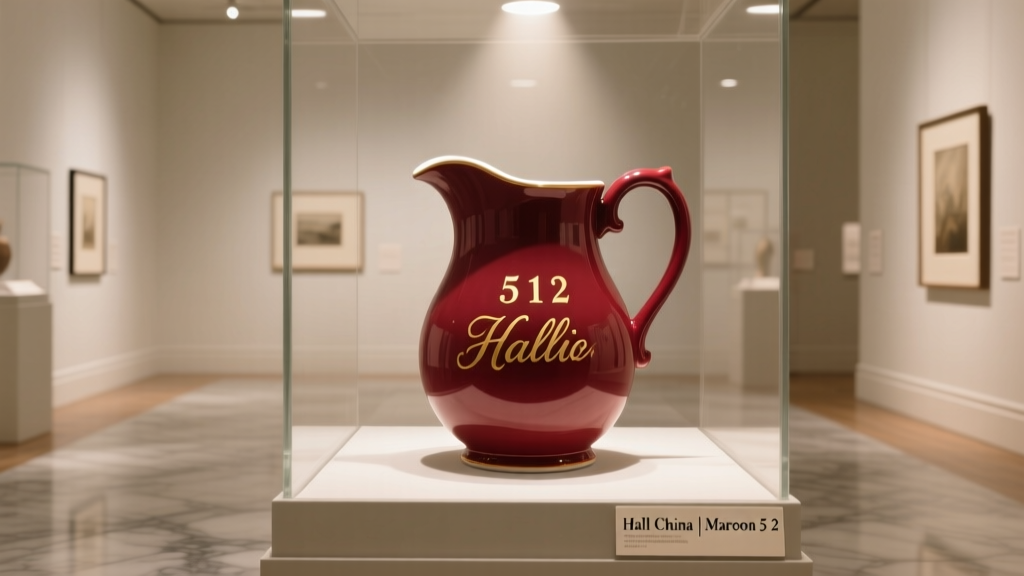
Hall China Pitcher Maroon, 5½-Inch: Authentication, Production History, and Market Value Analysis
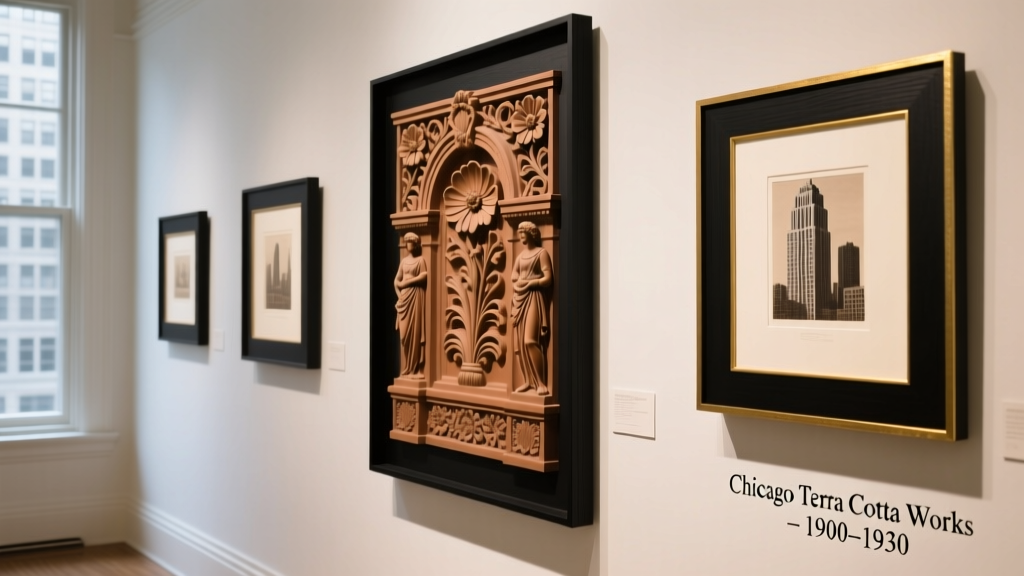
Chicago Terra Cotta Works: Architectural Legacy, Manufacturing Precision, and Authentication Challenges