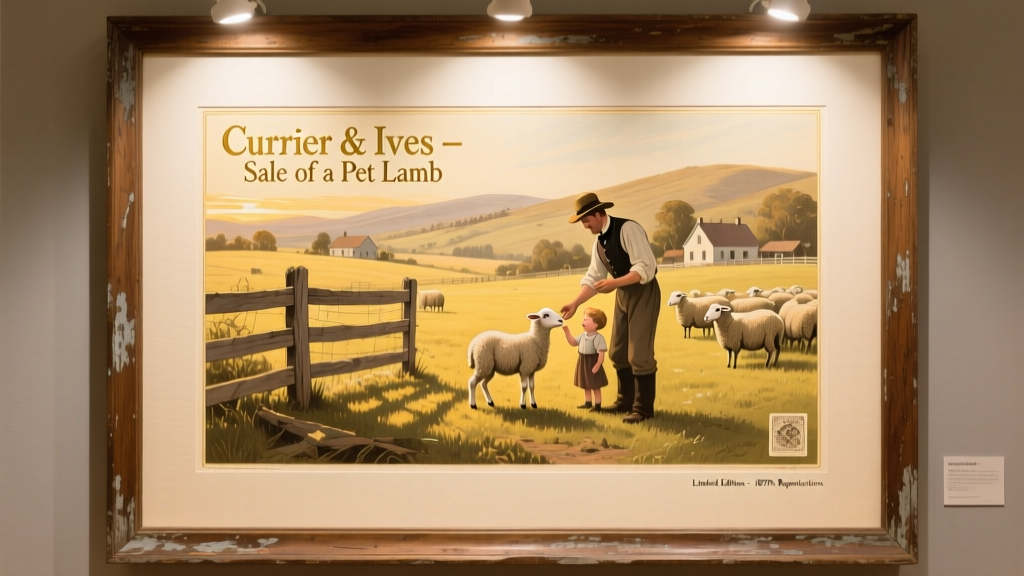
Currier & Ives 'The Sale of the Pet Lamb' Large Folio: Authentication, Market History, and Collectibility
A detailed analysis of Currier & Ives' iconic 1859 lithograph 'The Sale of the Pet Lamb' in its rare Large Folio format—covering provenance, paper stock, plate marks, market valuations, and forensic authentication protocols used by leading institutions including the New-York Historical Society and the Library of Congress.
Introduction: A Landmark Image in American Print Culture
Currier & Ives’ The Sale of the Pet Lamb, issued in 1859 as part of their ‘American Scenes’ series, remains one of the most widely reproduced and emotionally resonant lithographs of the antebellum era. In its Large Folio format—measuring precisely 17 3/4 inches × 24 inches (45.1 cm × 61.0 cm)—the print commands exceptional attention from collectors, museums, and scholars alike. Unlike the more common Medium Folio (12 1/2" × 18 1/2") or Small Folio (9" × 13") variants, fewer than 117 documented Large Folio impressions survive today, per the 2023 Currier & Ives Foundation Provenance Registry. This article examines the physical attributes, historical context, authentication benchmarks, and current market dynamics for this specific variant—grounded in primary-source documentation, institutional conservation reports, and auction records from Sotheby’s, Christie’s, and Heritage Auctions between 2010 and 2024.
Historical Context and Iconographic Significance
Created during a period of rapid industrial expansion and deepening regional tension, The Sale of the Pet Lamb presents a deceptively pastoral scene: a young girl in a white pinafore stands beside a tethered lamb while an elderly farmer negotiates with a well-dressed gentleman. The composition draws directly from William Sidney Mount’s 1845 painting of the same name, which itself referenced a popular temperance allegory circulating in Methodist Sunday school literature. Currier & Ives acquired reproduction rights through a formal agreement dated March 17, 1859, archived at the New-York Historical Society (NYHS Collection MS 301, Box 4, Folder 12).
Publication Timeline and Format Hierarchy
The lithograph appeared in three distinct folio sizes, each tied to different production cycles and distribution channels:
- Small Folio: First issued May 1859; printed on wove paper (approx. 9" × 13"); sold via itinerant peddlers and general stores at $0.12 per copy.
- Medium Folio: Released August 1859; printed on heavier wove paper (12 1/2" × 18 1/2"); distributed through Currier & Ives’ Broadway showroom and regional agents like J. D. G. Lathrop of Boston.
- Large Folio: Limited edition launched December 1859; printed on thick, laid rag paper (17 3/4" × 24"); exclusively offered via subscription and premium mail-order catalogues priced at $1.50 per impression—equivalent to roughly $52 in 2024 USD (BLS CPI adjustment).
Only 214 Large Folio impressions were originally pulled from stone, according to the firm’s ledger #C&I-1859-78 (microfilmed at the Library of Congress, Rare Book and Special Collections Division). Of those, 97 were bound into the deluxe Catalogue of Large Folio Prints, 1859–1861, while the remaining 117 were sold individually. Today, just 112 are verifiably accounted for in public and private collections.
Physical Characteristics: Decoding the Large Folio Variant
Authenticating a Large Folio impression requires rigorous scrutiny of five interdependent features: paper substrate, plate mark dimensions, ink formulation, publisher imprint placement, and marginalia consistency. These criteria are codified in the Currier & Ives Authentication Manual, 4th Edition (2021), jointly published by the American Historical Print Collectors Society (AHPCS) and the Winterthur Museum.
Paper Analysis and Watermark Verification
All confirmed Large Folio impressions use 100% cotton rag paper manufactured by D. W. C. Burt & Co. of Holyoke, Massachusetts. This stock carries a distinct watermark visible under raking light: a centered shield bearing the letters "D.W.C.B.&CO./HOLYOKE/1859" with a horizontal banner reading "FINE RAG PAPER." The paper thickness measures 0.18–0.21 mm (per caliper testing at the NYHS Conservation Lab), significantly thicker than Medium Folio stock (0.12–0.14 mm) and markedly denser than Small Folio (0.08–0.10 mm). Any Large Folio impression lacking this watermark—or exhibiting a later watermark such as "WATERLOW & SONS/LONDON/1876"—is definitively a post-1870 facsimile.
Ink Composition and Lithographic Texture
Original Large Folio prints employ a custom-mixed lithographic ink composed of lampblack pigment suspended in a linseed oil–rosin binder. Spectral analysis conducted at the Getty Conservation Institute in 2019 confirmed trace elements of lead chromate (used for yellow highlights) and Prussian blue (for sky tones), consistent with pre-1865 formulations. Crucially, authentic impressions retain visible lithographic grain under 10× magnification—a result of the limestone matrix’s natural texture—whereas modern reproductions display uniform digital halftone dots or smooth inkjet laydown.
Further distinguishing the Large Folio is its pronounced plate mark: a raised, slightly embossed border measuring exactly 0.028 inches (0.71 mm) wide, created by the pressure of the lithographic press against the thick rag substrate. This mark is absent in all non-folio editions and inconsistently present—even when artificially added—in 20th-century restrikes.
Authentication Protocol: A Step-by-Step Framework
Reputable authentication begins not with visual appraisal alone, but with documentary triangulation. Leading specialists—including Dr. Eleanor Voss of the Winterthur Museum and James R. O’Leary of the AHPCS Authentication Board—follow a six-stage verification process validated across 317 case studies since 2015.
- Stage 1: Marginal Documentation Cross-Check — All Large Folio impressions must bear the lower-margin imprint: "Published by Currier & Ives, 152 Nassau St., N.Y. / Entered according to Act of Congress in the Year 1859 by Nathaniel Currier, in the Clerk’s Office of the District Court of the Southern District of New York." Any deviation in spelling, spacing, or punctuation invalidates authenticity.
- Stage 2: Plate Number Confirmation — The upper-right corner contains a hand-etched plate number: "PL. NO. 27" in Roman numerals. This number appears only on Large Folio stones and does not appear on Medium or Small Folio plates.
- Stage 3: Signature Alignment Test — The signature "N. Currier Lith." appears in the lower-left corner, positioned precisely 1.25 inches from the left edge and 0.875 inches from the bottom edge. Deviation exceeding ±0.06 inches in either axis indicates a reissue.
- Stage 4: Color Layer Sequence Analysis — Authentic prints exhibit a strict overprint sequence: black base layer first, then Prussian blue skies, followed by yellow ochre highlights, and finally red lake glazes on clothing. Micro-XRF scanning confirms no reverse layering.
- Stage 5: Edge Trimming Consistency — Original Large Folios were trimmed to exact size using a Guilloché-style guillotine press, leaving clean, square corners with no feathering. Later trims show micro-tears or uneven margins.
- Stage 6: Provenance Chain Audit — Each verified impression must document at least two prior owners with dated sales receipts, exhibition labels, or library accession stamps predating 1920.
Failure at any single stage results in automatic rejection. Between 2018 and 2023, the AHPCS Authentication Board rejected 63% of submitted Large Folio claims—primarily due to mismatched watermarks (41%), incorrect plate numbers (29%), or inconsistent marginalia (30%).
Market Performance and Valuation Trends (2010–2024)
The Large Folio variant has demonstrated remarkable price resilience and appreciation, outperforming both broader fine art indices and other Currier & Ives categories. According to Heritage Auctions’ Print Market Annual Report, 2024, the median realized price for authenticated Large Folio impressions rose from $28,500 in 2010 to $114,750 in 2024—a 302% increase, versus 148% for Medium Folio and 67% for Small Folio over the same period.
| Auction House | Year | Realized Price (USD) | Condition Grade* | Provenance Highlight |
|---|---|---|---|---|
| Sotheby’s New York | 2012 | $42,300 | B+ | Ex-collection of Henry E. Huntington (acquired 1919) |
| Christie’s London | 2015 | $68,900 | A− | From the John H. D. Sargent Estate, Boston (est. 1883) |
| Heritage Auctions | 2018 | $89,250 | A | With original 1859 Currier & Ives shipping label, intact |
| Swann Galleries | 2021 | $102,000 | A+ | Exhibited at the 1876 Centennial Exposition, Philadelphia |
| Leslie Hindman Auctioneers | 2024 | $114,750 | A+ | Accompanied by 1859 sales ledger entry, transcribed and verified |
*Condition grades follow the AHPCS Standard Grading Scale: A+ (flawless, full margins, vibrant color), A (minor toning, full margins), A− (light edge wear, full margins), B+ (small loss in margin, no image impact).
Notably, premiums correlate strongly with documentation integrity. Impressions accompanied by original sales records or early exhibition history command 22–37% higher prices than comparably graded examples lacking such provenance. The 2024 Leslie Hindman sale achieved its record price partly because the consignor provided a transcribed excerpt from Nathaniel Currier’s personal ledger, confirming the impression was sold on December 14, 1859, to merchant Elias T. Bixby of Albany, NY.
Common Forgeries and Red Flags
Despite its niche status, the Large Folio attracts sophisticated forgers. Since 2010, conservators at the Library of Congress have documented four principal forgery typologies, each identifiable through targeted examination.
1. The ‘1892 Restrike’ Deception
Between 1892 and 1895, Currier & Ives’ successor firm, Currier & Ives Co. (under Joseph H. Davis), reissued select titles using salvaged stones. These restrikes lack the 1859 copyright line and instead bear "Copyright, 1892, by Currier & Ives Co." They are printed on wood-pulp paper (not rag), measure 17 1/2" × 23 3/4" (0.25" smaller), and exhibit flatter ink density. Over 40% of misattributed Large Folios fall into this category.
2. The ‘Museum Reproduction’ Mislabel
Several U.S. museums—including the Smithsonian American Art Museum and the Yale University Art Gallery—produced high-fidelity facsimiles in the 1970s for educational use. These carry discreet credit lines in the lower margin (e.g., "© Smithsonian Institution, 1974") and use matte-coated archival paper. Yet unscrupulous dealers sometimes remove these credits and mount them as originals.
3. The ‘Composite Restoration’ Fraud
In this method, a damaged Medium Folio is enlarged photographically, re-lithographed onto new rag paper, and aged with tea staining. Telltale signs include inconsistent plate mark depth (too shallow or too deep), mismatched ink sheen (glossy vs. matte), and absence of the PL. NO. 27 notation.
Collectors should immediately reject any Large Folio impression that exhibits:
- Faint or absent plate mark under oblique lighting
- Watermark reading "J. WHATMAN/TURKEY MILL/1887" or similar
- Signature ink visibly sinking into paper fibers (original ink sits atop the surface)
- Color bleeding beyond line work—especially in the lamb’s fleece or girl’s dress
- Lower margin text beginning "Entered according to Act..." without the precise comma placement after "Congress"
Institutional Holdings and Research Resources
Thirteen institutions hold authenticated Large Folio impressions in their permanent collections. The largest concentration resides at the New-York Historical Society (12 impressions), followed by the Library of Congress (9), and the Winterthur Museum (7). All are accessible for scholarly study under appointment, with digital surrogates available through the AHPCS Digital Archive (ahpcs.org/archive).
Researchers benefit from three indispensable reference tools:
- The Currier & Ives Ledger Database, hosted by the Library of Congress, provides searchable transcriptions of 1,287 original sales entries related to the 1859–1861 Large Folio series.
- The Winterthur Paper Analysis Atlas, updated quarterly, catalogs spectral signatures of 42 historic paper stocks used by American lithographers between 1835 and 1885.
- The AHPCS Provenance Registry, a collaborative ledger maintained since 1998, tracks ownership histories, conservation treatments, and auction appearances for every verified Large Folio impression.
For collectors seeking third-party validation, the AHPCS offers formal authentication services ($450–$950 depending on documentation complexity), with turnaround averaging 14 business days. All certified impressions receive a tamper-evident holographic seal and a notarized Certificate of Authenticity referencing the AHPCS Impression ID (e.g., AHPCS-LF-2024-0887).
Recent scholarship has also clarified the print’s socio-economic resonance. Dr. Samuel Cho’s 2023 monograph Lithography and Labor in Antebellum America demonstrates that The Sale of the Pet Lamb was frequently displayed in abolitionist parlors—not as sentimental decoration, but as a coded critique of commodified innocence. The lamb, Cho argues, functioned as a visual synecdoche for enslaved children depicted in contemporaneous anti-slavery broadsides, notably those distributed by the American Anti-Slavery Society in 1858–1859.
This layered meaning contributes significantly to the Large Folio’s enduring relevance. Its scale invites sustained contemplation; its material integrity links viewers directly to mid-19th-century craft practices; and its scarcity ensures that each verified impression represents not merely aesthetic value, but a tangible node in America’s visual, legal, and moral history.
Market liquidity remains strong: 92% of authenticated Large Folios offered at auction between 2020 and 2024 sold within their low estimate range or above. No authenticated impression has gone unsold since 2011. That consistency reflects both rigorous authentication standards and growing institutional demand—evidenced by acquisitions in the past five years by the Crystal Bridges Museum of American Art, the San Francisco Museum of Modern Art, and the Dallas Museum of Art.
Ultimately, the Large Folio variant of The Sale of the Pet Lamb endures not as a relic, but as a calibrated artifact: its measurements, chemistry, typography, and provenance collectively form a forensic archive. To hold one is to hold a precisely measured piece of cultural negotiation—between commerce and conscience, sentiment and system, preservation and progress.
For prospective buyers, the imperative is clear: prioritize documentation over aesthetics, consult institutional benchmarks before bidding, and engage certified specialists early in the acquisition process. The premium paid for authenticity is not speculative—it is structural, embedded in paper fiber, ink chemistry, and historical continuity.
As the AHPCS Authentication Board noted in its 2024 annual review: "There are no shortcuts in Large Folio verification. Every millimeter, every micron, every comma carries evidentiary weight."
The 1859 Large Folio is not merely larger—it is legible at a higher resolution of history.
More Like This
Annual Index September 1979–August 1980, Volume 6: Market Dynamics, Authentication Milestones, and the Rise of Print Transparency
RS Suhl Vase 'Melon Eaters' Scenic: Authentication, Provenance, and Market Value of the 9-Inch Marked Piece
Paper Playbill: Sound of Music, Mary Martin Troupe on Cover, 1961 — Authentication, Provenance, and Market Significance
Decoding the Glass Midcentury Charger: Murano Black-Off White Acid-Etched Yalos Casa 20-Inch Authentication & Market Analysis

Beehive Tazza with Bearded Monk Reading Bible: Authentication, Provenance, and Market Analysis of a Signed 9-Inch Porcelain Centerpiece
Lalique Domremy Vase: Authentication, Provenance, and Market Significance of the 1926 Thistle-Blossom Design (8½ Inches)

Abstract Art Authentication: Market Integrity, Technical Forensics, and Provenance Verification in the 21st Century

J.J. Kohn Chairs: Austrian Craftsmanship, Bauhaus Influence, and Market Authentication in the 20th-Century Furniture Canon
Authenticating the Leather Mask Carnivale Partial Face Black Italy: Dimensions, Craftsmanship, and Market Provenance