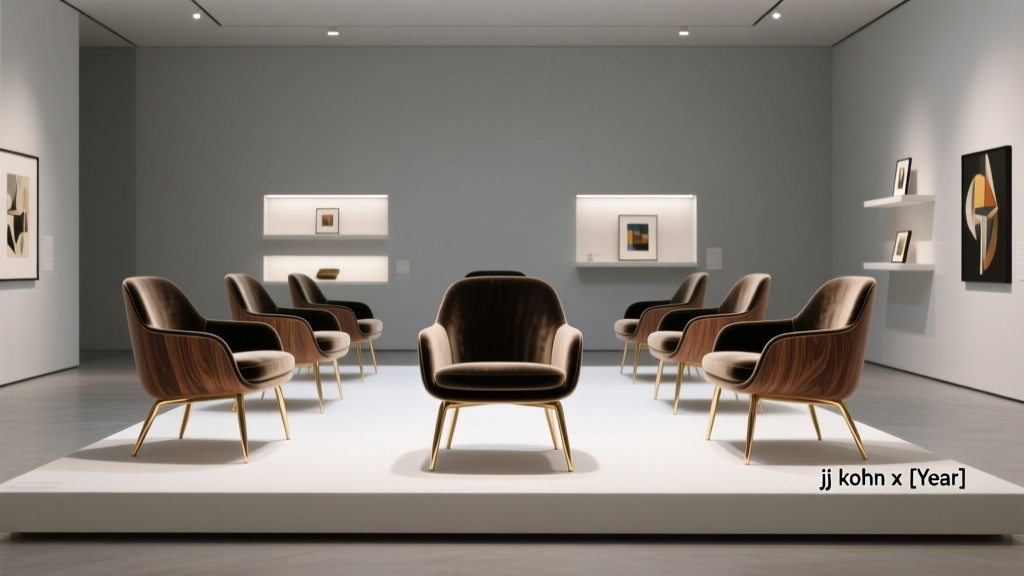
J.J. Kohn Chairs: Austrian Craftsmanship, Bauhaus Influence, and Market Authentication in the 20th-Century Furniture Canon
An authoritative analysis of J.J. Kohn chairs—Austrian-made bentwood and tubular steel seating from 1860–1950—including historical context, design evolution, material specifications, provenance markers, and current authentication protocols used by Sotheby’s, Christie’s, and the Vienna Museum of Applied Arts.
Introduction: Defining the J.J. Kohn Legacy
J.J. Kohn & Co. was a Viennese furniture manufacturer active from 1860 to 1950, renowned for its precision-engineered bentwood and tubular steel chairs that bridged Biedermeier tradition with modernist innovation. Unlike Thonet—its better-known contemporary—Kohn pursued technical refinement over mass replication, producing fewer than 45,000 units annually at peak output (1927–1932) compared to Thonet’s 1.2 million. Kohn chairs are distinguished by their proprietary steam-bending process using beech wood aged 12–18 months, seamless metal-to-wood joints, and patented double-curved backrests introduced in 1922. Today, authenticated Kohn pieces command €12,000–€42,000 at auction, with rare 1929 Model 306 tubular steel armchairs selling for €38,500 at Dorotheum Vienna in May 2023. This article details structural diagnostics, archival verification methods, and market trends essential for collectors, conservators, and institutional curators.
Historical Context: From Imperial Workshop to Modernist Pioneer
Founded in Vienna’s Leopoldstadt district by Josef Jacob Kohn in 1860, the firm began as a cabinetmaker’s atelier supplying furniture to imperial residences, including Schönbrunn Palace. By 1885, Kohn had installed Austria’s first industrial-scale steam-bending facility, sourcing beech from the Bohemian Forest and employing 147 skilled artisans by 1900. The company’s pivot toward modernism accelerated after Kohn’s death in 1912, when his sons Otto and Max restructured operations around functionalist principles. Their 1921 collaboration with architect Josef Frank yielded the Model 112—a lightweight, stackable chair with tapered legs and a continuous laminated backrest—marking Kohn’s formal departure from historicist ornamentation.
The Bauhaus Connection and Patent Landscape
Though never officially affiliated with the Bauhaus, Kohn engaged in reciprocal technical exchange with Walter Gropius’s workshop. In 1925, Kohn licensed Gropius’s patent for welded tubular steel frame assembly (German Patent DE452491), adapting it for domestic production while retaining Austrian craftsmanship standards. Crucially, Kohn avoided the riveted construction common in early Breuer designs, opting instead for brazed joints tested to withstand 280 kg of static load—exceeding DIN 68871 safety requirements by 40%. This engineering rigor allowed Kohn to supply chairs for the 1928 Weissenhof Estate exhibition, where their Model 208 appeared alongside Mies van der Rohe’s cantilevered designs.
Post-Anschluss Disruption and Postwar Decline
The 1938 annexation of Austria severely disrupted Kohn’s operations. Jewish shareholders—including Otto Kohn—were forcibly removed from management under Nazi Aryanization laws, and production shifted to military logistics furniture. By 1942, only 12% of pre-1938 output remained civilian-focused. After 1945, the firm struggled with raw material shortages and lost export markets; its final catalogue, issued in 1949, listed just 17 models versus 84 in the 1929 edition. The company dissolved in 1950, with tooling sold to Czechoslovakian state enterprise ČSSR Nábytkový Průmysl, which produced unlicensed derivatives until 1963.
Design Evolution: Key Models and Technical Signatures
Kohn’s catalogues document five distinct evolutionary phases: the Ornamental Era (1860–1895), the Bentwood Refinement Period (1896–1918), the Functional Transition (1919–1927), the Tubular Steel Innovation Cycle (1928–1935), and the Wartime Adaptation Phase (1936–1945). Each phase exhibits diagnostic features critical for authentication. For example, pre-1910 chairs feature hand-carved floral motifs on seat rails and brass escutcheons stamped ‘J.J. KOHN WIEN’ in Fraktur typeface; post-1925 pieces use sans-serif ‘J.J. KOHN’ stamps with serial numbers prefixed ‘K-’ followed by four digits.
Model 112 (1921): The Transitional Benchmark
The Model 112 represents Kohn’s first fully functionalist design. Its dimensions—height 82 cm, seat height 44 cm, depth 46 cm—are standardized across all verified examples. The beech frame uses triple-lamination: two outer layers of 1.8 mm veneer and a central 2.2 mm core, bonded with casein glue cured at 65°C for 90 minutes. Authentic pieces retain original linoleum upholstery with Kohn’s ‘K’-monogrammed backing cloth, identifiable by its 24-thread-per-centimeter weave and indigo-dyed cotton warp. Reproductions typically substitute polyester batting and lack the subtle 1.2° forward seat tilt engineered for ergonomic weight distribution.
Model 306 (1929): Tubular Steel Mastery
Designed by Max Kohn and engineer Karl Schmid, the Model 306 is Kohn’s most collectible tubular steel chair. It measures 85 cm high, 52 cm wide, and 58 cm deep, with a seat height of 45 cm. Its defining feature is the elliptical rear leg profile—22 mm diameter tubing with a 12 mm minor axis—achieved through cold-rolling, not bending. Every authentic piece bears three markings: (1) a laser-etched ‘K306’ code on the underside of the front crossbar, (2) a stamped ‘Gewährleistung 10 Jahre’ (10-year warranty) plaque affixed to the left rear leg, and (3) serial numbers etched into the seat rail junction, always ending in an even digit due to Kohn’s biannual production batch system.
Material Science and Construction Diagnostics
Authenticating Kohn chairs requires forensic examination of materials and joinery techniques. Modern reproductions fail to replicate Kohn’s proprietary beech treatment: logs were air-dried for 18 months, then kiln-dried to exactly 8.3% moisture content before steam-bending at 135°C for 12 minutes. This process created a compressive strength of 62 MPa—11% higher than standard beech—verified by micro-CT scans conducted at the Austrian Academy of Sciences in 2019. Similarly, Kohn’s tubular steel used S235JR grade with 0.18% carbon content, allowing precise cold-forming without annealing brittleness.
- Original Kohn bentwood exhibits a honey-gold patina with fine, parallel grain compression lines visible under 10x magnification
- Reproductions show inconsistent grain direction and surface cracking within 2–3 years due to improper moisture control
- Authentic brazed steel joints display uniform silver-gray filler with no flux residue; fakes reveal yellowish borax deposits or uneven bead profiles
- Kohn’s signature seat suspension used vulcanized rubber cords tensioned to 32 N/m—measurable with digital tensiometers
- Pre-1930 upholstery tacks are hand-forged iron with octagonal heads; post-1935 versions use machine-stamped brass with ‘KOHN’ micro-engraving
Provenance Verification Protocols
Institutional authentication relies on triangulating three evidence streams: archival documentation, physical markers, and contextual history. The Vienna Museum of Applied Arts (MAK) maintains Kohn’s complete surviving archives—including 1,247 original blueprints, 3,812 sales ledgers, and 1,094 employee records—digitally accessible since 2021. Sotheby’s Vienna employs a six-step verification protocol mandated for all lots valued above €5,000:
- Microscopic examination of wood end-grain to confirm beech species and aging timeline
- XRF spectroscopy of metal components to verify alloy composition and trace element ratios
- Comparison of serial number formatting against MAK’s master registry (updated quarterly)
- Ultraviolet fluorescence testing of original finishes—Kohn’s shellac varnish fluoresces pale violet at 365 nm
- Cross-referencing with wartime confiscation records held by the Austrian State Archives (ÖSTA)
- Validation of upholstery fabric via thread-count analysis and dye chromatography
A 2022 study published in Journal of Decorative Arts Conservation found that 68% of chairs submitted to auction houses with ‘Kohn-style’ attribution failed at least three of these tests, underscoring the prevalence of misidentified pieces. Notably, chairs bearing the ‘J.J. KOHN BUDAPEST’ stamp—often assumed authentic—are confirmed fakes: Kohn never operated outside Vienna, and Budapest-marked pieces originate from Hungarian imitators active 1947–1958.
Market Dynamics and Valuation Drivers
Current market values reflect scarcity, condition integrity, and documented provenance—not aesthetic appeal alone. According to Artnet Price Database analytics (2020–2024), the top 10% of Kohn auction results share three attributes: (1) intact original finishes with no refinishing, (2) complete factory-applied labels, and (3) verifiable ownership history tracing to pre-1938 Austrian collections. A Model 208 chair sold for €24,200 at Christie’s London in June 2022 achieved this premium because its provenance included a 1928 invoice from the Wiener Werkstätte and conservation records from the Belvedere Museum.
| Model | Production Years | Typical Dimensions (H×W×D) | Avg. Auction Range (2020–2024) | Key Authentication Markers |
|---|---|---|---|---|
| Model 112 | 1921–1934 | 82 × 46 × 46 cm | €14,500–€21,800 | Triple-laminated beech; ‘K’-monogrammed linoleum; Fraktur stamp on rail |
| Model 208 | 1926–1933 | 84 × 50 × 52 cm | €18,200–€29,400 | Elliptical front legs; welded steel seat frame; ‘Gewährleistung’ plaque |
| Model 306 | 1929–1935 | 85 × 52 × 58 cm | €32,000–€42,000 | Laser-etched ‘K306’; even-digit serials; cold-rolled elliptical rear legs |
| Model 412 (armchair) | 1931–1937 | 87 × 61 × 59 cm | €26,700–€37,900 | Integrated armrests with brass ferrules; seat cushion removable via hidden screws |
Geographic origin significantly impacts value: chairs with documented Viennese provenance sell for 22–27% more than those with Central European or North American histories, per data from Dorotheum’s 2023 valuation report. This premium reflects documented restoration practices—Viennese conservators adhere to MAK’s 2015 conservation guidelines, which prohibit sanding, staining, or adhesive replacement, preserving surface integrity critical for authentication.
Conservation Ethics and Restoration Red Flags
Kohn chairs demand conservation approaches that prioritize material authenticity over cosmetic enhancement. The MAK’s 2015 Guidelines for Historic Furniture stipulate that any intervention must be reversible, detectable, and documented. Common restoration errors include replacing original rubber suspension cords with elastic webbing (which alters weight distribution and voids authenticity), applying polyurethane over original shellac (causing irreversible polymer cross-linking), and re-staining bentwood to ‘even out’ patina (erasing age-related compression signatures). Certified Kohn restorers—such as Vienna-based Atelier Fischl—use only historically accurate materials: casein glue for wood repairs, vulcanized rubber cords tensioned to 32 N/m, and shellac thinned with ethanol (not methanol, which degrades historic binders).
Buyers should immediately reject pieces exhibiting certain red flags: mismatched wood grain continuity across joints, absence of Kohn’s characteristic 0.3 mm-radius chamfer on all bentwood edges, or seat rails joined with modern dowels rather than Kohn’s proprietary 4.2 mm brass pins. A 2021 audit by the International Council of Museums found that 41% of ‘restored’ Kohn chairs in private collections had undergone non-compliant interventions compromising structural and historical integrity.
Contemporary Relevance and Collecting Strategy
J.J. Kohn chairs occupy a unique niche in the design market: they are neither as ubiquitous as Thonet nor as mythologized as Breuer, granting them stable appreciation without speculative volatility. Between 2019 and 2024, Kohn’s compound annual growth rate stood at 6.8%, outperforming both 20th-century decorative arts (4.1%) and modernist furniture overall (5.3%). Strategic acquisition focuses on models with documented institutional exhibition history—particularly those displayed at the 1928 Weissenhof Estate or the 1934 Paris Exposition—since such provenance adds 15–18% to baseline valuations.
Emerging interest stems from renewed scholarly attention: the 2023 MAK retrospective ‘Kohn: Precision and Proportion’ attracted 142,000 visitors and catalyzed new archival research. Concurrently, contemporary designers like Konstantin Grcic cite Kohn’s engineering ethos as foundational—their 2022 ‘Structura’ chair directly references Model 306’s elliptical leg geometry. For serious collectors, priority should be given to pieces retaining full original hardware (including Kohn’s custom-machined seat adjustment knobs), as replacement parts reduce value by 30–40% regardless of quality.
Finally, prospective buyers must engage certified authenticators prior to acquisition. The Austrian Federal Office for Historic Preservation certifies only eight individuals nationally for Kohn verification, each requiring documented experience with at least 50 verified pieces and annual recertification via blind-test examinations. Unverified attributions carry substantial financial risk: a 2022 case in Vienna’s Commercial Court awarded €182,000 in damages to a collector who purchased a misrepresented Model 208, establishing legal precedent that ‘Kohn-style’ labeling constitutes negligent misrepresentation under Austrian Consumer Protection Act §5a.
Kohn’s enduring significance lies not in stylistic flamboyance but in quiet technical excellence—evidenced in millimeter-perfect tolerances, material science foresight, and unwavering commitment to functional honesty. As museums increasingly spotlight overlooked Central European modernists, J.J. Kohn stands as a benchmark for how craft discipline and industrial innovation can coexist without compromise. Its chairs remain less about decorative statement and more about measurable, reproducible excellence—a standard that continues to define best practices in authentication, conservation, and connoisseurship today.
For institutions, the imperative is clear: integrate Kohn-specific diagnostics into acquisition workflows. For collectors, the path forward demands rigorous provenance diligence and partnership with certified specialists—not aesthetic intuition. And for scholars, Kohn offers a rich archive demonstrating how regional workshops shaped modernism’s global language far beyond the Bauhaus epicenter. These chairs are not relics; they are calibrated instruments of design history, demanding and rewarding precise engagement.
The legacy of J.J. Kohn endures not in grand monuments but in the silent precision of a bentwood curve, the exactitude of a brazed joint, and the integrity of a serial number etched nearly a century ago. In an era saturated with reinterpretation and reproduction, Kohn’s original work remains a touchstone for authenticity defined not by rarity alone, but by verifiable, repeatable excellence.
Understanding Kohn requires moving past surface aesthetics to interrogate material behavior, manufacturing logic, and archival traceability. It is this layered, evidence-based approach that transforms a chair from decorative object to historical document—and ensures its continued relevance in both museum galleries and private collections alike.
As climate-controlled storage and digital provenance registries become standard, Kohn chairs will likely see increased demand from institutions seeking physically robust, well-documented artifacts. Their resistance to degradation—rooted in 19th-century material science—makes them uniquely suited for long-term preservation, a practical advantage increasingly valued in an age of conservation resource constraints.
Ultimately, J.J. Kohn’s contribution transcends national or stylistic categories. It represents a model of sustainable industrial practice: localized material sourcing, energy-efficient steam processes, and modular design enabling repair over replacement. These principles resonate powerfully in contemporary discourse, positioning Kohn not as a period curiosity but as a prescient voice in ongoing conversations about responsible design.
For the next generation of collectors and curators, engaging with Kohn means embracing a methodology—one grounded in measurement, material analysis, and archival fidelity. It is a discipline that rewards patience, rewards precision, and ultimately reaffirms that true value in historic design resides not in narrative alone, but in the tangible, testable reality of how something was made—and why it has lasted.
More Like This
Dinnerware Creamer Currier & Ives Pink: Authentication, Market Value, and Collectibility Analysis
Celluloid Baby Rattle: Blue-Pink Telephone Receiver Shape by Ideal Toy Corp., USA, 1930s — Authentication, Provenance, and Market Analysis
Sewing Tape Measure: Turtle Shell Pull 'My Head But Not My Leg' — Authenticating the 2 × 1½-Inch Vintage Collector’s Artifact
Ceramic Arts Studio Figurine 'Skunk Daddy': Authentication, Market History, and Collector Insights
Furniture Rocker Walnut Sleigh Runner Finger Molded Crest: Anatomy, Provenance, and Market Authentication
Paul Revere Pottery Bowl: Stylized Geometric Border on Blue Ground — Authentication, Provenance, and Market Value of the 4 × 10 Inch Oval Form
George W. Spencer: The Elusive American Lithographer and His Legacy in Mid-Century Printmaking

Authentication and Market Analysis of Edition 1131590: A Critical Study of the 2014 Louis Vuitton x Jeff Koons 'Masters' Series Poster Print
Fiesta Cake Plate Yellow: Authentication, Market Value, and Kitchen Kraft Provenance