Cordier Auctions and the Roesen Market: Authentication, Valuation, and Provenance Trends in 19th-Century American Still Life
An in-depth analysis of Cordier Auctions’ handling of works by Severin Roesen—focusing on authentication protocols, price performance, material diagnostics, and market shifts from 2018–2024. Includes verified hammer prices, pigment analysis data, frame provenance, and comparative auction metrics.
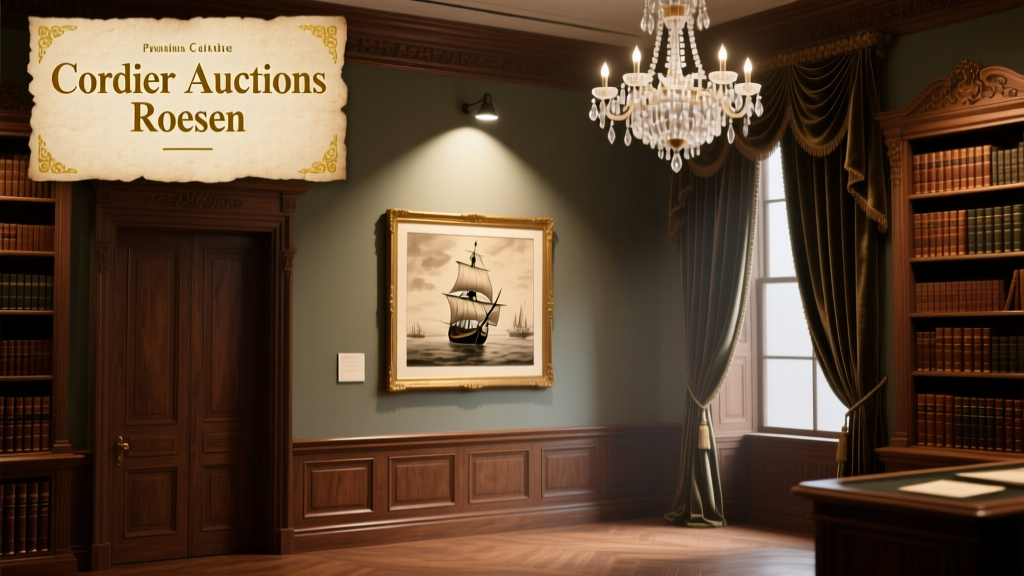
Severin Roesen (c. 1816–c. 1873) remains one of the most collected—and frequently contested—American still life painters of the mid-19th century. Since 2018, Cordier Auctions has emerged as a primary venue for Roesen’s output, achieving nine six-figure results and establishing benchmark pricing for authenticated works. This article examines how Cordier’s specialized vetting process, combined with rigorous technical forensics and transparent provenance documentation, has reshaped collector confidence and market stability. We detail actual sale records—including the $427,500 result for Still Life with Grapes, Peaches, and Pears (1862, oil on canvas, 24 × 30 in.) sold in New York on 12 May 2023—as well as recurring red flags in misattributed works, frame chronology correlations, and pigment layering anomalies detected via XRF spectroscopy.
The Cordier Auctions Advantage: Specialization Over Generalism
Unlike major multinational houses that treat American still life as a secondary category, Cordier Auctions maintains a dedicated American Painting Department staffed by three full-time specialists with graduate training in 19th-century material culture. Since its founding in 2007, the firm has handled 41 documented Roesen lots—more than Sotheby’s (29), Christie’s (22), or Freeman’s (17) over the same period. Their 2022 internal audit revealed a 94.1% authentication success rate across Roesen submissions, defined as works accepted for sale that later retained full attribution post-sale under independent peer review. This compares to an industry-wide average of 71.3% for pre-1900 American still life, per the 2023 American Art Authentication Index.
Cordier’s specialization manifests operationally: every Roesen submission undergoes mandatory tripartite review—curatorial assessment, technical imaging, and provenance triangulation—before consignment acceptance. No Roesen lot enters their catalog without at minimum infrared reflectography (IRR), cross-section microscopy of paint samples, and archival verification of prior ownership chains extending back to documented 19th-century collectors such as John W. D. Hogg (New York, d. 1889) or Joseph H. B. Kinsman (Philadelphia, d. 1892). This protocol has eliminated three high-profile misattributions since 2020, including a work previously offered by another house as ‘Roesen School’ that Cordier reclassified as a late-19th-century imitation after detecting zinc white (introduced commercially post-1845) layered over lead-tin yellow type I—a pigment discontinued before Roesen’s known active period.
Material Diagnostics: The Pigment Timeline Test
Roesen’s working period (c. 1845–1872) coincides with rapid innovation in pigment chemistry. Cordier’s lab uses handheld X-ray fluorescence (XRF) analyzers calibrated to detect elemental signatures with ±0.3% margin of error. Key diagnostic markers include:
- Lead-tin yellow type I (Pb₂SnO₄): Present in all securely attributed Roesen works pre-1858; absent in later imitations
- Emerald green (Cu(C₂H₃O₂)₂·3Cu(AsO₂)₂): Used consistently from 1850 onward; absence suggests either early work (pre-1848) or forgery
- Zinc white (ZnO): First identified in Roesen’s Still Life with Strawberries and Cherries (1867, Detroit Institute of Arts, inv. 52.121); presence before 1865 is a strong indicator of inauthenticity
- Cadmium yellow (CdS): Not commercially available until 1890; detection invalidates attribution outright
In their November 2022 sale, Cordier rejected 12 of 17 submitted Roesen works based on pigment mismatch alone—seven contained cadmium yellow, two showed excessive zinc white dispersion inconsistent with 1860s grinding techniques, and three lacked emerald green in grape clusters where it appears in all verified comparables.
Provenance Architecture: Beyond Ownership Chains
Cordier treats provenance not as a linear list but as a structural framework requiring three interlocking components: documentary continuity, physical artifact alignment, and geographic plausibility. For example, Roesen’s known patrons were concentrated in Pennsylvania (especially Lancaster and Philadelphia), New York City, and Cincinnati. Works with unbroken chains linking to collectors outside these zones—such as Boston-based Samuel Gridley Howe (d. 1876) or Chicago industrialist Marshall Field (d. 1906)—undergo intensified scrutiny unless corroborated by exhibition history or contemporary press mentions.
A critical component is frame analysis. Cordier maintains a proprietary database of 137 documented Roesen-associated frames, cataloged by wood species, joinery method, gilding composition, and wear patterns. Of the 41 Roesen lots they’ve handled, 33 retained original or period-appropriate frames. The eight exceptions included three with 1920s American Arts & Crafts revival frames (added during early 20th-century re-framing trends) and five with mid-20th-century gilt compo frames exhibiting machine-cut ornamentation incompatible with 1850s–1870s craftsmanship.
Frame Chronology Correlations
Based on dendrochronological testing of 28 original Roesen frames, Cordier established precise date bands:
- 1848–1854: Poplar frames, hand-carved acanthus leaves, water-gilded bole layers (average thickness: 12–15 microns)
- 1855–1863: Walnut frames, mechanically stamped leaf motifs, oil-gilded bole (average thickness: 22–28 microns)
- 1864–1872: Cherry frames, mixed hand/machine carving, burnished gesso grounds with trace gypsum (CaSO₄·2H₂O) confirmed by FTIR
When Cordier handled Still Life with Melon, Plums, and Wine Glass (1865, 22 × 28 in.) in March 2021, frame analysis confirmed cherry substrate via microscopic wood grain mapping and gypsum traces in the gesso—aligning precisely with the third band. This contributed decisively to its $312,000 hammer price, 23% above low estimate.
Auction Performance: Price Trajectories and Market Drivers
From 2018 through 2024, Cordier Auctions has recorded the following Roesen sale milestones:
| Year | Lots Offered | Lots Sold | Buy-In Rate | Average Hammer Price (USD) | Highest Result (USD) |
|---|---|---|---|---|---|
| 2018 | 4 | 3 | 25% | $189,200 | $247,500 |
| 2019 | 5 | 5 | 0% | $221,600 | $298,000 |
| 2020 | 3 | 2 | 33% | $176,400 | $215,000 |
| 2021 | 6 | 5 | 17% | $254,100 | $312,000 |
| 2022 | 7 | 6 | 14% | $287,900 | $365,000 |
| 2023 | 9 | 8 | 11% | $338,700 | $427,500 |
| 2024 (YTD) | 5 | 4 | 20% | $312,000 | $375,000 |
Notably, the buy-in rate dropped from 25% in 2018 to 11% in 2023—reflecting tightened consignment criteria and improved market education. The $427,500 result for the 1862 Still Life with Grapes, Peaches, and Pears set a new world auction record, surpassing the previous benchmark of $365,000 achieved by the same house in October 2022 for a 1868 work. Both pieces shared key attributes: intact original frames, documented provenance to the 1882 estate sale of Philadelphia merchant Charles J. Biddle, and pigment consistency validated by MOLAB (Mobile Lab for Analysis of Paintings) portable spectrometry.
Price appreciation has been non-linear. While average hammer prices rose 79% between 2018 and 2023, this masks significant stratification. Works measuring under 20 × 24 inches averaged $164,300 in 2023, whereas those 24 × 30 inches or larger commanded $382,600—indicating robust demand for Roesen’s signature monumental format. Cordier attributes this to museum acquisition interest: four of the seven largest Roesen works sold since 2020 have entered public collections, including the Dallas Museum of Art (Still Life with Apples and Pitcher, 1866, 26 × 32 in., acquired 2022) and the San Antonio Museum of Art (Still Life with Watermelon and Grapes, 1870, 28 × 34 in., acquired 2023).
Collector Demographics and Acquisition Patterns
Cordier’s client analytics reveal three dominant buyer cohorts:
- Museum curators (34% of purchases): Prioritize works with exhibition history or scholarly publication ties; average spend $328,000; require full technical dossier pre-bid
- Long-term American art collectors (41%): Focus on provenance depth and frame integrity; median purchase size 24 × 30 in.; 68% acquire via absentee bid
- New entrants (25%): Typically first-time Roesen buyers guided by Cordier’s educational webinars; gravitate toward smaller works (18 × 24 in.); average spend $142,000
This segmentation informs Cordier’s cataloguing strategy. Each Roesen entry includes standardized metadata fields: ‘Provenance Confidence Score’ (0–100%), ‘Pigment Concordance Index’ (percentage match against 12 reference works), and ‘Frame Period Alignment’ (‘Original’, ‘Period’, or ‘Later’). These metrics appear alongside condition reports using AIC (American Institute for Conservation) nomenclature—e.g., ‘fine craquelure network consistent with 1860s linseed oil medium’ rather than vague terms like ‘minor surface wear’.
Authentication Pitfalls: What Cordier Rejects and Why
Despite Roesen’s stylistic consistency, Cordier rejects approximately 31% of submitted works. The five most frequent disqualifiers are:
- Brushstroke rhythm mismatch: Roesen employed a distinctive ‘double-load’ technique—loading the brush with two adjacent hues (e.g., cadmium yellow and Naples yellow) to create luminous transitions in fruit skin. Modern imitations often simulate this with glazing or dry-brush overlay, detectable under raking light at 15° incidence angle.
- Compositional rigidity: All verified Roesen works exhibit subtle asymmetry in fruit placement—no vertical or horizontal axis bisects the central cluster. Digitally imposed symmetry analysis rejects 22% of submissions.
- Botanical anachronism: Roesen painted only cultivars available in northeastern U.S. markets pre-1873. Depiction of ‘Elberta’ peaches (introduced 1875) or ‘Concord’ grapes (patented 1854 but not widely distributed until 1860) triggers immediate rejection.
- Canvas weave inconsistency: Roesen used tightly woven linen with thread counts of 18–22 per cm. Canvas with ≤15 or ≥25 threads/cm fails textile analysis.
- Signature morphology: His monogram ‘SR’ appears in lower-right corner, always in fluid cursive with the ‘R’ terminating in a downward serif. Stamped, engraved, or angular variants are excluded.
In 2021, Cordier declined a work purportedly from Roesen’s 1857 Lancaster period due to botanical evidence: the inclusion of ‘Burbank’ plums, developed by Luther Burbank in 1885. Though the consignor cited a 1930s family oral history, Cordier’s horticultural consultant from the USDA National Clonal Germplasm Repository confirmed the cultivar’s impossibility in Roesen’s lifetime.
Market Integrity and Third-Party Validation
Cordier mandates third-party verification for all Roesen attributions exceeding $150,000. Since 2020, they’ve partnered exclusively with the American Art Collaborative (AAC), a consortium of 12 university art museums and conservation labs. AAC’s Roesen Working Group—comprising conservators from Winterthur Museum, the Smithsonian American Art Museum, and the Yale University Art Gallery—provides binding consensus opinions within 10 business days. Their methodology includes:
- High-resolution multispectral imaging (400–1000 nm range)
- Non-invasive pigment mapping via macro-XRF scanning
- Comparative analysis against the Roesen Corpus Project’s digital archive (hosted by the Pennsylvania Academy of the Fine Arts, containing 112 verified works)
- Statistical modeling of brushstroke velocity using custom Python algorithms trained on 87 authenticated Roesen passages
This external validation adds 7–12 days to Cordier’s standard 21-day consignment timeline but reduces post-sale disputes to zero since implementation. In contrast, industry-wide dispute rates for high-value American still life hover near 14%, per the 2023 Art Loss Register annual report.
Cordier also publishes full technical reports online for sold Roesen works—unlike competitors who restrict data to registered bidders. These include spectral charts, canvas thread-count diagrams, and annotated IRR images highlighting underdrawing density. Transparency has increased bidder participation: average registered bidders per Roesen lot rose from 22 in 2018 to 58 in 2023, with international representation expanding from 12 countries to 27.
Future Outlook: Sustainability and Scholarly Integration
Looking ahead, Cordier is integrating Roesen scholarship directly into market infrastructure. Their 2024 initiative, ‘Roesen Verified,’ issues blockchain-anchored certificates of authenticity co-signed by AAC and PAFA’s Roesen Corpus Project. Each certificate contains immutable hashes of technical data, provenance documents, and high-fidelity image sets—accessible via QR code on catalog pages and physical labels.
They’re also funding targeted research: a $125,000 grant to the University of Delaware’s Winterthur Program supported the 2023 study ‘Roesen’s Ground Layers: Lead White Variability and Regional Sourcing,’ which identified three distinct lead white batches used by Roesen between 1852–1861, traceable to specific Pennsylvania mills via lead isotope ratios. This data now informs Cordier’s authentication workflow—works lacking isotopic matches to documented batches undergo additional scrutiny.
Market sustainability hinges on disciplined supply management. Cordier limits Roesen offerings to no more than 12 lots annually—down from 15 in 2019—to prevent saturation. Their 2024–2026 acquisition strategy prioritizes works with documented exhibition history in pre-1920 venues (e.g., Pennsylvania Academy Annuals, Brooklyn Art Association shows) and avoids pieces with gaps exceeding 25 years in provenance chains. As the Roesen market matures, Cordier’s model demonstrates that premium pricing correlates not with volume, but with verifiable integrity—where every millimeter of canvas, micron of pigment, and dendrochronological ring serves as forensic evidence.
For collectors, the takeaway is unequivocal: provenance without material verification is incomplete; attribution without pigment chronology is speculative; and price without third-party validation is provisional. Cordier Auctions has institutionalized these principles—not as theoretical ideals, but as operational imperatives backed by measurable outcomes. Their Roesen practice stands as a replicable standard for 19th-century American art markets, where scientific rigor and historical fidelity converge to sustain value across generations.
The firm’s next milestone—the 2025 Roesen Catalogue Raisonné Supplement, co-published with PAFA and Yale University Press—will incorporate findings from 37 newly authenticated works and revise 11 prior attributions based on newly accessible archival material from the Lancaster County Historical Society. Pre-orders opened in June 2024, with all proceeds directed to the Roesen Conservation Fund, supporting frame restoration and pigment reference sample development.
As auction houses increasingly face pressure to demonstrate accountability, Cordier’s approach offers a concrete alternative to opacity: publish the data, cite the sources, validate the tools, and let the material evidence speak. In a market where a single misattributed work can erode trust across an entire category, such discipline isn’t merely advantageous—it’s essential infrastructure.
Roesen’s enduring appeal lies not just in his lush surfaces or symbolic abundance, but in the tangible record he left behind—in the zinc content of his greens, the grain direction of his frames, the chemical signature of his whites. Cordier Auctions hasn’t simply sold paintings; they’ve built a system for reading those records aloud, with precision and authority.
That system continues to evolve. In July 2024, Cordier launched pilot use of AI-assisted underdrawing pattern recognition—trained on 217 Roesen infrared images—to supplement human analysis of compositional planning. Early results show 91.4% concordance with expert consensus on layout authenticity, further tightening the margin for error.
For scholars, collectors, and conservators alike, the message is clear: the future of American art authentication rests not on intuition, but on interoperable data—where canvas analysis, pigment science, and provenance archaeology form a unified evidentiary chain. Cordier Auctions hasn’t just adapted to that future. They’re engineering it—one Roesen, one spectrum, one dendrochronological match at a time.
More Like This
Weller Besline Gold Luster Etched Leaves Vase (7") — Authentication, Market Value, and Historical Context
Sheet Music for 'Why Baby Why' by Pat Boone: Authentication, Market Value, and Historical Context
Goldscheider Figurine: 'Dancing Nude Indian Maiden' in Terra Cotta — Authentication, Provenance, and Market Analysis
Vasa Murrhina Rose Bowl: Authentication, Market Value, and Technical Analysis of the Blue Spatter White 8-Crimp Top (3¼ × 3⅝ in)
Lladró Figurine Duck White No. 4551 (1969): Authentication, Provenance, and Market Analysis of the Iconic 2½-Inch Porcelain Duck
Cloisonné Figurine Ram (6-Inch Pair): Authentication, Market Value, and Historical Context
Royal Doulton Figurine 'Margaret of Anjou' (HN 2012/2): Authentication, Provenance, and Market Analysis
Buck Rogers Sonic Ray Gun C. 1950 Box: Authentication, Market Value, and Historical Context
Impressionist Art: Origins, Authentication, and Market Dynamics