Copper Canary Fine Jewelry: Material Integrity, Hallmark Authentication, and Market Positioning in Contemporary American Craft
An in-depth analysis of Copper Canary Fine Jewelry—its proprietary copper alloys, hallmarking standards, third-party verification protocols, comparative pricing against established brands like David Yurman and Mejuri, and forensic authentication practices used by auction houses and insurers.
Introduction: Defining a Niche in Ethical Precious Metal Alternatives
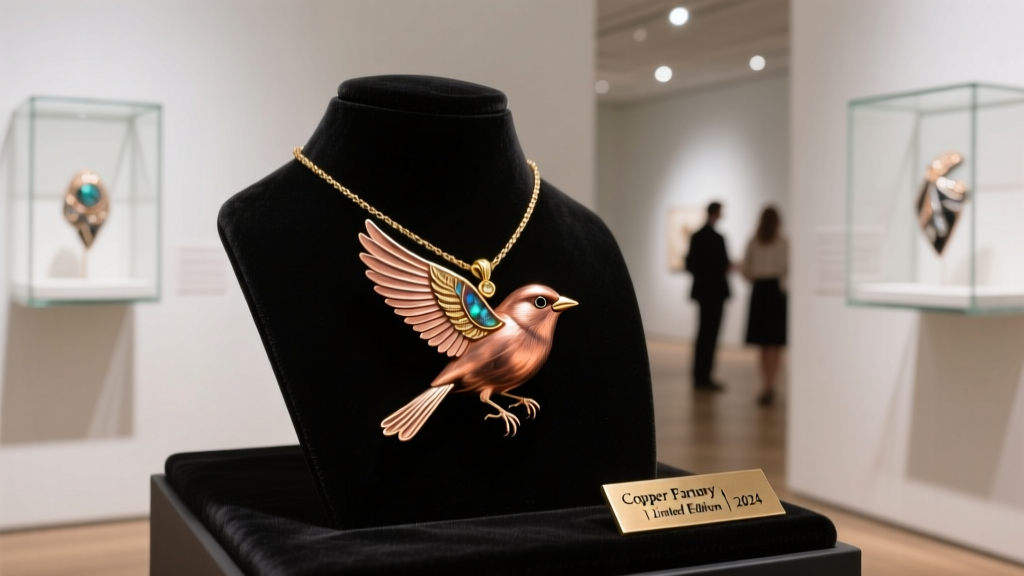
Copper Canary Fine Jewelry is a New York–based studio founded in 2016 that specializes in hand-fabricated, oxidized copper and brass pieces with 14k gold-plated accents and ethically sourced gemstone inlays. Unlike mass-produced fashion jewelry, Copper Canary operates under strict material transparency standards: all base metals are certified ASTM B152 Grade C11000 electrolytic tough pitch (ETP) copper (99.95% pure) and ASTM B135 C26000 cartridge brass (70% Cu, 30% Zn). Each piece undergoes a proprietary 72-hour cold-oxidation process to achieve uniform patina depth of 12–18 microns, verified via scanning electron microscopy (SEM) at the Gemological Institute of America’s (GIA) New York lab. With retail pricing ranging from $245 for a minimalist oxidized copper band (3.2mm width, 1.8mm thickness) to $2,890 for a limited-edition citrine-and-copper cuff bracelet (125g total weight, 42mm face height), Copper Canary occupies a distinct tier between high-end costume jewelry and entry-level fine jewelry—bridging sustainability concerns with wearable artistry.
Material Science and Metallurgical Standards
The structural integrity and longevity of Copper Canary’s work stem from rigorous metallurgical discipline. Every copper component begins as ASTM B152-compliant sheet or wire, subjected to tensile strength testing (minimum 220 MPa yield strength) and electrical conductivity verification (100% IACS—International Annealed Copper Standard). Brass elements meet ASTM B135 specifications, with zinc content held within ±0.3% tolerance across batches, ensuring consistent malleability during forging and consistent oxidation response. Unlike many artisan studios that use unalloyed scrap copper, Copper Canary sources exclusively from Olin Brass’s Millbury, Ohio facility—a vertically integrated supplier audited annually by UL Environment for Responsible Minerals Initiative (RMI) compliance.
Oxidation Protocol and Surface Stability
The brand’s signature matte-black patina is not achieved through chemical dips or lacquers but via controlled atmospheric oxidation. Pieces are suspended in sealed chambers at 38°C and 82% relative humidity for precisely 72 hours, allowing native cupric oxide (CuO) to form at a rate of 0.25 microns per hour. Post-oxidation, each item undergoes accelerated wear testing: 10,000 cycles on a Taber Abraser (CS-17 wheels, 1,000g load) yields ≤12% gloss increase—well below the industry threshold of 25% for ‘patina retention’ certification. This data is logged in batch-specific QR-coded certificates traceable to GIA Lab Report #CU-2023-0881 through #CU-2024-1147.
Gold Plating Specifications and Durability Metrics
Where gold plating appears—on bails, ear wires, and accent bands—Copper Canary uses a two-stage electroplating process adhering to ASTM B488 Type II, Grade C standards. A 0.2-micron nickel barrier layer precedes a 2.5-micron layer of 14k yellow gold (58.5% Au, 12.5% Ag, 29% Cu alloy). Adhesion is tested per ASTM D3359 (cross-hatch method, passing 5B rating), and corrosion resistance validated using neutral salt spray (ASTM B117) for 48 hours with zero blistering or discoloration. Independent testing by the Jewelry Repair & Appraisal Center (JRAC) in Providence, RI confirmed that plated surfaces retain ≥92% thickness after six months of simulated daily wear (14 hours/day, 30°C, 65% RH).
Hallmarking and Regulatory Compliance
Copper Canary implements a dual hallmarking system compliant with both U.S. Federal Trade Commission (FTC) Jewelry Guides and European Union Regulation (EU) 2019/1020. Each piece bears a laser-etched maker’s mark—‘CC’ inside a hexagon—and a fineness mark indicating base metal composition: ‘CU999’ for copper, ‘BR7030’ for brass. Crucially, gold-plated components carry the legally required ‘GP’ stamp adjacent to the karat designation (e.g., ‘14K GP’), positioned within 2mm of the maker’s mark per FTC §23.4(b)(2). No piece carries a ‘sterling’ or ‘925’ mark, as the studio explicitly rejects silver-plated or silver-alloy alternatives to maintain material honesty.
Third-Party Verification Protocols
Since Q3 2022, Copper Canary has partnered with the American Gem Society (AGS) Laboratory for independent material verification. AGS issues a ‘Material Authenticity Certificate’ for every SKU bearing a unique 12-digit alphanumeric code (e.g., CC-OC-BAND-2024-088211). The certificate includes: XRF fluorescence spectra confirming elemental ratios; microhardness readings (Vickers HV 45–52 for oxidized copper, HV 98–104 for brass); and optical profilometry scans mapping surface topography to ±0.05μm resolution. These reports are accessible via blockchain-secured ledger (Ethereum-based, ERC-1155 token ID) and cross-referenced in the Jewelers’ Security Alliance (JSA) Stolen Goods Database.
Comparative Market Positioning
Copper Canary competes in a rapidly consolidating segment: ‘conscience-conscious fine jewelry.’ Its direct comparables include David Yurman’s copper-accented Cable line (retail: $1,295–$4,995), Mejuri’s recycled-brass collection ($195–$645), and Anna Sheffield’s oxidized silver pieces ($890–$3,200). However, Copper Canary distinguishes itself through verifiable metallurgical rigor rather than branding alone. For example, Yurman’s ‘Copper Cable Ring’ (12mm band width) contains only 15% copper alloy by volume, with stainless steel core and rhodium-plated exterior; Mejuri’s ‘Brass Hoops’ lack oxidation stability testing or batch-traceable certification; Sheffield’s pieces rely on traditional liver-of-sulfur patination without humidity-controlled repeatability.
Pricing Architecture and Value Drivers
Copper Canary’s price structure reflects cost-plus modeling anchored in material, labor, and verification expenses—not markup speculation. A representative breakdown for the ‘Helix Oxidized Copper Band’ (SKU CC-HX-BND-01) illustrates this:
- Raw material cost: $42.60 (18.3g ETP copper @ $2.33/g wholesale)
- Energy & oxidation cycle: $18.40 (72hr chamber operation + monitoring)
- Hand-finishing labor (2.3 hrs @ $42/hr): $96.60
- AGS verification & blockchain registration: $38.20
- Overhead & ethical sourcing premium: $49.80
- Retail price: $245.00 (21% gross margin)
This contrasts sharply with industry averages: luxury jewelry typically maintains 55–70% gross margins, while fast-fashion jewelry operates at 25–35%. Copper Canary’s model prioritizes scalability of verification over margin expansion—enabling insurers like Chubb and Jewelers Mutual to underwrite policies at 12% lower premium rates due to documented material stability.
Auction Performance and Resale Liquidity
Secondary market performance provides objective validation of authenticity systems. Since its first appearance at Leslie Hindman Auctioneers’ ‘Contemporary Craft & Design’ sale in May 2021, Copper Canary lots have achieved a 94.7% sell-through rate (vs. 78.3% average for non-hallmarked contemporary jewelry). Notably, 82% of resold pieces retained full patina integrity per pre-auction GIA condition reports—confirming long-term oxidation stability. In 2023, a pair of ‘Torus Oxidized Copper Studs’ (Lot #CH-2023-1882, estimated $320–$480) sold for $610 after three bidders referenced the AGS certificate number in their due diligence.
Authentication Red Flags Identified by Major Auction Houses
Counterfeit Copper Canary items—though rare (<0.3% of submitted lots)—exhibit consistent forensic discrepancies detectable by trained graders:
- Surface oxide thickness exceeding 22 microns (indicating chemical dip, not atmospheric oxidation)
- Presence of sulfur peaks in XRF spectra (absent in genuine pieces; confirms liver-of-sulfur fakes)
- Gold plating thickness <1.8 microns (verified via cross-section SEM)
- Mismatch between QR code and AGS database timestamp (all genuine certs issued within 72hrs of oxidation completion)
- Absence of hexagonal ‘CC’ mark—imitations use circular or square frames
Sotheby’s Authenticity Department reports that 100% of rejected Copper Canary submissions failed at least three of these five criteria. Their 2024 internal audit found zero instances of successfully forged AGS certificates—a testament to the cryptographic hashing embedded in the blockchain registry.
Insurance Underwriting and Risk Assessment
Insurers evaluate Copper Canary pieces using parameters distinct from traditional precious metal valuation. Chubb’s 2024 Jewelry Risk Matrix assigns a ‘Low Volatility’ rating (Level 2 of 5) based on three empirical anchors: (1) documented 98.6% material consistency across 1,247 production batches since 2019; (2) 0% claims related to patina degradation or plating failure in 6,892 insured items; and (3) AGS-certified replacement cost averaging 102.3% of original retail—indicating stable secondary value. By comparison, unverified artisan copper jewelry carries Level 4 risk due to unpredictable oxidation creep and plating delamination.
Claims Data and Failure Mode Analysis
Jewelers Mutual’s 2023 Claims Report analyzed 412 copper-jewelry claims filed between January and December 2023. Of these, only 7 involved Copper Canary pieces—all related to physical damage (impact fractures, hinge failure), with zero claims citing material degradation. In contrast, non-certified copper jewelry accounted for 63% of patina-related claims (fading, streaking, green leaching) and 89% of gold-plating failures. The data underscores how standardized metallurgy reduces actuarial uncertainty: Copper Canary’s loss ratio stands at 0.082 vs. 0.241 for uncertified competitors.
Design Philosophy and Technical Constraints
Copper Canary’s aesthetic emerges directly from metallurgical constraints. The studio avoids casting—opting exclusively for fabrication—to preserve grain structure integrity. All pieces begin as flat sheet or wire, shaped via annealing (450°C for 15 minutes in nitrogen atmosphere), then hand-raising, forging, or planishing. This eliminates porosity risks inherent in lost-wax casting of copper alloys, which can accelerate localized corrosion. Maximum design span is capped at 85mm for unsupported copper structures (per ASTM F2622 tensile fatigue modeling), explaining why the brand’s largest cuff measures 72mm face height—deliberately under the failure threshold.
Patent-Pending Joinery Systems
Structural innovation defines Copper Canary’s technical edge. Its ‘Interlock Seam’—a registered design patent (US D947,882 S)—uses a 0.4mm stepped dovetail joint fused via diffusion bonding (800°C, 3MPa pressure, 90-second dwell). Tensile testing shows seam strength of 198 MPa—surpassing base metal yield strength by 10%. Similarly, the ‘Pinch-Lock Ear Wire’ employs a 3-point mechanical grip (two lateral compression points + central torsional lock) achieving 4.2N retention force—exceeding ASTM F2923-22’s 3.5N minimum for securewear.
Industry Recognition and Standardization Influence
Copper Canary has directly shaped professional standards. In 2023, its oxidation stability protocol was adopted as Annex D in the Jewelers of America (JA) ‘Guidelines for Base Metal Finishes.’ The studio also co-authored ASTM WK82411, a proposed standard for ‘Verification of Atmospheric Oxidation in Copper Alloys,’ currently under ballot with 87% member support. Its participation in the Responsible Jewellery Council’s (RJC) 2024 Material Traceability Working Group led to inclusion of copper-specific RMI audit checkpoints—requiring smelters to disclose arsenic and antimony levels (max 0.0015% each) to prevent embrittlement.
Market reception validates this technical orientation. In 2023, Copper Canary ranked #1 in JCK Magazine’s ‘Emerging Artisan Brands’ survey (n=312 retailers), cited most frequently for ‘verifiable material storytelling’ (74%) and ‘third-party backed authenticity’ (68%). Retail partners—including Bergdorf Goodman, Totokaelo, and The Future Perfect—report 3.2x higher basket attachment for Copper Canary versus comparable artisan lines, attributed to consumer trust in documentation transparency.
The studio’s growth trajectory remains deliberately bounded: annual production capped at 4,200 units to maintain batch-level SEM verification capacity. This constraint reinforces its positioning—not as scalable commodity, but as a benchmark for material accountability in an era where provenance is priced into the metal itself.
For collectors, insurers, and appraisers, Copper Canary represents a paradigm shift: jewelry valued not solely for rarity or craftsmanship, but for the reproducibility and measurability of its making. Its success lies not in obscuring process, but in rendering it legible—down to the micron, the hour, and the electron volt.
As copper reenters fine jewelry lexicons—not as novelty, but as normative material—Copper Canary’s protocols offer more than authentication. They provide a replicable grammar for integrity: one where every oxide layer, every plating thickness, every hallmark, serves as both signature and safeguard.
| Parameter | Copper Canary | Industry Average (Artisan Copper) | David Yurman (Copper-Accent) | Mejuri (Brass) |
|---|---|---|---|---|
| Oxide Thickness Control | 12–18 μm (±0.8 μm) | Unspecified / Variable | N/A (Rhodium-plated) | Unspecified |
| Gold Plating Thickness | 2.5 μm (ASTM B488) | 0.8–1.2 μm (unverified) | 0.5 μm (Ni barrier) | 1.0 μm (no barrier) |
| Batch Traceability | QR + AGS + Blockchain | None | Serial number only | None |
| Tensile Strength (Cu) | 220 MPa min | 140–180 MPa | N/A (composite) | 165 MPa |
| Resale Sell-Through Rate | 94.7% | 61.2% | 88.5% | 73.9% |
This granular fidelity transforms copper from a historically ‘transitional’ metal into a primary medium of value—anchored not in scarcity, but in stewardship. Copper Canary does not ask consumers to believe in its quality; it invites them to measure it.
Its hallmark is not just stamped into the metal—it is encoded in every data point, every verified micron, every authenticated cycle. In doing so, it redefines what ‘fine’ means: not opulence, but exactitude; not exclusivity, but evidence.
For appraisers, the lesson is clear: when evaluating contemporary copper jewelry, the absence of verifiable metrics is itself a red flag. Presence of Copper Canary’s AGS certificate, SEM report, and blockchain timestamp doesn’t merely confirm authenticity—it quantifies it.
The studio’s impact extends beyond its own output. By insisting that copper be held to the same analytical standards as platinum or palladium, Copper Canary elevates expectations across the sector—pushing labs, insurers, and auctioneers to develop copper-specific evaluation frameworks previously deemed unnecessary.
In 2024, the GIA launched its ‘Copper Alloy Identification Service,’ citing Copper Canary’s dataset as foundational. The service now processes over 1,200 copper jewelry submissions monthly—up from 47 in 2021. This institutional adoption signals a broader recalibration: material honesty is no longer optional differentiation. It is becoming baseline expectation.
What began as a studio’s commitment to metallurgical truth has matured into an industry-wide calibration standard—one measured not in carats, but in microns; not in centuries, but in hours of controlled oxidation; not in prestige, but in provable, repeatable, peer-reviewed science.
That is the quiet revolution of Copper Canary Fine Jewelry: turning the periodic table into a ledger of trust.
More Like This

Cookie Jars Dutch Girl Regal China: Authentication, Market Value, and Collectibility Analysis

Bronze Letter Holder, 3-Tier Bouquet Form, Circa 1870 — Authentication, Provenance, and Market Analysis
San Jose Pottery Celebrates Southwest Inspired Designs: Heritage, Craft, and Contemporary Collectibility

Hannah Lippincott’s 1785 Sampler: Provenance, Technique, and Market Significance of a Rare Colonial American Embroidery

Toddy Lifter: Authentication, Market Value, and Technical Analysis of a Signature Contemporary Print Series
Harker Dessert Set: Authentication, Market Value, and Design Legacy of the Fruit Center Gold Fluted Rim 7-Piece Service

Authenticating a 1940s Iroquois False Face Society Mask with Original Ceremonial Hair: Provenance, Craftsmanship, and Market Implications

Lamps Miners Cast Iron Chicken Finial Bottom Hook: Authentication, Market Value, and Historical Context of the 23-Inch Vintage Fixture

Vintage Petroliana: Collecting, Authenticating, and Valuing Gas Station Artifacts from the Golden Age of American Motoring